AMPK pathway
Investigated for AMPK-activation signalling in metabolic models. AMPK is the cellular energy sensor, and the same pathway exercise activates.
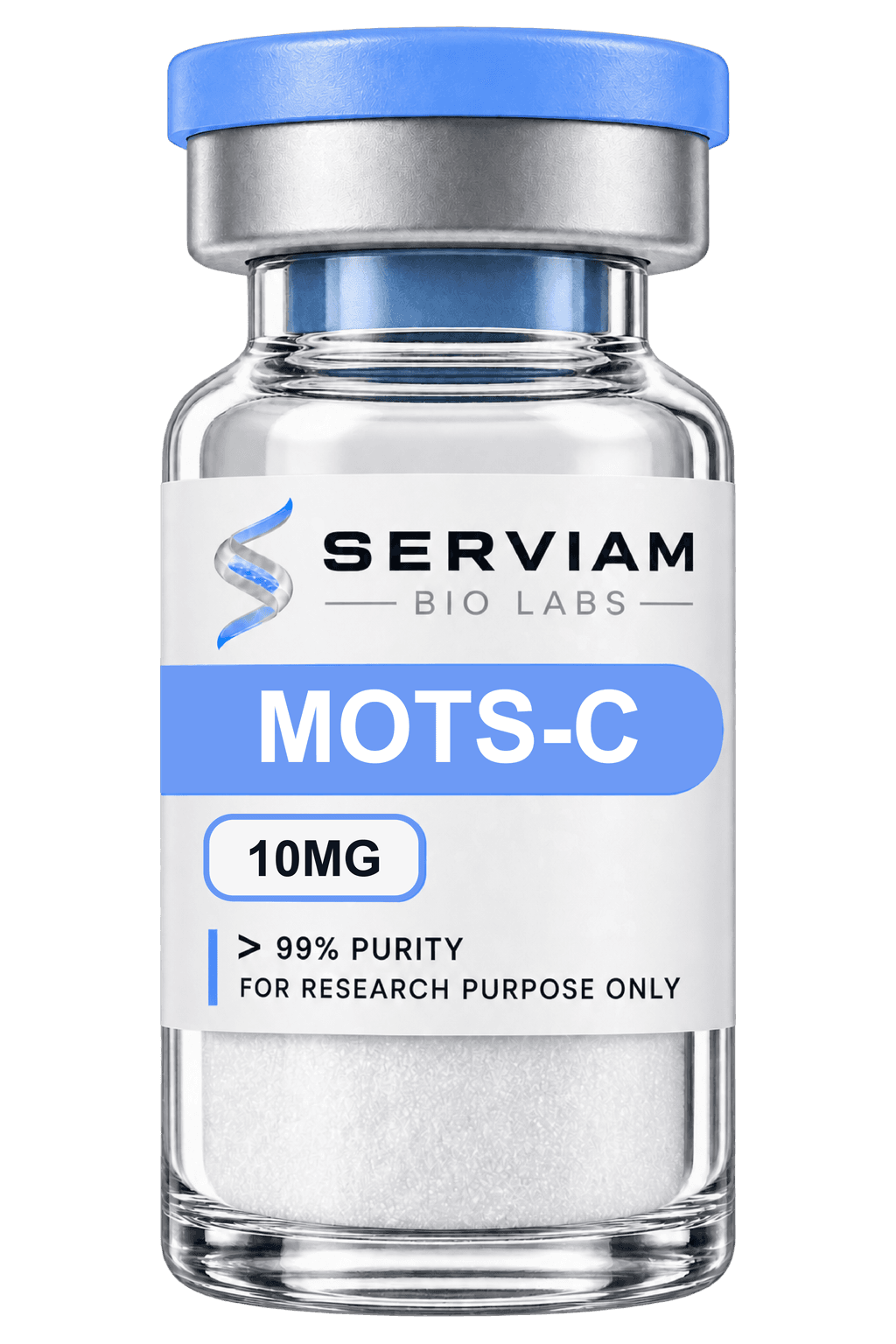
Lyophilised powder · 99%+ documented HPLC
Mitochondrial-derived peptide studied in metabolic-homeostasis and cellular-aging models.
$64.99per 10mg vial
Figures are structural data from our specification and certificates, or are drawn from published third-party literature about the compound, and are provided for orientation only. Nothing here is a claim about what this material does. Supplied for laboratory research use only.
MOTS-c is a sixteen-residue peptide encoded inside mitochondrial DNA rather than in the cell nucleus, which is unusual and is much of why it is studied. Research examines how the body handles blood sugar and stores fat, and why a peptide from the cell's energy compartment appears to influence metabolism throughout the body.
C101H152N28O22S2 · composition, not conformation
Signalling pathways examined in preclinical models. Descriptive of published research directions, not claims of effect.
Investigated for AMPK-activation signalling in metabolic models. AMPK is the cellular energy sensor, and the same pathway exercise activates.
Explored for mitochondrial-function endpoints in cellular models, and for how a mitochondrially encoded peptide signals to the nucleus.
Studied in glucose-regulation models, where the reported activity was located principally in skeletal muscle.
Insulin resistance from a high-fat diet did not develop in the treated group.
Less fat accumulated, particularly the deeper fat around the organs.
Traced to increased fat burning through the AMPK energy pathway.
Reference class characteristics for orientation. Half-life figures are typical literature values, not lot measurements.
| Compound | Receptor class | Typical half-life | Note |
|---|---|---|---|
| MOTS-C | Mitochondrial-derived peptide | Short | AMPK activation |
| NAD+ | Redox coenzyme | Short | Sirtuin substrate |
| Tesamorelin | GHRH analogue | Short | Visceral adipose models |
| Ipamorelin | GH secretagogue | Short | Selective GH release |
Milestones in the study of this compound class.
Identified by Lee et al. as a mitochondrial-derived peptide promoting metabolic homeostasis in mouse models.
Population studies linked sequence variants, notably R150Q, to longevity phenotypes.
Reported as an exercise-induced regulator of age-dependent physical decline.
Characterised as an exercise-mimetic mitochondrial signal.
Every lot is documented by an independent laboratory. The newest lot appears first.
| Lot | Reported | Size | HPLC | Laboratory | Certificate |
|---|---|---|---|---|---|
| MOT10-052026-4 | 14 May 2026 | 10mg | 99.76% | Freedom Diagnostics | View |
| MOT10-052026-1 | 14 May 2026 | 10mg | 99.59% | Freedom Diagnostics | View |
| MOT10-032026-H | 12 Mar 2026 | 10mg | 99.763% | Freedom Diagnostics | View |
99.76%
HPLC purity
The signed PDF is the full certificate. The accession and search code above resolve the same record at the laboratory.
HPLC purity
RP-HPLC, 214 nm
Identity
LC-MS
Lot MOT10-052026-4
This material is supplied as a reference standard for in-vitro laboratory research only. It has not been evaluated by the FDA, is not a drug, and is not intended for human or veterinary use. Handling should follow your institution's chemical hygiene plan, including appropriate PPE and documented disposal.
Every lot is documented at 99%+ by RP-HPLC with identity confirmed by LC-MS, run by an independent laboratory. Released lots have measured between 99.59% and 99.763%; the figure for the lot you receive is in the certificate table above.
Yes. Every lot ships with its own signed certificate, and every certificate is published here, including for lots no longer in stock.
10mg vials.
MRWQEMGYIFYPRKLR. Sixteen residues, encoded in the 12S rRNA region of mitochondrial DNA rather than in the nucleus.
Because it established that mitochondria can produce bioactive peptides that signal to the rest of the cell, rather than acting purely as energy machinery. That finding is what opened the field this compound belongs to.
Store the sealed vial at −20°C for long-term stability and 2–8°C for short-term handling. Protect from light and avoid repeated freeze-thaw cycles. Compound-specific stability data is printed on the certificate of analysis supplied with the lot.
Independent published research relating to this compound. Listed for reference; Serviam Bio Labs is not affiliated with these authors and makes no claims based on their findings.
The mitochondrial-derived peptide MOTS-c promotes metabolic homeostasis
Lee C et al. · 2015 · Cell Metabolism
metabolicMOTS-c is an exercise-induced mitochondrial-encoded regulator of age-dependent physical decline
Reynolds JC et al. · 2021 · Nature Communications
exerciseA mitochondrial-derived peptide variant and longevity in an elderly Japanese population
Zempo H et al. · 2016 · Aging
longevityThe full reference entry: molecular data, the mechanisms described in the literature, what the research covers, the specification and the papers behind it.
For laboratory research use only. All compounds listed on this site are sold strictly as reference materials for in-vitro laboratory research conducted by qualified professionals. They are not drugs, foods, cosmetics, or medical devices. They are not intended for human or veterinary consumption, therapeutic use, diagnostic application, or any in-vivo use whatsoever. These statements have not been evaluated by the Food and Drug Administration. By purchasing, you affirm that you are a qualified researcher and that you will comply with all applicable institutional, local, state and federal regulations governing the handling of research chemicals.