

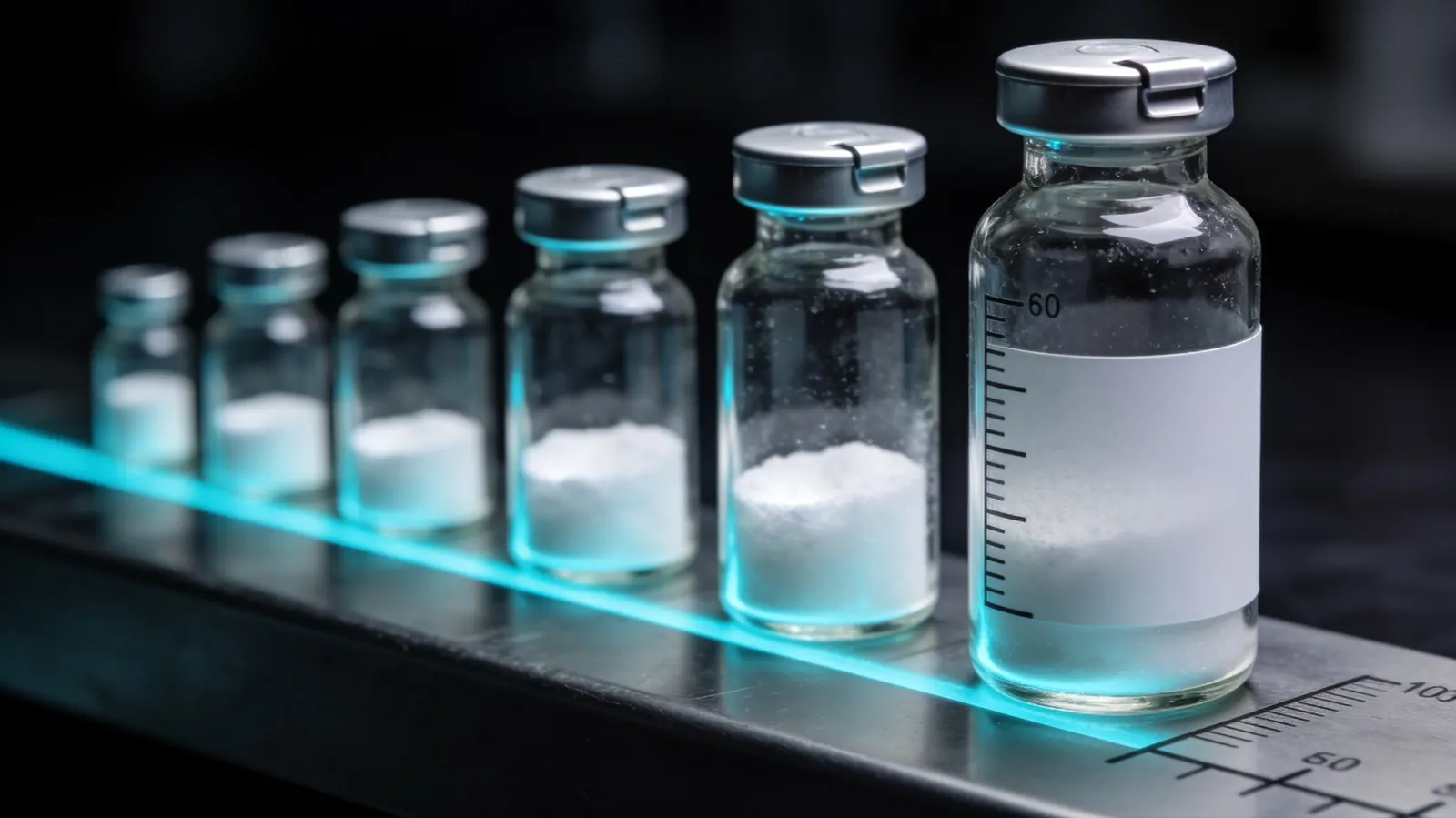
What is a peptide? A peptide is a chain of amino acids joined end to end by peptide bonds. Each bond forms when the carboxyl group of one amino acid joins the amino group of the next and a molecule of water is lost. Chains of up to roughly fifty residues are called peptides; longer chains are called proteins.
- What is a peptide, at its simplest: a chain of amino acids linked by peptide bonds. The order of those amino acids is the sequence, and the sequence defines the molecule. Change one residue and it is a different compound with a different mass.
- Peptide and protein describe the same kind of molecule at different lengths. The boundary is usually drawn at about fifty residues, but it is a convention rather than a law, which is why a 43-residue chain is described as a protein and the 44-residue tesamorelin peptide is described as a peptide.
- Forming a peptide bond costs a molecule of water, so a residue inside a chain weighs about 18 less than the free amino acid it came from. That single subtraction explains every molecular weight printed on a specification.
- A sequence is read left to right from the N-terminus, in one-letter or three-letter code. Prefixes and suffixes are part of the molecule: Ac- is an acetylated N-terminus, as on what is TB-500, and a trailing -NH2 is an amidated C-terminus, as on the ipamorelin peptide.
- A synthetic peptide with the same sequence and the same terminal chemistry as a natural one is the same molecule. What differs between sources is the impurity profile and the salt that ships with it, which is what a certificate measures.
- Purity and net peptide content answer different questions. Peptide purity is the share of detected material that was the target; content is how many milligrams of peptide the vial actually holds. Across the 42 lots published here that report a content figure, the measured content runs from 93.6% to 131.6% of label, median 107.9%.
What is a peptide? A chain of amino acids, joined end to end
The question what is a peptide has a one-line answer: a peptide is a molecule built from amino acids joined in a line. Each amino acid is linked to the next by a peptide bond, and the order in which they are linked is called the sequence. Everything else on this page is vocabulary stacked on top of that.
Amino acids are the units. Each carries an amino group at one end, a carboxyl group at the other, and a side chain that makes it the amino acid it is. Twenty of them are encoded genetically and make up almost every natural peptide and protein. The side chains are where the chemical variety lives, because the backbone of every peptide is the same repeating pattern of nitrogen, carbon and carbonyl carbon.
Joining two amino acids gives a dipeptide. Three gives a tripeptide. Seven gives a heptapeptide, and fifteen a pentadecapeptide, the word that turns up on the specification for BPC-157. Past about ten the counting names stop being useful and the material is simply called a peptide, then a polypeptide, then a protein.
Where a peptide stops and a protein starts has no chemical answer, because there is no chemical difference. The convention most references use puts the line at about fifty residues, and it is a habit rather than a property of the molecule. A chain of forty-nine is not built differently from a chain of fifty-one.
One consequence matters for anyone reading a label. Because sequence defines the molecule, two compounds can share a trade name and not be the same substance. The clearest case in this catalogue is TB-500, a name used both for the seven-residue acetylated fragment Ac-LKKTETQ at 889.0 g/mol and for the full-length thymosin beta-4 chain, which is several times heavier. Molecular weight is the field that separates them in one glance.
- 0
- genetically encoded amino acids that make up almost every natural peptide
- the standard set, each with a one-letter and a three-letter code
- ~50
- residues, the conventional boundary between a peptide and a protein
- a convention of usage, not a chemical distinction
- 0 to 44
- residues across the single peptides in this catalogue
- from the GHK tripeptide to the 44-residue tesamorelin chain
The peptide bond, and why a residue weighs about 18 less than its amino acid
Answering what is a peptide chemically means answering what a peptide bond is. The bond that joins two amino acids is an amide bond, and in this context it is called a peptide bond. It forms between the carboxyl group of one amino acid and the amino group of the next: the carboxyl gives up an OH, the amino group gives up an H, and those three atoms leave together as a molecule of water. A reaction that joins two things and releases water is a condensation, and a peptide chain is a string of them.
That lost water is why the arithmetic on a specification works the way it does. A free amino acid has a known mass. The same amino acid sitting inside a chain has lost 18.02 of it, and is no longer called an amino acid at all: inside the chain it is a residue, and its residue mass is the free mass minus the mass of water.
Work it on the smallest possible case. Glycine is C2H5NO2 at 75.07 g/mol. Join two of them and the result is glycylglycine, a dipeptide: 75.07 plus 75.07 is 150.14, minus 18.02 for the water released gives 132.12 g/mol. One bond, one water, one subtraction.
Now do it on a real catalogue compound. GHK is glycine, histidine and lysine in that order. The free amino acids weigh 75.07, 155.15 and 146.19, which sum to 376.41. Three residues are joined by two peptide bonds, so two waters leave: 376.41 minus 36.04 gives 340.37 g/mol for the free tripeptide. The GHK-Cu copper peptide sold here is that tripeptide holding a copper(II) ion, and copper weighs 63.55, which is where the 403.94 g/mol on the specification comes from.
The general rule follows: a chain of n residues contains n minus 1 peptide bonds, so the mass of the peptide is the sum of the free amino acid masses minus n minus 1 waters. A 15-residue chain has lost fourteen waters, about 252 g/mol, before anything else is counted.
One property of the bond explains why a peptide is not a floppy string: it has partial double-bond character, which holds the atoms around it flat and stops them rotating.
Residues, the N-terminus and the C-terminus
A residue is what an amino acid becomes once it is part of a chain. The word matters because it is the unit everything else is counted in: a sequence is a list of residues, a chain length is a residue count, a deletion impurity is a chain missing one residue.
A chain has two different ends, and they are not interchangeable. At one end there is a free amino group, and that end is the N-terminus, N for nitrogen. At the other there is a free carboxyl group, and that is the C-terminus, C for carbon. Every residue in between has both its groups tied up in peptide bonds.
By universal convention a sequence is written and read left to right, from the N-terminus to the C-terminus. That is the direction used in every database, on every certificate and in every paper, and it is also the direction in which a ribosome builds a chain in a cell. Reversing a sequence gives a different molecule, not the same one written backwards.
Take the TB-500 sequence as it appears on the label: Ac-LKKTETQ. Strip the prefix for a moment and read the letters. L is leucine and sits at the N-terminus. Then K, lysine. Then K again. Then T, threonine. Then E, glutamic acid. Then T again. Then Q, glutamine, at the C-terminus. Seven letters, seven residues, six peptide bonds holding them together. Positions are numbered from the N-terminus too, so leucine is residue 1 and glutamine is residue 7, and when a fragment is named as a range, such as GRF(1-44), the numbers count the same way from the N-terminal end of the parent chain.
One-letter and three-letter codes, read on a real sequence
Every standard amino acid has two abbreviations. The three-letter code is readable and is used in prose and on labels where space allows: Gly, His, Lys. The one-letter code is a single capital and is used for anything longer than a few residues, because a 44-residue sequence in three-letter code is unreadable and in one-letter code is one line.
Most one-letter codes are the first letter of the name. G for glycine, L for leucine, P for proline. The exceptions exist because several names start with the same letter, so the set was assigned to avoid collisions: K for lysine, W for tryptophan, F for phenylalanine, Y for tyrosine, R for arginine, Q for glutamine and N for asparagine are the ones that catch people out. Here is the full set, with the catalogue sequences each letter appears in.
Now read a real sequence straight through. BPC-157 is written GEPPPGKPADDAGLV. That is glycine, glutamic acid, proline, proline, proline, glycine, lysine, proline, alanine, aspartic acid, aspartic acid, alanine, glycine, leucine, valine. Fifteen letters, fifteen residues, fourteen peptide bonds, and a run of three prolines near the N-terminus which is a structural feature rather than a typographical error. The formula is C62H98N16O22 and the mass is 1419.53 g/mol, and the BPC-157 peptide is the same molecule whichever of those three notations it is written in.
The same method reads MOTS-c, written MRWQEMGYIFYPRKLR: methionine, arginine, tryptophan, glutamine, glutamic acid, methionine, and so on to the final arginine. Sixteen residues, 2174.61 g/mol, every letter checkable against the table above. If a sequence printed on a certificate does not match the sequence on the product page character for character, the two documents describe different molecules, and that is worth catching before anything else on either page is read.
| Amino acid | Three-letter code | One-letter code | Appears in these catalogue sequences |
|---|---|---|---|
| Alanine | Ala | A | BPC-157 |
| Arginine | Arg | R | MOTS-c |
| Asparagine | Asn | N | None of the sequences worked through here |
| Aspartic acid | Asp | D | BPC-157 |
| Cysteine | Cys | C | None of the sequences worked through here |
| Glutamic acid | Glu | E | BPC-157, TB-500, MOTS-c |
| Glutamine | Gln | Q | TB-500, MOTS-c |
| Glycine | Gly | G | BPC-157, MOTS-c, GHK-Cu |
| Histidine | His | H | GHK-Cu, ipamorelin |
| Isoleucine | Ile | I | MOTS-c |
| Leucine | Leu | L | TB-500, BPC-157, MOTS-c |
| Lysine | Lys | K | TB-500, BPC-157, MOTS-c, GHK-Cu, ipamorelin |
| Methionine | Met | M | MOTS-c |
| Phenylalanine | Phe | F | MOTS-c, and as D-Phe in ipamorelin |
| Proline | Pro | P | BPC-157, MOTS-c |
| Serine | Ser | S | None of the sequences worked through here |
| Threonine | Thr | T | TB-500 |
| Tryptophan | Trp | W | MOTS-c |
| Tyrosine | Tyr | Y | MOTS-c |
| Valine | Val | V | BPC-157 |
What is a peptide next to a protein and a single amino acid?
Three words get used as if they named a hierarchy of different things, and they are really one kind of thing at three sizes. An amino acid is a single unit. A peptide is a short chain of them. A protein is a long chain of them. The chemistry of the backbone is identical in all three cases, so the honest answer to what is a peptide against what is a protein is: length, by convention.
Size does change behaviour, which is why the vocabulary survives. A short peptide is usually flexible and often has no fixed fold at all. A long chain folds into a defined three-dimensional structure held together by its side chains, and that folded shape is what people mean by protein structure. The transition between the two is gradual.
The ladder below runs from a single amino acid to a chain that reference databases call a protein. Two rows make the point that the fifty-residue boundary is a convention: thymosin beta-4 is a 43-residue chain described as a protein, tesamorelin a 44-residue chain described as a peptide. One residue apart, different words, no chemical difference.
The masses are worth a second look. Residue count and mass are not interchangeable, because residues are not the same size. TB-500 has seven residues and weighs 889.0 g/mol, an average of about 127 per residue; MOTS-c has sixteen and weighs 2174.61, an average of about 136. The difference is in the side chains. A specification prints both numbers because neither implies the other.
| Molecule | Residues | Molecular weight | What it is usually called |
|---|---|---|---|
| Glycine | 1, as a free amino acid | 75.07 g/mol | An amino acid |
| Glycylglycine | 2 | 132.12 g/mol | A dipeptide |
| GHK, the copper-binding tripeptide | 3 | 340.37 free, 403.94 as GHK-Cu | A tripeptide |
| Ipamorelin | 5 | 711.85 g/mol | A pentapeptide, with non-standard residues |
| TB-500, as Ac-LKKTETQ | 7 | 889.0 g/mol | A heptapeptide, acetylated |
| BPC-157 | 15 | 1419.53 g/mol | A pentadecapeptide |
| MOTS-c | 16 | 2174.61 g/mol | A peptide |
| Thymosin beta-4 | 43, from a 44-residue precursor whose initiator methionine is removed | Several times the mass of its seven-residue fragment | A protein, in sequence databases |
| Tesamorelin | 44 | 5135.89 g/mol | A peptide, or a polypeptide |
Modifications on a label: Ac-, -NH2 and non-standard residues
A sequence of letters is often not the whole molecule. Peptides are routinely modified at one or both ends, and those modifications are printed as part of the sequence line because they change the compound, its mass and its formula.
Ac- at the front means the N-terminus is acetylated. An acetyl group, CH3CO, has replaced one hydrogen on the terminal amino group, adding 42.04 to the mass and removing the positive charge a free amino group carries. TB-500 is written Ac-LKKTETQ for exactly this reason: the seven letters are the chain and the Ac- is a real chemical change to its front end. A molecule with the same seven letters and a free N-terminus is a different compound with a different mass.
A trailing -NH2 means the C-terminus is amidated. The terminal carboxyl group, COOH, has been replaced by a carboxamide, CONH2, which removes the negative charge the free acid would carry. Ipamorelin is written Aib-His-D-2-Nal-D-Phe-Lys-NH2, and that -NH2 is the amidated end. So is the one on tesamorelin, written trans-3-hexenoyl-GRF(1-44)-NH2, where the front of the molecule carries an acyl group instead of an acetyl one.
Non-standard residues appear by name rather than by letter, because there is no one-letter code for them. Ipamorelin has three in a five-residue chain: Aib is alpha-aminoisobutyric acid, which is not one of the twenty; D-2-Nal is D-3-(2-naphthyl)alanine; and D-Phe is phenylalanine in its D form. Amino acids are chiral, and almost all of those in natural peptides are the L form. A D residue is the mirror image and makes a genuinely different molecule. One-letter code silently loses that distinction, which is why chains containing D residues are spelled out in three-letter code.
Metal ions are a modification of a different kind. GHK-Cu is the GHK tripeptide holding a copper(II) ion, and the copper is part of the substance the CAS number refers to. So read the whole sequence line, including everything before the first letter and after the last.
Natural or synthetic: what is a peptide made in a synthesiser?
Peptides occur throughout biology. Cells make them on ribosomes from a genetic template, and many more are produced by cutting longer proteins into fragments. Some compounds here have a natural parent: the MOTS-c peptide is encoded in mitochondrial DNA, and TB-500 corresponds to a fragment of the thymosin beta-4 protein. Others, such as ipamorelin, contain residues that do not occur in natural peptides at all.
The chemistry does not care where a molecule came from. A peptide assembled in a synthesiser with the same sequence, the same terminal modifications and the same stereochemistry as a natural one is the same molecule. Same formula, same molecular weight, same CAS number, same behaviour in an instrument. There is no test that distinguishes identical molecules by origin, because there is nothing to distinguish.
What does differ is everything that is not the peptide. Synthesis leaves its own impurity profile: chains that stopped short, chains missing a residue, fragments of protecting groups. Purification leaves a counter-ion behind. That is why a certificate measures the material rather than the molecule, and why two vials of the same compound are not automatically equivalent.
So what is a peptide made in a synthesiser? The same molecule, arriving with a different set of neighbours. Asking whether a peptide is natural or synthetic asks about the route; asking what is in the vial asks about the material, and only the second question has an answer on a document.
How peptides are made: solid-phase synthesis, one residue at a time
Almost every research peptide is built by solid-phase peptide synthesis, which assembles the chain while it is anchored to an insoluble resin bead. The first residue is attached by its C-terminus, and everything after that is a repeated cycle.
The cycle has three steps. A protecting group is removed from the amino end of the growing chain. The next amino acid, itself protected everywhere except the carboxyl group about to react, is coupled on. Then the excess reagent is washed away, which is the point of working on a solid support: the product stays on the bead and everything else goes down the drain. The chain grows from the C-terminus towards the N-terminus, the opposite direction to the one the finished sequence is read in.
An n-residue chain needs n minus 1 couplings once the first residue is loaded. Ipamorelin, at five residues, needs four. TB-500, at seven, needs six. BPC-157, at fifteen, needs fourteen. Tesamorelin, at forty-four, needs forty-three, each with its own deprotection and its own washes, so that synthesis is a few hundred separate operations before the chain is cleaved from the resin and purified.
Length is what makes a synthesis hard, and the reason is arithmetic. No coupling goes fully to completion. If each one reached 99%, a 15-residue chain with fourteen couplings would leave about 87% of the material as full-length product, and a 44-residue chain with forty-three couplings about 65%. Real syntheses use large reagent excesses and capping steps to push those figures up, but the direction is fixed: every residue added is another chance to fall short.
The failures have names that turn up in any purity discussion. A coupling that fails and is then capped leaves a deletion sequence, the full chain minus one residue. A chain that stops growing leaves a truncated fragment. Both are close structural relatives of the target, which is what makes them difficult to separate on a column and why peptide purity testing needs mass spectrometry alongside chromatography rather than chromatography alone.
After cleavage the crude material is purified by reversed-phase HPLC, and the solvent is then removed by freeze-drying, which is why the vial holds a lyophilized powder rather than a liquid or a crystal.
- n - 1
- couplings needed to build an n-residue chain after the first residue is loaded
- fourteen couplings for the fifteen residues of BPC-157
- 0
- couplings in a 44-residue tesamorelin synthesis
- each with its own deprotection and wash steps
- about 65%
- full-length material left after 43 couplings at 99% each
- illustrative arithmetic, before capping and purification
What a specification sheet tells you about a peptide
A specification is where the answer to what is a peptide turns into a short list of constants, each field answering a different question. None of them says anything about the batch in front of you, which is what a certificate is for, but together they pin down which molecule is described.
The sequence names the residues in order. The molecular formula counts every atom in one molecule: C62H98N16O22 for BPC-157, C38H68N10O14 for TB-500, C38H49N9O5 for ipamorelin, C221H366N72O67S for tesamorelin. That single sulfur in the tesamorelin formula is a sulfur-containing residue somewhere in the chain, the sort of detail a formula carries and a sequence makes you count for yourself.
The molecular weight is the mass of a mole of the peptide in grams, the same number as the mass of one molecule in daltons. It does the most work in practice, because it is what a mass spectrometer measures and what two similarly named compounds will differ on. It is also the number a peptide calculator needs if a concentration is to be expressed in molar terms rather than in milligrams.
The CAS number is a registry identifier assigned to one substance by the Chemical Abstracts Service, and it is useful precisely because trade names are not unique: 885340-08-9 refers to the acetylated seven-residue TB-500 fragment and to nothing else. A specification carrying a formula, a mass and a CAS number has said which molecule it means in three independent ways.
Then there is the field that explains why the powder in the vial weighs more than the peptide in it. Peptides are purified in acid and isolated as salts, most often trifluoroacetate, because reversed-phase purification runs in trifluoroacetic acid. That counter-ion is real mass sitting in the vial alongside the peptide, and so is residual water, since lyophilised material is hygroscopic. A 10 mg vial is 10 mg of fill, not 10 mg of peptide.
| Field | What it states | Worked example from this catalogue | What it does not tell you |
|---|---|---|---|
| Sequence | The residues in order from the N-terminus, with any terminal modifications | GEPPPGKPADDAGLV for BPC-157; Ac-LKKTETQ for TB-500 | Whether the vial actually holds that molecule, which is an identity measurement |
| Residue count | How many amino acids are in the chain | 7 for TB-500, 15 for BPC-157, 44 for tesamorelin | The mass, because residues are not all the same size |
| Molecular formula | Every atom in one molecule of the peptide | C38H49N9O5 for ipamorelin | The counter-ion and residual water that ship with it |
| Molecular weight | The mass of one mole in grams, equal to one molecule in daltons | 1419.53 g/mol for BPC-157; 5135.89 g/mol for tesamorelin | How much of the vial's mass is peptide |
| CAS number | A registry identifier for one specific substance | 885340-08-9 for TB-500 as the acetylated fragment | Anything at all about the quality of a given batch |
| Salt form and counter-ion | Which acid the peptide was isolated as a salt of | Trifluoroacetate, the usual outcome of reversed-phase purification | How much counter-ion is present, unless a content figure is given |
| Appearance | What the contents should look like when the seal is broken | White to off-white lyophilised cake or powder | Anything measurable; it is a visual check, not an assay |
| Purity | The share of detected material that was the target peptide | Reported as HPLC area percent, commonly above 99% here | How much peptide the vial holds |
| Net peptide content | How much peptide the vial actually holds | Reported in milligrams against the label strength | Which peptide it is; that is the identity question |
Purity and net peptide content are two different questions
This distinction catches most people. A vial contains peptide, counter-ion and water, and a certificate reports two numbers about it that are not two versions of the same measurement.
Purity is usually measured by reversed-phase HPLC and reported as area percent: of all the material the detector registered, what share was the target peptide? It is a ratio between peaks: how clean the peptide is relative to what else the detector saw.
Net peptide content is a mass. It answers how much of what is in the vial is peptide at all, and what it counts against the peptide is exactly what an area-percent figure cannot see: counter-ion, residual moisture, and anything else that does not absorb where the detector is looking. On the certificates behind this catalogue it is reported as a measured mass per vial against the label strength, which is more directly checkable than a percentage.
Neither number can be derived from the other, they do not average, and the larger does not stand in for the smaller. Across the 42 lots published on this site that report a content figure, the measured content runs from 93.6% to 131.6% of label with a median of 107.9%, because fills are set above the label strength so that every unit in a run clears its target once the filling tolerance is accounted for. A figure above the label is ordinary. A figure well below it, with no explanation beside it, is worth a question.
Reading one peptide certificate of analysis with those two fields in mind teaches this faster than any amount of definition does.
Read the two numbers on a real certificate
Every released lot here is published with its signed report, its purity figure and the peptide mass measured in the vial, filed by lot number.
Open the certificate libraryWhat is a peptide not? Where the word stops
A definition is sharper when it excludes things, and this market applies the word peptide to several things that are not peptides. The clearest example sits in this catalogue. NAD+ is not a peptide. It is nicotinamide adenine dinucleotide, a coenzyme built from two nucleotides joined by a phosphate bridge, with the formula C21H27N7O14P2. There are no amino acids in it and no peptide bonds. It is sold alongside peptides, supplied as a lyophilised powder in a vial like a peptide, and routinely described as one, which is why NAD+ peptide is a search term worth answering rather than correcting in silence. A molecule with no peptide bonds has a completely different chemistry from one that is nothing but peptide bonds.
Blends are a second case. A vial containing GHK-Cu, BPC-157 and TB-500 together is a mixture of three peptides, not a single peptide with a name of its own. It has no sequence, no formula and no molecular weight, because those fields describe one molecule and there are three in the vial. A blend certificate has to report the measured mass of each component separately.
Proteins are the third case, and there the word is being stretched. A 43-residue chain called a protein and a 44-residue chain called a peptide are the same kind of molecule, so the boundary is worth holding loosely. What is not loose is the difference between a seven-residue fragment and the full-length chain it was cut from: different molecules, different masses, whatever name they are sold under.
The test that settles all three cases is the same. Ask for the sequence, the formula and the molecular weight. A peptide has all three. A mixture has none of them. A coenzyme has a formula and a mass but no sequence, because it has no residues to list. That is the practical form of the question what is a peptide, and the products in this catalogue each publish all three fields alongside the certificate for the lot in the vial.
What is a peptide, finally, is a question with a one-line answer and a long tail: a chain of amino acids joined by peptide bonds, defined by its sequence, weighed by adding up its residues and subtracting the water each bond released. Everything a specification prints follows from that, and everything a certificate measures describes the material around the molecule rather than the molecule itself. Once the two are held apart, the rest of this research library is readable, and so is the label on any vial.
Common questions
What is a peptide in simple terms?
A peptide is a short chain of amino acids joined end to end. Amino acids are the building blocks; a peptide bond is the link between two of them; the order they are joined in is the sequence, and the sequence is what makes one peptide different from another.
What is the difference between a peptide and a protein?
Length, and nothing else chemically. Both are chains of amino acids joined by peptide bonds. The convention most references use calls a chain of up to roughly fifty residues a peptide and anything longer a protein, but the line is a habit rather than a rule: thymosin beta-4 at 43 residues is described as a protein while the 44-residue tesamorelin is described as a peptide.
Is a peptide the same thing as an amino acid?
No. An amino acid is a single unit. A peptide is two or more of them joined by peptide bonds. Once an amino acid is inside a chain it is called a residue, and it weighs about 18 less than the free amino acid because forming each bond releases a molecule of water.
What is a peptide bond?
An amide bond between two amino acids. It forms when the carboxyl group of one amino acid reacts with the amino group of the next, releasing water. The bond is flat and does not rotate freely, which is why a peptide chain has a restricted set of shapes rather than behaving like a loose string.
What does residue mean in a peptide sequence?
A residue is an amino acid that is part of a chain rather than free in solution. It is the unit everything is counted in: a chain length is a residue count, a sequence is a list of residues, and a deletion impurity from synthesis is a chain missing one residue.
Which end of a peptide sequence is written first?
The N-terminus, the end carrying a free amino group. Sequences are always written and read left to right from the N-terminus to the C-terminus, the end carrying a free carboxyl group. Positions are numbered the same way, so the first letter is residue 1.
What do the single letters in a peptide sequence mean?
Each letter is a one-letter code for one amino acid. Most are the first letter of the name, such as G for glycine and P for proline, but names that collide were given other letters: K is lysine, W is tryptophan, F is phenylalanine, Y is tyrosine, R is arginine, Q is glutamine and N is asparagine. The three-letter codes, such as Gly and Lys, mean the same things.
What does Ac- mean at the start of a peptide sequence?
The N-terminus is acetylated: an acetyl group has replaced a hydrogen on the terminal amino group, adding 42.04 to the mass and removing that end's positive charge. TB-500 is written Ac-LKKTETQ for this reason, and a molecule with the same seven letters and a free N-terminus is a different compound.
What does -NH2 mean at the end of a peptide sequence?
The C-terminus is amidated: the terminal carboxyl group has been replaced by a carboxamide, which removes the negative charge the free acid would carry. Ipamorelin is written Aib-His-D-2-Nal-D-Phe-Lys-NH2, and both that suffix and the non-standard residues in front of it are part of the molecule rather than notation.
How many amino acids does a peptide have?
Anything from two upwards. The compounds in this catalogue run from the three residues of GHK to the 44 of tesamorelin, with TB-500 at seven, BPC-157 at fifteen and MOTS-c at sixteen. Above roughly fifty residues the chain is conventionally called a protein instead.
Are synthetic peptides different from natural ones?
Not as molecules. A synthetic peptide with the same sequence, the same terminal modifications and the same stereochemistry as a natural one is the same compound, with the same formula, mass and CAS number. What differs is everything around it: the impurity profile left by synthesis and the counter-ion left by purification, which is what a certificate measures.
How are research peptides made?
By solid-phase peptide synthesis. The chain is anchored to a resin bead by its C-terminus and extended one residue at a time, each cycle deprotecting the growing end, coupling the next amino acid and washing the excess away. An n-residue chain needs n minus 1 couplings, so a 15-residue chain takes fourteen and a 44-residue chain takes forty-three.
Why is a longer peptide harder to make?
Because the shortfalls multiply. No coupling is quantitative, so if each reached 99% a 15-residue chain would leave about 87% full-length material and a 44-residue chain about 65%. Each extra residue is another chance to leave a deletion sequence or a truncated fragment behind, and those are close structural relatives of the target that are difficult to separate.
What does molecular weight mean on a peptide specification?
The mass of one mole of the peptide in grams, which is the same number as the mass of one molecule in daltons. It follows from the sequence: add the free amino acid masses and subtract one water for each peptide bond. It is also the number a mass spectrometer compares its measurement against, and the number that distinguishes two compounds sharing a trade name.
Why is the powder in a peptide vial not all peptide?
Because the peptide is isolated as a salt and lyophilised material holds water. Reversed-phase purification runs in trifluoroacetic acid, so the peptide usually ships as a trifluoroacetate salt, and that counter-ion is real mass in the vial. A 10 mg vial is 10 mg of fill, not 10 mg of peptide, which is why net peptide content is measured separately.
What is the difference between purity and net peptide content?
Purity is a ratio, usually HPLC area percent: of everything the detector saw, how much was the target peptide. Net peptide content is a mass: how many milligrams of peptide the vial holds. Neither can be worked out from the other. Across the 42 lots published here that report a content figure, measured content runs from 93.6% to 131.6% of label, median 107.9%.
Is NAD+ a peptide?
No. NAD+ is nicotinamide adenine dinucleotide, a coenzyme made of two nucleotides joined through a phosphate bridge, with the formula C21H27N7O14P2. It contains no amino acids and no peptide bonds. It is sold and stored like a peptide and is often called one, but it has no sequence and no residues to count.
What is a polypeptide?
A peptide long enough that the counting names have run out. There is no fixed threshold: the word tends to be used from roughly twenty residues upwards, and it overlaps with both peptide and protein. Tesamorelin at 44 residues is described either way depending on the source.
What is a CAS number on a peptide specification?
A registry identifier assigned by the Chemical Abstracts Service to one specific substance. It matters because trade names are not unique: 885340-08-9 refers to the acetylated seven-residue TB-500 fragment and to nothing else, so quoting it removes the ambiguity that a name alone leaves. It says nothing about the quality of any particular batch.
Why do some sequences contain D-amino acids?
Amino acids are chiral, and almost all of those in natural peptides are the L form. A D residue is the mirror image, and it makes a genuinely different molecule. Ipamorelin contains two, D-2-Nal and D-Phe. One-letter code cannot express the difference, which is why sequences containing D residues are written out in three-letter code.
Can two products with the same name be different peptides?
Yes, and TB-500 is the standard example: the name is used both for the seven-residue acetylated fragment Ac-LKKTETQ at 889.0 g/mol and for the full-length thymosin beta-4 chain, which is several times heavier. Comparing the sequence and the molecular weight settles which one a given product is before any purity figure is worth reading.
How do I check that a vial holds the peptide the label names?
Compare the sequence, formula, molecular weight and CAS number between the product page and the certificate, then check the lot number on the certificate against the number printed on the vial. Identity is established by mass spectrometry, not by a purity figure, and a certificate whose lot number does not match your vial describes a different batch.
- PubChem CID 73587, glycyl-L-histidyl-L-lysine (GHK): the free tripeptide mass the worked residue arithmetic in this article arrives at
- PubChem CID 139035031, copper tripeptide (GHK-Cu): the same tripeptide with a copper(II) ion, and the mass difference the metal accounts for
- PubChem CID 62707662, TB-500 (Ac-LKKTETQ): the seven-residue acetylated fragment, its formula and its CAS number
- UniProt P62328, Thymosin beta-4 (human): the 43-residue chain described as a protein, recorded as 44 residues including the initiator methionine that is removed
- PubChem CID 9941957, BPC-157: the fifteen-residue sequence GEPPPGKPADDAGLV, its formula and its calculated mass
- PubChem CID 5892, NAD+ (nadide): that NAD+ is a dinucleotide coenzyme with no amino acids and no peptide bonds in it
- ICH Q6A, Specifications: Test Procedures and Acceptance Criteria (FDA): the convention that a specification names the test and the acceptance criterion rather than a bare figure
Read more
- GLP-1 peptideThe GLP-1 peptide this catalogue sells as GLP-1 S is an engineered analogue of the hormone it shares a name with, registered under CAS 910463-68-2. This page states what the molecule is, how the analogue and the hormone differ, and what our single published certificate actually says.
- GLP-3 RT peptideThe GLP-3 RT peptide is a 39-residue acylated chain registered under CAS 2381089-83-2. This page states what the molecule is, how a chain that long is built, and what the certificates we publish for it actually say.
- What is in the KLOW peptide blendThe KLOW peptide blend is four separate molecules sharing one vial, which means four identities to describe and four assays to read rather than one of each.
- What is the GLOW peptide blend?The GLOW peptide is not one peptide. GLOW is a product name for three molecules dried into a single vial, 70mg in total, in a ratio fixed before it was sealed.
- NAD+ peptide: a coenzyme, not a peptideNAD+ peptide is how the compound is usually searched for, and the word peptide is the wrong word. NAD+ is a dinucleotide coenzyme with no amino acids in it at all.
- Ipamorelin peptideThe ipamorelin peptide contains three pieces no natural protein would supply. Read the sequence and the rest follows: this is a designed molecule, not a fragment of anything, and its identity is a matter of registry record.
For laboratory research use only. All compounds listed on this site are sold strictly as reference materials for in-vitro laboratory research conducted by qualified professionals. They are not drugs, foods, cosmetics, or medical devices. They are not intended for human or veterinary consumption, therapeutic use, diagnostic application, or any in-vivo use whatsoever. These statements have not been evaluated by the Food and Drug Administration. By purchasing, you affirm that you are a qualified researcher and that you will comply with all applicable institutional, local, state and federal regulations governing the handling of research chemicals. Published by SERVIAM BIO LABS.