


The MOTS-c peptide is a 16-amino-acid chain, MRWQEMGYIFYPRKLR, molecular weight 2174.61 g/mol, CAS 1627580-64-6. It is a mitochondrial-derived peptide: the coding sequence lies in MT-RNR1, the 12S rRNA gene of mitochondrial DNA, not in the nucleus. It is studied in AMPK-signalling, mitochondrial-function and glucose-regulation model systems, and supplied as a white lyophilised powder for in-vitro research.
- The MOTS-c peptide is a 16-amino-acid chain, MRWQEMGYIFYPRKLR, molecular formula C101H152N28O22S2, molecular weight 2174.61 g/mol, CAS 1627580-64-6, PubChem CID 146675088, UNII A5CV6JFB78.
- It is classed as a mitochondrial-derived peptide because its open reading frame sits inside MT-RNR1, the 12S rRNA gene of mitochondrial DNA, rather than anywhere in the nuclear genome.
- The MOTS-c peptide was described by Changhan Lee and colleagues in the laboratory of Pinchas Cohen at the USC Leonard Davis School of Gerontology, in Cell Metabolism 2015;21(3):443-454, PMID 25738459.
- The sequence carries two methionines and a tryptophan inside its first six positions. Those are the side chains in an ordinary peptide most readily oxidised, and the ones a purity assay will see first.
- The current lot of the MOTS-c peptide, MOT10-052026-4, was released at 99.76% by HPLC with a net peptide content of 12.07mg, assayed by Freedom Diagnostics and published in the certificate of analysis library before purchase.
The MOTS-c peptide in specification terms
Sixteen amino acids, or 16 in the numeral form the registries use, in the order methionine, arginine, tryptophan, glutamine, glutamate, methionine, glycine, tyrosine, isoleucine, phenylalanine, tyrosine, proline, arginine, lysine, leucine, arginine, written MRWQEMGYIFYPRKLR. The molecular formula of the MOTS-c peptide is C101H152N28O22S2 and the average molecular weight 2174.61 g/mol. It is registered under CAS 1627580-64-6, PubChem CID 146675088 and UNII A5CV6JFB78.
Those last two identifiers are carried here because most pages about this compound do not carry them, and because they are what a database actually resolves on. A CAS number indexes a substance in the CAS Registry. A UNII is the unique ingredient identifier issued through the FDA's substance registration system, which is a naming service and not an approval of anything. The InChIKey, WYTHCOXVWRKRAH-LOKRTKBUSA-N, is a fixed-length hash of the structure itself: paste it into a search box and it either matches this molecule or it does not, with no room for a spelling variant to get in the way. Names drift between sources. Hashes and registry numbers do not, which is why a specification page is worth more with them than without.
One small discrepancy is worth settling rather than leaving for a reader to trip over. This site publishes 2174.61 g/mol for the MOTS-c peptide; PubChem's computed average mass rounds to 2174.62. Both describe the same molecule. The difference is the second decimal place of a weighted average over natural isotope abundances, and which way the last digit falls depends on the atomic-weight table used and where the rounding happens. Nothing hangs on it, but a figure that appears twice with two endings is the sort of thing that makes a specification look careless, so: 2174.61 g/mol is the figure on the certificate for this material, and 2174.62 g/mol is the figure PubChem computes.
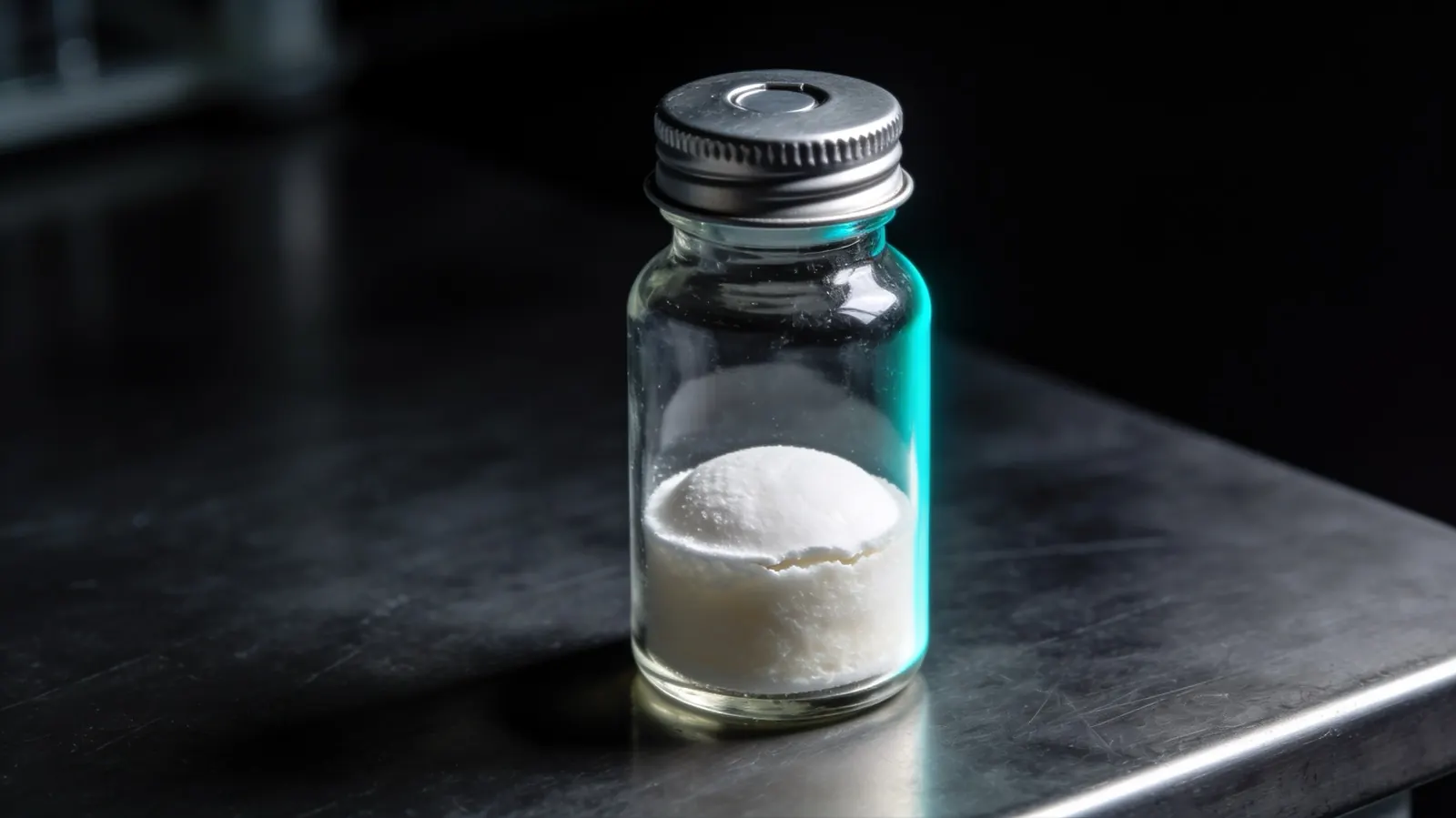
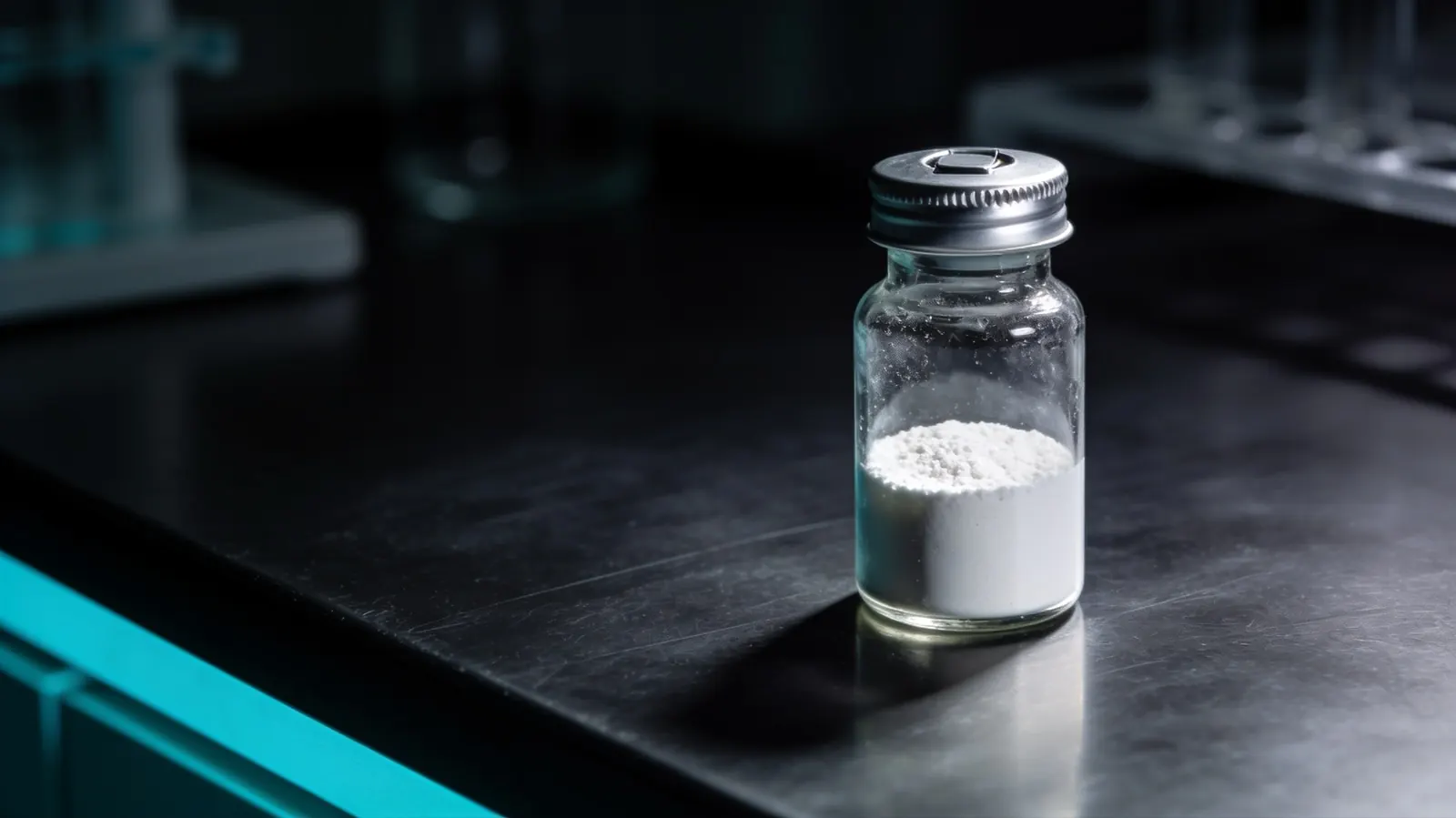
Physically the MOTS-c peptide is a white lyophilised powder, soluble in bacteriostatic water, stored at −20°C for the long term and 2 to 8°C in use. In this catalogue it ships as the MOTS-C 10mg vial, released at 99.76% purity by HPLC and catalogued under Longevity Research, which is a description of the literature it appears in rather than a claim made for it.
One detail of that formula is worth pausing on, because much of this article turns on it. The S2 at the end of C101H152N28O22S2 is two sulfur atoms, and those two sulfurs are the two methionines in the chain. They are the part of the specification that decides how the vial has to be looked after.
- 0
- amino acids in the chain, MRWQEMGYIFYPRKLR
- Lee et al., Cell Metabolism 2015;21(3):443-454
- 0 g/mol
- average molecular weight as published on the certificate
- Certificate of analysis, lot MOT10-052026-4
- 0
- PubChem CID, the identifier a structure search resolves on
- PubChem compound record
| Property | Value | Registry or source |
|---|---|---|
| One-letter sequence | MRWQEMGYIFYPRKLR | Product specification |
| Three-letter sequence | Met-Arg-Trp-Gln-Glu-Met-Gly-Tyr-Ile-Phe-Tyr-Pro-Arg-Lys-Leu-Arg | Product specification |
| Residue count | 16 amino acids | Product specification |
| Molecular formula | C101H152N28O22S2 | PubChem |
| Average molecular weight | 2174.61 g/mol | Certificate of analysis; PubChem computes 2174.62 |
| CAS number | 1627580-64-6 | CAS Registry |
| PubChem CID | 146675088 | PubChem |
| UNII | A5CV6JFB78 | FDA substance registration system |
| InChIKey | WYTHCOXVWRKRAH-LOKRTKBUSA-N | PubChem |
| Encoding gene | MT-RNR1 | Mitochondrial genome |
| Genomic location | 12S rRNA region of mitochondrial DNA | Lee et al., Cell Metabolism 2015 |
| Appearance | White lyophilised powder | Certificate of analysis, every released lot |
| Solubility | Soluble in bacteriostatic water | Product specification |
| Storage | −20°C long term, 2 to 8°C in use | Product specification |
| Supplied size | 10mg vial | MOTS-C product page |
What a mitochondrial-derived peptide is, and which gene the MOTS-c peptide sits in
Nearly every protein in a cell is transcribed from nuclear DNA, translated in the cytoplasm, and delivered wherever it is needed. Mitochondria are the exception that proves the rule: they carry their own small, circular genome, a remnant of the free-living bacterium they descend from, and they translate it with their own machinery. For decades that genome was read as a short and closed list: subunits of the respiratory chain, plus the RNAs needed to make them.
The MOTS-c peptide sits inside one of those RNA genes. Its coding sequence is in the 12S rRNA region, the gene catalogued as MT-RNR1: a stretch already annotated as structural RNA, carrying an open reading frame that had not been read as one. The peptide it specifies is short, it is made from a mitochondrial transcript, and its gene is nowhere in the nucleus. The name records exactly that, mitochondrial open reading frame of the 12S rRNA type-c.
MT-RNR1 is worth naming rather than leaving as "the 12S rRNA region", because it is the string that connects this molecule to genome browsers and variant databases. It is also the reason the sequence has a population genetics literature at all: a point variant in the mitochondrial genome can change a residue in this peptide while leaving the ribosomal RNA function it overlaps apparently intact, which is a genuinely odd thing for a gene to permit and is part of why the finding was taken seriously.
That is what the category name records as well. A mitochondrial-derived peptide is one encoded in mitochondrial DNA rather than nuclear DNA, and the class is small because almost nothing else qualifies. It is worth being exact about what the label does and does not say. It locates a coding sequence, and it stops there. It is not a grade of quality, it is not a statement of activity, and it does not group the compound with anything by what it does, only by where it is written.
The term that recurs in this literature for what such a peptide is thought to be doing is retrograde signalling: information moving from the mitochondrion outwards to the rest of the cell, the reverse of the usual direction in which the nucleus instructs the organelle. Papers in this field use the phrase as a framing device for why a peptide encoded inside the organelle would be interesting at all. It is a description of a research question, not of an outcome.
The distinction shows up in the comparison tables on this site. Where other compounds in the full research catalogue list a receptor class, GHRH analogue or growth-hormone secretagogue, the MOTS-c peptide lists mitochondrial-derived peptide, because the honest entry in that column is an origin rather than a target. A specification row is easier to read across a catalogue once that column is understood not to be answering the same question every time.
Nuclear-encoded peptide
Gene in the cell nucleus, transcript exported, translated in the cytoplasm. This describes almost every peptide in this catalogue, including BPC-157 and tesamorelin.
Mitochondrial-derived peptide
Gene inside the mitochondrial genome, translated from a mitochondrial transcript. The MOTS-c peptide is encoded in MT-RNR1, the 12S rRNA gene, which is what places it in this class.
The rest of the small class: humanin and the SHLPs
Saying a class is small is cheap unless the other members are named, so here they are. The mitochondrial-derived peptides described so far are humanin, the six small humanin-like peptides usually written SHLP1 through SHLP6, and MOTS-c. That is the list as it stands in the published literature.
Humanin came first, reported in 2001, and it is encoded in MT-RNR2, the 16S rRNA gene, the other ribosomal RNA gene in the same small genome. It is 24 residues in its mitochondrially encoded form. The six SHLPs were described in 2016 and are also read out of MT-RNR2, from a set of overlapping open reading frames in the same stretch of sequence; their reported lengths run from roughly 20 to 38 residues depending on which reading frame and start site a given paper takes.
The MOTS-c peptide is the odd one out in that set, and the difference is structural rather than rhetorical: it is the one encoded in MT-RNR1 rather than MT-RNR2, the 12S rather than the 16S gene. Two ribosomal RNA genes, three separate peptide-coding findings, one small circular genome that was supposed to have been fully annotated decades ago.
None of the others is stocked here, which is worth stating plainly rather than leaving to be inferred from an empty column. The MOTS-c peptide is the only mitochondrial-derived peptide in this catalogue; everything else on the shelf is nuclear-encoded, designed, or a fragment of something nuclear-encoded, and the section below sets that out compound by compound.
| Peptide | Residues | Encoding gene | First described | Stocked here |
|---|---|---|---|---|
| MOTS-c | 16 | MT-RNR1 (12S rRNA) | 2015, Cell Metabolism | Yes: MOTS-C 10mg |
| Humanin | 24 | MT-RNR2 (16S rRNA) | 2001, PNAS | No |
| SHLP1 to SHLP6 | Reported at roughly 20 to 38 | MT-RNR2 (16S rRNA) | 2016, Aging | No |
Two expansions of one name, and the word "mimetic"
The MOTS-c peptide has two published expansions, which is unusual and causes real confusion when a reader meets both in the same afternoon. The original, from the 2015 paper, is mitochondrial open reading frame of the 12S rRNA type-c. It is a map reference: it says where in the genome the sequence was found and nothing else, which is the right way to name something whose function is the open question.
The second appears in the 2021 Nature Communications work and reads exercise-induced mitochondrial-encoded regulator of muscle homeostasis. That is a backronym, a set of words fitted to letters that already meant something else, and it describes what the later paper was investigating rather than replacing the original naming. Both strings are in circulation. Only the first one explains the letters.
The practical consequence is small but worth knowing: a search on the second expansion returns the exercise literature, a search on the first returns the genetics and identification literature, and the two bodies of work sit on either side of 2015 without much overlap in vocabulary.
"Exercise mimetic" is the other term that follows the MOTS-c peptide around, and it is used in the literature as a classification rather than a claim. A compound is described as an exercise mimetic when it is being studied against endpoints that exercise also moves in the same model system, which is a statement about how an experiment is designed rather than about what happens to anyone. The label attaches to several unrelated molecules for the same reason. It is doing filing work, and reading it as a promise is reading it wrong.
The same caution applies to "mitochondrial-derived", which reads to a general audience like a quality grade and to a geneticist like a postcode. It is the postcode.
Who described the MOTS-c peptide, and where it was published
The MOTS-c peptide was identified by Changhan Lee and colleagues in the laboratory of Pinchas Cohen at the USC Leonard Davis School of Gerontology, and published as Lee C et al. in Cell Metabolism 2015;21(3):443-454, PMID 25738459, DOI 10.1016/j.cmet.2015.02.009.
That citation is given in full deliberately. A great many pages about this compound say "discovered in 2015" and stop, which is a date rather than a source: it cannot be checked, followed, or argued with. A PMID can be pasted into PubMed and a DOI resolves to the publisher's record, and both take a reader about four seconds. On a subject where most of what circulates is downstream of a single paper, naming the paper is the least a page can do.
Two later publications are cited on the product page and are worth knowing about by name. Zempo H et al. reported the frequency of a mitochondrial sequence variant affecting this peptide in an elderly Japanese population, in Aging, 2016. Reynolds JC et al. published "MOTS-c is an exercise-induced mitochondrial-encoded regulator of age-dependent physical decline and muscle homeostasis" in Nature Communications, 2021. That is the paper that supplied the second expansion of the name.
None of those three papers is a clinical recommendation, and none of them is being offered here as one. They are named so that the factual assertions on this page, where the gene sits, when the finding was made and what the model systems were, have somewhere to be checked. The standard this site tries to hold is the one set out in how to vet a research peptide supplier: a number or a claim with no traceable source behind it is decoration.
- 0
- year MOTS-c was described, in Cell Metabolism
- Lee C et al., Cell Metab 2015;21(3):443-454
- 0
- PubMed identifier of the paper that described it
- PubMed
What the preclinical MOTS-c peptide literature studies
Three study points recur, and each of them is a model system. AMP-activated protein kinase signalling is investigated in metabolic models, AMPK being the pathway that reports cellular energy state, and the reason a mitochondrially encoded peptide is examined alongside it is one of origin rather than of effect: the gene sits inside the organelle that supplies the cell's energy. Mitochondrial-function endpoints are explored in cellular models. Glucose regulation is studied in its own models, where the reported activity was located principally in skeletal muscle.
The 2015 paper's proposed route is more specific than "AMPK", and the detail is the interesting part. It describes the MOTS-c peptide acting on the folate cycle and one-carbon metabolism in cultured cells, with a consequent accumulation of the purine-synthesis intermediate AICAR, which is a known activator of AMP-activated protein kinase. Whether that route is the whole story is a live question in the field; more recent work has reported casein kinase 2 as a binding partner. Both of those are statements about what the literature reports, not mechanisms this page asserts.
Those are described as study points rather than as findings on purpose. They say where the papers looked, not what anyone should expect. The literature is in-vitro and animal work, and a model system is a deliberate simplification chosen because it can be controlled, which is what makes it useful and what stops it being a statement about people. The endpoint vocabulary in those papers, insulin sensitivity, glucose uptake, metabolic homeostasis, oxidative stress and age-dependent physical decline, is the vocabulary of what was measured in those systems, and it carries no meaning here beyond that.
Nothing on this page describes what the MOTS-c peptide does in a person, because that is not a question this material can answer or this site can address. There is no dosing information here, no route of administration, and no protocol, and their absence is deliberate rather than an oversight. Everything in this catalogue is supplied strictly for in-vitro laboratory research.
It is worth noting how much of the interest in this molecule is a consequence of the origin rather than anything else about it. A 16-amino-acid peptide with those study points would be unremarkable if its gene sat in the nucleus. The reason it was pursued is that the gene does not.
| Paper | Year | Journal | System studied | What it examined |
|---|---|---|---|---|
| Lee C et al., the mitochondrial-derived peptide MOTS-c promotes metabolic homeostasis | 2015 | Cell Metabolism 21(3):443-454 | Cultured cells and mice | Folate cycle, one-carbon metabolism, AMP-activated protein kinase |
| Zempo H et al., a mitochondrial-derived peptide variant and longevity in an elderly Japanese population | 2016 | Aging | Human population genotypes | Frequency of a mitochondrial sequence variant |
| Reynolds JC et al., MOTS-c is an exercise-induced mitochondrial-encoded regulator of age-dependent physical decline | 2021 | Nature Communications | Mice and skeletal muscle samples | Exercise response and muscle homeostasis endpoints |
Two methionines and a tryptophan
Read the sequence from the front: MRWQEMGYIFYPRKLR. The first residue is methionine, the third is tryptophan, the sixth is methionine again. Those are the three side chains in an ordinary peptide most readily oxidised, and this sequence has all three inside its first six positions.
Methionine carries a thioether sulfur, which takes up a single oxygen atom to become methionine sulfoxide. It does not take a strong oxidant to do it: dissolved oxygen, trace peroxide in a solvent, or a little contaminating metal will serve, slowly, at room temperature. The chemical change is one atom, which sounds trivial and is not. The oxidised molecule is more polar than the parent, it moves differently on a reversed-phase column, and it therefore appears as its own peak on the assay that produces the purity figure.
Tryptophan is the light-sensitive one. Its indole ring absorbs in the near-ultraviolet and photo-oxidises under ultraviolet and short-wavelength visible light, giving kynurenine and N-formylkynurenine among other products. A peptide containing tryptophan is kept in the dark for a specific chemical reason rather than as a general precaution, and that reason is the same one behind the general guidance on how to store peptides.
The two tyrosines, at positions 8 and 11, belong on the same list at a lower rank. They oxidise, but more slowly and under harsher conditions than either methionine or tryptophan, so they are rarely the first thing a chromatogram shows. They are in the table below for completeness, because a handling rule that mentions only the worst case teaches the reader less than one that ranks everything.
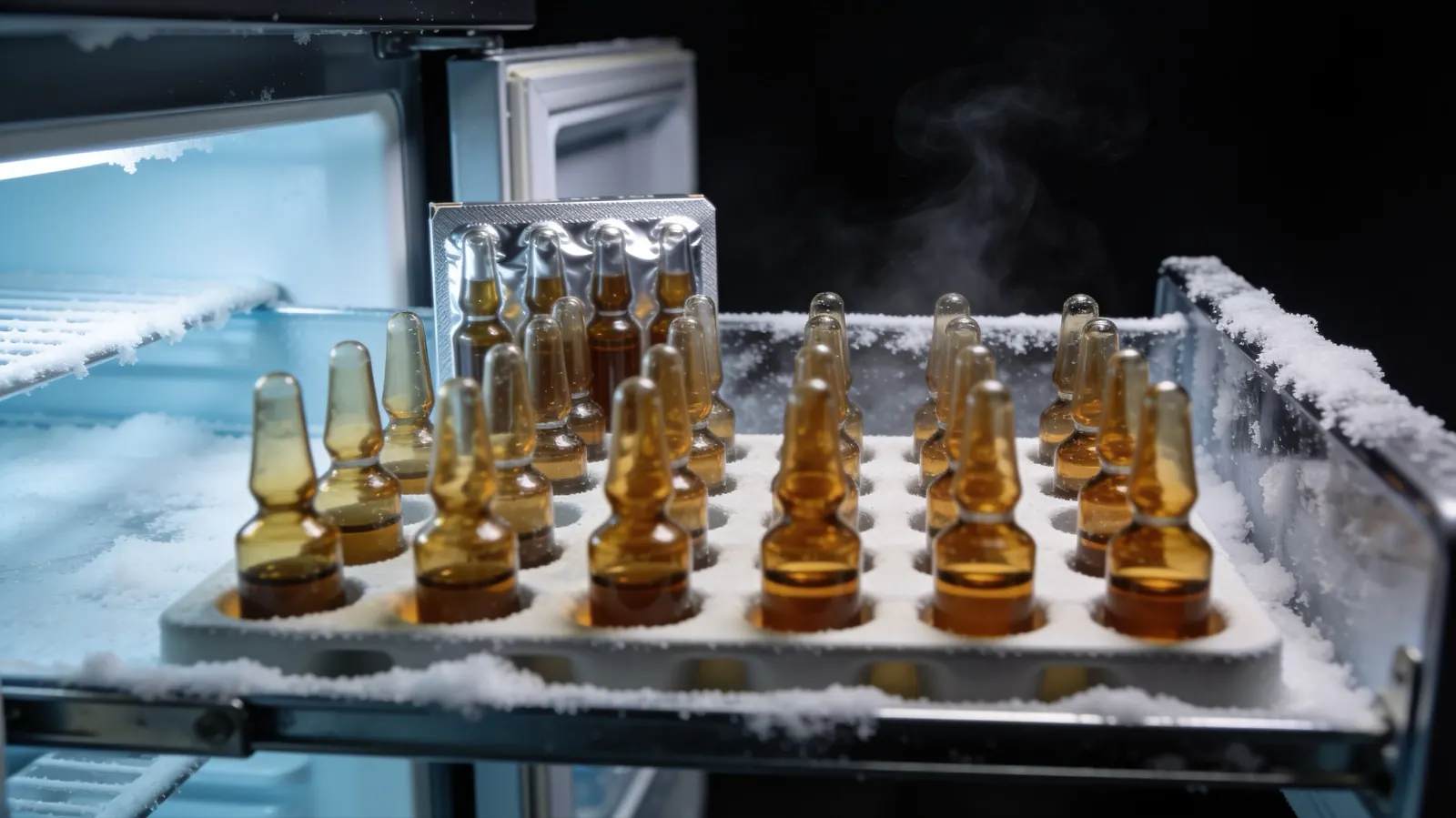
So light and air matter more for the MOTS-c peptide than they do for some other peptides, and the comparison is worth making concretely. A sequence built from leucine, lysine, threonine and glutamate has nothing in it that oxidises readily. This one has five such positions, two of them sulfur. Kept cold, kept dark, and with the vial opened as few times as the work allows, the oxidised species that a purity assay would count against the material never get the chance to form.
None of that makes the compound delicate in absolute terms. Lyophilised and frozen, it is a stable white solid, which is the whole point of supplying peptides lyophilised. The claim is about ranking rather than fragility: among vials sharing a freezer, this is one of the ones that earns the amber box.
| Residue | Position | Sensitive to | Reaction product | How it shows on reversed-phase HPLC |
|---|---|---|---|---|
| Methionine | 1 | Dissolved oxygen, trace peroxide, contaminating metal ions | Methionine sulfoxide | A separate, earlier-eluting peak, because the sulfoxide is more polar than the parent |
| Tryptophan | 3 | Ultraviolet and short-wavelength visible light | Kynurenine, N-formylkynurenine and related species | Several small peaks, plus a change in the 280nm absorbance the detector reads |
| Methionine | 6 | As Met1 | Methionine sulfoxide | As Met1; the two singly oxidised forms can resolve from each other |
| Tyrosine | 8 and 11 | Light and strong oxidants, considerably more slowly | Hydroxylated and cross-linked tyrosine species | Minor late peaks; rarely the first impurity to appear |
How a 16-residue chain is made
The MOTS-c peptide is made by solid-phase synthesis, like effectively every peptide of this length. The C-terminal arginine is anchored to a resin bead and the chain is extended towards the N-terminus one residue at a time. Deprotect, couple, wash, repeat, with the growing peptide held in place by the bead throughout.
Length is what makes it harder than a short fragment. Every coupling step is very slightly less than complete, and those small shortfalls compound along the chain, so each residue added costs something in final purity. A 16-residue peptide is a materially more demanding product than a short fragment, and that is the honest reason purity figures across this category cluster higher at the short end: the seven-residue TB-500 and the three-residue GHK-Cu are not being made better, they are being made shorter.
This particular sequence brings its own demands. Cleaving the finished chain from the resin uses strong acid, and tryptophan is the residue most vulnerable to what that acid releases, so scavengers go into the cleavage mixture specifically to protect it. Methionine can be carried through synthesis oxidised and has to be handled accordingly. Four arginines in 16 positions add their own burden, since arginine side-chain protection is bulky and slows the couplings around it. The chemistry is well established, but it is not the chemistry of a peptide made only of unreactive residues.
What comes out is purified by preparative HPLC, then lyophilised: frozen and dried under vacuum so that the water leaves as vapour without ever passing through a liquid phase, which is what leaves a dry cake rather than a residue. That cake is what the vial holds, and the reasons a dry cake is the form peptides are supplied in are set out in what lyophilized powder is. Its appearance is the first thing a certificate records: white, for this compound, every lot.
The MOTS-c peptide against the nuclear-encoded compounds on this shelf
The claim that the MOTS-c peptide's origin is unusual is easier to accept when it is shown against the others rather than asserted. Every other compound in this catalogue is either nuclear-encoded, a fragment of something nuclear-encoded, or designed from scratch by a medicinal chemist. Only one of them has a gene inside an organelle.
The table below compares them on specification columns only: residue count, where the coding sequence sits, molecular weight, CAS number and the purity of the lot currently released. There is no column for what any of them does, because that column would have to be filled with claims this site does not make. Each row links to its own product page, and every lot behind every purity figure is published in the certificate of analysis library.
Two comparisons in that table are worth reading twice. Ipamorelin, at five residues, has no natural gene at all: it contains aminoisobutyric acid and two D-configured residues, which no ribosome builds with, so it cannot be a fragment of anything. The details are in the ipamorelin peptide profile. Tesamorelin, at 44 residues plus an N-terminal acyl group, is the longest chain here and is a modified copy of a nuclear-encoded human hormone. MOTS-c sits between them in length and outside both in origin. At the short end of the table, the GHK-Cu copper peptide is three residues of collagen sequence bound to copper(II), and the only compound in the table carrying a metal ion at all.
The other comparison people ask for is against NAD+, and it is a category error rather than a contest. NAD+ is a redox coenzyme: a nucleotide, not a peptide, with no amino acids in it and no gene encoding it directly. The MOTS-c peptide is a 16-amino-acid chain. Asking which is better is like asking whether a spanner is better than a litre of oil, and the note on the NAD+ peptide question sets the distinction out properly.
| Compound | Residues | Where the coding sequence sits | Molecular weight | CAS | Current lot purity |
|---|---|---|---|---|---|
| MOTS-C | 16 | Mitochondrial DNA, MT-RNR1 | 2174.61 g/mol | 1627580-64-6 | 99.76% |
| Ipamorelin | 5 | Nowhere: a designed sequence | 711.85 g/mol | 170851-70-4 | 99.90% |
| Tesamorelin | 44 plus an N-terminal acyl group | Nuclear: a modified GHRH sequence | 5135.89 g/mol | 218949-48-5 | 99.87% |
| BPC-157 | 15 | Nuclear: a partial sequence of a gastric protein | 1419.53 g/mol | 137525-51-0 | 99.51% |
| TB-500 | 7, acetylated | Nuclear: a fragment of thymosin β4 | 889.0 g/mol | 885340-08-9 | 99.58% |
| GHK-Cu | 3, with copper(II) | Nuclear: a collagen-derived tripeptide | 403.94 g/mol | 89030-95-5 | 99.86% |
The only mitochondrial-derived peptide on this shelf
MOTS-C ships as a 10mg vial of white lyophilised powder, 99.76% by HPLC on the current lot, with its certificate of analysis published against its lot number before purchase. Supplied for in-vitro laboratory research only.
See the MOTS-C specification and lotStorage and handling of the MOTS-c peptide vial
The supplied conditions are −20°C for long-term storage of the sealed lyophilised vial and 2 to 8°C in use, in the dark in both cases. Those are not arbitrary numbers picked for caution: each one follows from the residue table above, and the storage matrix below states which residue each line is protecting.
In the dry state the MOTS-c peptide has very little water to react with and almost no molecular mobility, which is why lyophilisation is worth the expense. In solution both of those protections are gone at once, so a reconstituted vial is on a much shorter clock than a sealed one, and every additional needle-stick through the stopper adds a little more headspace air to the vial it is protecting.
| State | Temperature | Light | Why, in residue terms |
|---|---|---|---|
| Lyophilised, sealed, long term | −20°C | Dark: original box or foil | Low mobility and almost no free water; the two methionines have little to oxidise with |
| Lyophilised, in use | 2 to 8°C | Dark | Short-term working condition; limits condensation cycles on the cake |
| In solution | 2 to 8°C | Dark, amber vial or foil-wrapped | Dissolved oxygen reaches Met1 and Met6 freely, and Trp3 is exposed to any incident light |
| In transit | Ambient, padded | Boxed throughout | The dry solid tolerates a short excursion; light exclusion is what the packaging is for |
Making a solution of known concentration
Reconstitution is arithmetic, and it is the sort of arithmetic that is easy to get wrong at the bench and impossible to correct afterwards. A 10mg vial of the MOTS-c peptide holds a fixed mass; what changes is the volume of diluent added, and therefore the concentration of the solution. The table below sets out the four volumes most often used, the resulting concentration in mg/mL, and the volume of that solution containing 1mg of peptide. It is presented as preparation of a solution of known concentration for in-vitro work, and for no other purpose.
Two practical notes on the diluent. Bacteriostatic water is sterile water containing 0.9% benzyl alcohol as a preservative, which is what allows a vial to be entered more than once without the diluent itself becoming the contamination route. The note on what is bacteriostatic water covers the composition, sterile water vs bacteriostatic water covers the difference from the unpreserved article, and this catalogue supplies it as a 3mL bacteriostatic water vial. And the water should be run down the inside wall of the vial rather than directly onto the cake, which dissolves the solid without driving air through it.
One further figure belongs in this arithmetic. The certificate for each lot reports net peptide content separately from the labelled mass, 12.07mg on the current lot, and that figure, not the label, is what a calculation needs when the mass of peptide rather than the mass of solid is what matters. The next sections explain why those two numbers are different.
| Bacteriostatic water added | Resulting concentration | Volume containing 1mg | Volume containing 0.5mg |
|---|---|---|---|
| 1.0 mL | 10 mg/mL | 0.10 mL | 0.05 mL |
| 2.0 mL | 5 mg/mL | 0.20 mL | 0.10 mL |
| 3.0 mL | 3.33 mg/mL | 0.30 mL | 0.15 mL |
| 5.0 mL | 2 mg/mL | 0.50 mL | 0.25 mL |
Regulatory and sport status, as a matter of record
This section states facts about how MOTS-c is classified by three bodies. It is here because those classifications are part of what the compound is, and because leaving them out would make this page less honest than the search results it sits among.
The MOTS-c peptide is not approved by the FDA for any indication. There is no approved product containing it, no approved labelling, and no indication for which it has been cleared. Material sold for research is not an approved drug and nothing about a certificate of analysis changes that.
The World Anti-Doping Agency names the MOTS-c peptide on its Prohibited List from the 2024 edition onwards, and USADA's published guidance for athletes describes it as prohibited at all times, in and out of competition. Anyone subject to anti-doping rules is bound by the current list rather than by anything written here, and the list is republished every year.
This catalogue's own classification is the one that governs supply: research use only, in-vitro laboratory work, not for human or veterinary use, not a medicine and not a supplement. That is the condition on which every compound here is sold, and it is set out in full in the shipping and supply terms.
| Body | Classification | In force | What it means here |
|---|---|---|---|
| FDA | Not approved for any indication | No approval has ever been granted | Supplied as a research chemical, never as a medicine |
| WADA | Named on the Prohibited List | 2024 edition onwards | Relevant to anyone subject to anti-doping rules |
| USADA | Prohibited at all times, in and out of competition | Per USADA's published athlete guidance | Stated here as a matter of record |
| This catalogue | Research use only, in-vitro laboratory use | Every lot, every order | Not for human or veterinary use; see supply terms |
What the MOTS-c peptide certificate documents
The current lot is MOT10-052026-4: 10mg, 99.76% by HPLC, net peptide content 12.07mg, identity confirmed by LC-MS, assayed by Freedom Diagnostics against a report dated 14 May 2026 and released on 17 Jul 2026. The lot before it, MOT10-052026-1, measured 99.59% with a net peptide content of 12.23mg and was released on 22 May 2026. The one before that, MOT10-032026-H, measured 99.763% with a net peptide content of 12.81mg.
Purity and net peptide content answer different questions, and neither stands in for the other. Purity is a proportion: of the peptide material present, how much is the intended sequence rather than a truncation, a deletion variant or an oxidised form. Net peptide content is an absolute: how much of the weighed solid in the vial is peptide at all, the remainder being counter-ion from purification and bound water. A vial can report a high purity percentage and still hold less peptide than its label implies. The two numbers together are what close that gap, which is set out at greater length in the note on what peptide purity actually measures, and the assays behind both figures are described in peptide purity testing.
For the MOTS-c peptide the purity figure carries information a shorter peptide's would not. Methionine sulfoxide separates from the parent peak on reversed-phase HPLC, so oxidation is visible to the same assay that produces the number. A purity figure on a methionine-containing peptide is partly a statement about how carefully the material was kept between synthesis and assay, not only about how well it was made. On the certificate for MOT10-052026-4, the 0.24% that is not the parent peak is the whole population of truncations, deletion variants and oxidised species combined.
Endotoxin is reported separately and passes on both replicates for each of the three lots above, which is a different question again from either purity or content: it asks about bacterial contamination of the material, not about the molecule.
Then the lot number, which is the part most easily skipped. A certificate describes one batch and no other. Unless the number printed on it matches the number printed on the vial, it documents someone else's material, however impressive the percentage on it is. Every certificate here is published against its lot before purchase, and any lot of the MOTS-c peptide can be checked against its number in the batch verification lookup, including lots no longer in stock. How to read a peptide certificate of analysis walks through the lines in the order they appear.
- 0%
- purity by HPLC on the current lot, MOT10-052026-4
- Freedom Diagnostics, report dated 14 May 2026
- 0mg
- net peptide content on the same lot, reported separately from purity
- Certificate of analysis, lot MOT10-052026-4
- 0
- released lots published with full certificates, including those out of stock
- [Certificate of analysis library](/coa)
| Lot | Purity by HPLC | Net peptide content | Identity | Assayed by | Released |
|---|---|---|---|---|---|
| MOT10-052026-4 | 99.76% | 12.07mg | Confirmed by LC-MS | Freedom Diagnostics | 17 Jul 2026 |
| MOT10-052026-1 | 99.59% | 12.23mg | Confirmed by LC-MS | Freedom Diagnostics | 22 May 2026 |
| MOT10-032026-H | 99.763% | 12.81mg | Confirmed by LC-MS | Freedom Diagnostics | 8 May 2026 |
The MOTS-c peptide is 16 amino acids, MRWQEMGYIFYPRKLR, 2174.61 g/mol, CAS 1627580-64-6, PubChem CID 146675088, and its distinguishing feature sits upstream of all of that, in where the gene is. The coding sequence lies in MT-RNR1, the 12S rRNA gene of mitochondrial DNA, not in the nucleus, which is what makes it a mitochondrial-derived peptide and what made it worth investigating when Lee and colleagues described it in Cell Metabolism in 2015. The sequence that origin produces, with two methionines and a tryptophan packed into its first six positions, is why this vial is kept dark and cold and why the purity figure on its certificate rewards a close reading. What the MOTS-c peptide does in a person is not addressed anywhere on this page and is not a question this material answers: the MOTS-C vial is supplied for in-vitro laboratory research, with its lot published in the certificate library before purchase.
Common questions
What is the MOTS-c peptide?
A 16-amino-acid peptide, MRWQEMGYIFYPRKLR, molecular weight 2174.61 g/mol, CAS 1627580-64-6, encoded in MT-RNR1, the 12S rRNA gene of mitochondrial DNA. The MOTS-c peptide is studied in AMPK-signalling, mitochondrial-function and glucose-regulation model systems, and is supplied as a white lyophilised powder for laboratory research.
What does MOTS-c stand for?
Mitochondrial open reading frame of the 12S rRNA type-c. The name is a description of where the coding sequence was found rather than of anything the molecule is claimed to do, which is why it reads like a map reference. A second expansion, exercise-induced mitochondrial-encoded regulator of muscle homeostasis, appears in the 2021 Nature Communications paper and is a backronym fitted to the existing letters.
What gene encodes MOTS-c?
MT-RNR1, the mitochondrial gene for the 12S ribosomal RNA. The peptide's open reading frame sits inside a stretch of sequence that was already annotated as structural RNA, which is why it went unnoticed for as long as it did.
Who discovered MOTS-c and when?
Changhan Lee and colleagues, in the laboratory of Pinchas Cohen at the USC Leonard Davis School of Gerontology, published in Cell Metabolism 2015;21(3):443-454, PMID 25738459, DOI 10.1016/j.cmet.2015.02.009.
What does mitochondrial-derived peptide mean?
That the peptide's gene sits in mitochondrial DNA rather than in the cell nucleus. Mitochondria carry their own small genome, and MOTS-c is encoded within one of its RNA genes, which places it in a very small class of peptides not specified by the nuclear genome at all.
What other mitochondrial-derived peptides are there?
Humanin, reported in 2001 and encoded in MT-RNR2 at 24 residues, and the six small humanin-like peptides SHLP1 to SHLP6, described in 2016 and also read out of MT-RNR2. MOTS-c is the only one of the set encoded in MT-RNR1, and the only one stocked in this catalogue.
What is the amino acid sequence of MOTS-c?
MRWQEMGYIFYPRKLR: methionine, arginine, tryptophan, glutamine, glutamate, methionine, glycine, tyrosine, isoleucine, phenylalanine, tyrosine, proline, arginine, lysine, leucine, arginine. Molecular formula C101H152N28O22S2, molecular weight 2174.61 g/mol, 16 residues.
What is the PubChem CID for MOTS-c?
146675088. The UNII is A5CV6JFB78 and the InChIKey is WYTHCOXVWRKRAH-LOKRTKBUSA-N. Those identifiers resolve to the structure regardless of how the name is spelled, which is what makes them worth quoting on a specification page.
Is MOTS-c a peptide or a protein?
A peptide. The chain is 16 amino acids long, which is far short of the length at which a sequence is normally called a protein. The distinction matters for handling: a chain this short has no folded structure to lose, so what a certificate reports is chemical integrity rather than conformation.
Is MOTS-c natural or synthetic?
Both descriptions are doing different jobs. The coding sequence occurs in mitochondrial DNA, so the sequence itself is not an invention. The material in a vial is made by solid-phase peptide synthesis, purified by preparative HPLC and freeze-dried, so the solid is synthetic even though the sequence it reproduces is not.
What does "exercise mimetic" mean when it is applied to MOTS-c?
It is a literature classification, not a claim. A compound is filed as an exercise mimetic when it is studied against endpoints that exercise also moves in the same model system, which is a statement about how an experiment was designed. The label attaches to several unrelated molecules for that reason and says nothing about what happens in a person.
Why does MOTS-c need to be protected from light?
Because of the tryptophan at the third position and the methionines at the first and sixth. Tryptophan photo-oxidises under ultraviolet and short-wavelength visible light, and methionine oxidises to the sulfoxide in air, so this sequence is more exposed to light and oxygen than one without those residues.
How is the MOTS-c peptide stored?
The supplied storage condition is −20°C for the long term and 2 to 8°C in use, as a white lyophilised powder, in the dark in both cases. Keeping the vial out of the light follows from the chemistry of the sequence rather than from a separate instruction on the label, and the general reasoning is set out in how to store peptides.
How much bacteriostatic water does a 10mg MOTS-c vial take?
That depends on the concentration the work calls for, because the mass in the vial is fixed and only the volume changes: 1mL gives 10mg/mL, 2mL gives 5mg/mL, 3mL gives about 3.33mg/mL and 5mL gives 2mg/mL. This is solution preparation for in-vitro work. Bacteriostatic water for peptides covers the diluent itself.
What should MOTS-c look like in the vial?
A white lyophilised cake or powder. Appearance is the first line on the certificate for every lot of this compound, and it is white each time, so a vial that looks otherwise is worth raising before anything else is done with it.
What purity is MOTS-c supplied at?
The current lot, MOT10-052026-4, was released at 99.76% by HPLC with a net peptide content of 12.07mg, assayed by Freedom Diagnostics. The previous lot, MOT10-052026-1, measured 99.59%, and the one before it, MOT10-032026-H, measured 99.763%.
What does net peptide content mean on a MOTS-c certificate?
How much of the weighed solid in the vial is peptide, as opposed to counter-ion left from purification and water bound to the cake. It answers a different question from the purity percentage, and a certificate that reports only one of the two has left the more expensive question open. How to read a peptide certificate of analysis walks through both lines.
How do I check a MOTS-c certificate matches my vial?
Compare the lot number on the certificate with the lot number printed on the vial label; they have to be the same string, character for character. Every lot released here is published in the certificate of analysis library before purchase, so the document can be read against the label rather than taken on trust.
Is MOTS-c approved by the FDA?
No. The MOTS-c peptide is not approved by the FDA for any indication, there is no approved product containing it, and material supplied for laboratory research is not an approved drug.
Is MOTS-c banned in sport?
The World Anti-Doping Agency names MOTS-c on its Prohibited List from the 2024 edition onwards, and USADA's published athlete guidance describes it as prohibited at all times. Anyone subject to anti-doping rules should work from the current published list rather than from any third-party page.
What's better, MOTS-c or NAD+?
They are not the same kind of thing, so the comparison does not resolve. The MOTS-c peptide is a 16-amino-acid chain encoded in mitochondrial DNA; NAD+ is a redox coenzyme, a nucleotide with no amino acids in it. The note on the NAD+ peptide question sets out the distinction, and neither is offered here for anything other than laboratory research.
What are the benefits and side effects of MOTS-c?
Nothing on this site describes effects, benefits or side effects, because MOTS-c is supplied strictly for in-vitro laboratory research and those are statements about people. The published literature is cell and animal work, and this page reports where those papers looked rather than what they concluded about anyone.
Is MOTS-c for human use?
No. MOTS-c is supplied strictly for in-vitro laboratory research. It is not a medicine, it is not a supplement, and nothing on this site describes what it does in a person, how long it would be taken for, or how it would be administered.
Which vial does this catalogue supply the MOTS-c peptide in?
A single 10mg vial of white lyophilised powder, listed as MOTS-C 10mg, released against a published certificate and a lot number that resolves in the batch verification lookup. It is the only mitochondrial-derived peptide on the shelf, and it is supplied for in-vitro laboratory research only.
- PubChem CID 146675088, MOTS-c: the molecular formula C101H152N28O22S2, the computed average mass quoted against the certificate figure of 2174.61 g/mol, and the InChIKey WYTHCOXVWRKRAH-LOKRTKBUSA-N
- FDA, Lyophilization of Parenteral: Inspection Technical Guide: the freeze-drying step described in the synthesis section, and why the dry cake is the form the vial holds
- ICH Q6A, Specifications: Test Procedures and Acceptance Criteria (FDA): the framework in which a specification is a list of tests with acceptance criteria, which is what a lot certificate reports against
- Bacteriostatic Water for Injection, USP: FDA label (DailyMed): the benzyl alcohol preservative content of the diluent named in the reconstitution table, and the multiple-dose designation that follows from it
- PubChem CID 5892, NAD+ (nadide): the nucleotide structure behind the statement that NAD+ is a coenzyme with no amino acids in it rather than a peptide
Read more
- GHK-Cu copper peptideA GHK-Cu copper peptide vial is blue, and every other vial in this catalogue is white. The colour is not a dye. It is the evidence that the complex formed.
- NAD+ peptide: a coenzyme, not a peptideNAD+ peptide is how the compound is usually searched for, and the word peptide is the wrong word. NAD+ is a dinucleotide coenzyme with no amino acids in it at all.
- What is the GLOW peptide blend?The GLOW peptide is not one peptide. GLOW is a product name for three molecules dried into a single vial, 70mg in total, in a ratio fixed before it was sealed.
- What is in the KLOW peptide blendThe KLOW peptide blend is four separate molecules sharing one vial, which means four identities to describe and four assays to read rather than one of each.
- GLP-3 RT peptideThe GLP-3 RT peptide is a 39-residue acylated chain registered under CAS 2381089-83-2. This page states what the molecule is, how a chain that long is built, and what the certificates we publish for it actually say.
- GLP-1 peptideThe GLP-1 peptide this catalogue sells as GLP-1 S is an engineered analogue of the hormone it shares a name with, registered under CAS 910463-68-2. This page states what the molecule is, how the analogue and the hormone differ, and what our single published certificate actually says.
For laboratory research use only. All compounds listed on this site are sold strictly as reference materials for in-vitro laboratory research conducted by qualified professionals. They are not drugs, foods, cosmetics, or medical devices. They are not intended for human or veterinary consumption, therapeutic use, diagnostic application, or any in-vivo use whatsoever. These statements have not been evaluated by the Food and Drug Administration. By purchasing, you affirm that you are a qualified researcher and that you will comply with all applicable institutional, local, state and federal regulations governing the handling of research chemicals. Published by SERVIAM BIO LABS.