Actin binding
Regulates actin sequestration in cell-migration models, the core mechanism studied. Holding actin in its free form stops filaments assembling before the cell needs them.
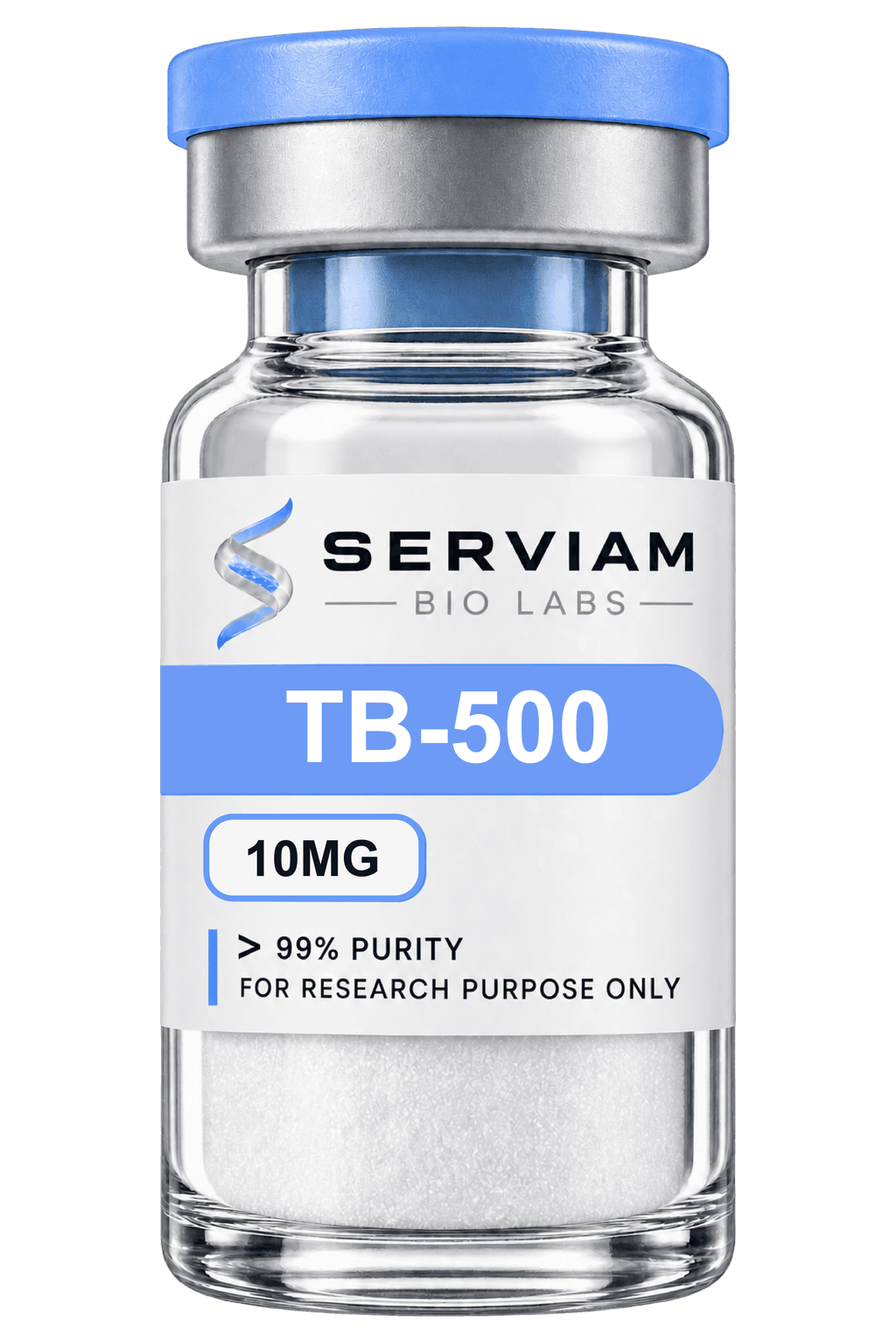
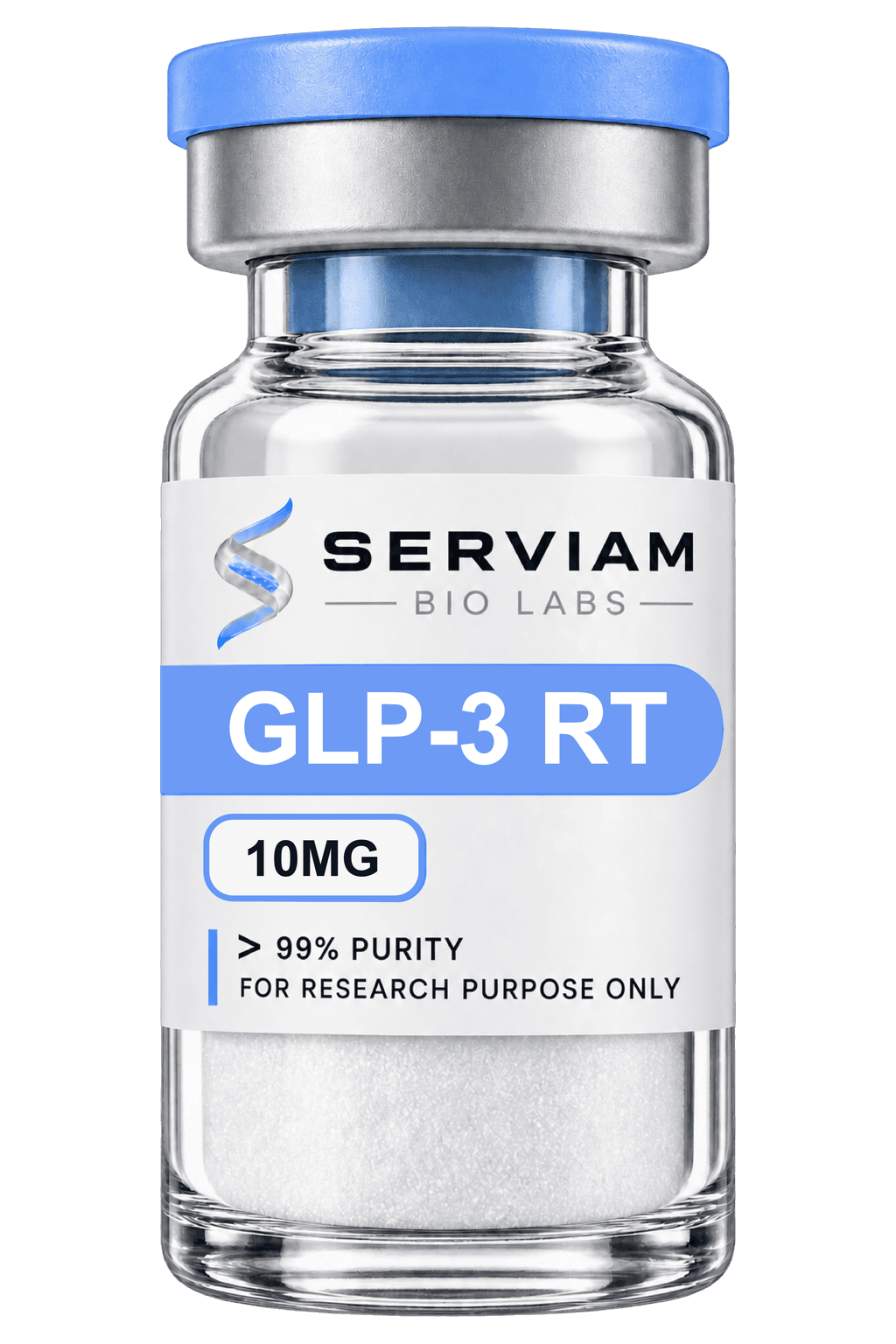
Lyophilised powder · 99%+ documented HPLC
Synthetic fragment of thymosin beta-4, studied for actin regulation and tissue-repair signalling in preclinical models.
$84.99per 10mg vial
Figures are structural data from our specification and certificates, or are drawn from published third-party literature about the compound, and are provided for orientation only. Nothing here is a claim about what this material does. Supplied for laboratory research use only.
TB-500 is the acetylated seven-residue active region of thymosin beta-4, isolated and made synthetically rather than the full 43-residue parent protein. Research centres on actin: the protein that forms a cell's internal scaffolding, and which has to be held in reserve until the cell is ready to move. That is the process underlying wound closure and tissue remodelling, and it is where the published preclinical work sits.
C38H68N10O14 · composition, not conformation
Signalling pathways examined in preclinical models. Descriptive of published research directions, not claims of effect.
Regulates actin sequestration in cell-migration models, the core mechanism studied. Holding actin in its free form stops filaments assembling before the cell needs them.
Investigated for effects on cell-migration rate in scratch-assay models, where the endpoint is how quickly a cleared area closes.
Explored in vascular-repair endpoints alongside the migration work. Not a human efficacy claim.
The parent protein was established as a major regulator of the cell's actin supply.
Holding actin in its free form stops filaments forming prematurely.
This characterisation is of the full parent protein; the product is its active fragment.
Reference class characteristics for orientation. Half-life figures are typical literature values, not lot measurements.
| Compound | Receptor class | Typical half-life | Note |
|---|---|---|---|
| TB-500 | Tβ4 fragment | Longer | Actin sequestration |
| BPC-157 | Pentadecapeptide | Short | Cytoprotection |
| GHK-Cu | Tripeptide-Cu | Short | ECM remodelling |
Milestones in the study of this compound class.
Thymosin beta-4 first isolated from thymus tissue and sequenced as a 43-residue peptide.
Sanders, Goldstein and Wang establish the parent protein as a major regulator of the cell's unpolymerised actin pool, binding roughly one to one.
The LKKTETQ region is identified as the actin-binding motif, which is what made an isolated fragment worth synthesising.
Preclinical work extends from actin sequestration to cell migration and vascular-repair endpoints.
Every lot is documented by an independent laboratory. The newest lot appears first.
| Lot | Reported | Size | HPLC | Laboratory | Certificate |
|---|---|---|---|---|---|
| PQ7MWD | 29 May 2026 | 10mg | 99.58% | Freedom Diagnostics | View |
| TB10-12222025-J | 24 Dec 2025 | 10mg | 99.721% | Freedom Diagnostics | View |
| 600001 | 20 Feb 2026 | 10mg | 99.859% | Freedom Diagnostics | View |
99.58%
HPLC purity
The signed PDF is the full certificate. The accession and search code above resolve the same record at the laboratory.
HPLC purity
RP-HPLC, 214 nm
Identity
LC-MS
Lot PQ7MWD
This material is supplied as a reference standard for in-vitro laboratory research only. It has not been evaluated by the FDA, is not a drug, and is not intended for human or veterinary use. Handling should follow your institution's chemical hygiene plan, including appropriate PPE and documented disposal.
Every lot is documented at 99%+ by RP-HPLC with identity confirmed by LC-MS, run by an independent laboratory. Released lots have measured between 99.58% and 99.859%; the figure for the lot you receive is in the certificate table above.
Yes. Every lot ships with its own signed certificate, and all three are published in the COA library, including for lots no longer in stock.
A single 10mg vial.
Ac-LKKTETQ — seven residues with an acetylated N-terminus, corresponding to the actin-binding region of thymosin beta-4. Identity is confirmed lot-by-lot against a certified reference standard by LC-MS, and that confirmation is what the certificate reports.
No, and the difference matters when reading the literature. Thymosin beta-4 is the full 43-residue protein. TB-500 is the seven-residue active region synthesised on its own. Binding figures published for the parent protein describe that protein, not this fragment.
Store the sealed vial at −20°C for long-term stability and 2–8°C for short-term handling. Protect from light and avoid repeated freeze-thaw cycles. Compound-specific stability data is printed on the certificate of analysis supplied with the lot.
Independent published research relating to this compound. Listed for reference; Serviam Bio Labs is not affiliated with these authors and makes no claims based on their findings.
Thymosin beta 4 (Fx peptide) is a potent regulator of actin polymerization in living cells
Sanders MC, Goldstein AL, Wang YL · 1992 · PNAS 89(10):4678-4682
Thymosin beta 4 and Fx, an actin-sequestering peptide, are indistinguishable
Safer D, Elzinga M, Nachmias VT · 1991 · Journal of Biological Chemistry
Thymosin beta4: actin-sequestering protein moonlights to repair injured tissues
Goldstein AL, Hannappel E, Kleinman HK · 2005 · Trends in Molecular Medicine
For laboratory research use only. All compounds listed on this site are sold strictly as reference materials for in-vitro laboratory research conducted by qualified professionals. They are not drugs, foods, cosmetics, or medical devices. They are not intended for human or veterinary consumption, therapeutic use, diagnostic application, or any in-vivo use whatsoever. These statements have not been evaluated by the Food and Drug Administration. By purchasing, you affirm that you are a qualified researcher and that you will comply with all applicable institutional, local, state and federal regulations governing the handling of research chemicals.