

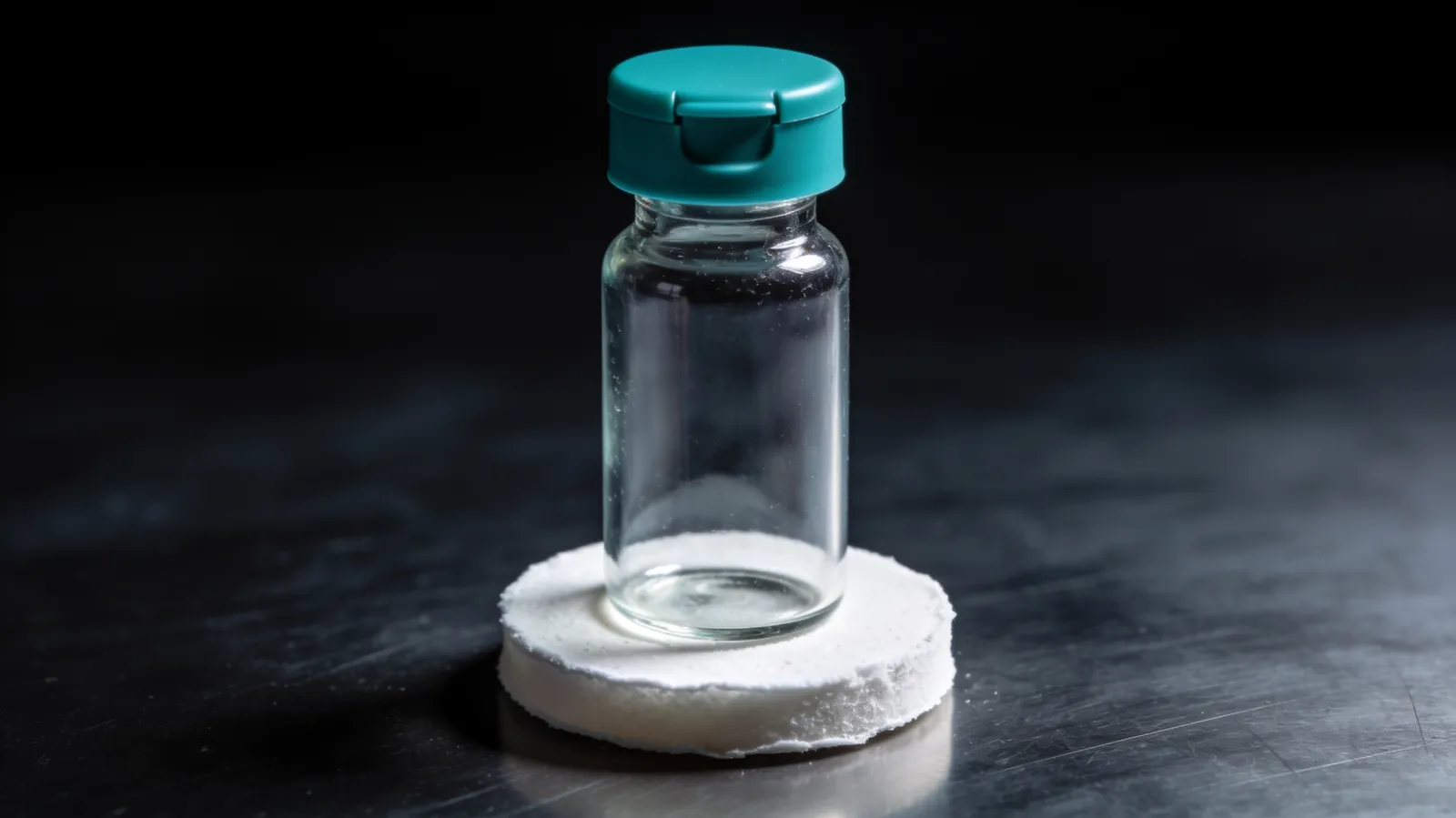
What is TB-500? A synthetic seven-residue peptide, Ac-LKKTETQ, acetylated at the N-terminus, average molar mass 889.018 g/mol, CAS 885340-08-9. The sequence corresponds to residues 17 to 23 of thymosin beta-4, the principal actin-sequestering protein in cells, and is studied in preclinical models of actin regulation and cell migration. It is not thymosin beta-4 itself.
- What is TB-500 at the level of sequence: Ac-LKKTETQ, positions 17 to 23 of thymosin beta-4, and not a loose approximation of the parent protein. Those seven residues carry the LKKTET motif that the beta-thymosin literature identifies as the actin-binding region, which is why they were the seven worth synthesising.
- A fragment is not the protein it came from, and the point has now been made by a regulator rather than only by chemists: the FDA's 2026 review of the material recorded that the wound-healing studies submitted to it had used the full protein, and that no human study had administered TB-500 itself.
- At seven residues TB-500 is an easy synthesis and high purity figures are the norm across the category, which makes purity a weak way to tell two vials apart; the mass-spectrometry identity result on a peptide certificate of analysis is the line that actually distinguishes them.
- A certificate describes one batch only, so the lot number on the paper has to match the lot number printed on the glass. Ours are published before purchase and can be checked by lot number.
- Ask what is TB-500 in regulatory terms and the answer is settled even though its pharmacology is not: it is not an approved drug, the World Anti-Doping Agency's 2026 Prohibited List covers it in and out of competition, and Australia and New Zealand classify it as a prescription medicine. Here it is a laboratory reagent and nothing else.
What is TB-500, in specification terms
What is TB-500 in the narrowest sense the word specification allows? A short synthetic peptide, seven residues long, acetylated at the N-terminus: leucine, lysine, lysine, threonine, glutamate, threonine, glutamine, written Ac-LKKTETQ. Its molecular formula is C38H68N10O14 and its average molar mass 889.018 g/mol, which a certificate will normally round to 889.0. It is registered under CAS 885340-08-9.
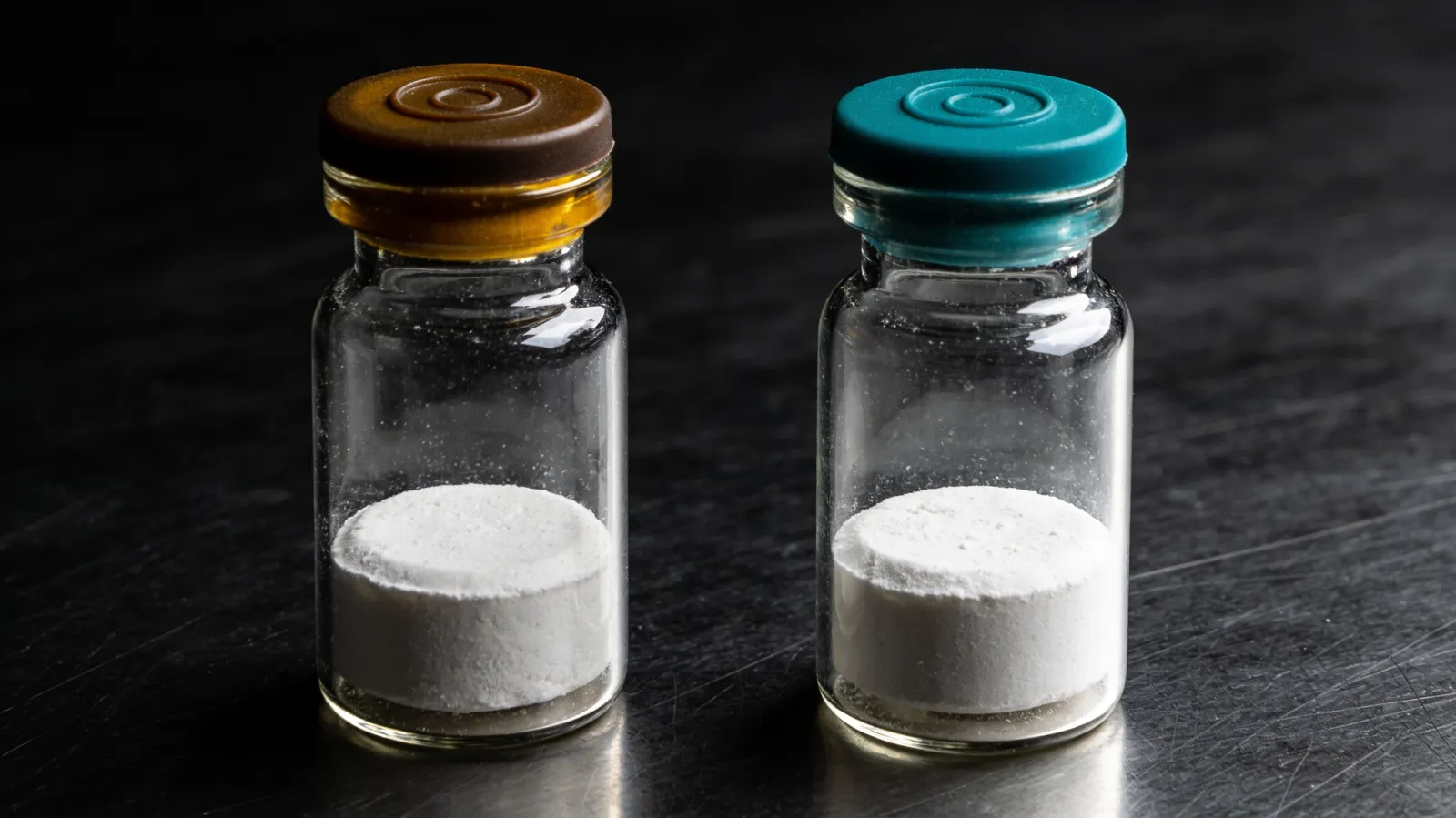
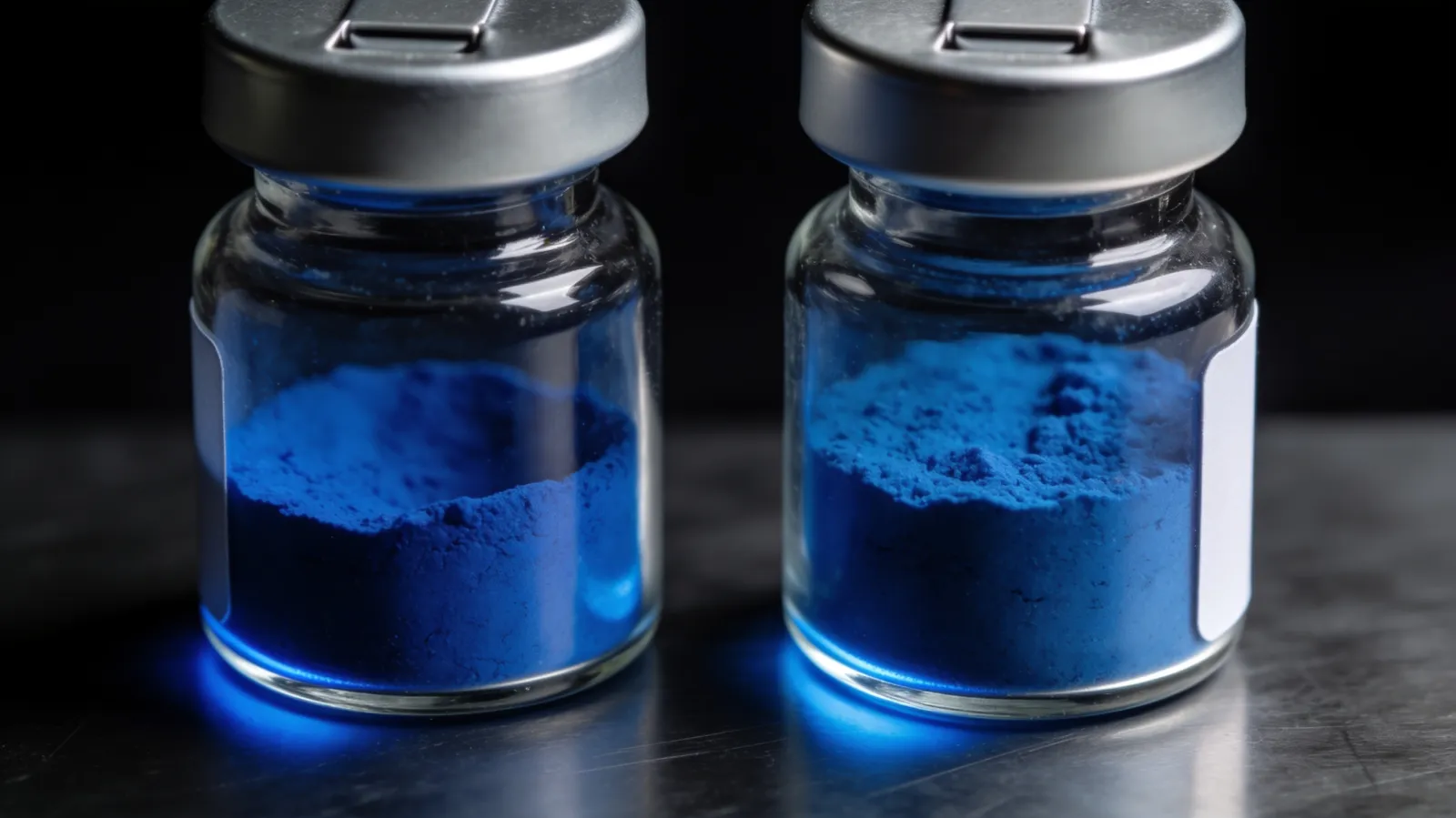
Seven residues makes it a heptapeptide, and that word is worth recognising because it is how the analytical and anti-doping literature refers to it when the trade name is avoided. Physically it is supplied as a white lyophilized powder, normally as a cake rather than a loose solid, readily soluble in bacteriostatic water for peptides. The rules in how to store peptides apply to it unchanged: −20°C for the long term, 2 to 8°C once it is in solution. In this catalogue it ships as a 10mg vial released at 99.58% purity by HPLC.
The acetyl group on the N-terminus is not decoration. Capping the free amine removes a charged end and makes the short chain considerably less attractive to aminopeptidases, which is the usual reason a fragment this length is supplied acetylated rather than free. The N-terminus, the residue count and the Ac- prefix are the vocabulary of what is a peptide, which is the page to read first if any of it is unfamiliar.
TB-500 is a catalogue designation rather than a chemical name, and catalogue designations drift. The registry identifiers below are the only unambiguous way to state which molecule is meant, and they are worth keeping to hand when comparing a listing, a paper and a certificate that all use different words for the same thing, or the same words for different things.
- 0 g/mol
- Average molar mass of Ac-LKKTETQ
- PubChem CID 62707662; our certificates round it to 889.0
- 0
- Residues in the chain, making it a heptapeptide
- Against 43 in the parent protein
- 0mg
- Nominal fill of the vial in this catalogue
- Product specification, current lot PQ7MWD
| Identifier | Value | Where it can be checked |
|---|---|---|
| CAS number | 885340-08-9 | CAS registry; printed on our vial label and certificate |
| PubChem CID | 62707662 | PubChem compound record |
| ChemSpider ID | 72380051 | ChemSpider record |
| UNII | QHK6Z47GTG | FDA Global Substance Registration System |
| InChIKey | ADKDNDYYIZUVCZ-ZQNQAVPYSA-N | PubChem or ChemSpider; a hashed fingerprint of the structure |
| Molecular formula | C38H68N10O14 | Stated on the certificate for each lot |
| Average molar mass | 889.018 g/mol | Chemical databases; rounded to 889.0 on a certificate |
| Sequence | Ac-LKKTETQ | Confirmed lot by lot by LC-MS identity |
What is TB-500 a fragment of? Residues 17 to 23 of thymosin beta-4
Thymosin beta-4 is a real protein: 43 amino acids, roughly 4,963 daltons, present in most cell types and the main molecule responsible for holding monomeric actin in reserve inside a cell. It is abundant, it was first isolated from thymus tissue in 1981, and it has been studied for decades.
TB-500 corresponds to positions 17 to 23 of that chain. Those seven residues contain the LKKTET motif, which the beta-thymosin literature identifies as the actin-binding region of the protein, and that is the reason this particular stretch was worth synthesising on its own rather than any other seven. The motif was pinned down through the 1990s, after the parent protein had already been established as a major regulator of the cell's unpolymerised actin supply.
The names are used interchangeably almost everywhere, and they should not be. A fragment is not the protein it was taken from: it lacks the rest of the structure, and preclinical findings on full-length thymosin beta-4 do not transfer to a seven-residue fragment as a matter of course. Where a study says one, it means one.
Arithmetic is the quickest guard against the confusion. 889 daltons against about 4,963 is a factor of roughly five and a half, so any mass spectrum separates the two without anyone needing to trust a label. That is also why the identity line on a certificate carries more weight here than the purity line does, and why what is TB-500 is a question better answered with a mass than with a name.
- 0
- Residues in thymosin beta-4, the parent protein
- First isolated and sequenced from thymus tissue, 1981
- 0 Da
- Approximate mass of that parent protein
- Beta-thymosin literature
- 0-23
- The positions in the parent chain that Ac-LKKTETQ matches
- The region carrying the LKKTET actin-binding motif
| Property | TB-500 (Ac-LKKTETQ) | Thymosin beta-4 | Why it matters on a certificate |
|---|---|---|---|
| Length | 7 residues | 43 residues | Sets the theoretical mass the MS line is checked against |
| Position in the parent chain | Residues 17 to 23 | Full length | A fragment paper and a protein paper are not interchangeable |
| Average mass | 889.018 g/mol | ~4,963 Da | A factor of about 5.6, so any mass spectrum separates them |
| Molecular formula | C38H68N10O14 | A 43-residue formula, far larger | Printed on the certificate for the lot |
| N-terminus | Acetylated | Acetylated in the native protein | Both are capped, so the acetyl group alone does not tell them apart |
| Origin | Solid-phase synthesis | Naturally occurring, intracellular | A synthetic product carries a counter-ion from purification; the native protein does not |
| What a study of it describes | The fragment only | The 43-residue protein only | The FDA's 2026 review noted submitted wound-healing studies had used the full protein |
Thymosin beta-4
43 residues, ~4,963 g/mol. A naturally occurring intracellular protein, the principal actin-sequestering molecule in most cell types, acetylated at its N-terminus in the native form.
TB-500
7 residues, 889.018 g/mol. A synthetic acetylated peptide matching positions 17 to 23 of that protein, made by solid-phase synthesis. Not the same substance.
What is TB-500 called on a label, and what each name denotes
Punctuation is the first thing to get past. TB-500, TB500 and TB 500 are the same designation with different punctuation, and all three turn up on labels and in papers. Tβ4, Tb4 and TB-4 are not: those are abbreviations for the 43-residue parent protein, and a page that mixes them with TB-500 in the same paragraph is describing two molecules as though they were one.
The ambiguous case is a label reading Thymosin Beta-4 Acetate. It may mean the full protein supplied as an acetate salt, or it may mean the acetylated fragment, and the words alone do not settle it. The mass on the certificate does: 889.0 for the fragment, around 4,963 for the protein.
This is not only other suppliers' problem. Four of our own blend certificates name that component Thymosin Beta-4 rather than TB-500, three GLOW lots and one KLOW lot, because that is what the testing laboratory wrote on the report, and the GLOW and KLOW pages list it the way the certificate does rather than quietly correcting the document after the fact. The certificate is the record; tidying its wording would make it a worse record.
Two further molecules attract the same confusion for different reasons. Thymosin alpha-1, or thymalfasin, shares a family name and nothing else: 28 residues, acetylated, derived from a different precursor protein called prothymosin alpha, with its own separate literature. BPC-157 shares no sequence at all. It is a 15-residue synthetic peptide, GEPPPGKPADDAGLV, of 1419.53 g/mol, and it collects the same confusion only because the two are so often studied and sold side by side. BPC-157 vs TB-500 sets them out properly, the BPC-157 peptide is described on its own terms elsewhere, and the Repair Reference Panel supplies the pair as separate lot-matched vials rather than as a mixture, because a blend cannot be assayed component by component as cleanly as two vials can.
| Name as it appears | What it denotes | Same as TB-500? | How the paperwork settles it |
|---|---|---|---|
| TB-500, TB500, TB 500 | The synthetic heptapeptide Ac-LKKTETQ | Yes | MS identity at 889.0 |
| Ac-LKKTETQ | The sequence itself, written out | Yes | Sequence line on the certificate |
| Tβ4, Tb4, TB-4 | The full 43-residue thymosin beta-4 protein | No | Mass around 4,963 Da |
| Thymosin Beta-4 Acetate | Ambiguous: protein or fragment, depending on the writer | Depends | Read the observed mass, not the name |
| Thymosin alpha-1, thymalfasin | A 28-residue peptide from prothymosin alpha | No | Different sequence, different precursor, different mass |
| BPC-157 | A 15-residue peptide, GEPPPGKPADDAGLV, 1419.53 g/mol | No | No sequence in common; supplied separately |
What is TB-500 studied for in the preclinical literature
Three areas recur in answer to what is TB-500 studied for. Actin sequestration, which is the mechanism the parent protein is known for and the reason this particular region was isolated. Cell migration, usually measured as migration rate in scratch-assay model systems. And angiogenesis markers in vascular-repair endpoints.
The actin work is the oldest and the most quantitative. Sanders, Goldstein and Wang established in PNAS in 1992 that thymosin beta-4 is a major regulator of the pool of unpolymerised actin inside a living cell, pairing with it at roughly one to one; binding strengths in the region of 0.5 to 0.7 micromolar appear in the beta-thymosin literature. Every one of those figures describes the 43-residue protein. None of them was measured on the seven-residue fragment, and quoting them for TB-500 is the error this article keeps returning to.
The chronology is short and explains why a fragment exists at all. Thymosin beta-4 was isolated from thymus tissue and sequenced as a 43-residue peptide in 1981. The 1992 PNAS work established it as a major regulator of the cell's unpolymerised actin supply. Through the 1990s the LKKTET region was identified as the actin-binding motif, which is the point at which synthesising those residues alone became a sensible thing to do rather than an arbitrary one. Work from the 2000s onward extended from sequestration into migration rate and vascular-repair endpoints. That work too was carried out, for the most part, on the parent protein.
Downstream of that sit the terms a reader will meet across the literature: G-actin sequestration, cytoskeletal organisation, endothelial and fibroblast migration, extracellular-matrix endpoints, and wound-closure and tendon or ligament model systems in animals. These are descriptions of what was measured and in what preparation, not of outcomes in people.
All of it is in-vitro and animal model work. None of it is an efficacy claim, and nothing on this site describes what TB-500 does in a person: it is supplied strictly for laboratory research use.
Where thymosin beta-4 studies get cited as TB-500 evidence
The substitution is so routine that it is worth stating as a rule: when a page selling TB-500 cites decades of research, check which molecule the research used. Most of the well-known numbers in this subject, the one-to-one actin pairing, the micromolar binding figures and the wound-model results, were generated with the full 43-residue protein, and often in preparations that have nothing to do with a lyophilised vial.
That observation is no longer confined to chemists. In its 2026 review of the material the FDA recorded that the wound-healing studies submitted in support of it had used the full protein, and that no human study had administered TB-500 itself. Public chemical and anti-doping references say the same thing more bluntly: there are no completed human trials of this fragment.
This matters commercially as well as intellectually. A supplier page that presents parent-protein findings as evidence for a fragment is either not reading its own citations or is counting on the reader not to, and either way it tells you something about the quality of the rest of the page. How to vet a research peptide supplier starts from the same instinct: follow the specific claim back to the specific document.
The compliant version of the point is simple. A study of thymosin beta-4 is evidence about thymosin beta-4. A study of Ac-LKKTETQ is evidence about Ac-LKKTETQ. Neither is evidence about anything happening in a person, because that work has not been done.
How a peptide this short is made
By solid-phase synthesis, which is how effectively all short peptides are built. The C-terminal residue is anchored to a resin bead and the chain is extended one residue at a time: deprotect, couple, wash, repeat. The growing peptide is held in place by the bead throughout. At seven residues that is six coupling cycles, plus the acetylation step at the end.
Short chains are forgiving. Each coupling is slightly less than perfect, and those small failures compound with length, which is why a fifty-residue peptide is a much harder product than a seven-residue one and why purity figures across this category are so consistently high at the short end.
The peptide is then cleaved from the resin, purified by preparative HPLC, usually with trifluoroacetic acid in the mobile phase, and lyophilised. That mobile phase is where the counter-ion in the finished vial comes from, and it is one of the things a figure for peptide purity does not describe.
The characteristic failure of a short synthesis is a deletion: one coupling that did not go, giving a chain missing a residue. On a seven-residue peptide that shifts the mass by between 101 and 129 daltons depending on which residue is absent. A purity percentage can miss a deletion sequence entirely if it co-elutes closely enough; a mass spectrum cannot, because the observed mass simply is not 889.0. That asymmetry is the whole argument for reading the identity line before the purity line.
What is TB-500 in a 10mg vial, once water and counter-ion are counted
Not the label strength, which is where most readers start. The label strength is a nominal fill of lyophilised solid, and that solid is not pure peptide by mass. It also holds residual water left after lyophilisation and the trifluoroacetate counter-ion carried over from purification. This is why a certificate reports purity and content as two separate lines: purity says what proportion of the peptide present was the intended sequence, and content says how much material was measured in the vial.
Ours run over the label rather than under it. Across the three released lots of TB-500 in the certificate library, measured content has been 12.16mg, 11.49mg and 10.85mg against a 10mg nominal fill, with HPLC purity between 99.58% and 99.859% and identity confirmed by LC-MS against a certified reference standard on every one. The current lot also carries an endotoxin result: LAL, pass on both replicates at ≤0.05 EU/mL. That is a test a good many certificates in this category simply do not run.
It is worth knowing what does not need checking at this size. Aggregation, higher-order structure and immunogenicity dominate the quality control of a therapeutic protein, and a seven-residue chain has almost none of that behaviour available to it: no fold to lose, little surface with which to self-associate. What replaces those concerns is narrower and more mundane: a deletion sequence from an incomplete coupling, the counter-ion load, residual water, and whether the material was handled cleanly enough to pass an endotoxin test. A certificate that reports the second set is answering the questions a short peptide actually raises rather than the ones borrowed from protein manufacturing.
Three lots is not a large dataset and the figures are not offered as a specification. They are offered because a released lot with a real number beside it is a different kind of statement from a category-wide claim about typical purity, and the difference is the only thing that separates one 10mg vial from another once both say 99% on the listing.
- 0%
- HPLC purity of the current released lot
- Lot PQ7MWD, Freedom Diagnostics, reported 29 May 2026
- 0mg
- Measured content in that nominal 10mg vial
- Same certificate
- 0 EU/mL
- Endotoxin limit the current lot passed on both replicates
- LAL assay, lot PQ7MWD
| Lot | Released | HPLC purity | Identity | Measured content |
|---|---|---|---|---|
| PQ7MWD | 30 May 2026 | 99.58% | Confirmed (LC-MS) | 12.16mg |
| TB10-12222025-J | 30 Apr 2026 | 99.721% | Confirmed (LC-MS) | 11.49mg |
| 600001 | 20 Feb 2026 | 99.859% | Confirmed (LC-MS) | 10.85mg |
TB-500, 10mg vial
Ac-LKKTETQ as a white lyophilised cake, released at 99.58% by HPLC with LC-MS identity confirmation, and the certificate for the lot published before you buy it.
See the TB-500 vialReconstitution arithmetic for a 10mg vial
Concentration is mass divided by volume, and nothing about TB-500 makes that arithmetic special. A 10mg vial taken up in 1ml of diluent gives 10mg/ml; in 2ml it gives 5mg/ml; in 5ml it gives 2mg/ml. The table below extends that to the volumes most often prepared. It is concentration arithmetic for making up a stock solution in a laboratory. It is not a dose, and nothing here is guidance for administering anything to anyone.
Bacteriostatic water is the usual diluent because it sits at a mildly acidic, unbuffered pH around 5.7 and carries 0.9% benzyl alcohol as a preservative, which is what allows a multiple-dose container to be entered more than once within its in-use period of 28 days. Sterile water vs bacteriostatic water comes down to that preservative and to nothing else: sterile water carries none at all, which is the reason a vial reconstituted with one is handled differently from a vial reconstituted with the other.
Mechanically: run the diluent slowly down the inside wall of the vial rather than onto the cake, and swirl rather than shake. A seven-residue peptide is not fragile, but foaming a solution wastes material at the meniscus and makes an accurate volume harder to take. Once in solution the material goes to 2 to 8°C rather than back to the freezer, and the rules in how to store peptides are the same for this material as for every other lyophilised peptide here.
| Diluent added | Resulting concentration | Volume containing 1mg | Volume containing 0.5mg |
|---|---|---|---|
| 1ml | 10mg/ml | 0.10ml | 0.05ml |
| 2ml | 5mg/ml | 0.20ml | 0.10ml |
| 3ml | 3.33mg/ml | 0.30ml | 0.15ml |
| 5ml | 2mg/ml | 0.50ml | 0.25ml |
Reading a TB-500 certificate of analysis
Because it is short, TB-500 is an easy synthesis, and peptide purity testing across this category returns correspondingly high figures. That makes purity a weak signal on its own, and identity the more informative one: a mass-spectrometry result showing observed mass against a theoretical 889.0, read the way a peptide certificate of analysis should be read, tells you the seven residues are the right seven in the right order and the acetyl group is present.
Then the lot number. A certificate describes one batch, and unless the number on it matches the number on the vial it describes someone else's batch. Ours are published before purchase, matched to the vial, and can be looked up directly by lot.
The table below is what to look at, field by field, and what a value that is evading the question looks like. Most of the certificates circulating in this category fail on the last two rows rather than the first: the chemistry is fine and the traceability is absent.
| Field | What a genuine TB-500 lot shows | What a weak or evasive value looks like |
|---|---|---|
| Appearance | White lyophilised powder or cake | No appearance line at all |
| HPLC purity | A figure with the method named, e.g. 99.58% by RP-HPLC | "≥99%" with no method and no measured number |
| MS identity | Observed mass against a theoretical 889.0, confirmed | "Conforms" with no mass, or no identity line at all |
| Counter-ion | Trifluoroacetate or acetate, stated | Omitted, leaving the net peptide figure unexplained |
| Water content | A Karl Fischer or loss-on-drying figure | Omitted |
| Content | A measured mass for the vial, e.g. 12.16mg | Only the nominal label strength repeated back |
| Endotoxin | LAL result with a limit, e.g. pass at ≤0.05 EU/mL | Not run |
| Lot and laboratory | A lot number matching the vial, a named independent lab and a report date | A generic certificate reused across lots, or an unnamed lab |
Check a lot before you trust it
Every lot we release is published against its number, including lots long out of stock. Type the number printed on the vial and read the certificate that belongs to it.
Verify a lot numberWhat is TB-500 in regulatory and anti-doping terms, and how it is detected
Ask what is TB-500 in law rather than in chemistry and the answer is unusually tidy: none of the pharmacology is settled and all of the status is. TB-500 is not an approved drug. A US advisory committee recommendation in July 2026 concerning the 503A Bulks List has been widely reported as though it were an approval; it is not one, and a recommendation to a list of substances that may be used in compounding is a different instrument entirely. Public references record it as a prescription medicine in Australia and New Zealand.
In sport the position is unambiguous. The World Anti-Doping Agency's 2026 Prohibited List covers it in and out of competition; anti-doping summaries place it under S0, unapproved substances, and S2, peptide hormones and growth factors. The Banned Substances Control Group reports a four-year sanction handed to a Canadian athlete on a non-analytical finding involving BPC-157 and TB-500. Non-analytical means the case rested on evidence other than a positive sample.
Which brings the subject back to chemistry, because the detection work is the most interesting analytical literature attached to this molecule and almost nobody writing about it covers it. TB-500 appeared first as a designer drug in racehorses, and equine laboratories built LC-MS/MS methods to find Ac-LKKTETQ and its breakdown products in urine and plasma. A seven-residue acetylated peptide is an awkward analyte: small, cleared quickly, and easily lost among endogenous peptides. Those methods therefore target the metabolite pattern as much as the parent, which is a harder piece of method development than a small-molecule screen.
The loop is worth noticing. The same liquid chromatography and tandem mass spectrometry that identifies Ac-LKKTETQ in a doping control laboratory is what confirms identity on the certificate that ships with a research vial. One asks whether the molecule is present in a sample; the other asks whether the molecule in a vial is the one on the label. Same instrument, same principle, opposite question.
| Body | Status | Instrument or category | As of |
|---|---|---|---|
| World Anti-Doping Agency | Prohibited at all times, in and out of competition | 2026 Prohibited List; reported under S0 and S2 | 2026 list, published Sept 2025 |
| US FDA | Not an approved drug | 503A Bulks List; an advisory committee recommendation only, which is not an approval | July 2026 |
| Australia and New Zealand | Prescription medicine | National scheduling, per public references | Current |
| This catalogue | Research use only, in vitro | Supplied as a laboratory reagent; not a medicine and not a supplement | Every lot |
What is TB-500, stated plainly: a seven-residue acetylated synthetic peptide, Ac-LKKTETQ, weighing 889.018 daltons, matching residues 17 to 23 of thymosin beta-4 and studied in preclinical models of actin regulation and cell migration. It is a fragment of that protein and not the protein, and the distinction matters every time a study is cited for one and read as though it described the other. The FDA's own 2026 review made exactly that point when it noted that the wound-healing studies submitted to it had used the full protein. What remains verifiable about a given vial is therefore narrow and worth holding on to: the sequence, the mass, the registry identifiers, and the certificate for the lot in your hand.
Common questions
What is TB-500 in one sentence?
A synthetic seven-residue acetylated peptide, Ac-LKKTETQ, of average molar mass 889.018 g/mol, matching residues 17 to 23 of the 43-residue protein thymosin beta-4, and supplied here as a laboratory reagent for in-vitro research use only.
What is TB-500 made of?
Seven amino acids: leucine, lysine, lysine, threonine, glutamate, threonine, glutamine, acetylated at the N-terminus and written Ac-LKKTETQ. Molecular formula C38H68N10O14, average molar mass 889.018 g/mol, CAS 885340-08-9.
What is TB-500 most often confused with?
Thymosin beta-4 itself, by a wide margin. The fragment is seven residues at 889.018 g/mol and the protein is 43 residues at about 4,963 daltons, so the two are separated by any mass spectrum, but a great deal of writing treats a study of one as evidence about the other. Thymosin alpha-1 and BPC-157 collect a smaller share of the same confusion.
Is TB-500 the same as thymosin beta-4?
No. Thymosin beta-4 is a 43-residue protein of about 4,963 daltons. TB-500 is a synthetic 7-residue acetylated peptide matching positions 17 to 23 of it.
Where in thymosin beta-4 does the TB-500 sequence come from?
Residues 17 to 23. That stretch contains the LKKTET motif identified in the beta-thymosin literature as the actin-binding region, which is why it was the part worth synthesising on its own rather than any other seven residues.
Why is TB-500 acetylated?
Capping the N-terminal amine removes a charged end and makes a short peptide considerably more resistant to aminopeptidases, which is the standard reason fragments of this length are supplied acetylated.
How is TB-500 supplied and stored?
As a white lyophilised cake, readily soluble in bacteriostatic water. Stored at −20°C long term and 2 to 8°C once reconstituted, protected from light and moisture.
What does TB-500 stand for?
TB is for thymosin beta, the family the fragment's sequence comes from. The 500 is a catalogue designation rather than a measurement: it is not the molecular weight, which is 889.018 g/mol, not a concentration, and not the strength of the vial. A 10mg vial holds 10mg of material whatever the number in the name suggests.
Is TB-500 a peptide or a protein?
A peptide. The working convention is that chains of up to roughly fifty amino acids are peptides and anything longer is a protein, and TB-500 is seven residues, a heptapeptide. Thymosin beta-4, the molecule it is a fragment of, is 43 residues and sits near that boundary, which is why it gets called a protein and a polypeptide in different papers.
What is the PubChem CID for TB-500?
62707662. The other public identifiers are ChemSpider 72380051, UNII QHK6Z47GTG and InChIKey ADKDNDYYIZUVCZ-ZQNQAVPYSA-N, alongside CAS 885340-08-9. These are the unambiguous way to say which molecule is meant, because the name TB-500 is a catalogue designation rather than a chemical one.
Is TB-500 the same as thymosin alpha 1?
No, and the two are unrelated beyond a shared family name. Thymosin alpha-1, also called thymalfasin, is a 28-residue acetylated peptide derived from a different precursor, prothymosin alpha. TB-500 is a seven-residue acetylated peptide matching a region of thymosin beta-4. Different sequences, different masses, separate literatures.
What is better, BPC-157 or TB-500?
Not a question anyone can answer honestly, because there is no head-to-head human evidence for either and the two are unrelated molecules studied in different model systems: BPC-157 in cytoprotection and angiogenesis models, TB-500 in actin-regulation and cell-migration models. BPC-157 vs TB-500 sets the chemistry and the literature scope of each side by side, and both are supplied as separate lot-matched vials rather than pre-mixed.
Has TB-500 been tested in humans?
No completed human trials of the fragment are on public record. In its 2026 review the FDA recorded that the wound-healing studies submitted in support of the material had used the full 43-residue protein, and that no human study had administered TB-500 itself. Nearly all the well-known figures quoted for it, the one-to-one actin pairing and the micromolar binding values, describe the parent protein.
Is TB-500 FDA approved?
No. It is not an approved drug. An advisory committee recommendation in July 2026 relating to the 503A Bulks List has been reported in places as though it were an approval, and it is not: that list concerns substances that may be used in compounding, and a committee recommendation is not an approval of a medicine.
Why is TB-500 banned in sport?
Because the World Anti-Doping Agency's Prohibited List covers it in and out of competition. Anti-doping summaries place it under S0, unapproved substances, and S2, peptide hormones and growth factors. Prohibition follows from its status as an unapproved substance in a covered class, not from a finding about what it does. The Banned Substances Control Group reports a four-year sanction on a Canadian athlete from a non-analytical case involving BPC-157 and TB-500.
How is TB-500 detected in a laboratory test?
By liquid chromatography with tandem mass spectrometry, targeting Ac-LKKTETQ and its breakdown products. The methods were developed largely by equine laboratories after the peptide appeared as a designer drug in racehorses, and they look for the metabolite pattern as much as the parent because a small acetylated peptide is cleared quickly and easily lost among endogenous peptides.
How much bacteriostatic water do you add to a 10mg vial of TB-500?
It is arithmetic rather than a rule: concentration is mass divided by volume, so 2ml of diluent into a 10mg vial gives 5mg/ml and 1ml gives 10mg/ml. Pick the volume that suits the measurement being prepared. Run the diluent slowly down the inside wall of the vial rather than onto the cake, and swirl rather than shake. There is more on bacteriostatic water for peptides as a diluent elsewhere in this library.
Why does my TB-500 vial look empty?
Ten milligrams of lyophilised peptide is a very small amount of solid, often a thin film or a loose cake rather than anything that fills the glass, and transit can shake an intact cake into powder around the walls. Neither is a defect. What tells you what is in the vial is the certificate for that lot, not how much of the vial the solid appears to occupy.
Does a 10mg TB-500 vial contain exactly 10mg of peptide?
Not exactly, and no vial in this category does. The label strength describes the nominal fill of lyophilised solid, which also holds residual water and the trifluoroacetate counter-ion left over from purification. That is why content is reported on its own line of the certificate rather than being assumed from the label: across our three released lots it has measured 10.85mg, 11.49mg and 12.16mg. See what peptide purity as a percentage does and does not cover.
How do I know a TB-500 certificate of analysis is genuine?
Three checks. The lot number on the certificate has to match the one printed on the vial in your hand; an independent laboratory has to be named with a report date, and ours are run by Freedom Diagnostics; and there has to be an LC-MS identity result beside the HPLC purity figure, because purity alone never says which molecule was measured. Every lot we release can be looked up by its number, and the wider checks worth making on any research peptide supplier apply here too.
Is TB-500 in the GLOW and KLOW blends?
Yes, 10mg of it in each. GLOW is GHK-Cu 50mg with BPC-157 and TB-500 at 10mg each; KLOW is those three plus KPV 10mg, and GLOW vs KLOW sets the two out component by component. TB-500 is also paired with BPC-157 on its own in the Repair Reference Panel. In the blends each component is assayed and reported separately rather than as one blended figure. On four of those certificates, three GLOW lots and one KLOW lot, the laboratory named the component Thymosin Beta-4 rather than TB-500, which we list as written rather than correcting.
Is TB-500 legal to buy?
It is supplied here as a laboratory reagent, for in-vitro research use only. TB-500 is not an approved medicine, it is classified as a prescription medicine in Australia and New Zealand, and it is not offered here as a medicine or as a dietary supplement. Nothing on this site describes what it does in a person, and no listing anywhere should. A seller who does describe it that way is telling you something about the seller.
- PubChem CID 62707662, TB-500 (Ac-LKKTETQ): the sequence Ac-LKKTETQ, the molecular formula C38H68N10O14 and the average molar mass of 889.018 g/mol quoted throughout
- UniProt P62328, Thymosin beta-4 (human): the 43-residue length of the parent protein, its N-terminal acetylation and the position of residues 17 to 23 within the chain
- PubChem CID 45382195, thymosin beta-4: the parent protein as a separate registry entry with its own mass, which is what makes the fragment and the protein distinguishable on paper
- PubChem CID 9941957, BPC-157: the 15-residue sequence GEPPPGKPADDAGLV and the 1419.53 g/mol figure used when separating BPC-157 from TB-500
- FDA, Lyophilization of Parenterals, Inspection Technical Guide: residual moisture and cake appearance in a lyophilised solid, part of why a nominal fill is not the same as peptide mass
Read more
- BPC-157 vs TB-500BPC-157 vs TB-500 is usually asked as though the two were variants of one thing. They are unrelated molecules with different lengths, masses and origins.
- Tesamorelin vs sermorelin vs ipamorelinTesamorelin vs sermorelin is a comparison between two versions of the same idea. Add ipamorelin and the comparison changes category entirely.
- GLOW vs KLOWGLOW vs KLOW is a question with a precise answer, because the difference between the two blends is a single named component. There is a larger question underneath it, because neither name is a formulation standard.
- Peptide purity testing: the methods, the laboratories and what they costPeptide purity testing is not one test. It is a short panel of quite different measurements run on different instruments, and knowing which is which tells you how much a certificate is worth.
- Peptide purity, and what the percentage measuresPeptide purity is quoted as a single number on every listing in this category. That number is measuring something quite specific, and it is not what most buyers assume.
- How to read a peptide certificate of analysisA peptide certificate of analysis is the only document that connects the vial in your hand to a measurement. Most buyers glance at one number on it and miss the three that matter.

For laboratory research use only. All compounds listed on this site are sold strictly as reference materials for in-vitro laboratory research conducted by qualified professionals. They are not drugs, foods, cosmetics, or medical devices. They are not intended for human or veterinary consumption, therapeutic use, diagnostic application, or any in-vivo use whatsoever. These statements have not been evaluated by the Food and Drug Administration. By purchasing, you affirm that you are a qualified researcher and that you will comply with all applicable institutional, local, state and federal regulations governing the handling of research chemicals. Published by SERVIAM BIO LABS.