

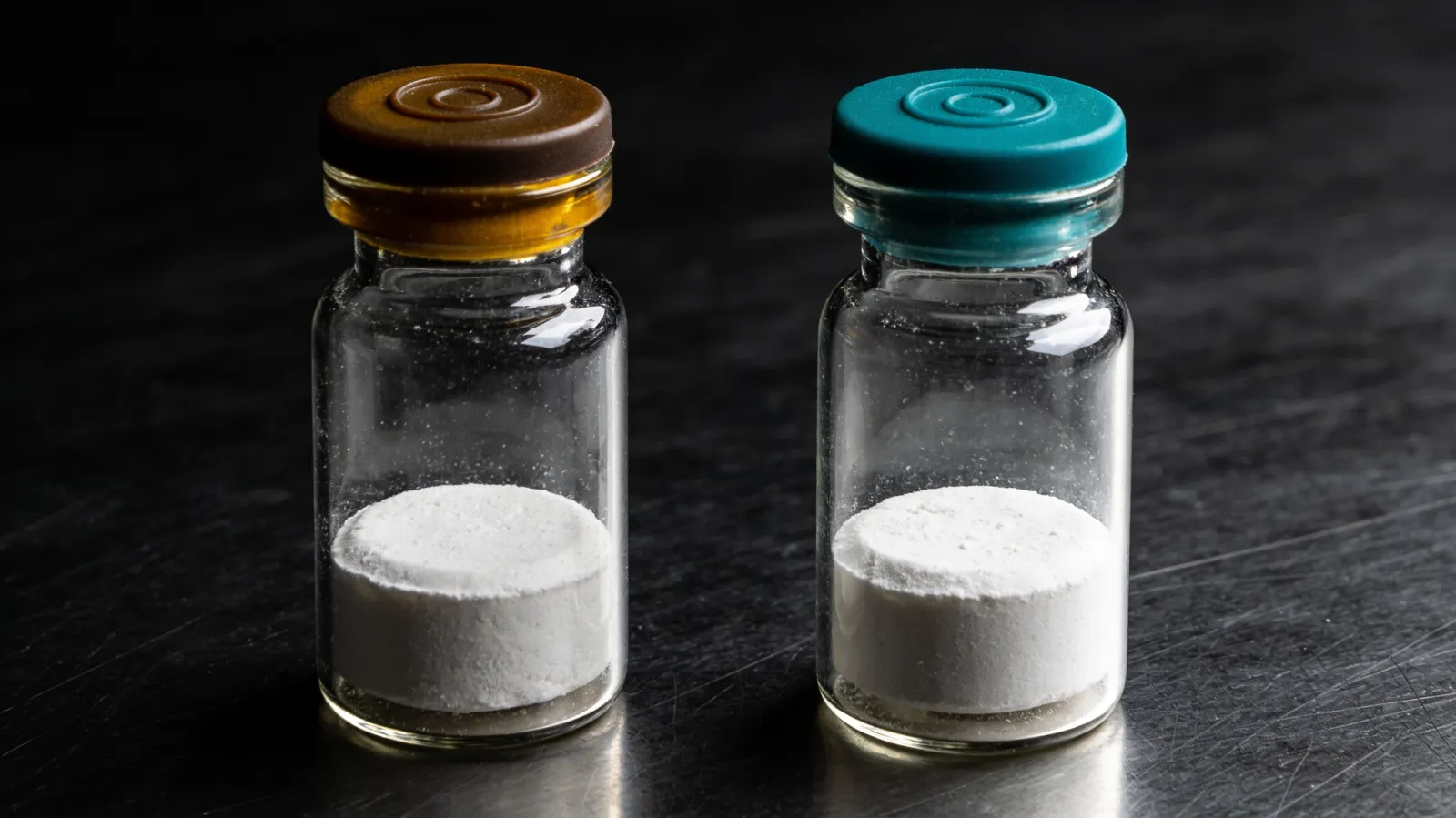
BPC-157 vs TB-500 compares two unrelated molecules. BPC-157 is a 15-residue peptide, GEPPPGKPADDAGLV, of molecular weight 1419.53, derived from a sequence found in a gastric protein. TB-500 is a 7-residue acetylated fragment, Ac-LKKTETQ, of molecular weight 889.0, corresponding to a region of thymosin beta-4. They share no sequence, no origin and no structural relationship.
- BPC-157 vs TB-500 sets two unrelated molecules side by side: 15 residues at 1419.53 g/mol against 7 residues at 889.0 g/mol, sharing no sequence and no origin.
- TB-500 is a fragment and not the protein it is named after: what is TB-500 covers the 43 residues of thymosin beta-4, roughly six times the mass of the seven-residue peptide.
- A 10mg vial of each holds a different number of molecules: 7.04 micromoles of BPC-157 against 11.25 of TB-500, about 60% more for the same printed weight, which is why a 10mg vial is a statement about grams and not about molecules.
- Both are short, straightforward syntheses, so a high purity figure separates almost nothing; the mass-spectrometry identity line, read against 1419.53 or 889.0, is what names the molecule in the vial.
- The two are supplied as a pair of separate vials in the Repair Reference Panel and together with GHK-Cu inside the GLOW and KLOW blends, where each component is assayed and reported on its own.
BPC-157 vs TB-500 as molecules
The fastest way to see how different BPC-157 vs TB-500 really are is to put their specifications side by side. One is more than twice the length of the other and over half again its mass, and they have no residues in common beyond what any two peptides would share by chance.
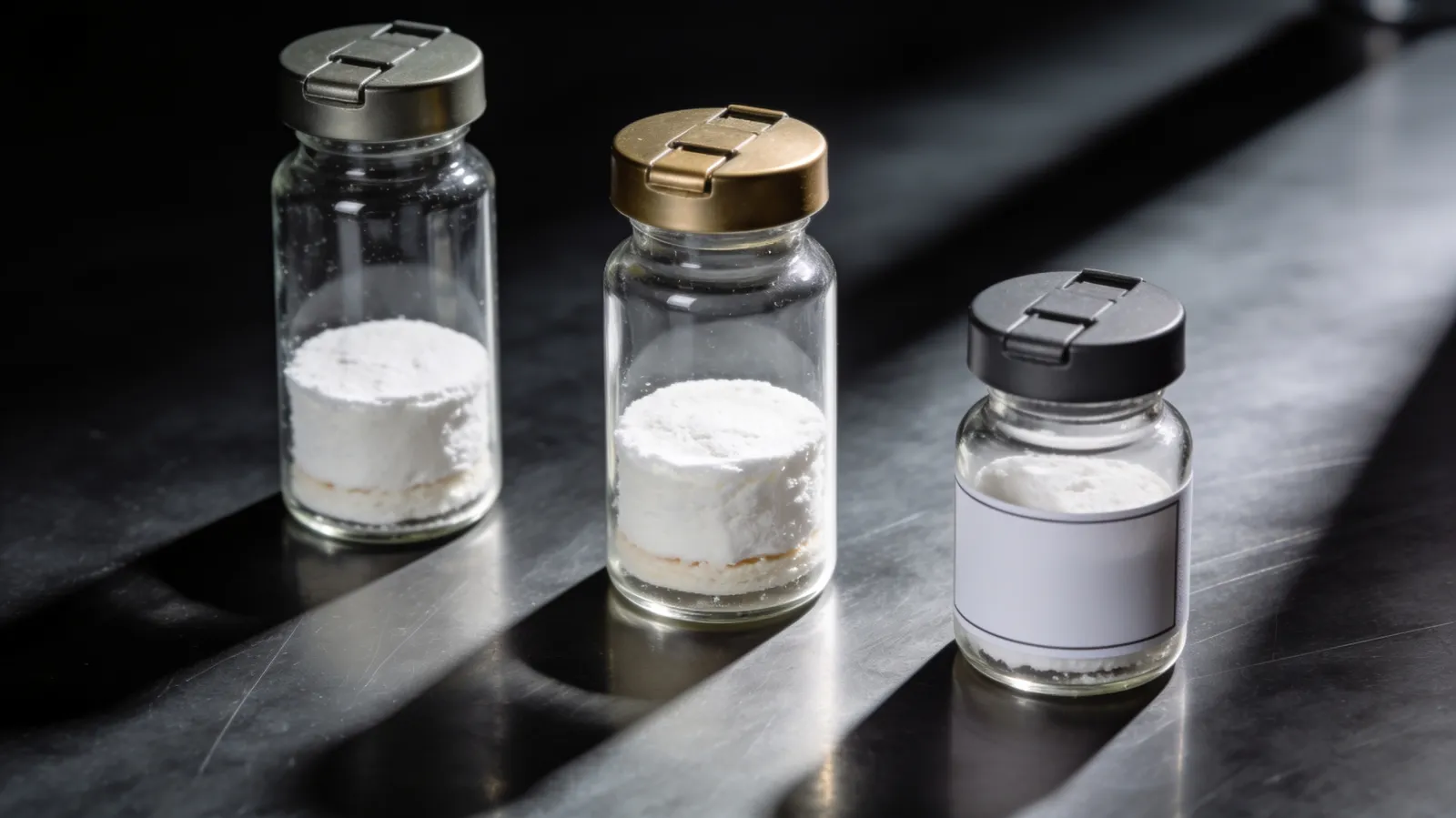
Both are supplied here as white lyophilised material in 10mg vials, both dissolve readily in bacteriostatic water, and both carry an independently assayed certificate against the lot number on the vial. That is the extent of what they have in common.
One shared absence is worth flagging at the start, because it comes back three times further down. Neither sequence contains cysteine, methionine, tryptophan, tyrosine or phenylalanine. That single fact rules out two whole classes of degradation, rules out one class of protease, and decides the wavelength at which each is detected on a chromatogram.
- 0 g/mol
- Molecular weight of BPC-157, for the formula C62H98N16O22
- Theoretical mass stated on the certificate; CAS 137525-51-0
- 0 g/mol
- Molecular weight of TB-500, for the formula C38H68N10O14
- Theoretical mass stated on the certificate; CAS 885340-08-9
- 0
- Residues in thymosin beta-4, the parent protein TB-500 is a fragment of
- First isolated from thymus tissue and sequenced in 1981
| Property | BPC-157 | TB-500 |
|---|---|---|
| Sequence | GEPPPGKPADDAGLV | Ac-LKKTETQ |
| Residues | 15 | 7 |
| Molecular formula | C62H98N16O22 | C38H68N10O14 |
| Molecular weight | 1419.53 g/mol | 889.0 g/mol |
| CAS number | 137525-51-0 | 885340-08-9 |
| Terminal modification | None, free N-terminus | N-terminal acetyl |
| Parent molecule | Body Protection Compound, a gastric-juice protein | Thymosin beta-4 |
| Parent size | Larger protein; the 15 residues are a partial sequence | 43 residues, roughly 4963 Da |
| Appearance | White to off-white lyophilised cake | White lyophilised cake |
| Vial | 10mg | 10mg |
| Solvent | Bacteriostatic water, 0.9% NaCl | Bacteriostatic water |
| Storage, sealed | −20°C | −20°C |
| Storage, in solution | 2 to 8°C | 2 to 8°C |
| Released HPLC purity | 99.51% | 99.58% |
| Identity method | LC-MS, confirmed | LC-MS, confirmed |
| Lot on the current certificate | 2FRBRG | PQ7MWD |
BPC-157
Sequence GEPPPGKPADDAGLV, 15 residues. Formula C62H98N16O22, molecular weight 1419.53 g/mol, CAS 137525-51-0. A synthetic pentadecapeptide corresponding to a partial sequence of a protein found in gastric juice.
TB-500
Sequence Ac-LKKTETQ, 7 residues, acetylated at the N-terminus. Formula C38H68N10O14, molecular weight 889.0 g/mol, CAS 885340-08-9. A synthetic fragment corresponding to a short region of thymosin beta-4.
What BPC-157 vs TB-500 share
White lyophilized powder, soluble in bacteriostatic water, stored at −20°C long term and 2 to 8°C in use, which is what how to store peptides sets out. Nothing about their chemistry is shared; the handling happens to be identical.
BPC-157 vs TB-500: two different origins
On origin, BPC-157 vs TB-500 divides cleanly. BPC-157 is a laboratory construct. Its sequence corresponds to a fifteen-amino-acid stretch of a larger protein identified in gastric juice and designated Body Protection Compound, from which the abbreviation comes. The fragment itself does not occur as a free peptide in nature: it was synthesised because that region was the part of interest.
TB-500's origin is different in kind. Thymosin beta-4 is a real, 43-residue protein found widely in cells, where it is the principal actin-sequestering molecule. TB-500 is a seven-residue acetylated fragment corresponding to a short region of it.
That distinction is worth making precisely because the two names are so often used interchangeably. TB-500 is not thymosin beta-4. It is roughly a sixth of its mass and does not carry the rest of the protein's structure, and preclinical work on one does not automatically describe the other.
The seven residues are not an arbitrary slice of the parent. LKKTETQ corresponds to residues 17 to 23 of thymosin beta-4, the stretch associated with the protein's actin-binding behaviour, which is why that region and not another was worth making on its own. The parent protein was first isolated from thymus tissue and sequenced in 1981; Sanders, Goldstein and Wang established it in PNAS in 1992 as a principal regulator of the cell's unpolymerised actin pool, pairing with actin at roughly one to one.
BPC-157 carries a second name from the same period. In the patent and development literature the identical fifteen-residue sequence appears as PL 14736, a company code rather than a different molecule. A fuller profile of the BPC-157 peptide sets the designations out against each other.
BPC-157 vs TB-500: same vial weight, different molecule count
Both compounds ship in a 10mg vial, which makes BPC-157 vs TB-500 look like matched quantities. They are not, and the reason is the mass difference in the table above.
Ten milligrams divided by the molecular weight gives the amount of substance in the vial. For BPC-157, 10 mg is 7.04 micromoles. For TB-500, the same 10 mg is 11.25 micromoles. The TB-500 vial holds about 60% more molecules than the BPC-157 vial for an identical printed weight, because each of its molecules weighs 37% less.
This is arithmetic, not chemistry, and it is why a labelled weight is a poor basis for comparing two different peptides. Molar concentration is the unit that counts molecules; milligrams count grams. Nobody ranking for this comparison states either mass, so nobody states this either. It is the single clearest way to see that the two are not interchangeable quantities of a similar thing.
- 0 µmol
- Amount of substance in a 10mg vial of BPC-157
- 10 mg ÷ 1419.53 g/mol
- 0 µmol
- Amount of substance in a 10mg vial of TB-500
- 10 mg ÷ 889.0 g/mol
- 0%
- More molecules in the TB-500 vial than the BPC-157 vial, at the same printed weight
- Ratio of the two figures above
| 10mg vial | Molecular weight (g/mol) | Amount of substance | Relative molecule count |
|---|---|---|---|
| BPC-157 | 1419.53 | 7.04 µmol | 1.00 |
| TB-500 | 889.0 | 11.25 µmol | 1.60 |
Reconstitution: what 10 mg of each becomes
Reconstitution is arithmetic and it stops at concentration. The mass in the vial and the volume of diluent are the only two inputs, so the milligram-per-millilitre figure is the same for both compounds: 10 mg in 1 mL is 10 mg/mL, in 2 mL is 5 mg/mL, in 3 mL is 3.33 mg/mL, in 5 mL is 2 mg/mL. The peptide calculator runs the same division for any vial strength and volume, and takes the net peptide content from the certificate rather than the label mass as its starting figure.
The molar concentration is not the same, for the reason set out above. Five milligrams per millilitre is 3.52 mM of BPC-157 and 5.62 mM of TB-500. Two solutions that read identically on a label are 60% apart in the unit that matters to a binding experiment.
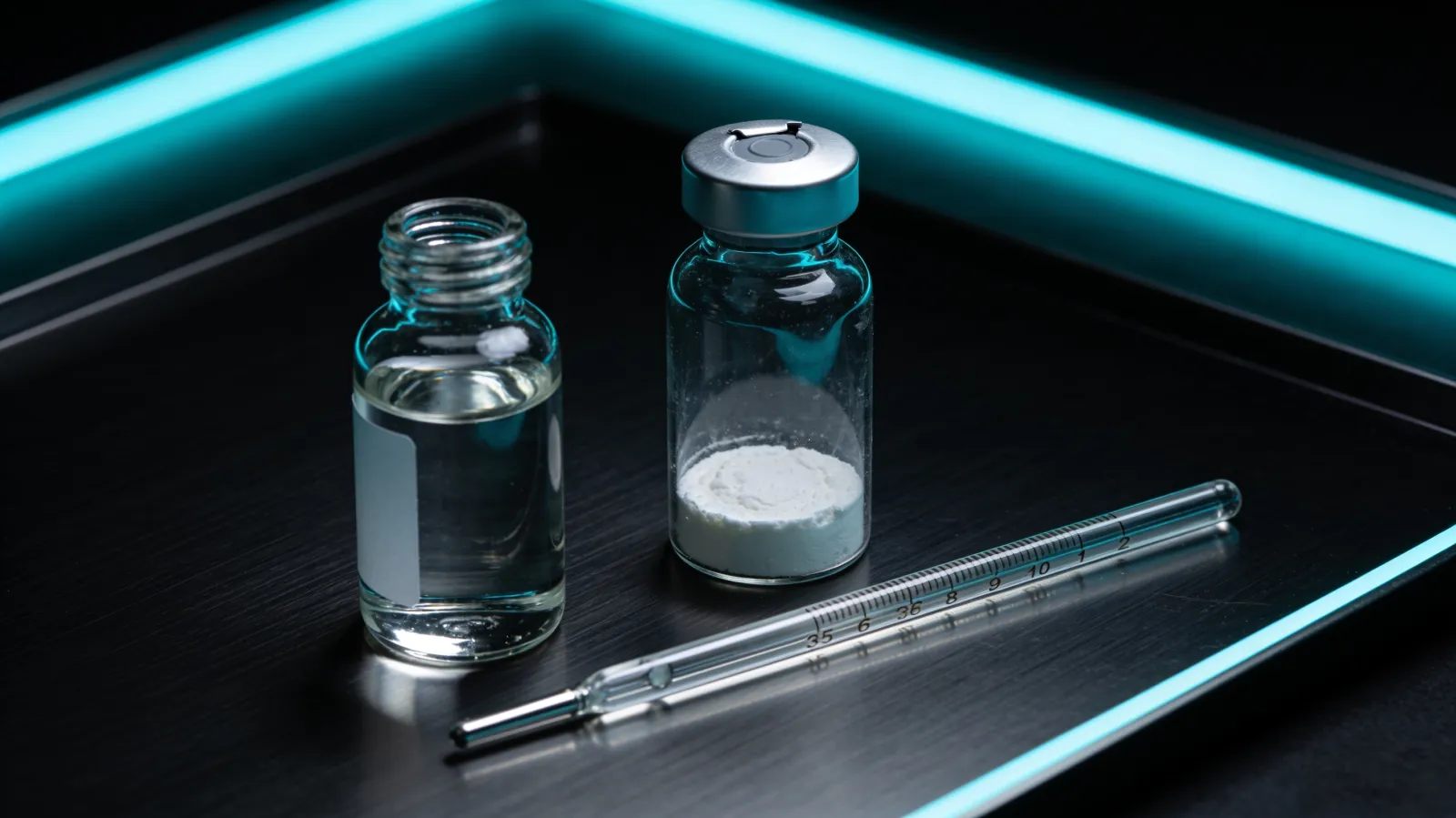
The diluent is the same for both. Bacteriostatic water is sterile water carrying 0.9% benzyl alcohol as a bacteriostatic preservative, which is what allows a reconstituted vial to be drawn from more than once; the 28-day in-use period that applies once the closure has been entered comes from USP General Chapter <797>'s default beyond-use date for a multiple-dose container and from CDC injection-safety guidance rather than from the FDA label, which does not carry the number at all, and it governs the water rather than the peptide dissolved in it. Plain sterile water carries no preservative and has no in-use period of that kind. Choosing bacteriostatic water for peptides turns on that difference and on nothing else.
Once either peptide is in solution it stops being the stable form. Sealed cake sits at −20°C; solution sits at 2 to 8°C and has a working life. The section on degradation below explains what water is actually doing to each sequence in the meantime.
| Bacteriostatic water added | Concentration (mg/mL) | BPC-157 (mM) | TB-500 (mM) |
|---|---|---|---|
| 1 mL | 10.0 | 7.04 | 11.25 |
| 2 mL | 5.0 | 3.52 | 5.62 |
| 3 mL | 3.33 | 2.35 | 3.75 |
| 5 mL | 2.0 | 1.41 | 2.25 |
Salt form, counterion and net peptide content
A peptide with basic residues is almost never isolated as the free base. It comes off reverse-phase purification as a salt, most often the trifluoroacetate, because reverse-phase purification is normally run with trifluoroacetic acid in the mobile phase and that is the counterion the chain leaves the column paired with. Other counterions appear: acetate where the material has been through a deliberate ion-exchange step afterwards, arginate and hydrochloride in some preparations. Each of them has a different mass.
That mass is part of what the vial weighs. Ten milligrams of BPC-157 trifluoroacetate is not ten milligrams of the fifteen-residue chain; some fraction is counterion and some is residual water, and the fraction depends on how many basic sites the sequence carries. BPC-157 has one lysine and a free N-terminal amine. TB-500 has two lysines and an acetylated N-terminus, the acetyl group having removed the alpha-amino group that would otherwise be the third. Both therefore present two basic sites, which is why BPC-157 vs TB-500 behave more similarly here than their sizes suggest.
This is the reason a certificate reports a measured content figure and not only a purity percentage. Peptide purity is the proportion of the chromatogram that is the right molecule. Content is how much peptide the vial actually holds. On the lots currently released those figures are 10.68 mg for BPC-157 lot 2FRBRG and 12.16 mg for TB-500 lot PQ7MWD, both against a nominal 10mg fill. A purity percentage on its own tells you nothing about either number.
When a supplier quotes a purity figure and no content figure, the salt form is where the missing weight goes. It is one of the few places in this subject where two vials with identical labels can genuinely differ.
What can actually degrade in each sequence
In BPC-157 vs TB-500 one absence is shared. Neither sequence contains cysteine or methionine. That removes the two commonest chemical failure modes for peptides in solution at a stroke: there are no thiols to oxidise and no disulfide bonds to scramble or mispair. Whatever else is true of these two compounds, those particular problems are not available to them.
What each does carry is different, and specific. TB-500 ends in glutamine. A C-terminal glutamine is a deamidation site: the side-chain amide hydrolyses to a carboxylic acid, the residue becomes glutamate, and the molecule becomes roughly 0.98 daltons heavier. That is a small shift and a real one, and mass spectrometry is precisely where it would show against a theoretical 889.0.
BPC-157 carries two adjacent aspartates, at positions 10 and 11. Aspartate can cyclise through a succinimide intermediate and reopen as isoaspartate. That is an isomerisation, not a change of composition, so the mass does not move at all: it appears as a retention-time shift and a shoulder beside the main peak on the chromatogram. It is a useful illustration of why a purity figure is read off a chromatogram rather than inferred from a mass.
BPC-157 is also unusually proline-rich: four of its fifteen residues are proline, the PPP run at positions 3 to 5 and a fourth at position 8. Proline has no amide hydrogen on its backbone nitrogen, which constrains the chain's conformation and makes those particular bonds poor substrates for a good many endopeptidases.
All of this is why both are supplied as lyophilized powder rather than as a liquid. Water is a reagent in deamidation and in succinimide hydrolysis; take it out and both processes slow to the point that a sealed vial at −20°C is stable over years while the same material in solution is not. How to store peptides follows from the chemistry rather than from convention.
Peptide bonds and protease chemistry
A peptide bond is a substrate. Proteases recognise particular residues on either side of it and hydrolyse it, and which residues a sequence contains determines which enzymes can act on it at all. This matters to anyone incubating either compound in a biological matrix, whether serum, a cell lysate or simulated gastric or intestinal fluid, where recovering the intact peptide is what the measurement depends on.
Trypsin cleaves on the C-terminal side of lysine and arginine, and does not cleave when the following residue is proline. BPC-157 has one lysine, at position 7, and the residue after it is proline. Its single tryptic site is blocked. TB-500 has two lysines, at positions 2 and 3, and neither is followed by proline, so a seven-residue chain carries two open tryptic sites.
Chymotrypsin cleaves after aromatic residues. Neither sequence contains tryptophan, tyrosine or phenylalanine, so chymotrypsin is not a route for either one, and pepsin, which also favours hydrophobic and aromatic positions, has little to work with. The exposure of BPC-157 vs TB-500 to the standard proteolytic enzymes is therefore quite different, and it is readable straight off the sequences.
None of that is a statement about what happens to either compound anywhere other than in an assay vessel. It is the same class of fact as a melting point: it says what the molecule is made of, and what that composition implies for a molecule sitting in a particular solution.
What each is studied for
BPC-157 vs TB-500 occupy different preclinical literatures, which is a more useful way to distinguish them than any comparison of potency.
BPC-157 appears in tissue-repair and cytoprotection models: angiogenesis markers in wound-healing systems, vascular endothelial growth factor receptor expression in endothelial-migration assays, gastrointestinal cytoprotective signalling in rodent mucosal models, connective-tissue endpoints in tendon-fibroblast cultures, and peripheral nerve preparations. TB-500 appears in work on actin regulation: actin sequestration, cell-migration rate in scratch-assay systems, and vascular-repair endpoints.
One scope limit is worth stating plainly, because the literature is routinely quoted across it. The binding figures published for thymosin beta-4, the roughly one-to-one pairing with actin and the micromolar affinities reported in the beta-thymosin literature, describe the 43-residue parent protein. They do not describe the seven-residue fragment, and a page that cites them beside a TB-500 vial has crossed from one molecule to another.
Both literatures are preclinical. Neither is a statement about effect in humans, and nothing here is one: these compounds are supplied for in-vitro research use only, and the models above are described as models.
| Model system | BPC-157 | TB-500 | Model type |
|---|---|---|---|
| Angiogenesis and vascular endpoints | Appears in this literature | Appears in this literature | In vitro and rodent |
| Tendon and ligament connective tissue | Appears in this literature | Not a primary subject | Rodent |
| Gastrointestinal mucosal cytoprotection | Appears in this literature | Not a primary subject | Rodent |
| Actin sequestration | Not a primary subject | Core mechanism studied | In vitro |
| Cell-migration rate, scratch assay | Not a primary subject | Appears in this literature | In vitro |
| Peripheral nerve preparations | Appears in this literature | Not a primary subject | Rodent |
Names you will see for the same material
Almost every page written on BPC-157 vs TB-500 uses at least two names for one of the two compounds without saying they are the same thing, and at least one name for a molecule that is not the one in the vial. The table sorts them out.
Two entries deserve a sentence of their own. Thymosin beta-4 is not a synonym for TB-500: it is the 43-residue parent, about 5.6 times the mass, and using the two names interchangeably is how binding figures from the parent end up quoted for the fragment. And a trade nickname for the two together is not a formulation: it has no defined ratio, no defined component list and no standard behind it, so what it covers varies from one supplier to the next. GLOW vs KLOW is the opposite case: named components at stated weights, each assayed separately.
| Name you will see | What it actually refers to | Accurate? |
|---|---|---|
| BPC-157 | The 15-residue synthetic peptide GEPPPGKPADDAGLV | Yes |
| Body Protection Compound 157 | The same peptide, written out | Yes |
| PL 14736 | A development code for the same sequence in the patent literature | Yes |
| Pentadecapeptide BPC 157 | The same peptide; pentadecapeptide just means fifteen residues | Yes |
| TB-500 | The 7-residue acetylated fragment Ac-LKKTETQ | Yes |
| Thymosin beta-4 fragment 17-23 | The same seven residues as TB-500 | Yes |
| TB4, thymosin beta-4 | The full 43-residue parent protein, about 5.6× the mass | No, when used to mean TB-500 |
| Trade nicknames for the pair | An informal name for the two supplied together; no formulation standard | Informal only |
| GLOW | A blend: GHK-Cu 50mg, BPC-157 10mg, TB-500 10mg | Yes, as a blend name |
| KLOW | A blend: GHK-Cu 50mg, KPV 10mg, BPC-157 10mg, TB-500 10mg | Yes, as a blend name |
BPC-157 vs TB-500: telling the two vials apart by certificate
Both cakes are white and both vials are 10mg. By eye there is nothing to tell them apart, and no amount of looking at a vial will settle which molecule is in it. The certificate will.
The identity line on a certificate reports an observed mass from LC-MS against a theoretical mass. For BPC-157 that theoretical figure is 1419.53; for TB-500 it is 889.0. The gap between them is 530.53 daltons, which is not a fine discrimination: any instrument capable of the measurement at all separates the two without difficulty. If the observed mass sits near one figure, that is what is in the vial, whatever the label says.
Purity is a separate measurement, by reverse-phase HPLC. Because neither peptide contains tryptophan or tyrosine, neither has useful absorbance at 280 nm, so detection is at the peptide-bond absorbance near 214 nm. That is standard for sequences of this composition and it is worth knowing when reading a chromatogram whose axis you did not choose.
Our BPC-157 lot 2FRBRG and TB-500 lot PQ7MWD were both assayed by Freedom Diagnostics, an independent laboratory named on the certificate, reported on 29 May 2026. Each certificate carries an accession number, 2605270306 and 2605270305, and a search code, so the document can be checked at the laboratory rather than taken on our word. The TB-500 certificate for that lot also reports an endotoxin result, pass on both replicates by LAL at ≤0.05 EU/mL. Reading a peptide certificate of analysis line by line explains the remaining fields, and peptide purity testing explains who is measuring what.
- 0%
- Released HPLC purity, BPC-157 lot 2FRBRG
- Freedom Diagnostics, reported 29 May 2026
- 0%
- Released HPLC purity, TB-500 lot PQ7MWD
- Freedom Diagnostics, reported 29 May 2026
- 0 Da
- Gap between the two theoretical masses the identity line is read against
- 1419.53 minus 889.0
Look up the lot before you trust the label
Every certificate here is published against the lot number printed on the vial, including lots no longer in stock. Type the number in and read the chromatogram rather than the headline figure.
Verify a lot numberWhat a single blended purity figure hides
GLOW holds GHK-Cu 50mg, BPC-157 10mg and TB-500 10mg in one vial. KLOW adds KPV 10mg to the same three. A blend can be documented two ways, and the difference is not cosmetic.
Reported as one number, the figure is a weight-weighted average dominated by whichever component is largest. Take an illustrative 70mg blend in which the 50mg component assays at 99.9% and the two 10mg components at 97%: the blended average is 99.1%, which reads as an excellent figure while saying nothing at all about the two components a reader came for. The arithmetic is not a trick; it is simply what an average of unequal weights does.
Reported per component, each assay stands on its own and the reader can see all three or all four. That is how GLOW and KLOW are documented here: the headline figures are 99.68% and 99.76%, and the certificate behind each breaks the blend out component by component rather than resolving it to one line.
The same logic is the argument for two separate vials where a model system does not require a fixed ratio. For BPC-157 vs TB-500, two vials means two certificates, two content figures and two independent reconstitutions at known concentrations, which is what the Repair Reference Panel is.
Regulatory status, stated as fact
Neither compound is an approved drug product. There is no approved medicine containing BPC-157 or TB-500, for any indication, anywhere, and nothing here is offered as one. Both are supplied for in-vitro laboratory research only.
BPC-157 sits in Category 2 of the FDA's interim 503A bulk drug substances list, the category for substances the agency has identified as raising significant safety questions while nominations are under review, which means a 503A compounding pharmacy may not compound it. The Pharmacy Compounding Advisory Committee met on 23 and 24 July 2026 and voted to recommend inclusion of specified free-base and acetate forms related to BPC-157; those votes are advisory and final agency action was still pending when this was written.
Both compounds appear on the WADA Prohibited List, and both are prohibited at all times rather than in competition only. The US Anti-Doping Agency states that BPC-157 was added to the 2022 list under S0, non-approved substances. Thymosin beta-4 and its derivatives, TB-500 among them, fall under S2, peptide hormones and growth factors. That is a statement about eligibility in sport and it is recorded here because it is a fact about the compounds' status, not because a research catalogue has any bearing on it.
TB-500's position on the 503A list has not been checked against the current published version for this article, and the row below says so rather than guessing.
| Status | BPC-157 | TB-500 |
|---|---|---|
| Approved drug product | None | None |
| FDA interim 503A bulks list | Category 2 | Not verified against the current list |
| WADA Prohibited List | S0, non-approved substances; prohibited at all times | S2, as thymosin beta-4 and derivatives; prohibited at all times |
| Supplied here as | 10mg lyophilised vial, in-vitro research use only | 10mg lyophilised vial, in-vitro research use only |
| Certificate against lot | Yes, lot 2FRBRG | Yes, lot PQ7MWD |
| Testing laboratory | Freedom Diagnostics, independent | Freedom Diagnostics, independent |
Buying either one
In BPC-157 vs TB-500 the practical difference between two vials of research material is rarely the molecule and almost always the documentation. Both of these are simple, well-characterised peptides that any competent synthesis house can make; what varies between research peptide suppliers is whether the specific lot in front of you was measured.
Ours are. BPC-157 released at 99.51% and TB-500 at 99.58% by HPLC, each with a mass-spectrometry identity confirmation, each assayed by an independent laboratory, and each certificate published against the lot number printed on its vial before it ships.
They are also supplied together in the Repair Reference Panel and, with GHK-Cu, inside the GLOW and KLOW blends, where each component is assayed and reported separately rather than as a single blended figure. The table sets out what actually ships, and how parcels are packed and sent covers the rest.
| Product | Vial | Released purity | Documentation |
|---|---|---|---|
| BPC-157 | 10mg lyophilised | 99.51%, lot 2FRBRG | Certificate published, LC-MS identity confirmed |
| TB-500 | 10mg lyophilised | 99.58%, lot PQ7MWD | Certificate published, LC-MS identity confirmed |
| Repair Reference Panel | Both, as separate vials | Per vial | Two certificates, one per vial |
| GLOW | 70mg blend | 99.68% | Per-component assay on one certificate |
| KLOW | 80mg blend | 99.76% | Per-component assay on one certificate |
| Bacteriostatic water | 3mL and 10mL | USP grade | No certificate: it is the diluent, not the analyte |
Two vials, two certificates, one order
The Repair Reference Panel ships BPC-157 and TB-500 as separate 10mg vials, so each is reconstituted to a known concentration and documented on its own.
See the Repair Reference PanelBPC-157 vs TB-500 is not a choice between two versions of the same thing. One is a fifteen-residue synthetic peptide weighing 1419.53 daltons whose sequence comes from a gastric protein; the other is a seven-residue acetylated fragment weighing 889.0 daltons, related to thymosin beta-4. They differ in length, mass, origin, salt behaviour, protease exposure and the literature each appears in, and an identical 10mg vial of each does not even hold the same number of molecules. The only thing they genuinely share is that both should arrive with a certificate naming the lot in your hand, and that certificate can be looked up by lot number before the vial is opened.
Common questions
What is the difference between BPC-157 and TB-500?
BPC-157 vs TB-500 puts two unrelated molecules side by side. BPC-157 is a 15-residue peptide (GEPPPGKPADDAGLV, 1419.53 g/mol) derived from a gastric protein sequence. TB-500 is a 7-residue acetylated fragment (Ac-LKKTETQ, 889.0 g/mol) corresponding to a region of thymosin beta-4.
Is TB-500 the same as thymosin beta-4?
No. Thymosin beta-4 is a 43-residue protein of roughly 4963 daltons. TB-500 is a seven-residue acetylated fragment corresponding to a short region of it, about a sixth of the mass.
Do BPC-157 and TB-500 need different storage?
No. Both are supplied as white lyophilised material, dissolve readily in bacteriostatic water, and are stored at −20°C long term and 2 to 8°C once reconstituted.
How many molecules are in a 10mg vial of each?
Different numbers, despite the identical label. Ten milligrams of BPC-157 is 7.04 micromoles; ten milligrams of TB-500 is 11.25 micromoles. That is about 60% more molecules in the TB-500 vial, because each TB-500 molecule weighs 889.0 g/mol against 1419.53 for BPC-157. Anything expressed in molar terms has to start from that conversion rather than from the printed weight.
What concentration does 10 mg make in 2 mL of bacteriostatic water?
5 mg/mL, for either compound: mass over volume, and nothing else enters into it. In molar terms the two differ: 5 mg/mL is 3.52 mM of BPC-157 and 5.62 mM of TB-500. Bacteriostatic water for peptides is a separate question from how much of it.
Is BPC-157 supplied as an acetate salt?
Peptides with basic residues are usually isolated as salts rather than free bases, most commonly the trifluoroacetate, because preparative HPLC is normally run with trifluoroacetic acid in the mobile phase; an exchange to acetate is a deliberate extra step rather than the default. Either way the counterion contributes to what the vial weighs. This is why a certificate reports a measured content figure alongside the purity percentage. On the lot currently released, BPC-157 lot 2FRBRG reports 10.68 mg of content against a nominal 10mg fill, and TB-500 lot PQ7MWD reports 12.16 mg.
Which parts of these sequences can degrade?
TB-500 ends in glutamine, a deamidation site: the side-chain amide can hydrolyse to a carboxylic acid, shifting the mass by about 0.98 daltons. BPC-157 has two adjacent aspartates at positions 10 and 11, which can isomerise to isoaspartate through a succinimide intermediate with no change in mass at all, showing instead as a retention shift on the chromatogram. Neither sequence contains cysteine or methionine, so oxidation and disulfide scrambling are not failure modes for either.
Why are these peptides detected at 214 nm rather than 280 nm?
Absorbance at 280 nm comes mostly from tryptophan and tyrosine. Neither BPC-157 nor TB-500 contains either residue, nor phenylalanine, so neither has a useful signal there. Detection instead uses the peptide-bond absorbance near 214 nm, which is standard for sequences of this composition and is what the chromatogram on the certificate is measured at.
Are BPC-157 and TB-500 stable against proteases?
BPC-157 vs TB-500 differ here, and it is readable from the sequences. Trypsin cleaves after lysine and arginine but not when proline follows; BPC-157's single lysine at position 7 is followed by proline, so its one tryptic site is blocked, while TB-500's two lysines at positions 2 and 3 are both open. Neither contains an aromatic residue, so chymotrypsin is not a route for either. This describes the molecules in an assay vessel and nothing else.
Can you buy BPC-157 and TB-500 together?
Yes, in two different forms. The Repair Reference Panel pairs them as two separate 10mg vials in one order, so each is reconstituted and documented on its own. The GLOW and KLOW blends hold both in a single vial alongside GHK-Cu, with every component assayed and reported separately on the certificate.
Is a BPC-157 and TB-500 blend the same as two vials?
No. Here the two are supplied together which here is the Repair Reference Panel: one 10mg vial of each, not a premixed blend. It is an informal trade name rather than a molecule or a formulation standard, so what it covers varies between suppliers. Read the component list and the certificates rather than the name.
Which is stronger, BPC-157 or TB-500?
That is not a question these pages can answer. Potency is a claim about effect, and everything in this catalogue is supplied for in-vitro laboratory research only. What can be compared in BPC-157 vs TB-500 is what each molecule is: 15 residues and 1419.53 g/mol against 7 residues and 889.0 g/mol, two unrelated sequences, and two separate preclinical literatures.
What does the BPC in BPC-157 stand for?
Body Protection Compound, the name given to a larger protein identified in gastric juice. The 157 is a laboratory designation carried over from the work that described it, not a count of amino acids: the peptide itself is fifteen residues long, GEPPPGKPADDAGLV. That fifteen-residue fragment does not occur on its own in nature; it is synthesised.
What is PL 14736?
A development code for the same fifteen-residue sequence as BPC-157, used in the patent and trial literature. It is a different name, not a different molecule: the sequence, the formula and the CAS number are unchanged. The BPC-157 peptide profile lists the designations together.
How many amino acids are in BPC-157 and TB-500?
BPC-157 has 15, GEPPPGKPADDAGLV, which is why it is described as a pentadecapeptide. TB-500 has 7, Ac-LKKTETQ, with an acetyl group capping the N-terminal end. That difference in length accounts for most of the difference in mass, 1419.53 g/mol against 889.0.
Why is TB-500 sometimes written as thymosin beta-4 fragment 17-23?
Because the seven residues LKKTETQ correspond to that stretch of the 43-residue thymosin beta-4 sequence, the region associated with its actin-binding behaviour. Both names describe the same synthetic fragment. Neither describes the whole protein, which is around six times the mass. What is TB-500 sets the two out side by side.
How do I tell whether a vial is BPC-157 or TB-500?
By the certificate, not by eye: both are white lyophilised cakes and look identical. The mass-spectrometry line reports an observed mass, which should sit within tolerance of 1419.53 for BPC-157 or 889.0 for TB-500; the two theoretical figures are 530.53 daltons apart, so there is no ambiguity in the measurement. Then match the lot number on the certificate against the one printed on the vial; ours can be looked up by lot number.
Can I check the sequence and molecular weight for myself?
Yes. Both compounds carry CAS numbers, 137525-51-0 for BPC-157 and 885340-08-9 for TB-500, and public chemical databases list the formula and mass against each. Compare those figures with the theoretical mass on the certificate, then with the observed mass printed beside it. Reading a peptide certificate of analysis line by line explains what the remaining fields mean.
Are BPC-157 and TB-500 approved by the FDA?
No. There is no approved drug product containing either compound, for any indication. BPC-157 additionally sits in Category 2 of the FDA's interim 503A bulk drug substances list, the category for substances the agency has flagged while nominations are reviewed, which bars a 503A compounding pharmacy from compounding it. Both are supplied here for in-vitro laboratory research only.
Are BPC-157 and TB-500 prohibited in sport?
Both appear on the WADA Prohibited List and both are prohibited at all times rather than in competition only. The US Anti-Doping Agency states BPC-157 was added to the 2022 list under S0, non-approved substances; thymosin beta-4 and its derivatives, TB-500 among them, fall under S2, peptide hormones and growth factors. That is a statement about sporting eligibility, recorded here as a fact of status.
What does the content figure on a certificate mean?
It is the measured mass of peptide the vial holds, as distinct from purity, which is the proportion of the chromatogram that is the right molecule. The two answer different questions and a vial can score well on one and poorly on the other. Peptide purity and what it does not tell you covers the distinction in full.
Can BPC-157 and TB-500 be reconstituted in the same vial?
They are supplied as separate vials, and in laboratory handling each is normally reconstituted on its own so that the concentration of each is known and recorded. Combining two lyophilised cakes in one vial makes both concentrations approximate and leaves nothing to check the certificate against. Where a model system calls for the two together, the premixed GLOW and KLOW blends exist for that, at fixed ratios and with per-component assays.
Do BPC-157 and TB-500 have to ship frozen?
No. Sealed lyophilised material tolerates ambient temperature for the days a parcel is in transit, which is why both ship as dry cake rather than in solution. Cold storage matters once it arrives: −20°C sealed for the long term, 2 to 8°C once in bacteriostatic water. How to store peptides covers the detail, and how parcels are packed and sent covers transit.
If they are unrelated, why are BPC-157 and TB-500 always mentioned together?
Mostly convention. Both are short, inexpensive syntheses that appear in repair and regeneration model systems, so suppliers pair them and the search demand followed the pairing. BPC-157 vs TB-500 is a market habit rather than a chemical relationship: the two share no sequence, no origin and no structural similarity.
- PubChem CID 9941957, BPC-157: the BPC-157 sequence, molecular formula, molecular weight and CAS number quoted in the comparison table
- PubChem CID 62707662, TB-500 (Ac-LKKTETQ): the seven-residue acetylated sequence, its formula, its mass and its CAS number
- UniProt P62328, Thymosin beta-4 (human): that the parent protein runs to 43 residues, and where the LKKTETQ stretch sits within it
- FDA, Lyophilization of Parenterals, Inspection Technical Guide: why both compounds are supplied as a dry cake rather than in solution, and what residual moisture means for it
- Bacteriostatic Water for Injection, USP, FDA label: the 0.9% benzyl alcohol content at 9 mg/mL and the multiple-dose designation of the reference product
Read more
- What is TB-500?What is TB-500, and why is it constantly confused with the protein it comes from? The answer is a matter of seven amino acids against forty-three.
- GLOW vs KLOWGLOW vs KLOW is a question with a precise answer, because the difference between the two blends is a single named component. There is a larger question underneath it, because neither name is a formulation standard.
- Tesamorelin vs sermorelin vs ipamorelinTesamorelin vs sermorelin is a comparison between two versions of the same idea. Add ipamorelin and the comparison changes category entirely.
- Peptide purity, and what the percentage measuresPeptide purity is quoted as a single number on every listing in this category. That number is measuring something quite specific, and it is not what most buyers assume.
- How to read a peptide certificate of analysisA peptide certificate of analysis is the only document that connects the vial in your hand to a measurement. Most buyers glance at one number on it and miss the three that matter.
- Bacteriostatic water for peptidesBacteriostatic water for peptides is the default diluent for a straightforward reason: it is the only one that lets a multi-milligram vial be used more than once.

For laboratory research use only. All compounds listed on this site are sold strictly as reference materials for in-vitro laboratory research conducted by qualified professionals. They are not drugs, foods, cosmetics, or medical devices. They are not intended for human or veterinary consumption, therapeutic use, diagnostic application, or any in-vivo use whatsoever. These statements have not been evaluated by the Food and Drug Administration. By purchasing, you affirm that you are a qualified researcher and that you will comply with all applicable institutional, local, state and federal regulations governing the handling of research chemicals. Published by SERVIAM BIO LABS.