

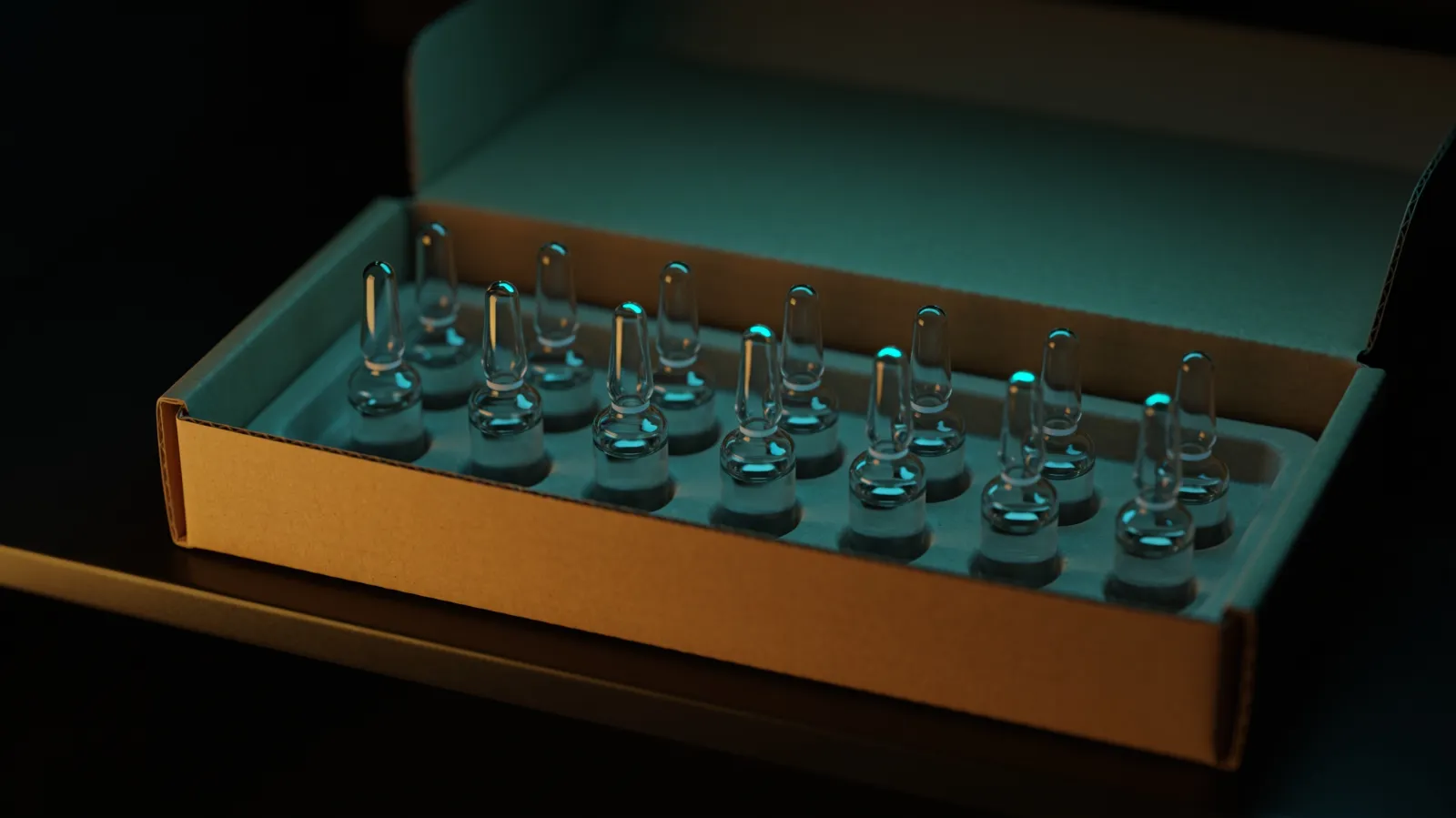
Bacteriostatic water storage is controlled room temperature, 20 to 25°C, upright and away from direct light. It does not need refrigeration and should not be frozen. Unopened, it is good until the printed expiry date. Once the stopper has been entered, the widely used in-use period is 28 days, after which the vial is discarded regardless of how much liquid remains.
- Bacteriostatic water storage is USP Controlled Room Temperature, 20 to 25°C or 68 to 77°F, upright and out of direct light. Refrigeration is unnecessary, and freezing is avoided because it stresses the container closure rather than because it harms the water.
- Two independent clocks run on every vial, and bacteriostatic water storage means managing both: the manufacturer's expiry date printed on the sealed product, typically two to three years from manufacture, and the in-use period that begins the moment the stopper is first entered. Whichever comes first ends the vial.
- The 28-day limit is not on the FDA-approved label at all: it comes from USP General Chapter <797> beyond-use dating for an entered multiple-dose container and from CDC injection-safety guidance, and it counts elapsed time rather than volume drawn, which is why a 10ml vial of bacteriostatic water for peptides opened for one small preparation is mostly discarded.
- Refrigerating an opened vial does not extend the 28 days, because the period is a limit on a punctured container rather than a decay curve for the liquid inside it.
- Clarity is the whole bench check: bacteriostatic water is clear and colourless, so cloudiness, particles or discolouration ends the vial, since the preservative suppresses growth rather than reversing it.
Bacteriostatic water storage before the vial is opened
Controlled room temperature, 20 to 25°C or 68 to 77°F, upright, in its carton or otherwise out of direct light. That is the whole of bacteriostatic water storage for a sealed vial. There is no cold chain, no special handling, and nothing about a warm delivery van that harms a sealed vial.
That phrase is not a loose one, and it is worth knowing the number behind it. The FDA-approved label for Bacteriostatic Water for Injection, USP carries the storage statement "Store at 20 to 25°C (68 to 77°F)" with an explicit cross-reference to USP Controlled Room Temperature, and the USP definition it points at permits brief excursions between 15 and 30°C. A vial that spent an afternoon at 29°C in a courier's van is inside the specification it was labelled against, not outside it. Sustained storage above 30°C is the condition that earns a closer look, and a windowsill in summer is the usual way a vial gets there.
An unopened vial is good until the expiry date printed on it. Commercial presentations are generally dated two to three years from manufacture, so a vial bought today is rarely anywhere near its printed date. That date describes the sealed product: the container closure is intact, the contents are sterile and non-pyrogenic, and the preservative is present at its stated concentration of 0.9%, which the reference label also writes as 9 mg per mL.
Two things to avoid. Freezing, which stresses the container closure and can compromise the seal: the liquid itself is not improved by it, and a seal that may have failed cannot be inspected back to good. And storage in a bathroom or beside a window, where repeated temperature swings and light exposure do the vial no good over a shelf life measured in years.
The container is part of the bacteriostatic water storage question, and it is specified rather than incidental. The reference label describes a semi-rigid vial fabricated from a copolymer of ethylene and propylene, its safety confirmed by tests to the USP biological standards for plastic containers. That is a material chosen for what it does not give up to the liquid across two or three years on a shelf, which is also the reason a vial decanted into any other container stops being the product that was tested.
- 0 to 25°C
- the bacteriostatic water storage temperature printed on the vial's own storage statement
- FDA-approved label for Bacteriostatic Water for Injection, USP (Hospira/Pfizer, via DailyMed)
- 0 to 30°C
- the brief excursion band USP Controlled Room Temperature allows
- USP Controlled Room Temperature, the standard the label's storage statement cross-references
- 0 to 3 years
- typical dating on a sealed vial from date of manufacture
- Range stated across current commercial suppliers; the date printed on your own lot governs
Bacteriostatic water storage temperature
20 to 25°C, with brief excursions to 15 to 30°C permitted by the USP Controlled Room Temperature definition the label cites. Refrigeration is unnecessary and not harmful; freezing is avoided because of the closure, not the water.
Light
Keep it in the carton. What is bacteriostatic water sets out the benzyl alcohol in it, which is not especially photosensitive, but there is no reason to test that over two years on a windowsill.
Orientation
Upright. A vial stored on its side keeps the stopper in constant contact with liquid, which is a slow and avoidable interaction, and it hides the fill level and any change in clarity.
Bacteriostatic water storage: does it need to be refrigerated?
No. Refrigeration is not part of bacteriostatic water storage, sealed or entered. The label asks for controlled room temperature and nothing else, and a vial held at 20 to 25°C is being stored correctly by the only specification that exists for it.
The more useful half of the answer is the one most pages leave out: refrigerating an opened vial does not buy extra days. The in-use period is a limit on how long a preserved multiple-dose container is relied upon after its closure has been punctured. It is not a decay curve for the liquid, so moving the vial to 2 to 8°C neither resets the clock nor extends it. A vial first entered on the first of the month is finished on the twenty-ninth whether those days were spent on a bench or in a fridge.
Refrigeration is not harmful either, and there is no reason to move a vial back and forth. The only practical costs are condensation on the label, which is how a hand-written first-entry date becomes unreadable, and the wait while a cold vial comes back to room temperature. One vendor in this market puts that at 15 to 20 minutes from a refrigerator, which is their figure rather than a published specification, but it is the right order of magnitude.
Freezing is the one temperature to treat as terminal. It is not that frozen water is chemically changed; it is that expansion stresses the closure, and closure integrity is the entire basis on which a sealed vial is called sterile. A vial found frozen is discarded rather than thawed, because there is no inspection that returns a seal to known-good.
The matrix below is the short version of every bacteriostatic water storage question in this cluster, including the two that arrive most often: a vial left in a hot car, and a vial someone put in the freezer compartment by mistake.
| Vial state | Temperature | Maximum period | Freeze? | What ends it early |
|---|---|---|---|---|
| Sealed, never entered | 20 to 25°C, upright, out of light | The printed expiry date | No | A damaged closure, any loss of clarity, or a label that can no longer be read |
| Entered, kept at room temperature | 20 to 25°C | 28 days from first entry | No | Cloudiness, particles, a lifted or visibly cored stopper |
| Entered, kept refrigerated | 2 to 8°C | 28 days from first entry, and refrigeration adds nothing | No | The same checks, plus condensation that obscures the written date |
| Held above 30°C for a sustained period | Outside the labelled condition | Inspect, and prefer a fresh vial | No | Sustained heat beyond the permitted 15 to 30°C excursion band |
| Frozen at any point | Outside the labelled condition | Discard | Never | Closure stress that cannot be inspected back to good |
| Stopper, crimp or vial damaged | Any | Discard | n/a | The container is the sterile barrier; a compromised one has no period at all |
| Solution not clear and colourless | Any | Discard | n/a | The label's own standard is that the solution is clear before use |
How long does bacteriostatic water last, and how long is it good for?
Two questions, two clocks, two different answers. Sealed and unopened, a vial lasts until the expiry date printed on it, which on current presentations is usually two to three years from manufacture. Entered, it is good for 28 days from the first puncture of the stopper. Whichever of those arrives first ends the vial.
The sealed expiry is a statement about the product: sterility of the contents and integrity of the closure over time, supported by the manufacturer's stability testing. The in-use period is a statement about what has happened to the vial since you started using it, specifically how many times a needle has crossed the closure. They are independent, and a vial well inside its printed date can be finished as far as use is concerned because it was entered a month ago.
It follows that neither clock can be read off the liquid. Nothing about clear water records how long ago it was punctured, and nothing about a full vial records that it was opened in March. Both facts live on the label or nowhere, which is why the dating habit further down this page does more work than any other bacteriostatic water storage decision.
| Clock | Starts when | Recorded where | What it is a statement about | Ends the vial when |
|---|---|---|---|---|
| Manufacturer's expiry | At manufacture | Printed on the vial and the carton | Sterility of the contents and integrity of the closure, under stability testing | The printed date passes, whether or not the vial was ever opened |
| In-use period | At the first puncture of the stopper | Nowhere unless you write it on the vial | How long a preserved multiple-dose container is relied on after repeated entry | 28 days later, regardless of how much liquid is left |
Where the 28-day bacteriostatic water storage figure comes from
Twenty-eight days is the conventional in-use period for a preserved multiple-dose container after its first entry, and the container class is the whole of it: sterile water vs bacteriostatic water is the same distinction read from the other side. It is not a measurement of when the water goes bad. It is a conservative limit on how long a preservative can reasonably be relied on to hold in check whatever has been introduced through repeated punctures of the stopper.
That framing matters, because it explains why the clock starts at first entry rather than at opening the box, and why the amount of liquid left is irrelevant. A vial entered once on day one and never again is still at day 28 four weeks later. The variable being counted is elapsed time under a preservative, not volume.
It is also worth being exact about who says it, because the obvious answer is wrong. The FDA-approved label for Bacteriostatic Water for Injection, USP, the Hospira/Pfizer record published on DailyMed and revised 10/2013, does not contain the number 28 anywhere. It states the composition, the pH, the container material, the storage temperature and the instruction to use aseptic technique for single or multiple entry and withdrawal, and it stops there. No manufacturer in that document assigns an in-use period at all.
The 28 days comes from two other places, and both are conventions applied to the container rather than measurements of this particular liquid. USP General Chapter <797> sets a default beyond-use date of 28 days after initial entry for a conventionally manufactured multiple-dose product, unless the manufacturer specifies otherwise, and here the manufacturer specifies nothing, so the default stands. CDC injection-safety guidance gives the same figure for multiple-dose containers. The occasional "30 days" seen on retailer pages has no comparable source behind it; where two numbers compete and only one is traceable to a published standard, take the traceable one.
None of that makes the figure soft. A default that applies because the manufacturer set no limit is still the only limit there is, and the honest way to hold it is as a convention with a name and a source rather than as folklore everyone repeats.
- 0
- times the number 28 appears in the FDA-approved label for Bacteriostatic Water for Injection, USP
- Checked against the Hospira/Pfizer record on DailyMed, label revised 10/2013
- 0 days
- the default beyond-use date after initial entry into a multiple-dose container
- USP General Chapter <797>, beyond-use dating for conventionally manufactured products
| Source | What it actually says | Evidence strength | States 28 days? |
|---|---|---|---|
| FDA-approved label, Hospira/Pfizer (DailyMed, revised 10/2013) | Composition, pH, container material, storage temperature, aseptic technique for single or multiple entry | Strong: the primary source for the product | No. The number 28 does not appear in it |
| USP General Chapter <797> | A default beyond-use date of 28 days after initial entry for a conventionally manufactured multiple-dose product, unless the manufacturer specifies otherwise | Strong: a published compendial standard, though written for compounding practice | Yes |
| CDC injection-safety guidance | Multiple-dose containers are discarded within 28 days of opening unless the manufacturer states otherwise | Strong: published guidance, consistent with USP | Yes |
| Supplier and retailer pages | "28 days after opening", almost always without attribution | Weak on its own: a repeated convention, correct here only because it matches the standards above | Yes |
| Pages quoting 30 days | A longer period, source unnamed | Weak: no published standard located that states it | No |
What the label on a vial of bacteriostatic water states
Almost everything worth knowing about bacteriostatic water storage is printed on the vial, and hardly anyone reads it. The reference presentation gives composition, preservative concentration, pH, container class, container material, storage condition, lot number, expiry and an NDC. A vial that omits several of those is telling you something about who made it.
Composition first. Bacteriostatic Water for Injection, USP is a sterile, non-pyrogenic preparation of Water for Injection containing 0.9% benzyl alcohol, which the same label also expresses as 9 mg per mL. The pH is stated as 5.7, with a specification range of 4.5 to 7.0. Unbuffered water sits slightly acidic, and that figure is a property of the product, not a sign of anything wrong with a particular vial.
Container class is the line that quietly governs everything else on this page. "Multiple-dose container from which repeated withdrawals may be made" is what earns the vial an in-use period in the first place; a single-dose, preservative-free vial has none, and is treated as finished once the closure is broken regardless of volume.
What is absent matters as much as what is present. A vial whose label names no monograph has nothing it was tested against, and a listing that says "USP grade" where the vial itself says nothing is a claim about the seller rather than the product. The specification we publish for the bacteriostatic water we supply is USP grade, sterile water with 0.9% benzyl alcohol, 0.2µm filtered, in 3ml and 10ml vials, stated in the same terms a label would use, because that is the only form in which it can be checked.
| Field on the label | What it should read | Why it matters |
|---|---|---|
| Grade | "USP", stated explicitly | Names the monograph the product was tested against. A grade implied by a product name is not a specification |
| Preservative | Benzyl alcohol 0.9% (9 mg per mL) | The concentration that makes the container multiple-dose, and the whole reason repeated entry is defensible |
| pH | 5.7, specification range 4.5 to 7.0 | A property of unbuffered preserved water, not a defect. Worth knowing before it is called an anomaly |
| Container class | Multiple-dose container | The classification that carries an in-use period at all. Single-dose carries none |
| Container material | Semi-rigid vial, copolymer of ethylene and propylene, tested to USP biological standards for plastic containers | The container was qualified with the liquid. Decanting into anything else voids that |
| Storage statement | 20 to 25°C (68 to 77°F), USP Controlled Room Temperature | The bacteriostatic water storage condition under which the printed expiry date was established |
| Lot number | Present on the vial itself | Traceability to a batch, and the only way a problem can be traced to everything it touched |
| Expiry date | Printed on the vial, not only on the carton | A vial separated from its carton keeps its date instead of losing it |
| NDC or monograph citation | Present on a commercially labelled presentation | Identifies the exact presentation, which is how you check any figure you were told about it |
Dating and labelling a vial in use
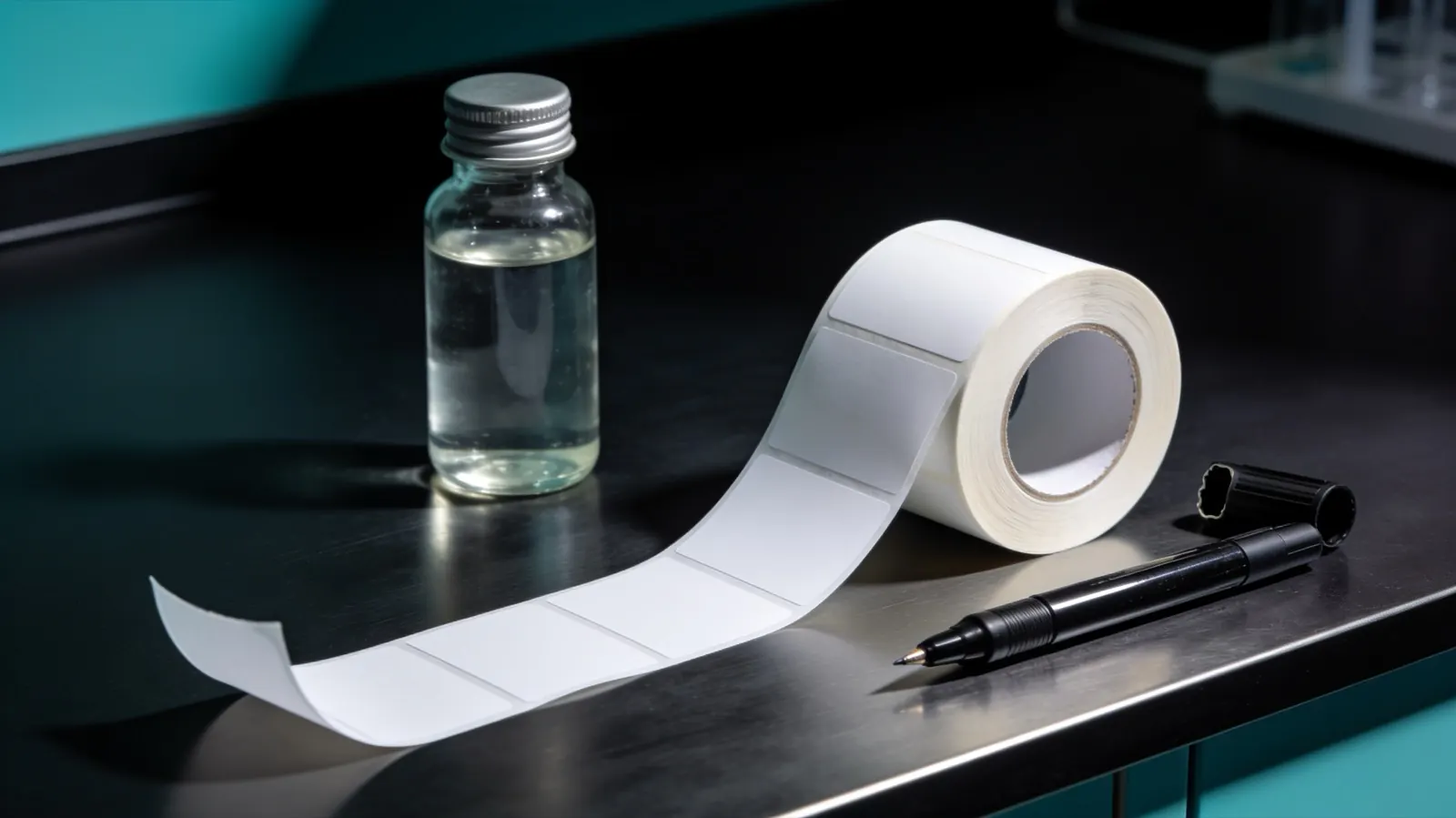
Write the date of first entry on the vial. It is the only thing that makes the 28-day rule enforceable, it takes three seconds, and it is the single habit that separates a bench where bacteriostatic water storage is managed from one where it is guessed at.
Write it unambiguously. "03/04" is two different dates depending on which side of the Atlantic wrote it, and a vial outlives the memory of who labelled it, so put the month in letters: "Opened 3 Apr". Add initials. If the vial will outlast the month, add the year.
Put it on the vial's own label, not the carton, because cartons and vials get separated and only one of them is the thing with liquid in it. Keep the writing clear of the fill level, the lot number and the printed expiry, because covering the manufacturer's own information to record yours is a poor trade. A fine permanent marker works; a strip of laboratory tape works better, because it comes off cleanly and does not smear when a refrigerated vial sweats.
The test of a good label is what a second person can do with it. Someone picking the vial up should be able to read, without asking anyone, what it is, which lot it came from, when it was first entered and therefore when it is finished. A vial that fails that test is treated as unknown and discarded, which is precisely why the habit is worth having. The alternative is a vial nobody will vouch for and nobody wants to throw away.
Where several vials are in rotation, a short bench log carrying the lot number, the date of first entry and the date it is finished removes the arithmetic entirely and gives the bacteriostatic water storage regime a record. It is also what makes a recall or a suspect lot tractable: without it, a problem traced to one batch cannot be traced to anything that batch touched.
The days a mixed vial inherits
The in-use clock belongs to the water vial and starts at its first puncture, not at the moment it is next used. So a vial first entered three weeks ago has seven days left on it, and material brought into solution today with that water is drawing on a diluent with seven days remaining, not a fresh 28.
This is the arithmetic that catches people out, because it is the only place where the two things on the bench have clocks of different ages. It is also easy to avoid: entering a fresh vial at the start of a run makes the diluent's remaining period equal to the full period, and removes the calculation altogether.
Two clarifications, because the table below is about the diluent and only the diluent. The days remaining on the water vial cap how long that vial can go on being drawn from; they say nothing about the material dissolved in it. A reconstituted peptide has its own stability, typically much shorter and refrigerated at 2 to 8°C, set by the compound's own documentation rather than by the water: how to store peptides covers that side of it, and the storage lines on our product specifications say so compound by compound. Where the two disagree, the shorter one governs.
| Water vial first entered | Days left on the water vial | What that caps if material goes into solution today | Which clock governs the solution |
|---|---|---|---|
| Today (day 0) | 28 | Nothing, since the diluent is at its full period | The solution's own, set by the compound's documentation |
| A week ago (day 7) | 21 | The diluent can be drawn from for 21 more days | The solution's own, set by the compound's documentation |
| A fortnight ago (day 14) | 14 | The diluent can be drawn from for 14 more days | The solution's own, set by the compound's documentation |
| Three weeks ago (day 21) | 7 | The diluent can be drawn from for 7 more days | The solution's own, set by the compound's documentation |
| 28 days ago | None | Open a fresh vial before preparing anything | Not applicable; the diluent is finished |
Bacteriostatic water storage by vial size, and the volume a 28-day clock discards
Because the in-use period counts time rather than volume, vial size is a bacteriostatic water storage decision rather than a purchasing one. The question is not how much diluent is needed in total but how much will be drawn within 28 days of the first entry, and everything past that figure is bought to be discarded.
A 3ml vial suits a single compound brought into solution once. It is the right size when the diluent will be finished inside the in-use window and there is no reason to have more sitting around, and at the price of a sandwich it is not a sensible place to economise.
A 10ml vial is the default when several vials of material are prepared in one session: a reference panel, or a run across a few compounds. It is also cheaper per millilitre. Its limit is not volume but time. The larger 30ml presentation is the one the FDA-approved reference label describes, and it exists for institutional throughput; on most benches it is a 28-day clock running over a mostly full vial.
We stock the two sizes that fit that arithmetic rather than the one that looks cheapest per millilitre, and they ship in the same parcel as the material they dissolve so nothing arrives without a diluent to go with it.
- $9.99
- the 3ml vial, the size that finishes inside its own in-use period
- Serviam Bio Labs catalogue
- $19.99
- the 10ml vial, for a multi-vial session
- Serviam Bio Labs catalogue
- 0 µm
- filtration stated for the bacteriostatic water we supply
- Serviam Bio Labs product specification
| Vial size | Preparations before day 28 | Volume likely discarded | When it is the right size | Product |
|---|---|---|---|---|
| 3ml | One, occasionally two | Little to none | A single compound brought into solution once inside the window | 3ml vial, $9.99 |
| 10ml | Four or five at 2ml each | Whatever is left on day 28 | A multi-vial reference panel prepared in one session | 10ml vial, $19.99 |
| 30ml | More than most benches draw in 28 days | Frequently most of the vial | Institutional throughput; the presentation the reference label describes | Not stocked here; see the catalogue |
Bacteriostatic water, 3ml and 10ml
USP-grade sterile water with 0.9% benzyl alcohol, 0.2µm filtered, in the two sizes that finish inside a 28-day in-use period. Shipped from Miami in the same parcel as the material it dissolves.
See both vial sizesWhat ends a vial early, and the bacteriostatic water storage checks that catch it
Visible change is the clearest signal, and it is the one the label itself relies on: the standard for a preserved aqueous product is that the solution is clear before it is used. Bacteriostatic water is clear and colourless. Cloudiness, particles, discolouration or anything floating means discard, immediately and without further thought. The preservative suppresses growth; it does not reverse it.
Turn that into a named inspection rather than a glance. Hold the vial against a light background and then a dark one, which is the only way small particulates and faint turbidity both show. Look at the meniscus and the shoulder of the vial, where fine material settles out of the light. Then look at the closure, because most of what goes wrong in an entered vial goes wrong there.
A damaged or lifted stopper, a compromised crimp, a cracked or distorted vial, visible rubber fragments from coring after repeated entry, a leak, a label that can no longer be read, or a vial found stored on its side in a warm place with no date on it are all reasons to open a new one. Bacteriostatic water is the cheapest item in any laboratory's inventory, and it is not a sensible place to economise.
Coring deserves its own line because it is the failure mode specific to a multiple-dose container. Every entry punches out a small disc of the septum; enough entries and fragments end up in the liquid and the closure stops sealing behind the needle. A fresh needle each time, entered at a slightly different point and at a consistent angle, is what keeps a septum intact for the length of its in-use period.
The same discipline applies to the material dissolved in it. A solution has its own, much shorter, refrigerated life. That is a separate question from the diluent's, and it is covered in the handling cluster: bacteriostatic water for peptides sets out how the two are paired.
Does the benzyl alcohol weaken over 28 days?
The pages ranking for this question contradict each other inside the same set of search results. One states that the preservative concentration declines only marginally across the in-use period and stays above the concentration at which it is effective; another states that antimicrobial effectiveness begins to decline after 28 days. Neither cites a dataset.
The honest position is that no public stability study measures benzyl alcohol concentration in a repeatedly punctured vial across four weeks, so both claims are assertions. What can be said is what preservative-efficacy testing actually establishes: it is performed on the sealed product, against deliberately introduced organisms, to show that the formulation suppresses growth. It is a property of the formulation at release. It is not a description of a vial that has been entered twenty times, left uncapped on a bench and topped with a needle that touched a glove.
That is why 28 days is a limit on the container rather than on the chemistry, and why bacteriostatic water storage is container management more than it is chemistry. The risk it manages is cumulative contamination through the closure, which rises with every entry and is not visible, and against which a preservative is a brake rather than a barrier. Read that way, the two competing claims stop mattering: even if the benzyl alcohol were undiminished on day 40, the number of times the septum had been crossed by then is the thing the standard is counting.
It also explains why the clock is indifferent to volume. A vial with 9ml left has had exactly as many punctures as the elapsed time implies, and a nearly empty one has had more. Neither is an argument for extending the period.
Diluents that are not bacteriostatic water
Three liquids get confused with this one, and only one of them is a near substitute. Sterile Water for Injection is the same water without the preservative: a single-dose, preservative-free container with no in-use period, correct where a method requires nothing but water in the solution, and wrong wherever a vial will be entered more than once.
Bacteriostatic 0.9% sodium chloride is the one most often bought by mistake, because the front of the label looks almost identical. It is preserved saline, not preserved water, and the sodium chloride is an extra component that appears in anything analytical run on the solution. Where a method calls for water, saline is not a substitute for it.
Distilled and deionised water are not laboratory diluents for this purpose at all. Distillation and ion exchange remove dissolved solids; neither establishes that nothing is living in the bottle, and a laboratory bottle of either carries no monograph, no lot testing and no closure-integrity data. Tap water is not in the conversation. The storage question does not arise for any of them, because they never had an in-use period to manage.
Whichever is on the bench, the bacteriostatic water storage rule generalises: the container class governs rather than the liquid, so a preserved multiple-dose container gets a dated in-use period, and everything else is finished when it is opened.
| Property | Bacteriostatic water | Sterile Water for Injection | Bacteriostatic 0.9% sodium chloride | Distilled or deionised water |
|---|---|---|---|---|
| Preservative | Benzyl alcohol 0.9% (9 mg/mL) | None | Benzyl alcohol, typically 0.9% | None |
| Container class | Multiple-dose | Single-dose | Multiple-dose | Bulk laboratory reagent |
| In-use period after first entry | 28 days by convention | None, and it is treated as finished once entered | 28 days by convention | Not applicable |
| Extra components in the solution | One preservative | None | Preservative plus sodium chloride | Unspecified; no monograph behind it |
| Suitable for repeated entry | Yes | No | Yes | No |
| Storage of the sealed container | 20 to 25°C, out of light | 20 to 25°C, out of light | 20 to 25°C, out of light | No compendial storage statement |
Brands, presentations and what changes between them
The reference product most figures on this page come from is the Hospira/Pfizer presentation: a 30ml multiple-dose plastic fliptop vial, NDC 0409-3977-01, supplied in trays of 25 under NDC 0409-3977-03, its label last revised 10/2013. Every number quoted here is read off that record: 0.9% benzyl alcohol at 9 mg per mL, pH 5.7 against a range of 4.5 to 7.0, the ethylene-propylene copolymer container, and the 20 to 25°C storage statement.
Other presentations exist in 3ml, 10ml, 20ml and 30ml, from that manufacturer and from generic and research-supply sources. Bacteriostatic water storage does not change between them: controlled room temperature, upright, out of light, with the same excursion band, and the same in-use convention once entered.
One figure does circulate that we have not been able to verify. Some pages report 11 mg/mL, or 1.1% benzyl alcohol, for a 20ml presentation. The 30ml label we read states 9 mg/mL. We have not located a label stating the higher figure, so treat it as unconfirmed, and read the preservative concentration off the vial in front of you rather than carrying it over from an article, including this one.
That is the general rule for this whole subject. Where a number is on a label, it is a specification; where it is on a page, it is a report of a specification. The checks in how to vet a research peptide supplier apply to a diluent as much as to the material, and the same instinct, read the document rather than the summary, is what a certificate of analysis is for on the peptide side of the catalogue.
Bacteriostatic water storage needs three habits and nothing more: keep sealed vials upright at 20 to 25°C and out of light, write the date of first entry on the vial itself, and discard 28 days later regardless of what is left. Knowing where that 28 days comes from, a USP <797> default and CDC guidance rather than the manufacturer's label, is what turns the rule from folklore into something you can defend. Add the obvious, that any cloudiness or particles finishes the vial, and the diluent will do exactly what it is supposed to for as long as it is supposed to.
Common questions
Does bacteriostatic water need to be refrigerated?
No. Bacteriostatic water storage is controlled room temperature, 20 to 25°C or 68 to 77°F, upright and out of direct light, and the storage statement on the FDA-approved label asks for nothing else. Refrigeration is not required and does not extend the 28-day in-use period. Freezing should be avoided because it stresses the container closure.
Can you use bacteriostatic water after 28 days?
No, not once the vial has been entered. Twenty-eight days is the beyond-use date USP General Chapter <797> applies to a conventionally manufactured multiple-dose container after initial entry, counted from first puncture regardless of how much liquid remains, and CDC injection-safety guidance gives the same figure.
Does bacteriostatic water expire if unopened?
Yes. The vial carries a manufacturer's expiry date, typically two to three years from manufacture. That date applies to the sealed product; the 28-day in-use period is a separate clock that starts at first entry.
How can I tell if bacteriostatic water has gone bad?
It should be clear and colourless. Any cloudiness, particles, discolouration or a damaged stopper means discard it. The preservative limits growth; it does not undo contamination.
Does the 28 day clock start when I open the box or when I first put a needle in it?
At first entry, meaning the moment the stopper is punctured rather than when the carton is opened or the flip-cap lifted. A vial sitting on the shelf with its cap removed but its stopper untouched is still governed only by the printed expiry date. Write the date of that first puncture on the label, because nothing about the liquid records it for you.
What happens if bacteriostatic water freezes or gets left somewhere hot?
A frozen vial is discarded rather than thawed and used: freezing stresses the container closure, and a seal that may have been compromised cannot be inspected back to good. Heat is more forgiving than people expect, because USP Controlled Room Temperature, which the label cross-references, permits brief excursions between 15 and 30°C, so an afternoon in a warm van is inside the specification. Sustained storage above 30°C is the condition that warrants inspection and, usually, a fresh vial.
What if there is still loads left in the vial after 28 days?
It is still finished. The in-use period counts elapsed time under a preservative, not volume drawn, so a nearly full vial and a nearly empty one both end on day 28 from first entry. If that feels wasteful, the answer is a smaller vial next time rather than a longer clock: 3ml and 10ml sizes exist for exactly that reason.
How long does bacteriostatic water last once a peptide has been dissolved in it?
That is a different question with a different answer. The diluent's 28-day in-use period governs the water vial you keep drawing from; once material is dissolved in it, the limiting clock belongs to that solution, which is much shorter and kept refrigerated at 2 to 8°C. How to store peptides is covered separately, and it is the stricter of the two.
Why is my bacteriostatic water cloudy?
There is no benign explanation for cloudiness in a liquid that should be clear and colourless, so the vial is discarded rather than diagnosed. The preservative suppresses bacterial growth; it does not reverse contamination that has already happened. Cloudiness that appears only after material was added to the vial is a solubility question about that material instead, and the place to look is its certificate of analysis.
Can you use the same vial of bacteriostatic water for more than one peptide?
Nothing about the diluent prevents it, and the 28-day clock runs on the vial regardless of how many preparations it served. The real exposure is what repeated entry introduces: every puncture carries in whatever was on the needle and on the surface of the stopper, and enough punctures core the septum itself. A fresh needle each time and a swab of the closure before entry is the whole discipline.
How do I know the bacteriostatic water I bought is actually USP grade?
The label has to say so. Look for 'USP' printed explicitly, benzyl alcohol at 0.9% or 9 mg per mL, a lot number, and an expiry date on the vial itself rather than only on the carton. Grade implied by a product name is not grade stated, and a vial that names no specification has nothing it can be measured against. Bacteriostatic water for peptides goes through a diluent label line by line.
Should bacteriostatic water be stored upright or on its side?
Upright, in its carton. Bacteriostatic water storage keeps the stopper out of the liquid, and a vial laid on its side holds the stopper in constant contact with it, which is a slow and entirely avoidable interaction across a shelf life measured in years. Upright also keeps the fill level and any change in clarity visible at a glance.
What actually changes when bacteriostatic water passes its printed expiry date?
Usually nothing you can see, which is the reason the date exists at all. The printed expiry is the manufacturer's statement, supported by stability testing, about sterility of the contents and integrity of the closure up to that point. Past it there is no specification standing behind the vial, so it is discarded on the date rather than judged by eye.
Does the FDA label for bacteriostatic water say 28 days?
No, and this is the most misreported fact in the subject. The Hospira/Pfizer label published on DailyMed, revised 10/2013, does not contain the number 28 anywhere. It gives composition, pH, container material, storage temperature and an instruction to use aseptic technique for single or multiple entry, and assigns no in-use period at all. The 28 days comes from USP General Chapter <797> and CDC injection-safety guidance, which apply a default to any entered multiple-dose container the manufacturer has not given a limit for.
Is the rule 28 days or 30 days?
Twenty-eight. Both numbers circulate, but only one is traceable: USP <797> sets 28 days as the default beyond-use date after initial entry into a conventionally manufactured multiple-dose container, and CDC guidance agrees. No published standard has been located behind the 30-day figure, so where two conventions compete and one has a source, the sourced one governs.
Does bacteriostatic water go bad if it is not refrigerated?
No. Room temperature is the labelled condition rather than a compromise: the storage statement on the reference label asks for 20 to 25°C and cross-references USP Controlled Room Temperature, which additionally permits brief excursions to 15 to 30°C. Refrigeration neither improves a sealed vial nor lengthens the in-use period of an entered one.
How do you know if bac water is bad?
Bac water is the colloquial name for the same product, and the inspection that closes out bacteriostatic water storage is a named one rather than a glance. Hold the vial against a light background and then a dark one, which is how faint turbidity and small particulates each become visible; look at the meniscus and the shoulder where fine material settles; then look at the closure for a lifted stopper, a compromised crimp, rubber fragments from coring or a leak. Any of those, or a vial with no first-entry date on it, ends the vial.
What else can I use instead of bacteriostatic water?
It depends entirely on whether the container will be entered more than once. For a single entry, Sterile Water for Injection is the preservative-free equivalent and is the correct liquid where a method requires nothing extra in the solution. For repeated entry, nothing else on the shelf qualifies: bacteriostatic sodium chloride adds salt to every sample, and distilled, deionised and tap water are not compendial diluents at all.
Can you buy bacteriostatic water over the counter?
Availability varies by country and by seller, and in the United States the injectable presentations are generally handled as prescription items by pharmacies while laboratory-supply presentations are sold to researchers directly. We supply it as a laboratory diluent in 3ml and 10ml vials, for in-vitro research use only, shipped domestically from Miami.
Can I buy bacteriostatic water at CVS, Walmart or Amazon?
Those are the retailers people search for most, and the answer is inconsistent enough that it is worth checking rather than assuming: listings appear and disappear, sellers on marketplaces vary in what they document, and a listing that names no manufacturer, lot number or USP monograph is not a specification. The checks that matter are the same wherever it is bought, and how to vet a research peptide supplier sets them out.
Where can I buy bac water for peptides?
From a seller who states USP grade, 0.9% benzyl alcohol, a lot number and an expiry printed on the vial, and who ships domestically, because a diluent that clears customs three weeks after the material it was bought to dissolve has failed at its one job. Ours ships from the same Miami warehouse as the research catalogue, in the same parcel, and bacteriostatic water for peptides covers the sizing arithmetic.
Does reconstitution solution need to be refrigerated?
The diluent does not; the solution usually does. Bacteriostatic water storage is room temperature throughout, whether the vial is unopened or entered. Once material is dissolved in it, the resulting solution is a different thing with its own storage condition, commonly 2 to 8°C, set by that compound's documentation rather than by the water. The storage line on each product specification states it compound by compound.
What happens if a vial of reconstituted material was left out of the fridge?
It is a storage deviation, and the honest handling of it is to record it rather than to reason it away: how long, at roughly what temperature, and whether the material had been through the same thing before. What that means for the material is set by the compound's own stability documentation, not by the diluent's 28-day clock, which is unaffected. How to store peptides covers the handling side, and unexplained cloudiness in the solution ends it regardless of what the log says.
- Bacteriostatic Water for Injection, USP, FDA-approved label (DailyMed): the 20 to 25°C storage statement, the 0.9% benzyl alcohol at 9 mg per mL, the pH of 5.7 against a range of 4.5 to 7.0, the ethylene-propylene copolymer container, and the multiple-dose designation
- Sterile Water for Injection, USP, FDA-approved label (DailyMed): the single-dose, preservative-free comparison behind the claim that only a preserved container carries an in-use period
- PubChem CID 244, benzyl alcohol: the identity of the preservative whose stated concentration makes the vial a multiple-dose container
Read more
- What is bacteriostatic water?What is bacteriostatic water, exactly? It is one ingredient away from ordinary sterile water, and that one ingredient is the entire reason it exists.
- Sterile water vs bacteriostatic waterSterile water vs bacteriostatic water is a question about one ingredient and one consequence: whether the vial can be opened more than once. The labels answer it in figures.
- Bacteriostatic water for peptidesBacteriostatic water for peptides is the default diluent for a straightforward reason: it is the only one that lets a multi-milligram vial be used more than once.
- GLP-1 peptideThe GLP-1 peptide this catalogue sells as GLP-1 S is an engineered analogue of the hormone it shares a name with, registered under CAS 910463-68-2. This page states what the molecule is, how the analogue and the hormone differ, and what our single published certificate actually says.
- GLP-3 RT peptideThe GLP-3 RT peptide is a 39-residue acylated chain registered under CAS 2381089-83-2. This page states what the molecule is, how a chain that long is built, and what the certificates we publish for it actually say.
- What is in the KLOW peptide blendThe KLOW peptide blend is four separate molecules sharing one vial, which means four identities to describe and four assays to read rather than one of each.
For laboratory research use only. All compounds listed on this site are sold strictly as reference materials for in-vitro laboratory research conducted by qualified professionals. They are not drugs, foods, cosmetics, or medical devices. They are not intended for human or veterinary consumption, therapeutic use, diagnostic application, or any in-vivo use whatsoever. These statements have not been evaluated by the Food and Drug Administration. By purchasing, you affirm that you are a qualified researcher and that you will comply with all applicable institutional, local, state and federal regulations governing the handling of research chemicals. Published by SERVIAM BIO LABS.