

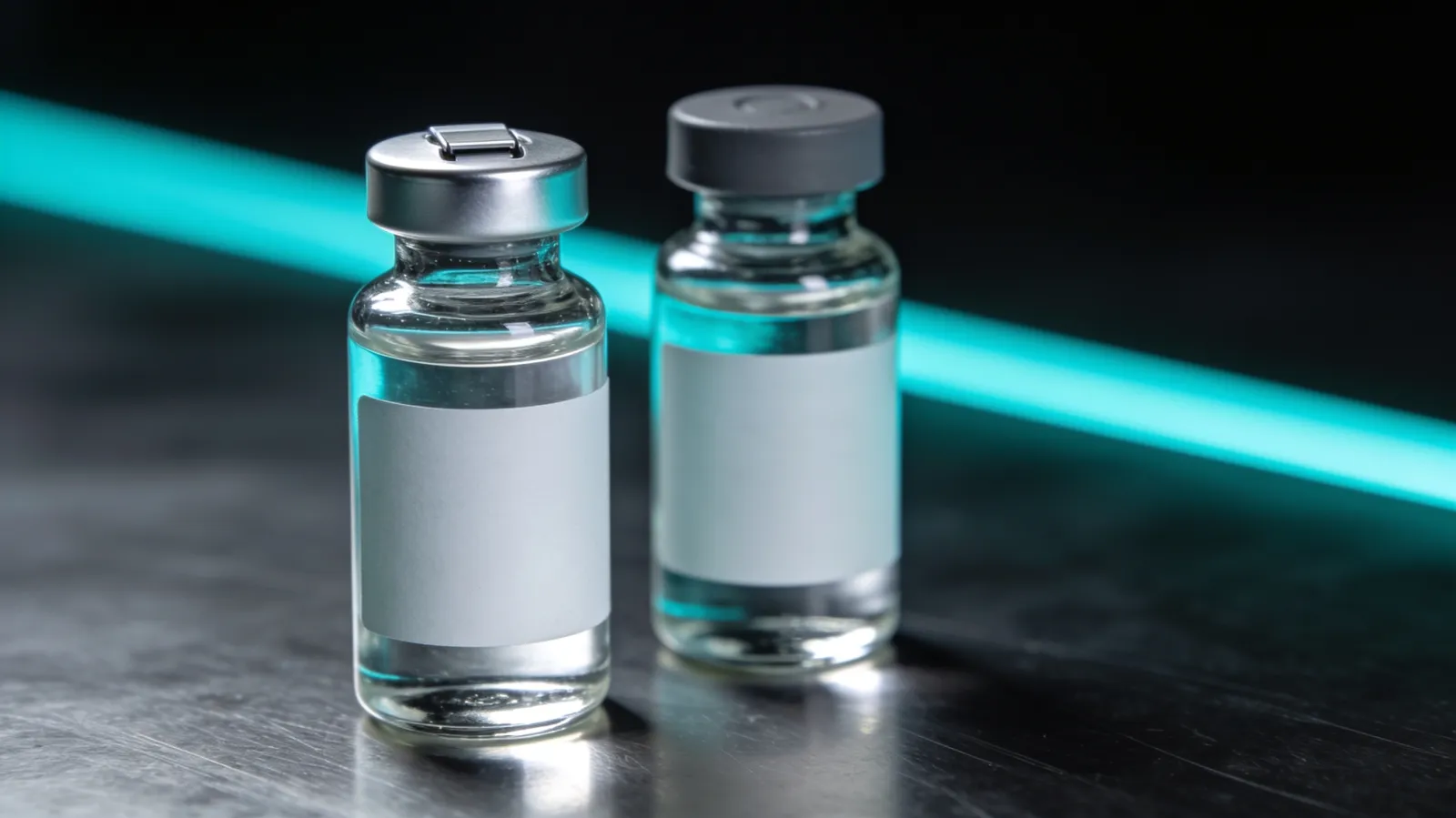
Sterile water vs bacteriostatic water comes down to one ingredient. Sterile water is water alone and is single-use: once the seal is broken, sterility is no longer guaranteed. Bacteriostatic water adds 0.9% (9 mg/mL) benzyl alcohol, a preservative that suppresses bacterial growth and allows repeated entry into the same vial. Reconstitution solution is a broader term for buffered diluents supplied for specific materials.
- Both liquids start out identical: purified, sterilised water in a sealed vial. The only difference between them is 0.9% benzyl alcohol, nine milligrams per millilitre, and that is where every practical difference comes from.
- Sterile water vs bacteriostatic water is settled by one question: will this vial be entered more than once? Sterile water is single-use once its seal is broken, while a vial of bacteriostatic water can be entered repeatedly within a defined in-use period.
- Bac water, BAC water and bacteriostatic water are three names for one product; bacteriostatic sodium chloride is a different product with salt in it, and it is the most common mis-purchase in the category.
- The USP labels carry the figures the arguments are about: pH 5.7 with a range of 4.5 to 7.0 for the preserved product, a multiple-dose semi-rigid polyolefin vial, and no buffer or antimicrobial agent beyond the benzyl alcohol itself.
- Plain sterile water is the correct choice in three situations: a method that specifies preservative-free diluent, a preparation used entirely in one sitting, and a material documented as incompatible with benzyl alcohol. What it gives up is the in-use period after first entry, which bacteriostatic water storage sets out in full.
Sterile water vs bacteriostatic water, side by side
Both liquids begin identically: purified water, sterilised, sealed in a vial. The difference is entirely what happens next. Sterile water stays pure water. Bacteriostatic water has benzyl alcohol added at 0.9%, nine milligrams per millilitre, and that addition changes the vial's classification from single-dose to multiple-dose. The monograph behind the preserved product is set out in what is bacteriostatic water.
Everything else that distinguishes sterile water vs bacteriostatic water in practice descends from that. The preservative is why one vial gets a defined in-use period after first entry and the other gets none, a clock bacteriostatic water storage covers on its own. It is why one is stocked in 10ml and 30ml sizes and the other commonly in small single-use ampoules. It is why one costs slightly more.
Five liquids get confused with one another in this subject, not two, and the confusion is expensive because four of them are clear and colourless in the glass. The table holds all five apart on the properties that actually decide which one a given piece of work needs.
| Liquid | Added to the water | Certified sterile? | Container class | In-use period after first entry |
|---|---|---|---|---|
| Sterile Water for Injection, USP | Nothing: no preservative, no buffer, no salt | Yes | Single-dose | None; treated as finished at first entry |
| Bacteriostatic Water for Injection, USP | Benzyl alcohol 0.9% (9 mg/mL) | Yes | Multiple-dose | Conventionally 28 days |
| Bacteriostatic Sodium Chloride 0.9% | Sodium chloride 0.9% plus benzyl alcohol | Yes | Multiple-dose | Conventionally 28 days |
| Sodium Chloride 0.9% (plain saline) | Sodium chloride 0.9% | Yes | Usually single-dose | None |
| Distilled or deionised laboratory water | Nothing: purified, not sterilised | No | Bottle, no closure specification | Not applicable; not a diluent for this work |
Sterile water for injection
Water only. No preservative. Sterile until the seal is broken, single-use thereafter. Required where a method specifies preservative-free diluent.
Bacteriostatic water
Water plus 0.9% benzyl alcohol. Multiple-dose: the vial can be entered repeatedly within a defined in-use period. The default diluent for lyophilised material.
Reconstitution solution
A category rather than a single product: buffered or stabilised diluents supplied for a specific material. Use one when the material's documentation calls for it, not by default.
What the USP labels say about sterile water vs bacteriostatic water
Sterile water vs bacteriostatic water is an argument between two pharmacopoeial products with published labels, and those labels settle most of what gets argued about. The figures below are read from the FDA-registered labels for the two reference injection products, Bacteriostatic Water for Injection, USP and Sterile Water for Injection, USP, rather than from a vendor's summary of them.
The specification everyone misses is pH. The label for the preserved product gives pH 5.7, with a range of 4.5 to 7.0. The corresponding sterile-water label gives 5.5, range 5.0 to 7.0, although that figure is manufacturer-specific and worth reading off the vial in front of you rather than assumed. Both are mildly acidic, and that is not incidental. A peptide in solution is a molecule with ionisable side chains, and the pH of the liquid it sits in is one of the variables governing how long it stays intact. Neither liquid is buffered, so the pH of the finished solution is wherever the material and the water settle.
The container is the other thing the labels describe and nobody quotes. The reference bacteriostatic product ships in a semi-rigid vial fabricated from polyolefin, a copolymer of ethylene and propylene, specified because it is inert against the contents rather than for any property of the water. Both labels describe a nonpyrogenic product. Neither describes a buffer, a stabiliser or an antimicrobial agent beyond the benzyl alcohol in the preserved version.
'Bacteriostatic' on a label is not a marketing adjective either. It points at a specific test. USP <51>, Antimicrobial Effectiveness Testing, challenges a preserved product with a defined microbial inoculum and measures whether the preservative system holds it in check over a set period. That test is what the word on the vial is claiming. It is also why benzyl alcohol stirred into water on a bench is not bacteriostatic water in any sense that means anything: the recipe is trivial and the specification is not.
Benzyl alcohol itself is a small aromatic alcohol, molecular weight 108.14 g/mol. Small is the operative word. It is a co-solute in everything that comes out of the vial afterwards, which is the entire reason a preservative-free grade exists at all and the reason peptide purity testing methods sometimes specify one.
One word on the other half of the label, because it is the half people assume rather than read. Sterility in a pharmacopoeial product is not a claim; it is a validated process, achieved either by sterilising the sealed final container or by filtering into the container under aseptic conditions, and then confirmed by test on the batch. The 0.2µm figure that appears on laboratory diluent labels, ours included, is that filtration step: 0.2 micrometres is the pore size conventionally taken to retain bacteria. Neither liquid in this comparison is sterile because of what is in it. Sterile water has nothing in it at all, and the preservative in the bacteriostatic version is there to protect what the process already achieved, not to achieve it.
- 0 mg/mL
- benzyl alcohol in bacteriostatic water, the same figure as 0.9% by volume
- FDA-registered label, Bacteriostatic Water for Injection, USP
- pH 5.7
- labelled pH of the preserved product, with a stated range of 4.5 to 7.0
- FDA-registered label, Bacteriostatic Water for Injection, USP
- 0 g/mol
- molecular weight of benzyl alcohol, the whole of the difference between the two liquids
- Standard chemical reference data
| Property | Bacteriostatic Water for Injection, USP | Sterile Water for Injection, USP |
|---|---|---|
| Added agent | Benzyl alcohol 0.9% (9 mg/mL) | None: no preservative, no buffer, no antimicrobial agent |
| Labelled pH | 5.7 (range 4.5 to 7.0) | 5.5 (range 5.0 to 7.0), manufacturer-specific |
| Buffered | No | No |
| Container | Multiple-dose semi-rigid polyolefin vial, an ethylene/propylene copolymer | Single-dose vial or ampoule |
| Repeated withdrawals intended | Yes | No |
| Pyrogens | Nonpyrogenic | Nonpyrogenic |
| Common vial sizes | 3 mL, 10 mL, 30 mL | 3 mL, 5 mL, 10 mL and larger |
Bac water, BAC water and the rest of the names
The same liquid is sold under half a dozen names and abbreviated three ways, and a fair share of the wrong purchases in this category are vocabulary problems rather than chemistry ones. Bac water, BAC water and bacteriostatic water are one product: sterile water with 0.9% benzyl alcohol, made and tested against the USP monograph. The abbreviation is shop shorthand and carries no implication about grade. Ours is the same liquid, listed under a research-neutral name as Reconstitution Solution in 3ml and 10ml vials.
Sterile water abbreviates to SWFI, for Sterile Water for Injection, and the abbreviation drags the full label name along with it. That matters, because 'sterile water' on its own is also what a bottle of autoclaved laboratory water gets called in conversation. The two are not the same grade and only one of them has a monograph, a lot number and a container closure behind it.
The genuinely dangerous name is bacteriostatic sodium chloride. It is preserved, it says bacteriostatic on the front, and it sits next to the water on the same supplier's shelf. It is not water. It is 0.9% saline with benzyl alcohol added, and the salt goes into everything measured downstream. Read the whole product name rather than stopping at the first word that looks familiar.
| Name you will see | What it actually is | Same thing as bacteriostatic water? |
|---|---|---|
| Bac water, BAC water | Shorthand for bacteriostatic water | Yes |
| Bacteriostatic Water for Injection, USP | The full label name of the drug product | Yes |
| Sterile Water for Injection, USP (SWFI) | Water only, no preservative, single-dose | No |
| Bacteriostatic Sodium Chloride 0.9% | Preserved saline: salt plus benzyl alcohol | No |
| Reconstitution solution | A category of buffered or stabilised diluents | No |
| Distilled or deionised water | Purified, not certified free of organisms | No |
Sterile water vs bacteriostatic water: when plain sterile water is correct
There are three situations. First, when a published method or a material's own documentation specifies preservative-free diluent: benzyl alcohol is a chemical presence, and some analytical procedures are sensitive to it. Second, when the reconstituted solution will be used immediately and entirely, in which case the preservative buys nothing. Third, when the material is known to be incompatible with benzyl alcohol.
Outside those cases, plain sterile water introduces a practical problem without solving one: the vial has to be used in a single sitting or discarded.
Set out as a table, the decision takes a few seconds, because there is only ever one question underneath it. The rows are the situations that actually come up at a bench.
| Situation | Correct diluent | Reason |
|---|---|---|
| A method or a material's documentation specifies preservative-free diluent | Sterile water | Benzyl alcohol is a co-solute the method was written to exclude |
| The whole vial is reconstituted and consumed in one sitting | Either; sterile water is sufficient | A preservative buys nothing across a single entry |
| A 10mg vial such as BPC-157 sampled repeatedly over weeks | Bacteriostatic water | Only a preserved vial supports repeated entry into the same stopper |
| A 50mg or 100mg fill such as GHK-Cu, prepared once and drawn from often | Bacteriostatic water | The same reason, across a much larger fill |
| A material documented as incompatible with benzyl alcohol | Sterile water | The preservative is a chemical presence, not an inert one |
| A preserved vial first entered more than 28 days ago | Neither: open a new vial | The in-use period covered in bacteriostatic water storage has run, whatever volume is left |
Where reconstitution solution fits
Reconstitution solution is not a third grade of water. It is a loose term for purpose-made diluents: buffered saline, acetate or citrate buffers, solutions containing a stabiliser, all supplied because a particular material is unstable or poorly soluble in plain water.
Most material supplied as lyophilized powder does not need one. It dissolves readily in water, and a buffer adds variables to a solution that will be assayed. Where a material genuinely requires a specific diluent, its documentation says so; where it does not, water is the cleaner choice.
A small number of materials will not go into neutral water at all and need a trace of dilute acetic acid or another solvent first. That is a solubility problem, not a sterility one, and it is answered by the compound's own data rather than by choosing a different water.
In practice the question is usually settled by the material rather than by the liquid. Every compound in the catalogue carries a solubility line in its specification, and the pattern across them is worth seeing in one place: bacteriostatic water is the documented diluent for most of them, while GHK-Cu, a copper-bound tripeptide, and NAD+, the only non-peptide in the catalogue, are simply described as readily soluble in water.
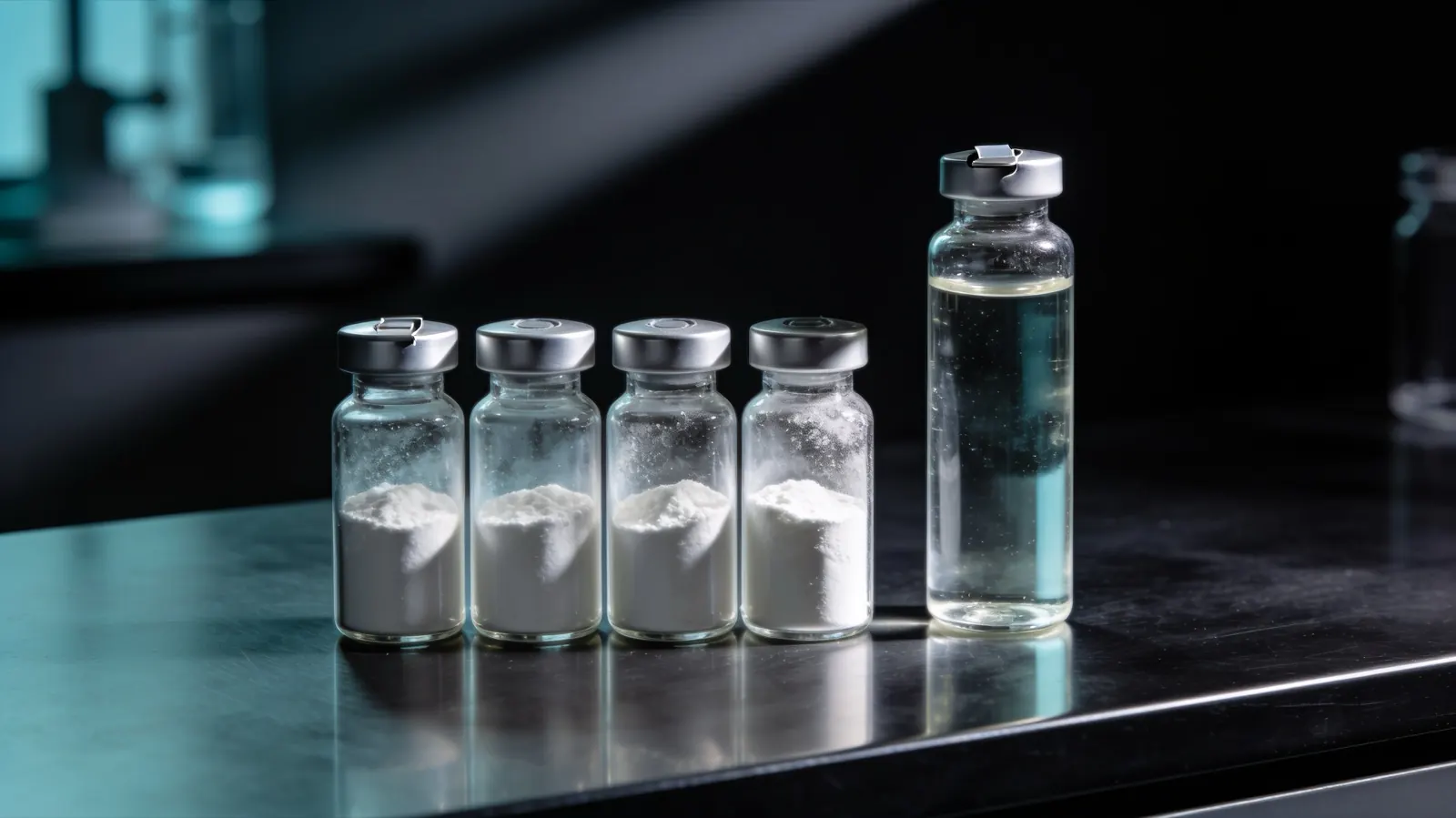
| Compound | Fill supplied | Solubility as documented |
|---|---|---|
| BPC-157 | 10mg | Soluble in bacteriostatic water and 0.9% NaCl |
| TB-500 | 10mg | Soluble in bacteriostatic water |
| Tesamorelin | 10mg or 20mg | Soluble in bacteriostatic water |
| Ipamorelin | 5mg or 10mg | Soluble in bacteriostatic water |
| GHK-Cu | 50mg or 100mg | Readily soluble in water |
| NAD+ | 1000mg | Readily soluble in water |
The liquids people reach for by mistake
Saline comes up constantly and is not the same thing. Sodium chloride 0.9% is water with salt in it, made for a quite different purpose, and the salt is a component that will show up in anything analytical done downstream, as peptide purity testing sets out. It is not a substitute for either water discussed above, and it carries no preservative unless it is specifically a bacteriostatic saline product.
Below sterile there is a whole ladder of water grades, and they are not interchangeable. Tap water carries dissolved minerals, chlorine and whatever the plumbing contributes. Distilled water has been boiled and condensed, which removes most dissolved solids. Deionised water has had its ions stripped by exchange resin, which is a different purification again and says nothing whatever about organisms. Deionised water can be microbiologically filthy and still meet its own specification perfectly. Water for Injection, WFI, sits above all of them as a manufacturing grade: purified, controlled for endotoxin, and the feedstock both liquids in this comparison are made from.
Endotoxin is the reason WFI sits at the top of that ladder rather than merely at the clean end of it. Endotoxins are fragments of bacterial cell wall; they survive the death of the organism that produced them, they are not removed by killing anything, and they are not detected by looking at a clear liquid. A grade controlled for endotoxin has been measured for them. Distillation and deionisation are not that measurement, which is the single most useful thing to know about why a laboratory bottle of purified water is not a diluent.
The ladder matters because purity and sterility are different axes. Distillation and deionisation are chemistry. Sterility is biology: it is established by a validated process, confirmed by test, and then held by a container closure. A laboratory bottle of deionised water with a screw cap has no closure integrity, no lot testing and no monograph, and none of that is repaired by how clean the water was when it went in.
The shortest way to hold the whole set apart: distilled and deionised are clean, sterile is clean and certified free of organisms, bacteriostatic is that plus a preservative, and the two sodium chloride products are a different article altogether with salt in them.
Container closure, and what repeated entry costs a vial
A multiple-dose vial is a preservative and a closure working together, and the closure is the half nobody discusses. The stopper is an elastomeric septum designed to reseal after a needle is withdrawn. It does that a finite number of times, and nothing on the label tells you how many.
The failure mode is coring. A needle pushed through at an angle, or a large-gauge needle through a septum already punctured a dozen times, can cut a small plug of rubber out and drop it into the liquid. A cored stopper has stopped resealing, and the particle it produced is now a component of the solution. Entering square on at the centre of the septum, with a fresh needle every time, is most of the defence, and a swab of the closure before entry is the rest.
This is also why vial size is a real decision rather than a price comparison. The 28-day in-use period set out in bacteriostatic water storage runs on the vial from the first puncture regardless of volume, so a 10ml vial bought for one 2ml preparation is mostly discarded, while a 3ml vial entered thirty times is asking a great deal of one septum. The number of entries a fill has to support, not the millilitres it holds, is the thing to size against.
Sterile water sidesteps all of it by not being in the argument. A single-dose vial is punctured once and the closure never has to reseal against a second needle, which is why a preservative-free product needs no in-use period and no puncture discipline. The trade is the one the whole comparison turns on.
Cost per millilitre runs the other way from the in-use clock, which is what makes the sizing decision feel harder than it is. Our 3ml vial is $9.99 and the 10ml is $19.99, which works out at $3.33 and $2.00 per millilitre, so the larger vial is around 40% cheaper by volume and much worse value if two thirds of it is discarded on day 28. Neither figure means anything next to the material being dissolved, which is the real argument for buying the size that gets used rather than the size that looks efficient.
Storage is the least demanding part of either liquid: controlled room temperature, 20 to 25°C, upright and out of direct light, with no cold chain on a sealed vial. Ours is USP grade and 0.2µm filtered, supplied in 3ml and 10ml.
- 0 days
- conventional in-use period for a preserved multiple-dose vial, counted from first entry
- Standard practice for preserved multiple-dose containers
- 0 µm
- final filtration on the bacteriostatic water we supply
- Product specification, Serviam Bio Labs
- 0 to 25°C
- controlled room temperature, the storage condition for both liquids
- Standard labelled storage for USP injection products
Why it is not on a pharmacy shelf
The most-asked question about this liquid is not a chemical one. People search for bacteriostatic water at CVS, at Walgreens, at Walmart and at Tractor Supply, and come away confused, because the answer depends on which product they mean.
Bacteriostatic Water for Injection, USP is a drug product. Its label reads 'Rx only', it is made by injectables manufacturers such as Hospira, Pfizer Injectables and Fresenius Kabi, and it moves through pharmacy and medical-supply channels rather than sitting on a retail shelf between the plasters and the vitamins. That is why a shop assistant cannot find it and why a general retailer does not stock it. Farm and veterinary suppliers sell their own preserved-water products under their own labels, which are different articles with different specifications.
The laboratory-supply channel is a separate one, and the distinction is worth stating plainly rather than blurring. What we supply is a research reagent: USP-grade sterile water with 0.9% benzyl alcohol, 0.2µm filtered, sold for bringing lyophilised material into solution in vitro. It is not a drug product, it is not dispensed against a prescription, and it is not supplied for use in humans or animals. That restriction is the condition of the channel, not a line of small print bolted underneath it.
What it means for an order is prosaic. The diluent ships in the same parcel as the material it was bought to dissolve, from the same warehouse, so nothing arrives without a liquid to go with it. How orders are packed and shipped covers the rest. The checks worth running on a diluent seller are the same ones worth running on any research peptide supplier, and they are set out there in full.
The diluent in the same parcel as the material
USP-grade bacteriostatic water, sterile water with 0.9% benzyl alcohol and 0.2µm filtration, in 3ml and 10ml vials, shipped alongside the compounds it reconstitutes.
Reconstitution Solution, 3ml and 10mlSterile water vs bacteriostatic water, the answer in practice
For a multi-milligram vial of lyophilised research material that will be sampled more than once, the preserved diluent is the standard choice, and bacteriostatic water for peptides covers why. It is what we supply in 3ml and 10ml vials alongside the catalogue it is bought to go with.
We do not stock plain sterile water, and saying so is more useful than implying otherwise. If a method in front of you specifies preservative-free diluent, that is a small purchase from a general laboratory-supply house rather than from here. Everything in our catalogue is documented against bacteriostatic water or plain water, and a two-vial set such as the repair reference panel sits comfortably inside one 10ml vial of diluent. What concentration a given volume of it leaves in a vial is division rather than judgement, and the peptide calculator sets that division out.
For a single-sitting preparation, or where a method demands preservative-free, sterile water is correct. Framed that way, sterile water vs bacteriostatic water takes about five seconds to settle, because the question underneath it is only ever 'will this vial be entered again?'
Sterile water vs bacteriostatic water comes down to a preservative and what it permits. Sterile water is cleaner in composition and single-use in practice. Bacteriostatic water carries 0.9% benzyl alcohol at a labelled pH of 5.7, and can therefore be entered repeatedly within its in-use period. Pick on whether the vial gets opened once or many times, and the rest follows from that one answer: the container class, the in-use clock, the price per millilitre. If the vial in question is a 10mg peptide that will be sampled over weeks, it was never really in doubt.
Common questions
Can I use sterile water instead of bacteriostatic water?
Yes, but the vial becomes single-use: there is no preservative to suppress growth after the seal is broken. Sterile water vs bacteriostatic water turns on that alone, and sterile water is the right choice when a method requires preservative-free diluent or the whole vial is used at once.
Is sterile water considered bacteriostatic?
No. Sterile water is free of organisms when sealed, but contains nothing that prevents growth once it has been entered. Only added benzyl alcohol makes water bacteriostatic.
Is bac water the same as bacteriostatic water?
Yes. Bac water and BAC water are shorthand for exactly the same product: sterile water with 0.9% benzyl alcohol, nine milligrams per millilitre, made and tested against the USP monograph. Nothing in the vial is different and the abbreviation implies nothing about grade. Ours is listed as BAC water in 3ml and 10ml simply because that is what reads faster in a cart.
What is the pH of bacteriostatic water?
The FDA-registered label for the reference product gives pH 5.7, with a stated range of 4.5 to 7.0. It is unbuffered, so that figure describes the water as supplied rather than the solution once something has been dissolved in it. The corresponding sterile-water label gives 5.5 with a range of 5.0 to 7.0, and both figures are manufacturer-specific enough to be worth reading off the vial.
Can I buy bacteriostatic water at CVS or Walgreens?
Not off the shelf. Bacteriostatic Water for Injection, USP is a drug product whose label reads 'Rx only', so it moves through pharmacy and medical-supply channels rather than general retail. The laboratory-supply channel is separate: what is sold there, including ours, is a research reagent supplied for in-vitro use and not for use in humans or animals.
Do any stores sell bacteriostatic water, like Walmart or Tractor Supply?
General retailers do not stock the USP injection product, for the same reason a supermarket does not stock any prescription item. Farm and veterinary suppliers sell their own preserved-water products under their own labels, which are different articles with different specifications. Read the label rather than the shelf position. A laboratory supplier states the grade, the benzyl alcohol concentration, a lot number and an expiry date, and a fuller list of checks sits in research peptide supplier.
What can be substituted for bacteriostatic water?
For a preparation used entirely in one sitting, plain sterile water does the same job minus the repeat entry. Nothing else on the list is a substitute: saline adds a salt that appears in everything measured afterwards, distilled and deionised water are purified but not certified free of organisms, and tap water is not a laboratory diluent at all. If a vial has to be entered more than once, there is no substitute, because the preservative is the whole product.
What is the difference between bacteriostatic water and reconstitution solution?
Bacteriostatic water is one specific product: water plus 0.9% benzyl alcohol. Reconstitution solution is a general term for buffered or stabilised diluents supplied for materials that do not dissolve well in plain water.
Does benzyl alcohol affect the material being dissolved?
For most lyophilised peptides, no. Where a material or an analytical method is specifically documented as requiring preservative-free diluent, use sterile water instead.
What does USP <51> have to do with the word bacteriostatic?
It is the test the word refers to. USP <51>, Antimicrobial Effectiveness Testing, challenges a preserved product with a defined microbial inoculum and measures whether the preservative system holds it in check over a set period. A product labelled bacteriostatic is claiming that specification, which is why benzyl alcohol mixed into water on a bench is not the same article however accurate the arithmetic was.
Is bacteriostatic water sterile?
Yes. It begins as sterile water, and the 0.9% benzyl alcohol is added on top of that sterility rather than instead of it. The preservative is what keeps the vial usable after it has been entered; it is not what makes the contents sterile in the first place, and it will not rescue a vial that has already been compromised.
Can I use saline instead of bacteriostatic water?
Saline is a different product, not a substitute. Sodium chloride 0.9% is water with salt in it, made for another purpose entirely, and that salt is an extra component in anything measured afterwards. Ordinary saline also carries no preservative unless the label specifically reads bacteriostatic sodium chloride.
Is bacteriostatic sodium chloride the same as bacteriostatic water?
No, although the names are close enough to be bought by mistake. Bacteriostatic sodium chloride is 0.9% saline with a preservative added; bacteriostatic water is water with a preservative and no salt at all. Read the whole product name on the label rather than stopping at the word bacteriostatic.
Is distilled water the same as sterile water?
No. Distillation removes dissolved solids and deionisation strips ions; neither certifies that nothing is living in the bottle. Sterile water is made and tested against a published USP monograph, with a lot number and an intact container closure behind it, and a laboratory bottle of distilled or deionised water has none of those things. The monograph side of it is covered in what is bacteriostatic water.
How long does sterile water last once the vial has been opened?
It gets no in-use period at all, because there is nothing in it to hold contamination in check. A vial of sterile water is sterile while sealed and is treated as finished once the stopper has been entered, whatever volume is left. The 28-day figure people try to apply to it belongs to preserved multiple-dose vials, as bacteriostatic water storage explains, and it does not transfer.
What happens if I use bacteriostatic water when the method says preservative-free?
You have added a variable the method was written to exclude. Benzyl alcohol is a small organic molecule, 108.14 g/mol, with its own behaviour in an assay, so a procedure calling for preservative-free diluent is usually one where it would either show up in the result or interact with the material. The answer in that case is plain sterile water, not a smaller volume of the preserved kind.
How do I find out which diluent a compound needs?
Start with the material's own documentation. The product page states the form supplied and what it dissolves in, and the lot's certificate of analysis covers identity and purity for the batch in front of you. Most lyophilised peptides go into water readily; where one does not, the compound's own data names the diluent, and a supplier that cannot say what its material dissolves in has a documentation problem.
Why does bacteriostatic water cost more than sterile water?
Three things account for it: the preservative itself, the testing a multiple-dose product carries, and a closure built to survive repeated entry. The comparison is not really per millilitre either, since a preserved vial is usable across its whole in-use period while a preservative-free one is finished after a single sitting. Measured against the material being dissolved, both are among the cheapest items on the bench.
Do I need to keep both sterile water and bacteriostatic water?
Most work needs only the preserved kind, because most lyophilised material dissolves readily in water and most vials are sampled more than once. A small quantity of sterile water covers the exceptions: a documented preservative-free method, or a material known to be incompatible with benzyl alcohol. If nothing in your procedures calls for preservative-free diluent, a vial of bacteriostatic water on its own is enough.
- Bacteriostatic Water for Injection, USP, FDA label (DailyMed): the 0.9% (9 mg/mL) benzyl alcohol content, the labelled pH of 5.7 and the multiple-dose polyolefin container
- Sterile Water for Injection, USP, FDA label (DailyMed): the preservative-free, unbuffered composition and the single-dose container it ships in
- PubChem CID 244, benzyl alcohol: the 108.14 g/mol molecular weight of the preservative that separates the two liquids
Read more
- What is bacteriostatic water?What is bacteriostatic water, exactly? It is one ingredient away from ordinary sterile water, and that one ingredient is the entire reason it exists.
- Bacteriostatic water for peptidesBacteriostatic water for peptides is the default diluent for a straightforward reason: it is the only one that lets a multi-milligram vial be used more than once.
- Bacteriostatic water storage and shelf lifeBacteriostatic water storage is simpler than most people expect, and the 28-day figure everyone quotes is measuring something quite specific.
- GLP-3 RT peptideThe GLP-3 RT peptide is a 39-residue acylated chain registered under CAS 2381089-83-2. This page states what the molecule is, how a chain that long is built, and what the certificates we publish for it actually say.
- What is in the KLOW peptide blendThe KLOW peptide blend is four separate molecules sharing one vial, which means four identities to describe and four assays to read rather than one of each.
- What is the GLOW peptide blend?The GLOW peptide is not one peptide. GLOW is a product name for three molecules dried into a single vial, 70mg in total, in a ratio fixed before it was sealed.
For laboratory research use only. All compounds listed on this site are sold strictly as reference materials for in-vitro laboratory research conducted by qualified professionals. They are not drugs, foods, cosmetics, or medical devices. They are not intended for human or veterinary consumption, therapeutic use, diagnostic application, or any in-vivo use whatsoever. These statements have not been evaluated by the Food and Drug Administration. By purchasing, you affirm that you are a qualified researcher and that you will comply with all applicable institutional, local, state and federal regulations governing the handling of research chemicals. Published by SERVIAM BIO LABS.