

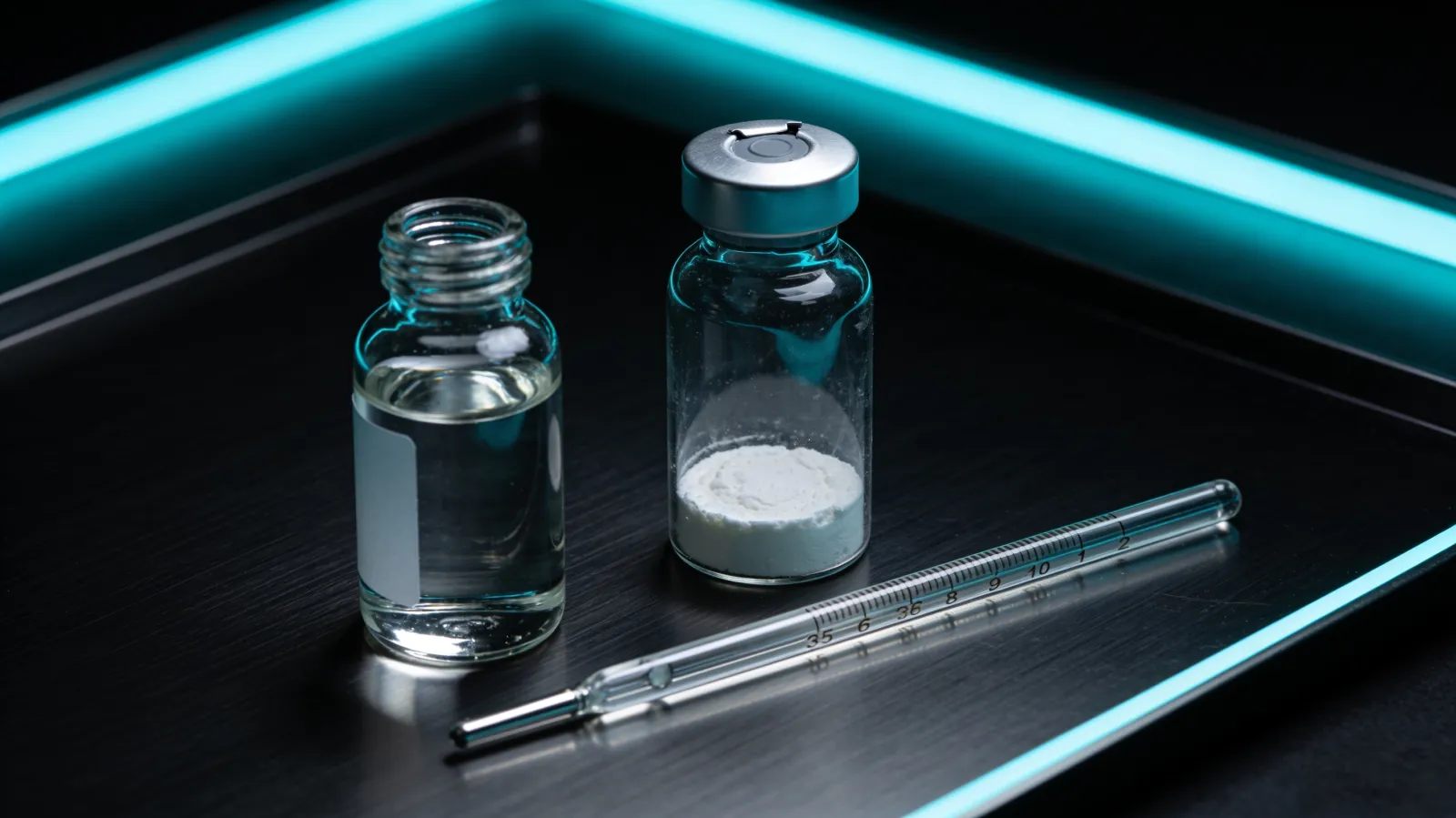
Bacteriostatic water for peptides is the standard diluent for reconstituting lyophilised material, because its 0.9% benzyl alcohol lets one vial be entered repeatedly. Concentration is mass divided by volume: 10mg in 2ml of diluent gives 5mg/ml. Buy USP-grade product in 3ml or 10ml vials, with a lot number and an expiry date on the label.
- Bacteriostatic water for peptides is sterile water with 0.9% benzyl alcohol in it, nine milligrams per millilitre, and that preservative is the only reason a 10mg vial can be entered eight or ten times rather than once.
- Reconstituted concentration is mass divided by volume and nothing else: 10mg of material in 2ml of diluent is 5mg/ml, and the same 10mg in 1ml is 10mg/ml.
- Run the diluent slowly down the inside wall of the vial and swirl rather than shake. Peptides are surface-active enough that foaming is worth avoiding, and most cakes go into solution within a minute or two unaided.
- Four things belong on the label before buying bacteriostatic water for peptides: USP grade stated explicitly, benzyl alcohol at 0.9%, a lot number, and an expiry date printed on the vial itself rather than only on the carton.
- The 28-day in-use period runs from first entry regardless of how much liquid is left, which is why a 10ml vial bought for one 2ml preparation is usually the more wasteful choice.
Why bacteriostatic water for peptides rather than anything else
Peptides are supplied lyophilised, freeze-dried to a dry cake and spelled lyophilized in most of the American literature, because dry material is far more stable than material in solution. What lyophilized powder is, and why the material is dried at all, is a subject of its own. To measure, assay or otherwise work with it, that cake has to go back into liquid, and almost all of it dissolves readily in water.
The choice of which water comes down to arithmetic. A 10mg vial used a milligram at a time is going to be entered eight or ten times. In plain sterile water that is not a reasonable thing to do, because nothing in the vial suppresses what a needle brings in, and sterile water vs bacteriostatic water sets the two liquids side by side. The 0.9% benzyl alcohol in bacteriostatic water for peptides is what makes repeated entry into one vial defensible, and that is the entire argument.
Benzyl alcohol is a small aromatic alcohol, C7H8O, 108.14 g/mol, and at 0.9% by volume, nine milligrams in every millilitre, it sits at a concentration that suppresses microbial growth without adding much else to the solution. Suppresses is the operative word. It is bacteriostatic rather than bactericidal: it holds a population in check rather than killing it, which is why a contaminated vial stays contaminated, and why a fresh sterile needle on every entry is not optional. What is bacteriostatic water takes the chemistry further.
It has a second, quieter advantage: it is unbuffered. A solution that will be assayed benefits from having as few components in it as possible, and water plus one preservative is close to the floor.
One word about scope, because it decides everything below. Reconstitution is a laboratory operation, a measured volume of diluent added to a lyophilised solid to reach a known concentration, and that is the only sense in which it is written about here. Millilitres, milligrams per millilitre, solubility, preservative behaviour, storage. Everything in the catalogue, diluent included, is supplied strictly for in-vitro research use.
What the USP label on bacteriostatic water for peptides specifies
Two components, and the label gives both. Water for Injection is the base and accounts for upwards of 99% of the volume; benzyl alcohol is the preservative, at 0.9%, which the same label states equivalently as 9 mg per millilitre. There is no buffer in it, no salt, no tonicity agent and no stabiliser.
The FDA-approved labelling for the reference product, Bacteriostatic Water for Injection USP published in full on DailyMed, states a pH of 5.7, inside the 4.5 to 7.0 the monograph allows. That figure is worth knowing rather than memorising: pH is one of the variables in any solution that will later be run on an instrument, and a diluent whose pH is defined to a published range is one fewer unknown.
USP grade is the part most often repeated by people who could not say what it means. A monograph is a published specification. It sets out what the product must contain and within what limits, what pH it must fall between, and that it must be sterile and free of visible particles in an intact container. USP grade means the product was made and tested against that document. Grade implied by a product name is not grade stated, and a vial naming no specification has nothing it can be measured against.
The label most often cited in this category belongs to Hospira, now part of Pfizer, whose Bacteriostatic Water for Injection USP is the reference product on DailyMed, and it is the reason "hospira bacteriostatic water" is searched more often than the phrase this page is written for. That is a manufacturer's label rather than ours. What ours shares with it is the specification: USP-grade sterile water, 0.9% benzyl alcohol, 0.2µm filtered, supplied in 3ml and 10ml vials.
One thing that label does not do is say anything about what gets dissolved in it. The diluent's documentation covers the diluent. The material carries its own, and for anything in this catalogue that is the certificate of analysis for the lot printed on the vial.
- 0 mg/ml
- benzyl alcohol in bacteriostatic water for peptides, the same figure as 0.9%
- FDA-approved labelling for Bacteriostatic Water for Injection USP, via DailyMed
- 0 g/mol
- molecular weight of benzyl alcohol, C7H8O
- Standard chemistry
- pH 5.7
- stated pH of the reference product, inside the monograph's 4.5 to 7.0
- The same FDA label; USP monograph range
Bacteriostatic water, sterile water, saline and reconstitution solution
Four liquids get proposed for the same job and only two are really in contention. The question that separates them is not purity or grade. It is whether the vial will be entered once or many times.
Plain sterile water is the right choice exactly when a method calls for preservative-free diluent, and the wrong one everywhere else, because it gets no in-use period at all: sterile while sealed, finished at first entry, whatever volume is left in it.
Sodium chloride 0.9%, normal saline, is a different proposition again. The salt is an extra component that turns up in anything analytical run on the solution, so where a procedure calls for water, saline is not a substitute for it. Bacteriostatic sodium chloride is that same liquid with the same preservative added, and it inherits both properties at once: repeat entry, plus a salt nobody asked for.
"Reconstitution solution" is a product name rather than a specification. Some of what is sold under it is bacteriostatic water; some is preserved saline; some does not say. The monograph terms are the ones with documents behind them, so read the composition rather than the name. Where the composition is not stated, the omission is the answer.
| Diluent | Preservative | Repeat entry | In-use period after first entry | Extra components in the solution | When it is the right choice |
|---|---|---|---|---|---|
| Bacteriostatic water | Benzyl alcohol 0.9% (9 mg/ml) | Yes, a multiple-dose container | Conventionally 28 days from first puncture | The preservative, and nothing else | Any vial that will be sampled more than once |
| Sterile water for injection | None | No, single-dose | None; finished once the stopper is entered | None | A method that specifies preservative-free diluent |
| Sodium chloride 0.9% | None | No, single-dose | None; finished once the stopper is entered | Sodium chloride | A method that specifies saline rather than water |
| Bacteriostatic sodium chloride | Benzyl alcohol 0.9% | Yes | Conventionally 28 days from first puncture | Preservative and sodium chloride | Repeat entry where the salt is wanted anyway |
| Branded "reconstitution solution" | Varies, read the label | Only if it names a preservative | Only what the label states | Unknown unless stated | Rarely; prefer a product with a monograph behind it |
Bacteriostatic water for peptides: concentration is arithmetic, not judgement
Reconstituted concentration is mass divided by volume, and nothing else. Add 2ml of diluent to a 10mg vial and the solution is 5mg/ml. Add 1ml to the same vial and it is 10mg/ml. Add 5ml and it is 2mg/ml. The material does not change; only how much liquid it is spread through.
Two practical notes on getting there. Run the diluent slowly down the inside wall of the vial rather than directly onto the cake. A hard stream can foam the solution, and peptides are surface-active enough that foaming is worth avoiding. And swirl gently rather than shaking; most lyophilised material goes into solution within a minute or two on its own.
If the cake will not dissolve, stop rather than escalating. Persistent cloudiness or visible particles after several minutes means something is wrong with the material or the diluent, and the answer is the lot's certificate of analysis, not more agitation.
Below is the same division done in advance for the vial sizes in this catalogue. Nothing in it is a recommendation about volume. It is arithmetic, and it stops at the concentration. For a vial strength or a volume that is not in the table, the same division is worked through on the peptide calculator.
NAD+ sits outside that table because the vial is an order of magnitude larger: 1000mg of material, which at 5ml is 200mg/ml and at 10ml is 100mg/ml. It is also a dinucleotide coenzyme rather than a peptide, a distinction worth keeping straight even where the handling looks the same, and the reason NAD+ peptide is a search term rather than a description. The vial is supplied lyophilised like the rest of the catalogue.
| Compound | Vial | + 1ml | + 2ml | + 3ml | + 5ml |
|---|---|---|---|---|---|
| BPC-157 | 10mg | 10mg/ml | 5mg/ml | 3.33mg/ml | 2mg/ml |
| TB-500 | 10mg | 10mg/ml | 5mg/ml | 3.33mg/ml | 2mg/ml |
| Tesamorelin | 10mg | 10mg/ml | 5mg/ml | 3.33mg/ml | 2mg/ml |
| MOTS-c | 10mg | 10mg/ml | 5mg/ml | 3.33mg/ml | 2mg/ml |
| GLP-3 RT | 10mg | 10mg/ml | 5mg/ml | 3.33mg/ml | 2mg/ml |
| Ipamorelin | 5mg | 5mg/ml | 2.5mg/ml | 1.67mg/ml | 1mg/ml |
| GLP-1 | 15mg | 15mg/ml | 7.5mg/ml | 5mg/ml | 3mg/ml |
| GHK-Cu | 50mg | 50mg/ml | 25mg/ml | 16.67mg/ml | 10mg/ml |
| GLOW | 70mg total | 70mg/ml | 35mg/ml | 23.33mg/ml | 14mg/ml |
| KLOW | 80mg total | 80mg/ml | 40mg/ml | 26.67mg/ml | 16mg/ml |
10mg in 1ml
10mg/ml. The most concentrated common preparation, and the least forgiving of measurement error at the point of sampling.
10mg in 2ml
5mg/ml. A common working concentration where the vial will be sampled repeatedly.
10mg in 5ml
2mg/ml. Dilute, which makes small samples easier to measure accurately but consumes vial volume faster.
The stopper, the needle and the cost of repeated entry
The preservative in bacteriostatic water for peptides buys repeat entry. The closure has to survive it. Under the flip-cap is a rubber septum designed to reseal after a needle is withdrawn, and most of what goes wrong with a multiple-dose vial goes wrong there.
Swab the septum with 70% isopropyl and let it dry before every entry, not only the first. The alcohol needs a few seconds of contact to do anything at all, and a surface still wet with it carries whatever it lifted straight in on the needle.
Use a fresh sterile needle each time. This follows directly from the preservative being bacteriostatic rather than bactericidal: it suppresses growth, so the sensible thing is to give it as little as possible to suppress.
Coring is the failure specific to this hardware. A needle pushed through at an angle, or a blunt one forced through, can punch a disc of rubber out of the septum and drop it into the liquid. A clean perpendicular entry avoids it; a visible fragment in the vial ends the vial, because nothing filters it back to good.
Manufacturers do not publish a puncture count for these closures, and in practice the 28-day in-use clock finishes the vial long before the rubber does. What ends it early is visible without instruments: a stopper that has lifted, a loose cap, a cracked vial, anything floating in a liquid that should be clear and colourless.
Vial sizes, cost per millilitre and what actually gets wasted
A 3ml vial suits a single compound reconstituted once. It is the right size when the diluent will be finished inside the 28-day in-use window and there is no reason to have more sitting around.
A 10ml vial is the sensible default when several vials of material are being prepared, and it is cheaper per millilitre. The limit is not volume but time: once entered, the 28-day clock applies to the whole vial, so a 10ml vial bought for one 2ml preparation mostly gets discarded.
At catalogue prices the arithmetic is unflattering to the larger vial in one specific case. A 3ml vial is $9.99, or $3.33 a millilitre; a 10ml vial is $19.99, or $2.00. The 10ml is 40% cheaper per millilitre and it is the right buy when several vials are reconstituted in one sitting. Bought for a single 2ml preparation it is $19.99 for 2ml of usable diluent and 8ml discarded on day 28, which is worse than two 3ml vials at $19.98, where the second vial's clock does not start until the first one is finished.
We supply bacteriostatic water for peptides in both sizes, in the same order as the material they dissolve, so that nothing arrives without a diluent to go with it. Prices here are catalogue prices at the time of writing; the product page is the one that is current.
- $2.00
- cost per millilitre of the 10ml vial
- This catalogue, 10ml at $19.99
- $3.33
- cost per millilitre of the 3ml vial
- This catalogue, 3ml at $9.99
- 0 days
- in-use period from first entry, whatever volume is left
- Conventional limit for a preserved multiple-dose container
| Format | Volume | Price | Cost per ml | Suits | Discarded on day 28 if only 2ml is used |
|---|---|---|---|---|---|
| 3ml vial | 3ml | $9.99 | $3.33 | One compound, reconstituted once | About 1ml |
| 10ml vial | 10ml | $19.99 | $2.00 | Several vials prepared in one sitting, or a reference panel | About 8ml |
| Two 3ml vials | 6ml | $19.98 | $3.33 | Staggered work, where the second clock starts later | About 1ml, then 1ml |
Bacteriostatic water, 3ml and 10ml
USP-grade sterile water with 0.9% benzyl alcohol, 0.2µm filtered, shipped in the same parcel as the material it dissolves.
See the vialsWhere bacteriostatic water for peptides is actually sold
Most of the demand behind this subject is not technical. Of the nine related questions Google shows alongside it, six ask where to buy the stuff: over the counter, at CVS, at Walgreens, at Walmart, on Amazon, at a pharmacy. The keyword data agrees. "Hospira bacteriostatic water" runs at 40,500 searches a month against 33,100 for this page's own phrase, with 9,900 more on CVS, 8,100 on "near me", 5,400 on Amazon and 4,400 on Walgreens (DataForSEO, September 2026).
The honest answer has two halves. Bacteriostatic Water for Injection USP is a labelled drug product rather than a shelf consumable, which is why it is not stacked beside the plasters; whether a particular pharmacy counter will supply it, and on what terms, varies by chain, by branch and by state. No supplier can tell you what your local one will do, and we are not going to pretend otherwise.
Marketplace listings are a different problem. The platform is not the supplier there. A third-party seller is, and what arrives depends entirely on that seller's sourcing. The checks are the same as for any vial: USP stated, benzyl alcohol 0.9%, a lot number, an expiry on the glass. A listing that will not show the label is not showing the product.
The laboratory route is the straightforward one, because the diluent travels with the material. Bacteriostatic water is heavy for its value and slow to clear customs, and a diluent that arrives three weeks after the compound it was bought to dissolve has failed at its one job. Ours ships from the same Miami warehouse as everything else, in the same parcel, which is the whole argument for buying the two together.
"Best", in this category, means the least interesting vial on the shelf: correct specification, legible label, traceable lot, delivery before the material. There is no performance dimension to a diluent, and a seller marketing one is selling something else.
Storage, and the two clocks that run at once
Bacteriostatic water for peptides is stored at controlled room temperature, 20 to 25°C, upright and out of direct light. It does not want the fridge and it does not want the freezer. Freezing is avoided because it stresses the container closure, not because it harms the water.
Two clocks run on every vial and they are independent. The printed expiry governs the sealed product and is typically a year or more out. The in-use period starts at the first puncture and is conventionally 28 days, counted in elapsed time rather than volume drawn. Whichever arrives first ends the vial. Write the first-puncture date on the label, because nothing about the liquid records it for you.
The material dissolved in the water runs a third clock, shorter and colder, and it belongs to the compound rather than to the diluent. How to store peptides covers that one; bacteriostatic water storage covers the vial being drawn from.
- 0 to 25°C
- controlled room temperature for the sealed vial
- USP definition; product labelling
- 0 to 8°C
- refrigerated condition for material already in solution
- Catalogue specification for the compounds sold here
| What | Temperature | Light | Freezing | Period | Source of the figure |
|---|---|---|---|---|---|
| Bacteriostatic water, sealed | 20 to 25°C | Keep in the carton | Avoid, it stresses the closure | Until the printed expiry | Product label; USP controlled room temperature |
| Bacteriostatic water, after first entry | 20 to 25°C | Keep in the carton | Avoid | 28 days from first puncture | Convention for a preserved multiple-dose container |
| Lyophilised material, unopened | minus 20°C long term | Keep in the carton | As supplied | Per the product's own documentation | Catalogue specification |
| Material in solution | 2 to 8°C | Protect from light | No | Much shorter; set by the compound | Catalogue specification |
When the solution does not come out clear
Most lyophilised cakes disappear within a minute or two of gentle swirling. When one does not, the useful instinct is to stop rather than escalate, because the remedies people reach for, such as shaking, warming or leaving it overnight on the bench, all have a cost, and none of them dissolves something insoluble.
Foam is the common self-inflicted problem. Peptides are surface-active, so they concentrate at the air-liquid interface, and a hard stream of diluent onto the cake creates a great deal of that interface. Run the liquid down the inside wall instead. Foam that has already formed will settle on standing and is not on its own a reason to discard anything.
Cloudiness or visible particles after several minutes is a different signal, and it points at the material or the diluent rather than at insufficient mixing. Check the water vial on its own first: hold it to the light, look for anything floating, confirm nothing has been cored out of the stopper. If the water is clear, the question moves to the material, and the place to look is the certificate for that lot number.
Precipitation after an initially clear solution is the third pattern, and it usually follows a change: refrigeration, a further dilution, several days standing. A small number of compounds are genuinely poorly soluble at neutral pH and say so in their documentation; for those the diluent named in that documentation is the one to use. Peptide purity testing is the separate question of what was in the vial to begin with, and it is answered by the certificate rather than by the appearance of the solution.
What to check before buying bacteriostatic water for peptides
Four things, all readable from the label or the listing. USP grade, stated explicitly rather than implied. Without it there is no specification the product was tested against. Benzyl alcohol at 0.9%, which is the standard concentration and the one that defines the product. A lot number, so the vial is traceable to a batch. And an expiry date on the vial, not just on the box.
Beyond the label there is the seller. How to vet a research peptide supplier applies to the diluent as much as to the material: who manufactured it, what specification it was made to, and whether those answers arrive without being chased. A seller who cannot name the manufacturer of a vial of water is answering a different question from the one being asked.
One last point, and it is the important one: bacteriostatic water for peptides is a laboratory diluent. It is supplied here, like everything in this catalogue, strictly for in-vitro research use, and nothing on this site describes preparing material for use in humans or animals.
| Label field | What good looks like | Why it matters | Red flag |
|---|---|---|---|
| Grade | "USP" printed explicitly | Names the published specification the product was tested against | Grade implied by the product name only |
| Preservative | Benzyl alcohol 0.9% (9 mg/ml) | It is the property that makes the vial multiple-dose | "Preserved" with no concentration given |
| Volume | 3ml, 10ml or 30ml, stated on the glass | Decides how much is discarded at day 28 | Volume only on the carton |
| Lot number | Printed on the vial itself | Traces the vial back to a batch and its testing | No lot, or a lot only on the outer box |
| Expiry | A date on the vial, not the carton | One of the two clocks that ends the vial | Carton-only dating, or none |
| Manufacturer | Named, and findable | Someone stands behind the specification | "Sourced from a US facility" with no name |
How well supported each figure on this page is
Everything above is a label fact, a monograph fact, a piece of arithmetic or a convention, and those are not equally strong. It is worth saying which is which, because a great deal in this category is asserted with identical confidence whether or not anyone has measured it.
The table below grades each figure used here against its primary source. Where the support is conventional rather than measured, the 28-day in-use period being the clearest case, it says so rather than smoothing it over. Where the figure belongs to our own material rather than to the category, the document behind it is the certificate for that lot, which is the same standard every compound here is published to.
Two things are deliberately absent. Nothing on this page describes what any of this material does in a living system, because that is not a claim a research supplier is in a position to make. And the clinical sections of the reference label, the parts that belong to a labelled medicine rather than to a bench reagent, are left where they are, because this is a laboratory diluent and that is the only thing it is sold as.
| Claim | Evidence strength | Primary source |
|---|---|---|
| 0.9% benzyl alcohol, equal to 9 mg/ml | Strong, stated on the approved label | FDA labelling for Bacteriostatic Water for Injection USP, via DailyMed |
| pH 5.7, within a permitted 4.5 to 7.0 | Strong, a label figure and a monograph range | The same FDA label; USP monograph |
| Benzyl alcohol is C7H8O, 108.14 g/mol | Strong, settled chemistry | Standard reference data |
| 28-day in-use period after first entry | Strong as a convention, not as a measurement of the liquid | Established practice for preserved multiple-dose containers |
| Storage at 20 to 25°C, upright, out of light | Strong | Product labelling; USP controlled room temperature |
| Concentration figures in the volume table | Certain, it is division | Vial masses in this catalogue |
| Purity and identity of the material dissolved | Strong, but lot by lot rather than in general | The certificate of analysis for that lot |
| Search volumes quoted in this article | Moderate, a third-party estimate rather than a census | DataForSEO, September 2026 |
Bacteriostatic water for peptides earns its place through one property: the preservative that lets a single vial be entered again and again within its in-use period. Get the arithmetic right, mass over volume written on the vial, buy USP-grade product with a lot number and a legible expiry, size the vial to the 28-day clock rather than to the price per millilitre, and the diluent stops being something to think about at all.
Common questions
Where can I buy bacteriostatic water for peptides?
From a supplier that states USP grade, 0.9% benzyl alcohol, a lot number and an expiry date on the vial, and that ships domestically. We supply it in 3ml and 10ml vials alongside the research catalogue, shipped from Miami in the same parcel as the material.
Can you buy bacteriostatic water over the counter?
It is a labelled drug product rather than a shelf consumable, so it is not something to pick up beside the plasters, and whether a pharmacy counter will supply it varies by chain, by branch and by state. No supplier can answer for your local one. Bought as a laboratory diluent it arrives the same way the material does, documented and shipped with the order.
Do CVS, Walgreens or Walmart sell bacteriostatic water?
Stocking and counter policy differ between chains and between branches of the same chain, and none of them publish a dependable national answer, which is why the question is asked around 14,000 times a month across CVS and Walgreens alone (DataForSEO, September 2026). The practical limit is that a pharmacy counter will not supply the compound the diluent was bought for, so the trip solves half the problem at best.
Does Amazon sell bacteriostatic water for peptides?
Marketplace listings exist, and a marketplace search page currently ranks first for this phrase. The platform is not the supplier though: a third-party seller is, and sourcing, grade and lot documentation vary with them. Check the same four things as on any vial: USP stated, benzyl alcohol 0.9%, a lot number and an expiry printed on the glass. Treat a listing that will not show the label as not showing the product.
What is the best bacteriostatic water for peptides?
There is no performance dimension to a diluent, so "best" collapses into specification and logistics: USP grade stated, 0.9% benzyl alcohol, a traceable lot, an expiry on the vial, and arrival before the material it is meant to dissolve. Everything past that is packaging. Ours is USP-grade and 0.2µm filtered, in 3ml and 10ml.
Is Hospira bacteriostatic water the standard?
It is the reference label. Hospira, now part of Pfizer, publishes the Bacteriostatic Water for Injection USP labelling that the rest of the category is compared against, and it is the source of the 0.9% and 9 mg/ml figures quoted everywhere, including here. A vial from another manufacturer is not automatically inferior. It was either made to the same monograph or it was not, and the label is where that is stated.
Is reconstitution solution the same as bacteriostatic water?
Sometimes, and the name will not tell you. "Reconstitution solution" is marketing language rather than a monograph term, so products sold under it range from ordinary bacteriostatic water to preserved saline to something whose composition is never stated. Read the composition: sterile water with 0.9% benzyl alcohol is bacteriostatic water under another name, and a product that will not say is answering the question by omission.
How much bacteriostatic water for peptides do I add to a vial?
Enough to reach the concentration the method calls for, since concentration is mass divided by volume: 10mg of material in 2ml gives 5mg/ml, in 1ml gives 10mg/ml. The volume table above does that division for every vial size in the catalogue. The vial's own documentation, not a rule of thumb, sets the target.
Can I use bacteriostatic water for every peptide?
For most lyophilised peptides, yes. They dissolve readily in water, and every compound in this catalogue is recorded as soluble in it. A small number of peptides are poorly soluble at neutral pH and their documentation specifies a different diluent, and some analytical methods require preservative-free water.
What size vial of bacteriostatic water should I buy?
3ml for a single preparation, 10ml when several vials are being reconstituted at once. The 28-day in-use period starts at first entry regardless of size, so a large vial bought for one small preparation is mostly wasted, and at $3.33 against $2.00 a millilitre, two small vials used in turn can beat one large vial left to expire.
Can I use distilled water or tap water instead of bacteriostatic water?
No. Distilled water is purified but not certified sterile. Distillation removes dissolved solids, it does not establish that nothing is living in the bottle, and a laboratory bottle of it has no monograph, no lot testing and no closure integrity behind it. Tap water is not a laboratory diluent at all. The real choice is between bacteriostatic water and plain sterile water, set out in sterile water vs bacteriostatic water, and it turns on whether the vial will be entered more than once.
How long does a peptide last after it has been mixed with bacteriostatic water?
Two clocks run at once and they are different lengths. The diluent's 28-day in-use period starts at the first puncture of the water vial; the material in solution has its own, much shorter and refrigerated, stability, which is set by the compound rather than by the water. The compound's own documentation governs that second figure, and how to store peptides covers the handling side.
Is bacteriostatic water the same as bacteriostatic sodium chloride?
No. Bacteriostatic sodium chloride is 0.9% saline with a preservative added; bacteriostatic water is plain water with the preservative and no salt in it. The distinction matters downstream, because sodium chloride is an extra component that appears in anything analytical run on the solution. Where a method calls for water, saline is not a substitute for it.
Why is my peptide still cloudy after adding bacteriostatic water?
Stop rather than agitating harder. Most lyophilised cakes clear within a minute or two of gentle swirling, so persistent cloudiness or visible particles after several minutes points at the material or the diluent rather than at insufficient mixing. Check the water vial itself for particles, then pull the certificate for that lot number; a small number of peptides are genuinely poorly soluble at neutral pH and say so in their documentation.
How do I know the bacteriostatic water I bought is actually USP grade?
The label has to say so: USP stated explicitly, benzyl alcohol at 0.9%, a lot number, and an expiry date printed on the vial and not only on the carton. Grade implied by a product name is not a specification, because with no monograph named there is nothing the product was tested against. A seller who cannot say who manufactured the vial is answering a different question, and the checks in how to vet a research peptide supplier apply to the diluent as much as to the material.
Can I use one vial of bacteriostatic water for more than one peptide?
Yes, and that is the whole point of a multiple-dose container. The preservative is there so one vial can be entered repeatedly. Swab the septum with 70% isopropyl and use a fresh sterile needle for every entry, since benzyl alcohol suppresses growth rather than sterilising whatever a needle carries in. The 28-day clock counts from the first entry into that water vial, not separately for each compound it is used on.
Does the benzyl alcohol show up when the reconstituted solution is assayed?
It is a component of the solution, so it is present in anything run on that sample; whether it interferes depends on the method. This is the usual reason a published procedure specifies preservative-free diluent, and where one does, plain sterile water is the correct liquid. Peptide purity testing sets out what each method is actually measuring.
Does bacteriostatic water come with a peptide order, or do you have to buy it separately?
Separately. It is its own line in the catalogue rather than something included with a peptide vial, and that holds for the multi-vial reference panels too. We stock 3ml and 10ml vials and ship them in the same parcel as the material, from the same Miami warehouse, so nothing arrives without a diluent to go with it. It is the cheapest item in the catalogue and the one most often left out of an order.
- Bacteriostatic Water for Injection, USP: FDA label (DailyMed): the 0.9% benzyl alcohol stated equivalently as 9 mg per millilitre, the pH figure and the multiple-dose designation
- Sterile Water for Injection, USP: FDA label (DailyMed): the preservative-free, single-dose composition the comparison table sets against bacteriostatic water for peptides
- PubChem CID 244, benzyl alcohol: the formula C7H8O and the molecular weight of 108.14 g/mol given for the preservative
- FDA, Lyophilization of Parenteral: Inspection Technical Guide: what a lyophilised cake is and what its appearance and dissolution on reconstitution are taken to indicate
Read more
- What is bacteriostatic water?What is bacteriostatic water, exactly? It is one ingredient away from ordinary sterile water, and that one ingredient is the entire reason it exists.
- Bacteriostatic water storage and shelf lifeBacteriostatic water storage is simpler than most people expect, and the 28-day figure everyone quotes is measuring something quite specific.
- Sterile water vs bacteriostatic waterSterile water vs bacteriostatic water is a question about one ingredient and one consequence: whether the vial can be opened more than once. The labels answer it in figures.
- What is a peptide?What is a peptide, in the vocabulary that every specification sheet, sequence line and certificate in this library already assumes. This is the page to read first.
- GLP-1 peptideThe GLP-1 peptide this catalogue sells as GLP-1 S is an engineered analogue of the hormone it shares a name with, registered under CAS 910463-68-2. This page states what the molecule is, how the analogue and the hormone differ, and what our single published certificate actually says.
- GLP-3 RT peptideThe GLP-3 RT peptide is a 39-residue acylated chain registered under CAS 2381089-83-2. This page states what the molecule is, how a chain that long is built, and what the certificates we publish for it actually say.
For laboratory research use only. All compounds listed on this site are sold strictly as reference materials for in-vitro laboratory research conducted by qualified professionals. They are not drugs, foods, cosmetics, or medical devices. They are not intended for human or veterinary consumption, therapeutic use, diagnostic application, or any in-vivo use whatsoever. These statements have not been evaluated by the Food and Drug Administration. By purchasing, you affirm that you are a qualified researcher and that you will comply with all applicable institutional, local, state and federal regulations governing the handling of research chemicals. Published by SERVIAM BIO LABS.