

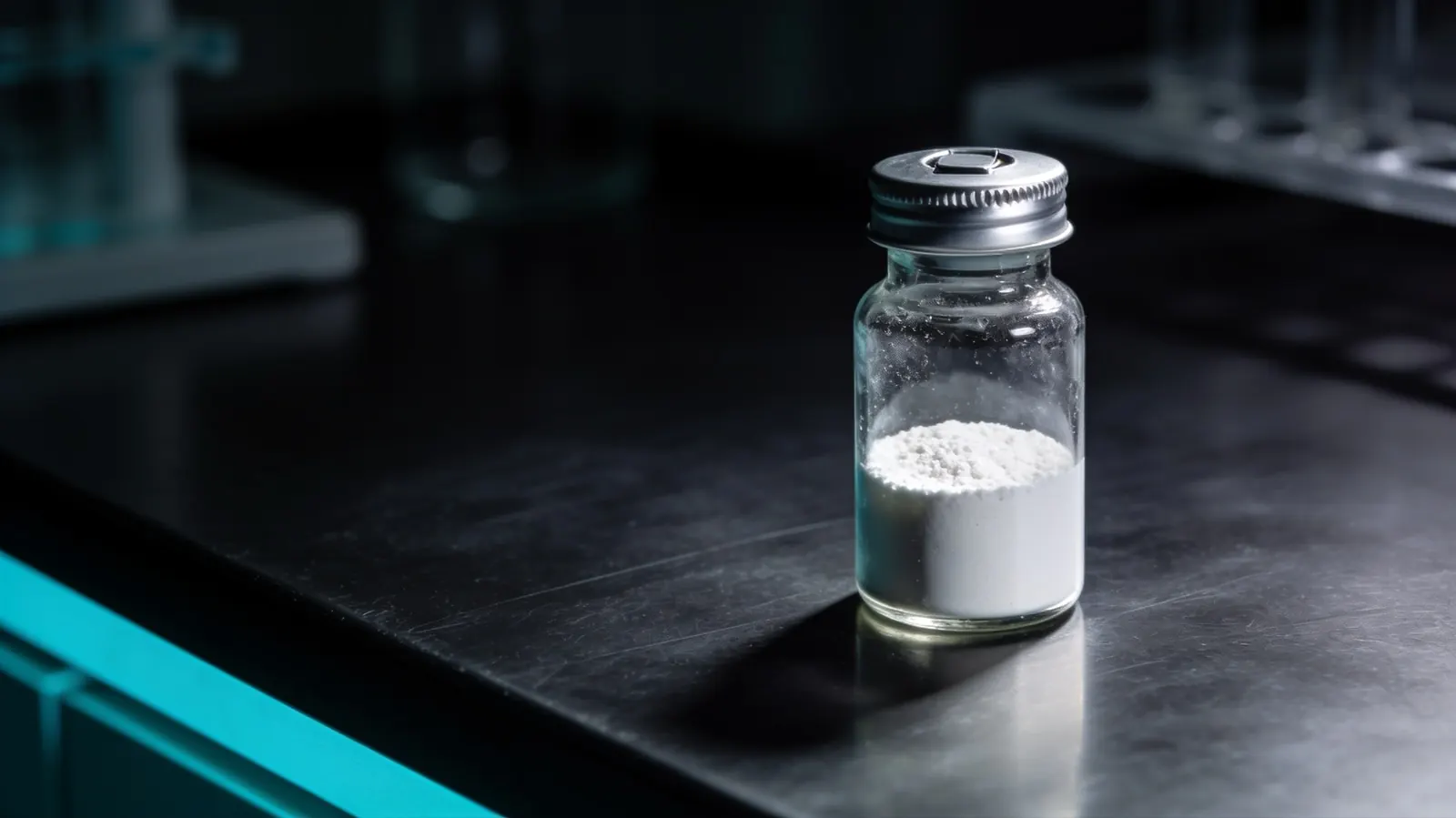
The GLP-1 peptide in this catalogue is GLP-1 S: a synthetic 31-residue acylated chain, CAS 910463-68-2, formula C187H291N45O59, molecular weight 4113.58 g/mol. It is a GLP-1 receptor agonist, and it is an engineered analogue of the native hormone also called GLP-1, not the hormone itself. Supplied lyophilised in a 15mg vial for laboratory research only.
- The GLP-1 peptide sold here is registered under CAS 910463-68-2, molecular formula C187H291N45O59, molecular weight 4113.58 g/mol, a 31-residue chain carrying a C18 diacid group on the lysine at position 26. On the vial and on the catalogue tile the same material is called GLP-1 S.
- GLP-1 is two different things with one name. The endogenous incretin hormone glucagon-like peptide-1 is a short unmodified peptide of 30 or 31 residues released from proglucagon. What is in this vial is a synthetic long-acting acylated analogue of that hormone, which is not the same molecule and does not have the same sequence.
- It is stocked as a single 15mg vial at $79.99, shelved under Metabolic / GLP Research, which works out at $5.33 per milligram.
- One lot has been released and published, GS20-032026-1, assayed by Freedom Diagnostics at 99.689% by HPLC against a 20mg fill, with a measured net peptide content of 23.85mg and a white lyophilised powder appearance.
- That lot's identity line reads Conforms (reference match). It is the only one of 51 published lots phrased that way: 48 state identity confirmed by LC-MS and two state a retention-time match against a certified reference standard.
- The same lot record is the thinnest in the archive in three further respects. It carries no laboratory accession number, no laboratory search code and no certificate report date, where 48, 48 and 50 of the 51 lots respectively carry each of those.
What the GLP-1 peptide is, in specification terms
A synthetic chain of 31 amino acids carrying a long fatty diacid group attached to a side chain partway along it. The catalogue sells it as GLP-1, the vial label reads GLP-1 S, and the compound underneath both of those names is registered under CAS 910463-68-2. Putting the registry number in the same sentence as the shelf name is the point of this page, because a reader who cannot map one onto the other has no way of checking anything at all.
Its molecular formula is C187H291N45O59 and its molecular weight is 4113.58 g/mol. There is no sulphur atom anywhere in that formula, which is worth pausing on rather than skimming. No sulphur means no cysteine and no methionine among the 31 residues, so no disulphide bridge can form and the two side chains most prone to oxidation during storage are simply absent from the sequence.
Our own catalogue line describes the sequence as a GLP-1 receptor agonist · acylated, which is a structural classification rather than a sequence. That classification says which receptor the chain engages and that a fatty acid has been hung off it. It says nothing else, and nothing else should be read into it on this page.
Physically it arrives as a lyophilised solid, soluble in bacteriostatic water, held at -20°C for the long term and kept away from light. The appearance on our specification and on the one published certificate agree: white lyophilised powder. It is stocked in one size only, a 15mg vial at $79.99, on the GLP-1 S product page.
By the standards of this catalogue the GLP-1 peptide sits in the middle of the range: ten times the length of the three-residue copper tripeptide at one end, eight residues shorter than the triple agonist at the other. The acyl group it carries is the feature that dominates everything difficult about making it.
- 0
- amino-acid residues in the GLP-1 S chain
- Serviam Bio Labs specification for GLP-1 S
- 0 g/mol
- molecular weight, formula C187H291N45O59
- Our label and catalogue record
- 0
- sulphur atoms in the formula, so no disulphide bridge is possible
- Read directly from C187H291N45O59
| Property | Value |
|---|---|
| Catalogue name | GLP-1 |
| Label name | GLP-1 S |
| CAS number | 910463-68-2 |
| Molecular formula | C187H291N45O59 |
| Molecular weight | 4113.58 g/mol |
| Residue count | 31 |
| Backbone | Acylated; a C18 diacid group on the lysine at position 26 |
| Receptor class | GLP-1 receptor agonist |
| Catalogue category | Metabolic / GLP Research |
| Appearance | White lyophilised powder |
| Solubility | Soluble in bacteriostatic water |
| Storage as supplied | -20°C long term, protected from light |
| Size stocked | A single 15mg vial at $79.99 |
| Lot on the product page | GS20-032026-1, 99.689% by HPLC, released 22 May 2026 |
Identity
CAS 910463-68-2, sold here as GLP-1 and labelled GLP-1 S. A 31-residue acylated backbone classified as a GLP-1 receptor agonist. That receptor classification is a statement about which receptor the molecule engages and carries nothing further.
Mass and formula
C187H291N45O59, molecular weight 4113.58 g/mol. The formula contains no sulphur, so no residue in the chain is sulphur-bearing and no disulphide bridge is possible anywhere in the molecule.
Supply and handling
Lyophilised solid in a single 15mg vial, soluble in bacteriostatic water, stored at -20°C long term and protected from light. The lot quoted on the product page is GS20-032026-1, released at 99.689% by HPLC.
GLP-1 the hormone, and the GLP-1 peptide in this vial
This is the single most useful distinction on the page, and almost nowhere in this market is it drawn properly. GLP-1 is the name of a hormone your own body makes. It is also, on this catalogue and on a hundred others, the shelf name for a synthetic compound that is not that hormone. The two share a name and a receptor, and they share almost nothing else.
The hormone is glucagon-like peptide-1, an incretin released after processing of proglucagon. It exists in the body in two active forms, one of 30 residues and one of 31, written as GLP-1(7-36)amide and GLP-1(7-37). It is an unmodified peptide: a plain chain of amino acids with no fatty acid attached and nothing else bolted to it. Being unmodified is why it is cleared from circulation very quickly indeed, on the order of minutes.
What is in this vial is a synthetic molecule designed from that hormone's sequence and then changed in three specific ways. The residue at position 8 of the native numbering is swapped for alpha-aminoisobutyric acid, an unnatural amino acid that is not a substrate for the enzyme that cuts the native chain there. The lysine at position 34 is swapped for arginine, so that only one lysine remains in the whole chain. And the remaining lysine, at position 26, is acylated: a C18 diacid chain is attached through a spacer, giving the molecule a long greasy tail the hormone does not have.
The result is a different compound with a different formula, a different molecular weight, a different CAS number and dramatically different pharmacokinetics. It is not the hormone, it is not purified hormone, and no amount of shared nomenclature makes it one. A catalogue that sells you GLP-1 is not selling you glucagon-like peptide-1 any more than a catalogue selling GLP-3 RT is selling you something that binds a receptor called GLP-3.
The practical consequence is that searching a literature index for GLP-1 returns the hormone, the receptor and the whole class, while the compound in the vial is indexed under its registry number, 910463-68-2. That number is the reliable handle: the shelf name returns nothing.
If the difference between a hormone, a peptide and an engineered analogue of one is not yet solid ground, the library's foundation article on what is a peptide sets out the vocabulary before any of this becomes relevant.
| Property | Native GLP-1, the hormone | GLP-1 S, the compound sold here |
|---|---|---|
| Registry number | Not applicable: an endogenous hormone | CAS 910463-68-2 |
| Origin | Released in the body from proglucagon | Made by synthesis and purified |
| Residue count | 30 or 31, depending on the active form | 31 |
| Active forms | GLP-1(7-36)amide and GLP-1(7-37) | One defined molecule |
| Side-chain modification | None; an unmodified chain | C18 diacid on the lysine at position 26 |
| Unnatural residues | None | Alpha-aminoisobutyric acid at position 8 |
| CAS number | Registered separately as the hormone | 910463-68-2 |
| Molecular weight | Not the figure on our label | 4113.58 g/mol |
| Persistence in circulation | Minutes | Engineered to be long-acting |
| Found in this catalogue | No | Yes, as a 15mg vial |
A registry number under the catalogue name GLP-1 S
Two names for one material is ordinary in this market. A catalogue name is a shelf name, chosen so a product line reads coherently, and it is indexed nowhere outside the shop that chose it. A registry number is an entry in a chemical index, and it is the only one of the two that will find anything.
GLP-1 S is the shelf name here. The S is a house convention distinguishing this single-receptor compound from the triple agonist on the next tile, and it carries no chemical meaning. Searching a chemical database for GLP-1 S returns nothing, because no chemical database has heard of it. The registry number does: 910463-68-2 resolves to one structure and only one, and a number is far harder to mistype into something plausible than a name is.
This page identifies the material by its registry number, formula and mass, and by nothing else. Identification is chemistry. A page that will not say which molecule is in the vial cannot then turn round and ask a reader to check a certificate against it, because there is nothing for the certificate to be checked against.
Nothing beyond identification follows onto this page. There is no description here of what the compound does in an animal or a person, and no suggestion that this material is, resembles or can stand in for any approved medicine. It is not one. It is a research chemical sold for in-vitro laboratory work, and the certificate is the only document that describes it.
The same reasoning governs the sibling page. The GLP-3 RT peptide article states its registry number for the same reason and stops in the same place, and the two pages are built to the same template so that the specification blocks can be read against each other.
Thirty-one residues and one acyl chain: making the GLP-1 peptide
A 31-residue chain is made the way almost every research peptide of this length is made, by solid-phase synthesis. The chain is grown one residue at a time on an insoluble resin support, each cycle deprotecting the free end of the growing chain and coupling the next protected amino acid onto it, with the excess washed away before the next cycle begins. At the end the finished chain is cleaved off the resin and the protecting groups are stripped.
The arithmetic of that process is why a long chain is harder than a short one. Every cycle yields below 100%, and the yields multiply. At 99.5% per coupling a 31-residue chain finishes near 86% of theory before any purification; at 99% it finishes near 74%. Each failed coupling leaves a chain missing one residue, and a deletion sequence differing from the intended molecule by one amino acid is the hardest kind of impurity to separate out afterwards.
The acylation is a second job on top of that. Only one lysine is left in the chain by design, so there is only one side chain for the fatty acid to attach to, which is the whole reason the position-34 lysine was swapped out. Two free lysines would acylate in two places and give a mixture. Selectivity here is built into the sequence rather than coaxed out of the chemistry.
What comes off the resin is therefore never one substance. It is the intended molecule plus deletion sequences, incompletely deprotected material and any unacylated chain. Preparative reversed-phase chromatography separates the intended molecule from that mixture, and the purity figure on a certificate measures how well that separation went on one batch. The methods behind that measurement are set out in peptide purity testing.
The long acyl tail also changes how the GLP-1 peptide behaves on the column. A greasy chain hung off a hydrophilic peptide retains far more strongly on a reversed-phase stationary phase than the unmodified chain does, which makes retention time a reproducible property of the compound. That matters again below, because retention time is how some certificates state identity.
What lot GS20-032026-1 reports
One lot of the GLP-1 peptide has been released and published: GS20-032026-1, released on 22 May 2026, assayed by Freedom Diagnostics, the laboratory behind 49 of the 51 certificates in this library. That single lot is the whole documented history of the compound here, and a one-lot archive should be read as exactly that rather than as a track record.
The HPLC purity result is 99.689%, reported to three decimal places, which is the Freedom Diagnostics house style and is the figure quoted on the product page. The specification the lot was released against is 99% or better. The measured net peptide content is 23.85mg. The appearance is recorded as a white lyophilised powder, matching our own specification line exactly. The certificate covers a 20mg fill.
The identity line is where this record stops looking like the rest of the archive. It reads: Conforms (reference match). Across all 51 published lots, 48 state identity as confirmed by LC-MS and two state that a retention time matched a certified reference standard. This is the only lot of the 51 phrased the way it is, and it is the only Freedom Diagnostics lot in the entire library that does not name LC-MS.
Taken literally, the wording says the material conformed and that conformance was established by matching it against a reference. What it does not say is which instrument produced the match. A retention-time match and a mass confirmation by LC-MS are both reference matches and they are not equally specific, so a line covering both without choosing leaves a reader with a question. We publish it as the laboratory wrote it rather than tidying it into the house phrasing used elsewhere, because tidying it would be inventing a method.
Our own product-page FAQ describes identity for this compound as confirmed against a certified reference standard by LC-MS. That is a stronger statement than the lot line supports on its own. The document to read is the signed certificate itself, which is published in full in the certificate of analysis library alongside every other document we hold, including for lots no longer in stock.
- 0%
- HPLC purity on lot GS20-032026-1, against a 99% specification
- Freedom Diagnostics certificate, released 22 May 2026
- 0mg
- measured net peptide content on a 20mg fill
- The same certificate
- 0 of 51
- lots in this archive whose identity line reads Conforms (reference match)
- 48 of the other 50 state LC-MS; two state a retention-time match
Read the certificate before the catalogue page
Every document we hold is published, including the one for this lot. The figures on a certificate are the only ones written by somebody other than us.
Open the certificate libraryThree fields this certificate does not carry
Omissions are worth naming rather than leaving to be discovered. Three fields that nearly every other record in this library carries are absent from this one.
The first is the laboratory accession number, the code by which the testing laboratory files its own record of the work. Forty-eight of the 51 lots here print one. The three that do not are the two GLP-3 RT lots assayed by a different laboratory and this one, which makes GS20-032026-1 the only Freedom Diagnostics lot out of 49 without an accession number on file.
The second is the laboratory's own search code, the string a buyer types in to pull the record up at source rather than taking our copy on trust. The same 48 lots carry one and the same three do not. Together those two fields are what turn a PDF on a seller's website into something independently checkable, and without either the document can only be read, not verified where it was written.
The third is the report date printed on the certificate. Fifty of the 51 lots record one, and this is the single exception. The release date, 22 May 2026, is a different thing: the date the lot went on sale, which ordinarily runs weeks or months behind the date the laboratory signed its report. With one and not the other, the gap between assay and sale cannot be measured here, and that gap is one of the more informative numbers on any certificate.
None of this makes the purity figure wrong. It makes the record thinner than the archive's own standard, and saying so is cheaper than having a reader find it. Which fields ought to be on a certificate, and what each of them is for, is worked through field by field in how to read a peptide certificate of analysis. Lot codes that do resolve can be checked on the lot verification page.
A 20mg certificate against a 15mg vial
The vial sold on the product page is a 15mg fill. The certificate published for it covers a 20mg fill. That mismatch is real, it is on the page already, and it deserves an explanation rather than a footnote.
The same released material is filled at more than one size. Bulk fills go out to wholesale at sizes that are not on the retail ladder, and the certificate on file is the document for one of those, so the lot table shows a fill that cannot be bought there. This is not unique to the GLP-1 peptide: the GLP-3 RT archive holds certificates for 12mg, 24mg, 48mg and 60mg fills, none of them on that product's ladder either.
What follows from it is a practical limit on what the certificate can tell a buyer about the vial in front of them. A purity figure is a property of the material and travels across fill sizes unchanged, so 99.689% describes the powder whatever mass of it went into a given vial. A net peptide content figure is a property of a specific fill, and it does not travel. Reading 23.85mg as a statement about a 15mg vial would be a straightforward error of arithmetic.
The honest position: the published document supports the purity, the identity wording and the appearance for this material, and supports a content figure only for the 20mg fill it was written against. Anyone needing a content figure for the retail fill should ask for the certificate covering it rather than scaling this one.
Net peptide content, and the figure above the fill
Net peptide content is the field that separates a serious certificate from a decorative one, and the one most often missing. It answers a question purity does not: of the total mass in the vial, how much is actually peptide? The rest is counter-ion from purification and residual water the lyophiliser did not remove. A batch can be 99.7% pure and still be a meaningful fraction salt and water by mass, because purity is a proportion of the peptide-related material detected, not of the powder.
Forty-two of the 51 lots in this library report a single measured net peptide content figure in milligrams. Seven of the other nine are multi-component blends reporting a figure per component, and the remaining two report target fill conformance counted vial by vial instead of a measurement. This lot is one of the 42.
Its figure, 23.85mg against a 20mg nominal fill, is 19.25% above the label. That is not an error and it is not generosity. Fills are set so that the peptide mass in the vial meets or exceeds the nominal figure once counter-ion and residual moisture have been accounted for, and the measured number is what the laboratory found rather than what the label promised. The type definition in our own codebase says as much in a one-line comment: the measured content is why the figure exceeds the label.
The consequence is arithmetic, and it is why the field exists. A concentration worked out from the label and one worked out from the measured figure are different numbers for the same vial, and on this lot they differ by nearly a fifth. Which of the two a stated concentration rests on is worth saying out loud whenever one is quoted.
Storing and handling the GLP-1 peptide
As supplied, the material is a lyophilised solid, and a lyophilised solid is stable in a way a solution is not. Water is what drives hydrolysis of the backbone, and freeze-drying removes nearly all of it. Our storage specification is -20°C for the long term, protected from light, and the vial should be brought to room temperature before it is opened so that atmospheric moisture does not condense onto cold powder the moment the seal is broken.
This chain has one advantage worth noting, and it comes straight out of the formula. With no sulphur in C187H291N45O59 there is no cysteine and no methionine, so the two residues that oxidise most readily in storage are absent. What remains is hydrolysis of the backbone, deamidation and aggregation, all three slowed by keeping the material dry, cold and dark.
Once the solid is in solution the rules change. Refrigeration rather than freezing suits a working stock, repeated freeze and thaw cycles are the thing to avoid above all, and light exposure should be minimised throughout. The general handling of all of this, across every compound in the catalogue, is in how to store peptides, and it applies to the GLP-1 peptide unmodified.
Shipping is a common worry and usually a misplaced one. A lyophilised solid tolerates ambient transit for days without measurable loss, which is why these materials ship without a cold chain and go into the freezer on arrival.
- 0°C
- long-term storage for the sealed lyophilised vial
- Serviam Bio Labs specification for GLP-1 S
- 0
- oxidation-prone sulphur residues in the chain
- Neither cysteine nor methionine appears in C187H291N45O59
Reconstitution arithmetic for the GLP-1 peptide
Bringing a lyophilised solid into solution for bench work is arithmetic and handling, and nothing in this section should be read as anything else. It describes the preparation of a laboratory stock for in-vitro work and no other procedure of any kind.
The diluent ordinarily used is bacteriostatic water, which is sterile water carrying 0.9% benzyl alcohol as a preservative, and the reasoning behind that choice over plain sterile water is set out in bacteriostatic water for peptides. Our specification lists this compound as soluble in it.
The handling is the same as for any lyophilised solid. Run the diluent down the inside wall of the vial rather than onto the face of the powder, because a stream landing directly on it generates foam, and an air-liquid interface full of foam is where peptide chains denature. Then swirl gently until it clears. Do not shake it. When it does not clear quickly the remedy is patience rather than force, heat or a vortex mixer.
The arithmetic is one division: the mass of peptide in the vial divided by the volume of diluent added. The part that catches people is which mass to use. Where a certificate states a measured net peptide content, that figure should be preferred over the label, and the difference is not always small. On lot GS20-032026-1 the measured content of 23.85mg against a 20mg nominal fill moves a 2mL stock from 10.00 mg/mL to 11.93 mg/mL, which is a 19.25% error waiting for anybody who reaches for the label instead.
The retail vial is a 15mg fill and no content figure has been published for it, so the 15mg column below is nominal and should be read that way. The peptide calculator performs the same division against whichever figure is entered, and entering the certificate figure rather than the label figure is the whole point of having one.
| Diluent added | 15mg fill, nominal | 20mg fill, nominal | 20mg fill at the measured 23.85mg |
|---|---|---|---|
| 1.0 mL | 15.00 mg/mL | 20.00 mg/mL | 23.85 mg/mL |
| 2.0 mL | 7.50 mg/mL | 10.00 mg/mL | 11.93 mg/mL |
| 3.0 mL | 5.00 mg/mL | 6.67 mg/mL | 7.95 mg/mL |
| 5.0 mL | 3.00 mg/mL | 4.00 mg/mL | 4.77 mg/mL |
Where the GLP-1 peptide sits in this catalogue
GLP-1 S is shelved under Metabolic / GLP Research, next to GLP-3 RT, which is a 39-residue acylated chain engaging three receptors rather than one, and near MOTS-c, a sixteen-residue mitochondrial-derived sequence that is not a receptor agonist of this family at all. The Metabolic Reference Set dispatches compounds from that shelf together as lot-matched vials.
The structural comparison with the triple agonist is clean. The GLP-1 peptide is 31 residues at 4113.58 g/mol with one C18 diacid on one lysine; GLP-3 RT is 39 residues at 4731.32 g/mol, about 15% heavier, with its own acyl group and a three-receptor classification. Both are single defined molecules shelved under names that are not their compound names.
Set against the profile cluster's pillar the range of the catalogue becomes obvious. The GHK-Cu copper peptide is three residues and a copper ion at 403.94 g/mol, the shortest molecule sold here and an order of magnitude lighter than this one. A tripeptide and a 31-residue acylated analogue are both accurately called peptides, and between them they show how little that word constrains.
For anyone arriving at the GLP-1 peptide from a search rather than from the shop, the pages worth opening next are the certificate of analysis library, which holds the signed document for this lot, and the full product range. A lot code that returns nothing when you check it is worth stopping over, whoever sold it to you.
The GLP-1 peptide, stated plainly: the compound this catalogue sells as GLP-1 and labels GLP-1 S is CAS 910463-68-2, a 31-residue acylated chain of formula C187H291N45O59 and molecular weight 4113.58 g/mol, classified as a GLP-1 receptor agonist and engineered from the sequence of the hormone that shares its name without being that hormone. One lot has been released and published, GS20-032026-1, at 99.689% by HPLC with a measured net peptide content of 23.85mg on a 20mg fill, and its record is the only one of 51 in this archive to state identity as a reference match rather than by LC-MS, the only Freedom Diagnostics lot without an accession number or search code, and the only lot of any kind without a certificate report date. The figures worth reading are the ones on the certificate for the lot in front of you rather than the ones on any catalogue page. The material is stocked as a single 15mg vial and is supplied strictly for in-vitro laboratory research use, not as a medicine and not for use in humans or animals.
Common questions
What is the GLP-1 peptide sold here?
It is a synthetic peptide compound registered under CAS 910463-68-2, with the molecular formula C187H291N45O59 and a molecular weight of 4113.58 g/mol. It is a 31-residue chain carrying a C18 diacid group on the lysine at position 26, and it is classified as a GLP-1 receptor agonist. This catalogue sells it as GLP-1 and labels it GLP-1 S.
Is the GLP-1 sold here the same thing as the GLP-1 hormone?
No. GLP-1 and GLP-1 S are the shelf and label names for the compound registered under CAS 910463-68-2. GLP-1 is also the name of the endogenous hormone glucagon-like peptide-1, which is a different molecule with a different sequence, a different mass and no fatty-acid group. The compound in the vial is an engineered analogue of that hormone.
What is the difference between the GLP-1 peptide and the GLP-1 hormone?
The hormone is glucagon-like peptide-1, an unmodified incretin peptide of 30 or 31 residues released in the body from proglucagon and cleared within minutes. The GLP-1 peptide sold here is a synthetic 31-residue chain with an unnatural residue at position 8, arginine in place of lysine at position 34, and a C18 diacid attached to the remaining lysine at position 26. Same name, different molecule.
What does GLP-1 stand for?
Glucagon-like peptide-1. The name reflects the fact that the hormone is produced from the same precursor protein as glucagon and shares part of its sequence. It is the name of a hormone and of the receptor that hormone engages, and it is used here as a catalogue name for a synthetic analogue of that hormone.
What is the molecular formula and mass of the GLP-1 peptide?
The molecular formula is C187H291N45O59 and the molecular weight is 4113.58 g/mol, as printed on our label and catalogue record. The formula contains no sulphur, which means no cysteine and no methionine appear anywhere in the 31 residues.
How many amino acids does the GLP-1 peptide have?
Thirty-one. The chain is 31 residues long, one of which is alpha-aminoisobutyric acid rather than one of the twenty standard amino acids, and one of which, the lysine at position 26, carries the fatty diacid group that makes the molecule long-acting.
What does GLP-1 receptor agonist mean?
It means the molecule binds the GLP-1 receptor and activates it, as opposed to binding and blocking it. The term is a structural and pharmacological classification of the compound, describing which receptor the chain engages. It is a statement about molecular recognition and nothing beyond that.
What does the S in GLP-1 S mean?
It is a house label convention distinguishing this single-receptor compound from the triple agonist stocked beside it. It carries no chemical meaning, it is not part of any registry name, and searching a chemical database for it returns nothing.
What purity is the GLP-1 peptide released at?
Against a specification of 99% or better by reversed-phase HPLC. The one released lot, GS20-032026-1, measured 99.689%. The figure for the lot you receive is printed on its own certificate rather than quoted as a range on a catalogue page.
How many lots of GLP-1 have been published?
One: GS20-032026-1, released on 22 May 2026, assayed by Freedom Diagnostics against a 20mg fill. That is the whole documented history of this compound in our library, which is fewer lots than any other compound on the shelf, and it should be read as a one-lot record rather than as a track record.
Why does the certificate say Conforms (reference match) instead of LC-MS?
That is the wording the laboratory used and we publish it unchanged. Of 51 published lots, 48 state identity as confirmed by LC-MS and two state a retention-time match against a certified reference standard. This lot is the only one phrased as a reference match without naming the instrument, and it is the only Freedom Diagnostics lot in the archive that does not name LC-MS.
Is a reference match weaker than LC-MS identity?
It is less specific as a statement, because it does not say which measurement produced the match. A retention-time match says a peak came off the column where the reference standard comes off. An LC-MS confirmation adds the mass of the molecule, which is a second independent property. A line that names neither leaves the reader unable to tell which of the two was done.
Why is there no accession number on this lot?
There is none in our record for it. Forty-eight of the 51 lots published here carry a laboratory accession number and the same 48 carry a laboratory search code. The three without are the two GLP-3 RT lots from a second laboratory and this one, which makes it the only Freedom Diagnostics lot out of 49 missing both.
Why does the lot table show no certificate report date?
Our record for this lot holds a release date, 22 May 2026, and no report date. Fifty of the 51 lots hold both, so this is the single exception. The two dates are not interchangeable: release is when the lot went on sale and the report date is what a buyer reads off the document itself.
Why is the certificate for a 20mg fill when the vial is 15mg?
The same released material is filled at more than one size, and bulk fills go out to wholesale at sizes that are not on the retail ladder. The certificate on file covers one of those. Purity and identity describe the material and apply to any fill of it; the net peptide content figure describes that specific 20mg fill and does not transfer to a 15mg vial.
What does net peptide content mean on a certificate?
It is the measured mass of actual peptide in the vial, as distinct from the total mass of powder, which also includes counter-ion from purification and residual moisture. Forty-two of the 51 lots here report a single such figure. Purity is a proportion of the peptide-related material detected; net peptide content is a mass.
Why is the measured content 23.85mg when the fill is 20mg?
Fills are set so that the peptide mass in the vial meets or exceeds the nominal figure once counter-ion and residual moisture are accounted for, so a measured figure above the label is expected rather than anomalous. On this lot it is 19.25% above nominal, which is large enough to change any concentration calculated from it.
What sizes of GLP-1 are sold?
A single 15mg vial at $79.99, which is $5.33 per milligram. There is no size ladder for this compound. The certificate in the library covers a 20mg bulk fill of the same material, and that fill is not sold on the product page.
How is the GLP-1 peptide stored?
As supplied, sealed and lyophilised, at -20°C for the long term and protected from light. Bring the vial to room temperature before opening it so that atmospheric moisture does not condense onto cold powder. Once in solution the material is kept refrigerated rather than frozen, and repeated freeze and thaw cycles are avoided.
Does it need to ship cold?
No. A lyophilised solid tolerates ambient transit for days without measurable loss, which is why these materials ship without a cold chain and go into the freezer on arrival. The storage specification describes how it is held, not how it travels.
How is the GLP-1 peptide reconstituted?
By adding bacteriostatic water down the inside wall of the vial and swirling gently until the solid clears, never shaking it. The concentration is the peptide mass divided by the volume added. Where a certificate gives a measured net peptide content, use that mass rather than the label figure.
Why is a 31-residue chain harder to make than a short one?
Because solid-phase synthesis yields multiply. At 99.5% per coupling a 31-residue chain finishes at roughly 86% of theory before purification, and at 99% nearer 74%. Every failed coupling leaves a chain missing one residue, and a deletion sequence differing by one amino acid is the hardest impurity to separate from the intended molecule.
Why does only one lysine in the chain get acylated?
Because only one is left. The native sequence has a lysine at position 34 as well as at 26, and in this compound the one at 34 is replaced by arginine. With a single lysine remaining there is a single site for the fatty acid to attach to, so selectivity is designed into the sequence rather than relied on in the chemistry.
Who tests GLP-1, and is the laboratory independent?
Freedom Diagnostics, which issued 49 of the 51 certificates published here. It is a third-party laboratory rather than an in-house one. Two lots of a different compound in this library were assayed by pH Solutions, and those are the only certificates in the archive from a second laboratory.
How do I check a GLP-1 lot number myself?
Take the code from the vial label to the lot verification page, which returns the certificate for that batch. Every document we hold is published, including for lots no longer in stock. Where a lot record carries a laboratory search code, that code can be used at the laboratory as well; this lot does not carry one.
Is the GLP-1 peptide legal to buy for research?
It is supplied as a research chemical for in-vitro laboratory use only, and it is sold on that basis. It is not supplied for use in humans or animals, it is not a medicine, and nothing on this page should be read as suggesting otherwise. Buyers are responsible for compliance with the rules applying where they are.
Is this material the same as an approved medicine?
No. It is a research chemical supplied for in-vitro laboratory work, documented by a certificate of analysis and nothing else. It is not an approved product, it is not equivalent to one, and it is not a substitute for one. This page identifies the compound and reports what our certificate says; it makes no claim of any other kind.
Why does this page name the compound when other pages do not?
Because identification is chemistry, and a page that will not say which molecule is in the vial cannot ask a reader to check a certificate against it. Naming the compound, its registry number, its formula and its mass is the whole of what that decision covers. Nothing follows from it about what the compound does in a living thing, and nothing of that kind appears here.
How does the GLP-1 peptide compare structurally with GLP-3 RT?
This chain is 31 residues at 4113.58 g/mol carrying one C18 diacid group, classified as a GLP-1 receptor agonist. GLP-3 RT is 39 residues at 4731.32 g/mol, about 15% heavier, with its own acyl group and a classification covering three receptors. Both are single defined molecules sold under catalogue names that are not their compound names.
- ICH Q6A, Specifications: Test Procedures and Acceptance Criteria (FDA): the framework behind a release specification such as 99% or better, and behind the separation of purity, identity and content into distinct fields on one certificate
- ICH Q2(R2), Validation of Analytical Procedures (FDA): identification set out as its own procedure type with its own specificity requirement, which is what distinguishes a reference match from an LC-MS confirmation
- FDA, Lyophilization of Parenteral, Inspection Technical Guide: the sublimation step that leaves the dry solid described on our certificate, and the residual moisture that net peptide content measures around
- PubChem CID 244, benzyl alcohol: the identity of the 0.9% preservative in the bacteriostatic water named as the diluent in the reconstitution section
Read more
- GHK-Cu copper peptideA GHK-Cu copper peptide vial is blue, and every other vial in this catalogue is white. The colour is not a dye. It is the evidence that the complex formed.
- The BPC-157 peptideThe BPC-157 peptide is fifteen residues long, and seven of those residues are proline or glycine. For a chain this short, that composition is the most interesting thing about it.
- What is the MOTS-c peptide?The MOTS-c peptide has a gene, and the gene is not in the nucleus. That is the first unusual thing about it, and most of the reason 16 amino acids were worth naming.
- Ipamorelin peptideThe ipamorelin peptide contains three pieces no natural protein would supply. Read the sequence and the rest follows: this is a designed molecule, not a fragment of anything, and its identity is a matter of registry record.
- NAD+ peptide: a coenzyme, not a peptideNAD+ peptide is how the compound is usually searched for, and the word peptide is the wrong word. NAD+ is a dinucleotide coenzyme with no amino acids in it at all.
- What is the GLOW peptide blend?The GLOW peptide is not one peptide. GLOW is a product name for three molecules dried into a single vial, 70mg in total, in a ratio fixed before it was sealed.
For laboratory research use only. All compounds listed on this site are sold strictly as reference materials for in-vitro laboratory research conducted by qualified professionals. They are not drugs, foods, cosmetics, or medical devices. They are not intended for human or veterinary consumption, therapeutic use, diagnostic application, or any in-vivo use whatsoever. These statements have not been evaluated by the Food and Drug Administration. By purchasing, you affirm that you are a qualified researcher and that you will comply with all applicable institutional, local, state and federal regulations governing the handling of research chemicals. Published by SERVIAM BIO LABS.