

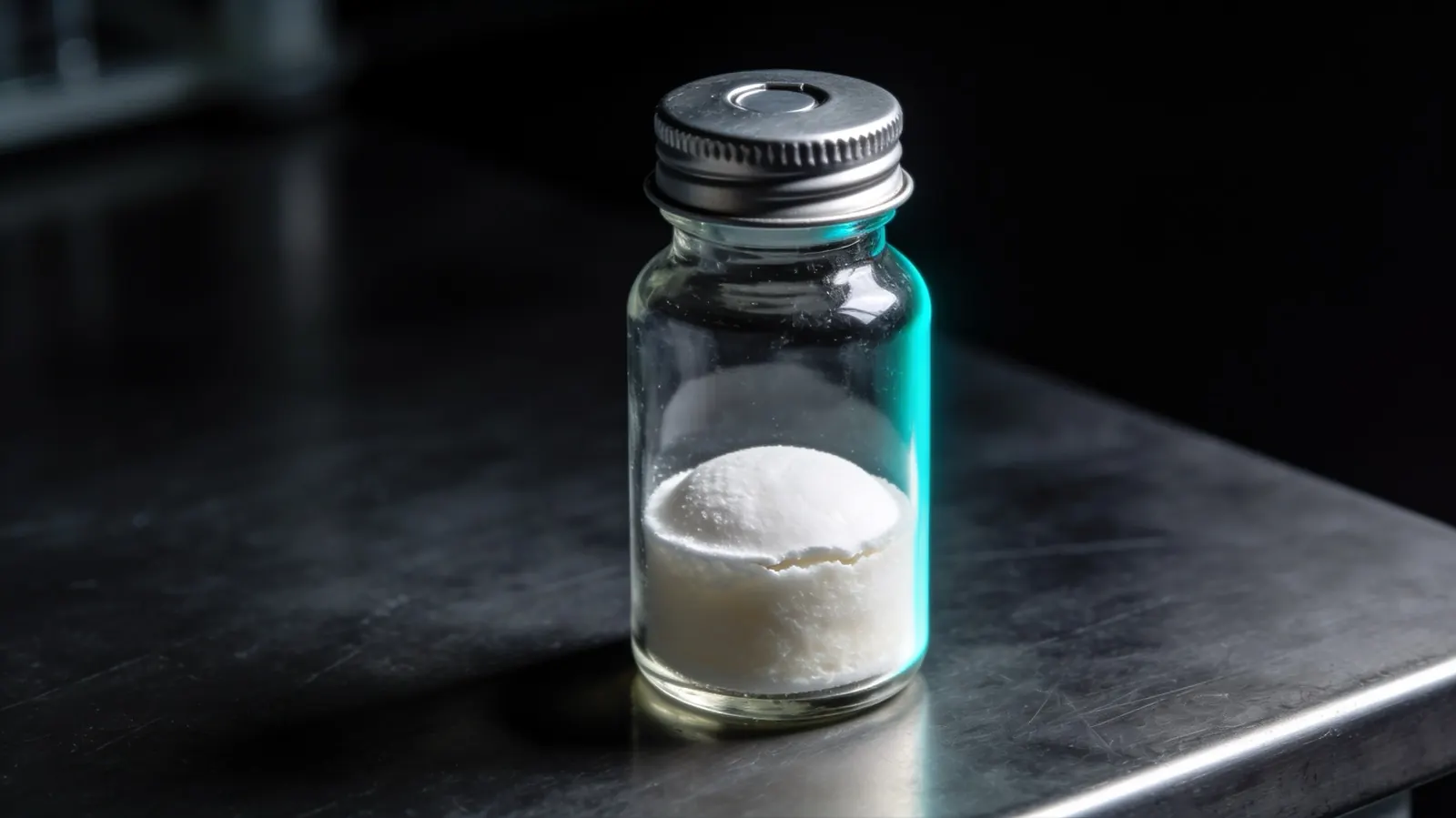
The GLP-3 RT peptide is a synthetic 39-residue acylated chain, CAS 2381089-83-2, formula C221H342N46O68, molecular weight 4731.32 g/mol. It is a single molecule with agonist activity at three receptors, GIP, GLP-1 and glucagon. It is supplied as a lyophilised solid in 10mg, 20mg and 30mg vials for laboratory research only.
- The GLP-3 RT peptide is a synthetic 39-residue acylated chain registered under CAS 2381089-83-2, with the molecular formula C221H342N46O68 and a molecular weight of 4731.32 g/mol. GLP-3 RT is the name on our label and size tiles; the registry number is the identifier that resolves to one structure.
- Structurally it is one molecule carrying agonist activity at three receptors: GIP, GLP-1 and glucagon. That is a statement about which receptors the chain engages, and this page makes no statement of any kind beyond it.
- It is stocked in three fills, 10mg at $99.99, 20mg at $129.99 and 30mg at $159.99, shelved in the catalogue under Metabolic / GLP Research.
- Ten lots of the GLP-3 RT peptide have been released and published, running from 99% to 99.91% by HPLC. Eight were assayed by Freedom Diagnostics and two by pH Solutions, and those two are the only lots in a 51-lot archive that a second laboratory issued.
- Lots Y4AWYQ and 2NPVBM are the only certificates in the whole archive that state identity by retention-time match against a certified reference standard rather than by LC-MS, and the only two that describe the solid as a cake rather than a powder.
- Neither pH Solutions certificate carries an accession number, and neither reports a net peptide content figure. Both report target fill conformance counted vial by vial instead: 337 of 337 on Y4AWYQ and 94 of 94 on 2NPVBM.
What the GLP-3 RT peptide is, in specification terms
A synthetic chain of 39 amino acids carrying a fatty-acid group attached to a side chain along its length. The catalogue sells it as GLP-3 RT, and GLP-3 RT is what is printed on the vial. The compound underneath that product name is registered under CAS 2381089-83-2. Stating the shelf name and the registry number together is the point of this page: a reader who cannot map a shelf name onto a registry number has no way of checking anything.
Its molecular formula is C221H342N46O68 and its molecular weight is 4731.32 g/mol. There is no sulphur in that formula, which is worth noticing rather than skimming past: no cysteine and no methionine anywhere in the 39 residues, so no disulphide bridge can form and neither of the two most readily oxidised side chains is present.
Physically it is supplied as a lyophilised solid, soluble in bacteriostatic water, held at -20°C for the long term and kept out of the light. Our own specification line calls the appearance a white lyophilised powder, and two of the ten published certificates call it a white to off-white lyophilised cake. Both are accurate about the material they were written against, and the reason they differ is a laboratory convention rather than a difference in the vial.
The size ladder runs 10mg at $99.99, 20mg at $129.99 and 30mg at $159.99, all three on the GLP-3 RT product page. Certificates exist for fills that are not on that ladder, including a 12mg, a 24mg, a 48mg and a 60mg, because the same material is released in bulk sizes. Those lots appear in the certificate of analysis library because the documents are real.
By the standards of this catalogue this is a long molecule, and almost everything difficult about it follows from that length and from the acyl group.
- 0
- amino-acid residues in the GLP-3 RT chain
- Serviam Bio Labs specification for GLP-3 RT
- 0 g/mol
- molecular weight, formula C221H342N46O68
- Our label and catalogue record
- 0
- sulphur atoms in the formula, so no disulphide bridge is possible
- Read directly from C221H342N46O68
| Property | Value |
|---|---|
| Catalogue and label name | GLP-3 RT |
| CAS number | 2381089-83-2 |
| Molecular formula | C221H342N46O68 |
| Molecular weight | 4731.32 g/mol |
| Residue count | 39 |
| Backbone | Acylated; a fatty-acid group on a side chain |
| Receptor class | GIP, GLP-1 and glucagon receptor agonist |
| Catalogue category | Metabolic / GLP Research |
| Appearance, our specification | White lyophilised powder |
| Appearance, pH Solutions certificates | White to off-white lyophilised cake |
| Solubility | Soluble in bacteriostatic water |
| Storage as supplied | -20°C long term, protected from light |
| Sizes stocked | 10mg, 20mg and 30mg vials |
| Lot on the product page | Y4AWYQ, 99% by HPLC, released 13 Jul 2026 |
Identity
CAS 2381089-83-2, sold here as GLP-3 RT. A 39-residue acylated backbone with agonist activity at the GIP, GLP-1 and glucagon receptors. That receptor list is the structural classification of the compound and carries no further claim.
Mass and formula
C221H342N46O68, molecular weight 4731.32 g/mol. No sulphur atom appears in the formula, so no residue in the chain is sulphur-bearing and no disulphide bridge is possible.
Supply and handling
Lyophilised solid in 10mg, 20mg and 30mg vials, soluble in bacteriostatic water, stored at -20°C long term and protected from light. The lot quoted on the product page is Y4AWYQ, released at 99% by HPLC.
GLP-3 RT on the label, a CAS number in the registry
Two names for one material is normal in this market and it causes more confusion than anything else. A catalogue name is a shelf name, chosen so a product line reads coherently, and it is indexed nowhere outside the shop that chose it. A registry number is an entry in a chemical index, and it is the only one of the two that will find anything.
GLP-3 RT is the shelf name here. Searching a chemical index for it returns nothing, because no chemical index has heard of it. The registry number does: 2381089-83-2 resolves to one structure and only one, and a number is harder to mistype into something plausible than a name is.
It is worth being plain about the shelf name itself. There is no receptor called GLP-3 in the standard nomenclature, and the molecule does not engage anything by that name. The three it engages are the GIP receptor, the GLP-1 receptor and the glucagon receptor. GLP-3 is a product name gesturing at a third arm, not a fourth hormone.
This page identifies the material by its registry number, formula and mass, and by nothing else. Identification is chemistry: a page that will not say which molecule is in the vial cannot then ask a reader to check a certificate, and a registry number is the identifier that resolves to one structure. Nothing on this page describes an effect in a person or an animal, and nothing here suggests the material is or resembles any approved medicine, because it is neither.
Everything else follows the discipline used for the GHK-Cu copper peptide, the pillar of this library's compound profiles: start at the label, move to the certificate, and stop where the documents stop.
The GLP-3 RT peptide as a triple receptor agonist, stated as structure
The defining structural fact about the GLP-3 RT peptide is that one chain carries agonist activity at three separate receptors. Most engineered peptides in this family are built for one, and a few for two. Three from a single 39-residue sequence is the feature the compound is classified by.
That this is possible at all is a fact about the receptors. The GIP receptor, the GLP-1 receptor and the glucagon receptor are close relatives: all three belong to the class B1 family of G-protein-coupled receptors, and all three are addressed by peptide ligands of recognisably related architecture, binding in two parts with the back end of the peptide in the receptor's extracellular domain and the front end reaching into the transmembrane bundle. A designed chain that satisfies all three is a sequence-engineering result rather than a pharmacological surprise.
The word agonist is a description of binding behaviour: a ligand that occupies a receptor and activates it, as against an antagonist, which occupies it and does not. Saying the compound is a GIP, GLP-1 and glucagon receptor agonist states which three locks the key turns. It states nothing about what any of those receptors goes on to do, and this page does not go on to say.
The second structural feature is the acylation. A fatty-acid group is attached through a linker to a lysine side chain rather than to either end of the chain, a different arrangement from the N-terminal cap on the tesamorelin peptide. For this page the significance of that fatty acid is analytical: it contributes heavily to the molecule's hydrophobicity, it dominates how the compound behaves on a reversed-phase column, and it is therefore much of why retention time is a usable identity handle here at all.
Held against the rest of the catalogue the arithmetic is stark. GLP-3 RT is 39 residues and 4731.32 g/mol. The MOTS-c peptide is sixteen residues at 2174.61 g/mol, and the GHK-Cu tripeptide is three. Length is not a quality ranking; it is a manufacturing problem.
Thirty-nine residues and one acyl group: making the GLP-3 RT peptide
The GLP-3 RT peptide, like almost everything in this category, is built by solid-phase synthesis. The final residue is anchored to a resin bead and the chain is extended one residue at a time, each cycle running deprotect, couple, wash, repeat. A chain of n residues takes n minus one coupling cycles, so a 39-residue sequence is a run of 38 of them.
No coupling goes to completion. Each cycle leaves behind a small fraction of chains that failed to extend, and those failures accumulate, so the proportion of material coming off the resin as the intended sequence falls as the chain lengthens. That is the plain reason short fragments in this catalogue post uniformly high purity figures and long chains are a harder problem.
The failures are awkward to remove as well as to prevent. A chain missing one residue out of 39 differs from the target by a small fraction of its mass and behaves on a column much like it, so preparative reversed-phase HPLC has to resolve species chemically almost identical to the product. What a purity figure does and does not measure is set out in peptide purity: the percentage counts the main peak rather than naming what the rest of the chromatogram is.
The acylation adds a step the short peptides do not have. The fatty acid has to go onto one specific lysine side chain and nowhere else, so that side chain carries a different protecting group, is unmasked on its own at the right moment, and is acylated while everything else stays covered. An acylation that landed on the wrong side chain would produce a molecule of correct mass and wrong structure, which is the class of error a mass measurement alone cannot catch.
Purification leaves its own mark. Preparative HPLC is normally run with trifluoroacetic acid in the mobile phase, so the peptide comes off the column as the trifluoroacetate salt, and that counter-ion is still in the vial when the solid is filled. It is real mass and it is not peptide, which is why net peptide content is measured separately from purity.
The last step is lyophilisation, which removes the water by sublimation under vacuum and leaves a porous solid rather than a dense granular powder. The general behaviour of lyophilized powder covers that in more detail than a compound page usefully can.
Two certificates from a second laboratory
Forty-nine of the 51 lots published in this library were assayed by Freedom Diagnostics. The other two are both lots of this compound, and both were assayed by pH Solutions. That makes the GLP-3 RT peptide the only compound in the catalogue whose archive contains work from two laboratories.
pH Solutions reports under ISO/IEC 17025 accreditation, the international standard for the technical competence of testing laboratories, audited externally and attaching scope by scope to specific methods rather than to the laboratory as a whole. Its purity assay for this compound runs at 274 nanometres, against the 214 nanometres the Freedom Diagnostics certificates use. Both read a real absorbance, and the certificate says which was used.
The purity result is stated differently too. The pH Solutions certificates report a pass against a specification of not less than 99% rather than a figure to decimals, so both lots read a flat 99% in our lot table. The eight Freedom Diagnostics lots of the same compound read between 99.47% and 99.91%. A round number is often called a sign of a fabricated document, and it is a fair heuristic that is not a rule: here it is the house style of an accredited laboratory reporting a conformance result, and those two lots carry microbial, mycotoxin, residual solvent and elemental impurity panels that appear on no Freedom Diagnostics certificate we hold.
Lot Y4AWYQ was released on 13 July 2026 against a 30mg target fill, with 337 of 337 vials conformant. Lot 2NPVBM was released on 9 July 2026 against a 60mg target fill, with 94 of 94 conformant. The 60mg is a bulk fill that is not on the size ladder.
Two omissions are worth naming rather than leaving to be discovered. Neither certificate prints an accession number, and 48 of the 51 lots here do print one. And neither reports a measured net peptide content figure in milligrams; they report fill conformance vial by vial instead, which answers a different question. One document gives a measurement and the other gives a conformance statement, and reading them as though they sat on the same scale is the mistake. Working through any of this field by field is covered in how to read a peptide certificate of analysis, and what the assays cost and measure is in peptide purity testing.
- 0 of 51
- lots in the whole archive assayed by a laboratory other than Freedom Diagnostics, and both are this compound
- Counted across every lot record the site publishes
- 0 of 337
- vials conformant to the 30mg target fill on lot Y4AWYQ
- pH Solutions certificate, released 13 Jul 2026
- 0
- published lots of GLP-3 RT, from 99% to 99.91% by HPLC
- Every one of them is in the COA library
| Field on the certificate | pH Solutions: Y4AWYQ and 2NPVBM | Freedom Diagnostics: the other eight lots |
|---|---|---|
| Purity method | HPLC at 274 nm, reported as a pass against a specification of not less than 99% | RP-HPLC at 214 nm, reported to two or three decimal places |
| Purity result | 99% on both lots | 99.47% to 99.91% across the eight |
| Identity | Retention time matches certified reference standard | Confirmed by LC-MS |
| Content | Target fill conformance, counted vial by vial: 337 of 337 and 94 of 94 | A measured net peptide content figure in milligrams |
| Appearance | White to off-white lyophilised cake | White lyophilised powder |
| Accession number | Not printed on either document | Printed, and searchable on the lot verification page |
| Accreditation recorded | ISO/IEC 17025 | Not recorded in our lot data |
| Additional panels | Microbials, mycotoxins, residual solvents, elemental impurities | Bacterial endotoxin, on three of the eight lots |
Read the two certificates yourself
Both pH Solutions documents and all eight Freedom Diagnostics documents for this compound are published in full, including the bulk fills that are not sold on the size ladder.
Open the certificate libraryRetention time and LC-MS: two ways of stating identity
Identity is the field that answers the only question that really matters, which is whether the material in the vial is the molecule on the label. Purity answers a narrower one: of the material that is there, how much is the main peak.
Across the 51 lots published here, identity is confirmed by LC-MS on 48. Lots Y4AWYQ and 2NPVBM state it as retention time matching a certified reference standard, and they are the only two certificates in the archive that use that wording. So the GLP-3 RT peptide accounts for the entire retention-time population of this library, and a reader who has only ever read Freedom Diagnostics documents meets the method for the first time here.
LC-MS separates the sample chromatographically and then measures the mass of what elutes, giving a number to compare against a calculated figure, which for this compound is 4731.32 g/mol. It is a strong method because mass is intrinsic and does not depend on the column, the gradient or the day.
A retention-time match is comparative rather than absolute. A certified reference standard of known identity is run on the same system under the same gradient, and the sample is run against it. If the main peak comes off at the same time, the sample behaves chromatographically like the standard. For a heavily acylated chain that is a demanding thing to match, because the fatty acid dominates the interaction. What it does not do is weigh the molecule.
Two consequences follow. The result is only as good as the reference standard behind it, so the certificate has to say a certified standard was used, and these do. And it is tied to the system that produced it, which is why it belongs on a lot certificate rather than in a catalogue-wide claim. ICH Q2(R2) sets identification out as its own analytical procedure type with its own specificity requirement, rather than as a by-product of an assay.
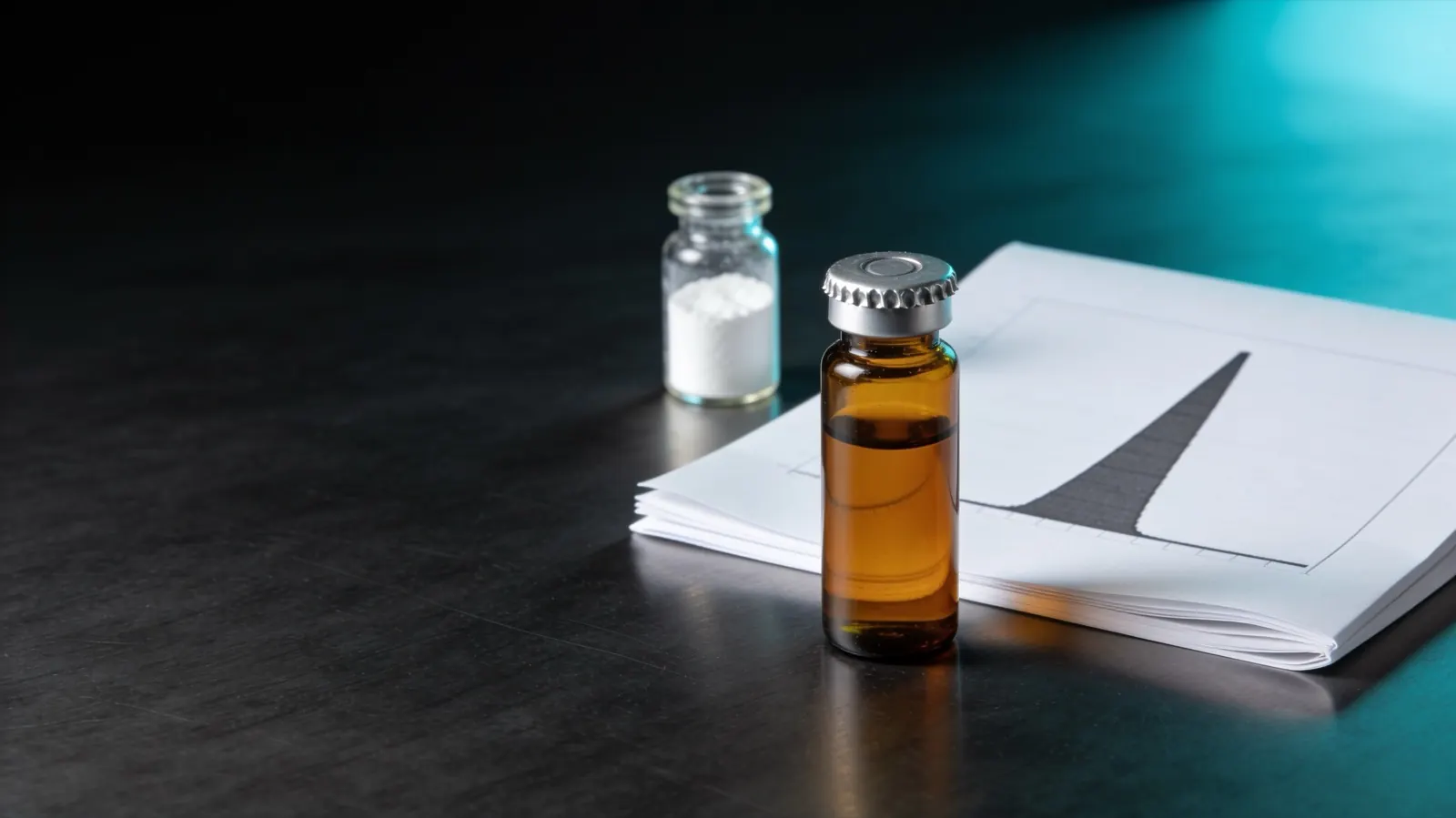
Cake or powder: why the appearance line changes with the laboratory
Forty-nine of the 51 appearance lines in this archive describe a powder. Two describe a cake, and they are the two pH Solutions lots of this compound. The wording is not a disagreement about what is in the vial, but about which stage of the same process the describer chose to name.
Lyophilisation freezes a solution and removes the water as vapour directly from the solid phase under vacuum, without letting it pass through liquid. What that leaves is a porous solid holding the shape of the frozen volume it came from. The word for that solid is a cake, and the FDA's inspection guidance on lyophilised parenterals uses it throughout.
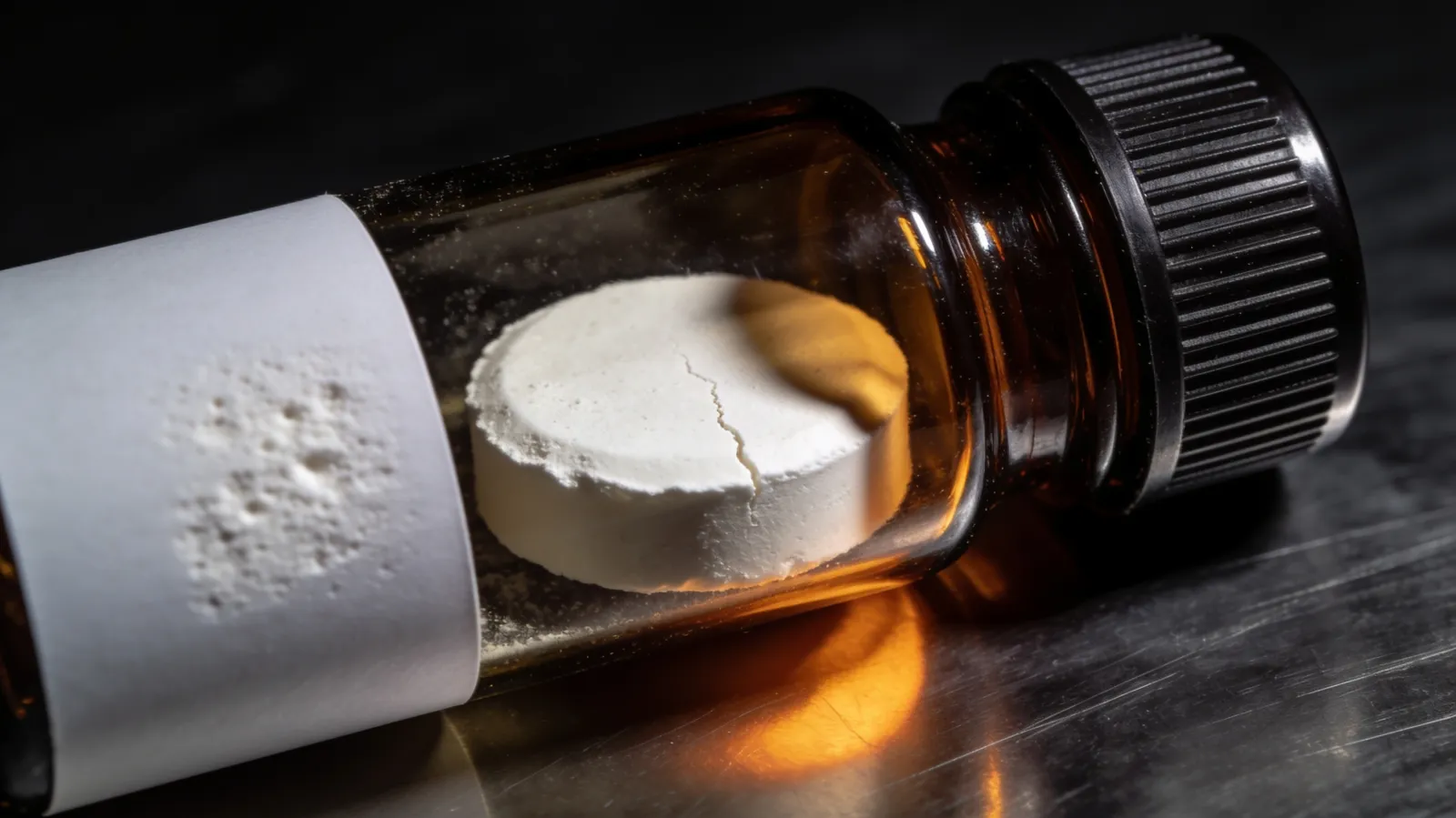
A cake is also fragile. It is mostly void space, it has been through a vacuum cycle, and then it is capped, boxed and moved. A cake that arrives intact looks like a neat disc at the bottom of the vial; one that has been jolted in transit looks like loose white granules, which is to say it looks like a powder. Neither says anything about purity, content or identity.
So a laboratory describing a vial from the filling run reasonably writes cake, and a laboratory describing a vial that has arrived reasonably writes powder. The off-white half of the phrase is ordinary too: lyophilised peptide solids are rarely optically white, and a faint cream cast is normal. A colour outside that range, or a solid slumped into a glassy layer, would be worth stopping over. A cracked or shrunken cake would not.
Appearance is the one field a reader can check against the object in front of them without any equipment, which makes it the field most likely to produce a false alarm. Reading it correctly means knowing that two accurate laboratories will describe one solid two ways.
Storing and handling the GLP-3 RT peptide
As supplied, the GLP-3 RT peptide is a sealed vial of dry solid, and a dry sealed vial is a robust object. It travels at ambient temperature without harm, which is why it arrives with no dry ice and no cold packs, and a vial warm to the touch on arrival has not been damaged by that alone. The -20°C on the label is a long-term storage condition, not a shipping requirement.
The long-term condition is -20°C, protected from light, with 2 to 8°C acceptable for short-term handling. Repeated freeze-thaw cycling is the thing genuinely worth avoiding, because the damage accumulates rather than reversing. The practical answer is to decide how much of a vial is needed before it is opened rather than after.
Light protection matters more for some sequences than others, and this one is comparatively well placed, with no methionine and no cysteine in the chain. That is not a reason to leave a vial in the sun. It is a reason to read the storage line as a general standard for lyophilised peptides, and the general case is set out in how to store peptides.
One thing this library does not publish is a shelf-life figure for reconstituted material, for this compound or any other. We have not measured one, and a number we have not measured is not worth printing.
- 0°C
- long-term storage for the sealed GLP-3 RT vial, protected from light
- Serviam Bio Labs specification for GLP-3 RT
- 0 to 8°C
- acceptable range for short-term handling of the sealed vial
- Our catalogue storage line
Reconstitution arithmetic for the GLP-3 RT peptide
Turning a lyophilised solid into a stock solution for laboratory work is arithmetic and handling, and nothing in this section should be read as anything else. It describes the preparation of a laboratory stock for in-vitro work and no other procedure of any kind.
The diluent ordinarily used for a lyophilised research peptide is bacteriostatic water, sterile water carrying 0.9% benzyl alcohol as a preservative, and the reasoning is set out in bacteriostatic water for peptides. Our specification lists the GLP-3 RT peptide as soluble in it.
The handling is the same as for any porous cake. Run the diluent down the inside wall of the vial rather than onto the face of the solid, because a stream landing on a porous disc breaks it apart and generates foam, and an air-liquid interface full of foam is where peptides denature. Then swirl gently until it clears. Do not shake it. A well-made cake usually clears in under a minute, and when it does not the answer is time rather than force, warming or a vortex mixer.
The arithmetic is one division: the mass of peptide in the vial divided by the volume of diluent added. The part that catches people is which mass to use, and for this compound it catches them in a specific way.
On the eight Freedom Diagnostics lots there is a measured net peptide content figure, and it should be used in preference to the label. Lot PSNN1N measured 9.68mg in a 10mg fill, so 2mL of diluent gives 4.84 mg/mL rather than the 5.00 mg/mL the label arithmetic implies, while lot K3BQAA measured 10.96mg in the same nominal fill and gives 5.48 mg/mL from the same 2mL.
On the two pH Solutions lots there is no content figure at all, only conformance to a target fill. Arithmetic on those lots has to start from the nominal fill, and anyone quoting a concentration derived that way should say so. The table below is nominal for that reason, and the peptide calculator will do the same division against whichever figure is entered.
| Diluent added | 10mg fill | 20mg fill | 30mg fill |
|---|---|---|---|
| 1.0 mL | 10.00 mg/mL | 20.00 mg/mL | 30.00 mg/mL |
| 2.0 mL | 5.00 mg/mL | 10.00 mg/mL | 15.00 mg/mL |
| 3.0 mL | 3.33 mg/mL | 6.67 mg/mL | 10.00 mg/mL |
| 5.0 mL | 2.00 mg/mL | 4.00 mg/mL | 6.00 mg/mL |
Where the GLP-3 RT peptide sits in this catalogue
GLP-3 RT is shelved under Metabolic / GLP Research, alongside GLP-1, which is a single-receptor agonist on a different and shorter acylated scaffold, and near MOTS-c, which is a sixteen-residue mitochondrial-derived sequence and not a receptor agonist of this family at all. The Metabolic Reference Set dispatches this compound and MOTS-c together as lot-matched vials.
Set against the library's profile pillar the contrast is useful. The GHK-Cu copper peptide is three residues and a copper ion at 403.94 g/mol, the shortest molecule the catalogue sells. This compound is 39 residues and 4731.32 g/mol with a fatty acid hung off a side chain. Between them they bracket almost the whole range of what a research peptide can be, and both pages are built the same way.
One consequence of sitting at the long end of that range is price, and the ladder reads better per milligram than per vial: $10.00, $6.50 and $5.33 per milligram for the 10mg, 20mg and 30mg fills respectively. That is the ordinary shape for a synthesis where the fixed cost of a run dominates the marginal cost of material.
For anyone arriving at the GLP-3 RT peptide from a search rather than from the shop, the two pages worth opening next are the certificate of analysis library, which holds all ten documents, and the lot verification page, which takes a code from a vial label and returns the certificate for that batch. A lot code that returns nothing is worth stopping over, whoever sold it.
The GLP-3 RT peptide, stated plainly: the compound sold here as GLP-3 RT, CAS 2381089-83-2, a 39-residue acylated chain of formula C221H342N46O68 and molecular weight 4731.32 g/mol, classified by its agonist activity at the GIP, GLP-1 and glucagon receptors. Ten lots have been released and published, eight by Freedom Diagnostics between 99.47% and 99.91% and two by pH Solutions at a flat 99% under ISO/IEC 17025, and those two are the only certificates in a 51-lot archive that state identity by retention-time match and describe the solid as a cake. The figures worth reading are the ones on the certificate for the lot in front of you rather than the ones on any catalogue page. The material is stocked as 10mg, 20mg and 30mg vials and is supplied strictly for in-vitro laboratory research use, not as a medicine and not for use in humans or animals.
Common questions
What is the GLP-3 RT peptide?
The GLP-3 RT peptide is a synthetic 39-residue acylated peptide registered under CAS 2381089-83-2, with the molecular formula C221H342N46O68 and a molecular weight of 4731.32 g/mol. It is classified as an agonist at the GIP, GLP-1 and glucagon receptors, and it is supplied for in-vitro laboratory research only.
How is GLP-3 RT identified chemically?
By its registry number, CAS 2381089-83-2, which resolves to a single structure, together with its formula C221H342N46O68 and molecular weight 4731.32 g/mol. GLP-3 RT is the product name on our label and size tiles; the registry number is what a certificate is checked against.
What does the GLP-3 RT peptide do?
This page does not answer that question, and the omission is deliberate. What can be stated is structural: the GLP-3 RT peptide is classified as an agonist at three receptors, GIP, GLP-1 and glucagon. Nothing on this site describes an effect in a person or an animal, because this is in-vitro laboratory material and not a medicine.
What is the molecular formula and mass of the GLP-3 RT peptide?
The formula is C221H342N46O68 and the molecular weight is 4731.32 g/mol. There is no sulphur atom in the formula, so no residue in the 39-residue chain is sulphur-bearing and no disulphide bridge can form.
How many amino acids does the GLP-3 RT peptide have?
Thirty-nine, in an acylated backbone: a fatty-acid group is attached through a linker to a lysine side chain rather than to either end of the chain. At 39 residues and 4731.32 g/mol it is one of the longest molecules in this catalogue.
What does triple agonist mean?
It means one molecule activates three different receptors rather than one. For this compound those receptors are the GIP receptor, the GLP-1 receptor and the glucagon receptor. All three belong to the class B1 family of G-protein-coupled receptors, which is the structural reason a single engineered sequence can be made to fit all three.
Is there a receptor called GLP-3?
No. There is no GLP-3 receptor in the standard nomenclature. GLP-3 RT is a product name on a shelf, not a pharmacological classification, and the three receptors the molecule actually engages are GIP, GLP-1 and glucagon.
What purity is GLP-3 RT released at?
Ten lots have been released and published, running from 99% to 99.91% by HPLC. The eight assayed by Freedom Diagnostics read between 99.47% and 99.91%. The two assayed by pH Solutions read a flat 99%, because that laboratory reports a pass against a specification of not less than 99% rather than a figure to decimals. The number for the vial you hold is on its own certificate.
Why do two certificates say 99% exactly?
Because pH Solutions states purity as conformance to a specification of not less than 99% rather than as a measured figure to two or three decimals. A flat 99% is often said to be a sign of a fabricated document, and it is a fair heuristic that is not a rule. Here it is the reporting style of an ISO/IEC 17025 accredited laboratory, and those two lots carry more test panels than any other lot in the archive.
Why is there no accession number on lots Y4AWYQ and 2NPVBM?
Because the pH Solutions certificate format does not carry that field. Forty-eight of the 51 lots published here print an accession number and three do not, and two of those three are these. The certificates are published in full and can be opened from the certificate library, so the absent field is a difference in document format rather than a gap in the record.
Why does the certificate say cake when the catalogue says powder?
Both are accurate about the same material. Lyophilisation leaves a porous cake, which is the technically correct term and the one the pH Solutions certificates use. That cake is fragile, and a vial that has been moved often arrives as loose granules, which is what our specification line describes as a white lyophilised powder. Neither description says anything about purity, content or identity.
What does identity by retention time mean on a certificate?
It means a certified reference standard of known identity was run on the same chromatographic system under the same conditions, and the sample's main peak came off at the same time. It is comparative evidence of chromatographic behaviour rather than a mass measurement. Lots Y4AWYQ and 2NPVBM are the only two certificates in this library that state identity that way; 48 of the 51 use LC-MS instead.
Is a retention-time match weaker than LC-MS?
It is different rather than simply weaker. LC-MS measures an intrinsic property, the mass, which does not depend on the column or the day. A retention-time match measures how the molecule interacts with the stationary phase against a certified standard run alongside it, which for a heavily acylated chain is a demanding match to make. Its limitation is that it does not weigh the molecule, and its strength is that it tests something a mass measurement does not.
Why is there no net peptide content figure on the pH Solutions certificates?
Because those documents report target fill conformance instead, counted vial by vial: 337 of 337 on lot Y4AWYQ and 94 of 94 on lot 2NPVBM. That answers how reliably the filling run hit its target rather than what fraction of the solid is peptide. The eight Freedom Diagnostics lots of the same compound do carry a measured content figure in milligrams.
What sizes of GLP-3 RT are sold?
Three: 10mg at $99.99, 20mg at $129.99 and 30mg at $159.99, all on the product page. Certificates exist for 12mg, 24mg, 48mg and 60mg fills as well, because the same material is released in bulk sizes for wholesale. Those lots appear in the certificate table and are not sold on the size ladder.
How is the GLP-3 RT peptide stored?
The sealed vial is held at -20°C for long-term storage and protected from light, with 2 to 8°C acceptable for short-term handling. Repeated freeze-thaw cycling should be avoided, because the damage accumulates rather than reversing. We do not publish a shelf-life figure for reconstituted material, here or anywhere else in the library, because we have not measured one.
Does GLP-3 RT need to ship cold?
No. A sealed lyophilised vial is a dry solid and travels at ambient temperature without harm, so it arrives without dry ice or cold packs. The -20°C on the label is a long-term storage condition rather than a shipping requirement, and a vial that arrives warm to the touch has not been damaged by that alone.
How is the GLP-3 RT peptide reconstituted?
With bacteriostatic water, directed down the inside wall of the vial rather than onto the face of the cake, then swirled gently until clear and never shaken. The resulting stock concentration is the mass of peptide in the vial divided by the volume of diluent added. On a lot with a measured net peptide content figure, use that figure; on the two pH Solutions lots there is none, so the arithmetic starts from the nominal fill and should be described as nominal.
Why is a 39-residue chain harder to make than a short peptide?
Because it takes 38 coupling cycles, each of which leaves behind a small proportion of chains that failed to extend, and those failures accumulate. A chain missing one residue out of 39 also behaves on a column very much like the target, so purification has to separate species that are chemically almost identical. The acylation adds a further step, since the fatty acid has to land on one specific side chain and nowhere else.
Who tests GLP-3 RT, and are the laboratories independent?
Two independent laboratories with no stake in the sale. Freedom Diagnostics assayed eight of the ten published lots, and pH Solutions, which reports under ISO/IEC 17025 accreditation, assayed the other two. This is the only compound in the catalogue with certificates from more than one laboratory, and all ten documents are published in the certificate library.
How do I check a GLP-3 RT lot number myself?
Read the lot code printed on the vial label and enter it on the lot verification page. The certificate for that specific batch comes back with its purity result, its identity result, the testing laboratory and the release date. A lot code that returns nothing is worth stopping over, whoever sold the vial.
Is the GLP-3 RT peptide legal to buy for research?
It is supplied as in-vitro laboratory material, not as a pharmaceutical, and it is not for human or veterinary use in any form. Purchasers are responsible for compliance with the rules that apply where they are and within their own institution, and handling belongs inside a chemical hygiene plan. We make no claim about any use other than laboratory research.
Is this material the same as an approved medicine?
No. This is research-grade material sold for in-vitro laboratory work. It is not an approved medicine, it is not a substitute for one, and nothing on this page should be read as suggesting otherwise. The only claims made here concern the chemistry of the molecule and the contents of the certificates we publish.
Why does this page identify the material by CAS number?
Because identification is chemistry. A page that will not say which molecule is in the vial cannot then ask a reader to check a certificate against it, and a registry number is the only identifier that resolves to one structure. That is all the registry number is for: this page makes no claim about what the molecule does.
What is the difference between GLP-3 RT and the GLP-1 product in the same category?
They are different molecules on different scaffolds. GLP-1 is listed here as a single-receptor agonist, an acylated chain of formula C187H291N45O59 and 4113.58 g/mol under CAS 910463-68-2. GLP-3 RT is a 39-residue acylated chain of 4731.32 g/mol classified as an agonist at three receptors rather than one. That is a structural comparison and not a comparison of anything else.
- ICH Q6A, Specifications: Test Procedures and Acceptance Criteria (FDA): the framework behind a certificate that reports conformance to an acceptance criterion, such as not less than 99%, rather than a measured figure
- ICH Q2(R2), Validation of Analytical Procedures (FDA): identification set out as its own analytical procedure type with its own specificity requirement, which is what separates a retention-time match from an LC-MS confirmation
- FDA, Lyophilization of Parenteral, Inspection Technical Guide: the sublimation step that leaves a porous cake rather than a loose powder, and why cake appearance varies between vials and between lots
- PubChem CID 244, benzyl alcohol: the identity of the 0.9% preservative in the bacteriostatic water named as the diluent in the reconstitution section
Read more
- GHK-Cu copper peptideA GHK-Cu copper peptide vial is blue, and every other vial in this catalogue is white. The colour is not a dye. It is the evidence that the complex formed.
- Tesamorelin peptideThe tesamorelin peptide is the whole 44-residue growth-hormone-releasing hormone sequence with one small group attached at the front. That group is the point of the molecule.
- The BPC-157 peptideThe BPC-157 peptide is fifteen residues long, and seven of those residues are proline or glycine. For a chain this short, that composition is the most interesting thing about it.
- What is the MOTS-c peptide?The MOTS-c peptide has a gene, and the gene is not in the nucleus. That is the first unusual thing about it, and most of the reason 16 amino acids were worth naming.
- Ipamorelin peptideThe ipamorelin peptide contains three pieces no natural protein would supply. Read the sequence and the rest follows: this is a designed molecule, not a fragment of anything, and its identity is a matter of registry record.
- NAD+ peptide: a coenzyme, not a peptideNAD+ peptide is how the compound is usually searched for, and the word peptide is the wrong word. NAD+ is a dinucleotide coenzyme with no amino acids in it at all.

For laboratory research use only. All compounds listed on this site are sold strictly as reference materials for in-vitro laboratory research conducted by qualified professionals. They are not drugs, foods, cosmetics, or medical devices. They are not intended for human or veterinary consumption, therapeutic use, diagnostic application, or any in-vivo use whatsoever. These statements have not been evaluated by the Food and Drug Administration. By purchasing, you affirm that you are a qualified researcher and that you will comply with all applicable institutional, local, state and federal regulations governing the handling of research chemicals. Published by SERVIAM BIO LABS.