

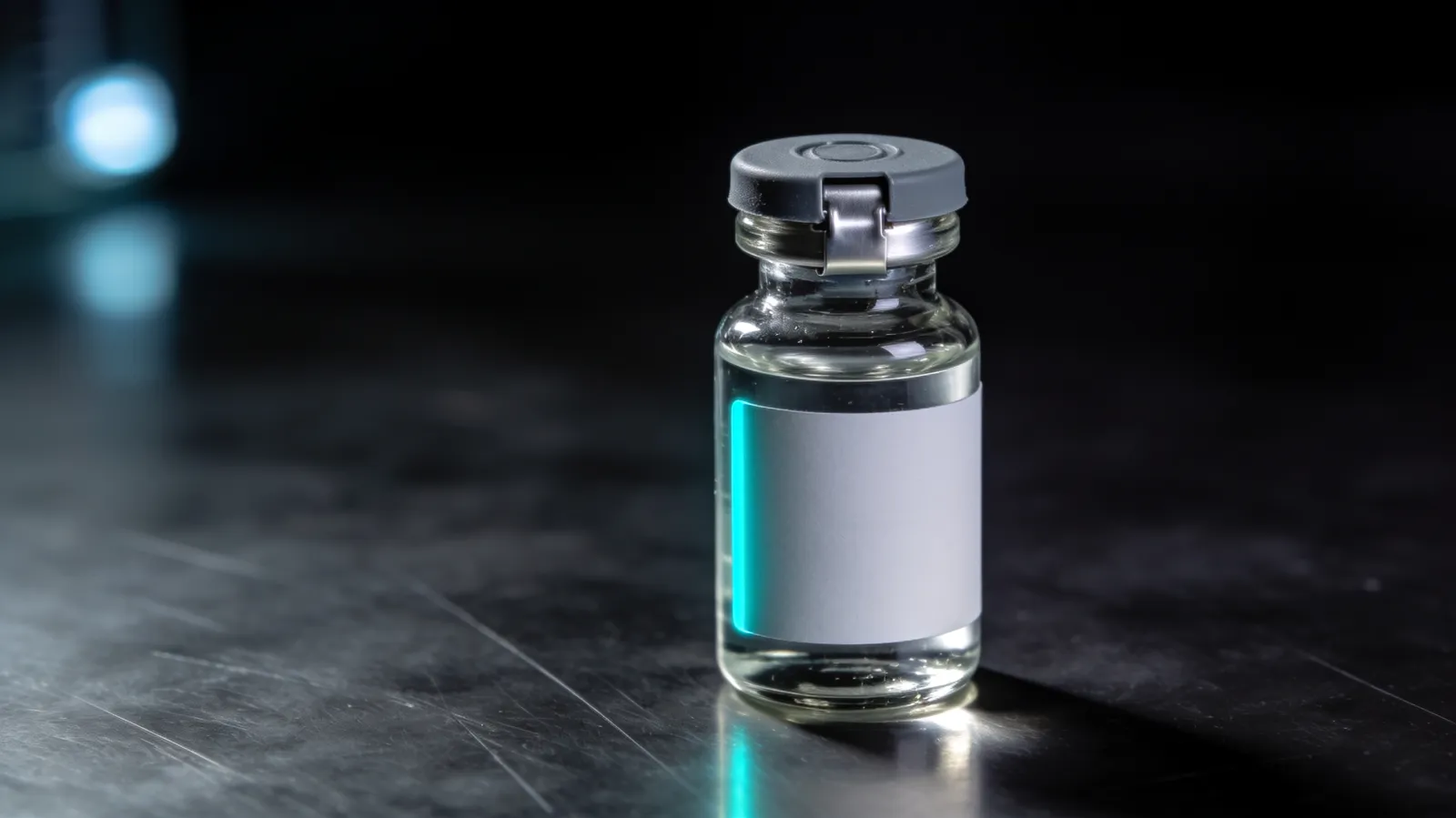
What is bacteriostatic water? It is sterile water containing 0.9% benzyl alcohol, 9 mg/mL, which inhibits the growth of bacteria that enter the vial. The preservative is what allows a multiple-dose container to be entered more than once. Without it, sterile water is single-use: sterile when sealed, and no longer guaranteed sterile after the first puncture.
- What is bacteriostatic water, in one line: sterile water with one thing added, benzyl alcohol at 0.9% by volume, 9 mg/mL, with no buffer, no salt and no tonicity agent in it.
- Bacteriostatic means the preservative holds bacterial growth in check rather than killing it, so a vial that has been contaminated stays contaminated.
- The preservative is the entire reason the vial is classed as multiple-dose. Plain sterile water is single-use from the moment its seal is broken, which is the whole of sterile water vs bacteriostatic water.
- A vial worth buying states five things on the glass itself rather than only on the carton: USP grade, benzyl alcohol 0.9%, nonpyrogenic, a lot number and an expiry date.
- Two separate clocks end a vial: the printed expiry on the sealed product, and the in-use period that starts at first entry, conventionally 28 days. Whichever arrives first finishes it, and bacteriostatic water storage sets both of them out in full.
What is bacteriostatic water made of
Two components. Water for injection, purified and sterilised to the standard set out in the United States Pharmacopeia, and benzyl alcohol at 0.9% by volume, which is 9 mg/mL. Nothing else: no buffer, no salt, no tonicity agent. The liquid is clear and colourless, and the FDA label for the reference drug product gives its pH as 5.7 against a specification range of 4.5 to 7.0.
That 0.9% figure is not arbitrary. It is the concentration at which benzyl alcohol reliably suppresses bacterial growth while staying low enough not to interfere with most of what the water is used to dissolve. It is the standard concentration across the category, which is why a vial claiming to be bacteriostatic water and not stating 0.9% benzyl alcohol is worth a second look.
The absences are as deliberate as the contents. There is no buffer because a buffer is a salt, and a salt in the diluent is a salt in everything measured afterwards. There is no tonicity agent for the same reason. A diluent's job is to disappear into the background of whatever is dissolved in it, and each component added to the water is one more peak, one more ion and one more interaction to account for downstream.
Written out, the answer to what is bacteriostatic water is unusually short: two ingredients, one concentration, one pH range, one appearance and two tests, sterility and pyrogens. That brevity is the point. Almost everything that goes wrong with this product goes wrong in the container or the handling rather than in the chemistry, which is why the rest of this page spends more time on closures and clocks than on the liquid itself.
- 0 mg/mL
- benzyl alcohol in the vial, which is 0.9% by volume written as a mass concentration
- FDA label for the reference drug product, DESCRIPTION section, via DailyMed
- pH 5.7
- typical pH of the liquid, against a specification range of 4.5 to 7.0
- FDA label for the reference drug product, via DailyMed
- 0 µm
- filtration our own vials are finished through before sealing
- Serviam Bio Labs product specification
| Component | Concentration | Function |
|---|---|---|
| Water for injection USP | Balance of the volume | Vehicle: the thing being preserved |
| Benzyl alcohol | 0.9% v/v, or 9 mg/mL | Bacteriostatic preservative |
| Buffer | None | Not applicable |
| Salt or tonicity agent | None | Not applicable |
| pH | 5.7 typical, 4.5 to 7.0 specified | Near-neutral; no adjustment made |
Bacteriostatic, not bactericidal
The distinction is real. Benzyl alcohol stops bacteria multiplying; it does not sterilise a contaminated vial. A vial that has been compromised stays compromised.
USP grade
A monograph exists for this liquid. USP grade means the product was made and tested against it. A vial with no grade stated has no specification to be measured against.
Multiple-dose container
The preservative is what earns the vial that label. It is the functional difference between a vial you enter once and a vial you enter repeatedly.
Benzyl alcohol, the molecule doing the work
Benzyl alcohol is C7H8O, a benzene ring carrying a single CH2OH group, with a molecular weight of 108.14 g/mol and CAS number 100-51-6. It is a colourless liquid with a faint aromatic smell, and it is only moderately soluble in water, roughly 40 mg/mL at room temperature. At 9 mg/mL the vial sits at about a quarter of that, comfortably in solution and nowhere near coming back out of it.
Every time a needle passes through a vial's rubber stopper, it carries the possibility of introducing organisms from the air or the surface of the closure. In plain sterile water those organisms have an ideal environment: neutral pH, room temperature, nothing to stop them. In bacteriostatic water they enter a solution that suppresses their replication.
The mechanism is physical rather than biochemical. Benzyl alcohol partitions into lipid membranes and disorders them, which is why it acts across a broad range of organisms and why the effect falls away with dilution rather than simply slowing down. Suppression is still the correct word: it is bacteriostatic rather than bactericidal, holding a population in check rather than eliminating it. That is enough to make repeated entry into one vial reasonable over a defined period, and it is not enough to rescue a vial that has been visibly contaminated or left open.
The preservative has consequences beyond the microbiology. Where a protocol specifies preservative-free diluent, bacteriostatic water is the wrong liquid, and that is the reason plain sterile water still exists as a separate product rather than a legacy one. Sterile water vs bacteriostatic water sets the two side by side.
The word bacteriostatic on a label is a claim, and claims of that kind are substantiated by a test rather than by the recipe. For preserved pharmacopoeial products that test is an antimicrobial effectiveness challenge: the product is deliberately inoculated with specified organisms, then sampled at intervals over 28 days to show the population is held down rather than growing. That test is what the word on the label claims, and it is not where the 28-day in-use period comes from: that figure is the default beyond-use date USP General Chapter <797> applies to an entered multiple-dose container, reinforced by CDC injection-safety guidance. It is a property demonstrated in a finished, sealed container under laboratory conditions, not a promise that any particular vial on any particular bench will behave the same way once it has been opened and entered repeatedly.
There is a second, quieter consequence that almost nobody writes down. An aromatic ring absorbs ultraviolet light, and benzyl alcohol absorbs strongly at the short wavelengths a reversed-phase HPLC method reads at: the purity method behind our own certificates runs at 214 nm, and peptide purity testing sets out how that method works. A preserved diluent is therefore the wrong liquid for preparing a sample that is about to be read by UV detection, not because it harms the material but because it turns up in the chromatogram alongside it.
| Property | Value | Why it matters here |
|---|---|---|
| Molecular formula | C7H8O | An aromatic alcohol rather than an alkyl one: the ring is what absorbs UV |
| Molecular weight | 108.14 g/mol | Small and freely mobile; it distributes evenly through the vial |
| CAS number | 100-51-6 | The identifier to match on a supplier's specification sheet |
| FDA UNII | LKG8494WBH | The identifier used on US drug labelling |
| Solubility in water | ≈40 mg/mL at room temperature | 9 mg/mL is roughly a quarter of saturation |
| Concentration in the vial | 0.9% v/v, or 9 mg/mL | The figure every legitimate label states |
| Action | Bacteriostatic, not bactericidal | Holds growth in check; does not sterilise a contaminated vial |
Nonpyrogenic is not a synonym for sterile
Sterile and nonpyrogenic are two different tests, and a label carrying only the first has told you less than it appears to. Sterile means nothing in the vial is alive. Nonpyrogenic means the liquid has been tested for pyrogens and found below a stated limit, measured in endotoxin units per millilitre. The pyrogen that matters here is bacterial endotoxin, the lipopolysaccharide fragment that Gram-negative bacteria leave behind after they die.
The distinction matters because the two are dealt with by different means. An autoclave at 121°C kills organisms; endotoxin is heat-stable and comes through the cycle intact. Destroying it takes dry heat at around 250°C, or a removal step built for the purpose. Water boiled, distilled or autoclaved on a bench may therefore be perfectly sterile and still not be nonpyrogenic, and nothing about its appearance will tell you which.
This is the real argument against laboratory distilled water as a substitute, and it is usually made badly. The objection is not that distilled water is dirty. It is that distillation is a purification step with no sterility test, no endotoxin test, no monograph, no lot number and no container-closure integrity behind it: five missing documents rather than one missing property.
The same logic runs through the rest of this catalogue. Endotoxin appears on our peptide lot certificates as a pass against a stated limit of 0.05 EU/mL where the lot was tested for it, rather than as a universal figure printed on a product page, because a specification the accompanying certificate does not substantiate is worse than no specification at all. The certificates are published in full, and any lot can be looked up by its number.
- 0°C
- steam sterilisation temperature, which kills organisms and leaves endotoxin intact
- conventional autoclave cycle, 15 minutes
- 0°C
- dry-heat temperature at which endotoxin is destroyed rather than merely killed
- conventional depyrogenation cycle, 30 minutes
- 0 EU/mL
- endotoxin limit our peptide lot certificates report a pass against
- archived certificates, published at /coa
What is bacteriostatic water against sterile water, saline and distilled
Four liquids get called water in this context, and only two of them are ever interchangeable. Asking what is bacteriostatic water against each of the other three settles most of the substitution questions at once. Bacteriostatic water and sterile water for injection are the same product one ingredient apart. Sodium chloride 0.9% is a different product with a solute in it. Distilled or deionised water is a laboratory utility rather than a pharmacopoeial article at all.
Saline comes up constantly, mostly because of a coincidence in the numbers: both labels read 0.9%, and in one it is salt and in the other it is benzyl alcohol. Sodium chloride at 9 mg/mL puts roughly 308 mOsm/L of solute into the liquid, and that solute travels into everything measured downstream. Plain saline also carries no preservative unless the label specifically reads bacteriostatic sodium chloride. That is a separate product, easy to buy by mistake, and sterile water vs bacteriostatic water sets the pair out properly.
The shortest way to hold all four apart: distilled is purified, sterile is purified and certified free of living organisms and pyrogens, bacteriostatic is that plus a preservative, and saline is a different product with salt in it.
| Property | Bacteriostatic water USP | Sterile water for injection USP | Sodium chloride 0.9% | Distilled / deionised water |
|---|---|---|---|---|
| Preservative | Benzyl alcohol | None | None unless labelled bacteriostatic | None |
| Preservative concentration | 0.9% v/v, or 9 mg/mL | Not applicable | Not applicable | Not applicable |
| Dissolved solute | None | None | Sodium chloride, 9 mg/mL | None specified |
| Osmolarity | Essentially zero | Essentially zero | ≈308 mOsm/L | Essentially zero |
| pH | 5.7 typical (4.5 to 7.0) | 5.5 typical (5.0 to 7.0) | Near neutral | Uncontrolled |
| Container classification | Multiple-dose | Single-dose | Single-dose unless preserved | Not a dose container |
| Entries after first puncture | Repeated, within the in-use period | One | One | Not applicable |
| In-use period | Conventionally 28 days | None | None | None |
| USP monograph | Yes | Yes | Yes | No |
| Nonpyrogenic | Yes, tested | Yes, tested | Yes, tested | Not certified |
| Suitable where a method says preservative-free | No | Yes | No | No |
| Typical presentation | 3, 10 and 30 ml vials | 2 to 10 ml ampoules and vials | 10 ml vials and larger | Laboratory bottles |
| Stocked here | 3 ml and 10 ml vials | No | No | No |
Reading the label on a vial
Five things should be printed on it, and a vial missing any of them is telling you something. The contents and concentration, sterile water with benzyl alcohol 0.9%, stated rather than implied by the product name. The grade, USP, which is the specification the product was tested against. The word nonpyrogenic, which is a second test and not a restatement of the first. A lot number, so the vial traces back to a batch. And an expiry date on the vial itself, not only on the carton it came in.
The closure is worth a glance too. A sealed vial has an intact flip-off cap over the stopper, and the stopper should sit flush. A cap that is loose, or a stopper that has lifted, is a vial to set aside whatever the label says.
One line on a US label confuses more people than the rest put together: Rx only. It is not a statement about the chemistry, which is identical either way. It is the marking a prescription drug product carries in the United States, and it is the whole reason the same liquid appears behind a pharmacy counter in one channel and on a laboratory-supply shelf in another. That split is the next section.
| What the label says | What it means | What its absence tells you |
|---|---|---|
| USP | Made and tested against the United States Pharmacopeia monograph | No published specification stands behind the contents |
| Benzyl alcohol 0.9% | The preservative and its concentration, stated rather than implied | The vial has not told you what is in it |
| Multiple-dose | The container is intended for repeated entry, which only a preservative permits | Treat it as single-dose |
| Nonpyrogenic | Tested for endotoxin, not merely sterilised | Sterility alone was tested, if anything was |
| Lot number | The vial traces back to one manufacturing batch | Nothing to trace, recall or query |
| Expiry on the vial, not only the carton | The sealed-product clock survives the packaging | The clock is thrown away with the box |
| Rx only | A US prescription drug product, dispensed by a pharmacy | Likely a laboratory-supply label rather than a drug label |
| Intact flip-off cap, stopper flush | Container-closure integrity, the thing actually keeping it sterile | Set the vial aside whatever else the label says |
Container, closure and the formats it comes in
The liquid is not what keeps the vial sterile. The closure is. A vial is a container, a rubber stopper compressed against its rim, an aluminium seal crimped over the stopper and a plastic flip-off cap over that. Container-closure integrity, meaning the seal holding through temperature change, pressure change and repeated puncture, is the property doing the work, and it is the property a frozen, cracked or lifted vial has lost regardless of what the label still says.
Two container materials are in general use. Type I borosilicate glass is the default for small vials: inert, transparent and easy to inspect against a light. The 30 ml reference product uses something different. The FDA label describes a semi-rigid polyolefin container, an ethylene and propylene copolymer, which is lighter and will not shatter.
That 30 ml vial is the one most people are picturing when they search for this. The reference product in the United States is the Hospira multiple-dose plastic fliptop vial, now under Pfizer, listed on DailyMed under NDA 018802 with NDC 0409-3977-01 for the single vial and 0409-3977-03 for a tray of 25. It is worth naming because every other label in the category is written against it: when a vial states USP grade and benzyl alcohol 0.9%, that is the specification it is matching.
Volume is the last decision and the easiest to get wrong at the point of ordering. Common sizes are 3 ml, 10 ml and 30 ml, and the in-use period applies to the whole vial from first entry regardless of which one you bought. A 30 ml vial sampled a little at a time is mostly a 30 ml vial that gets discarded, which is why the largest vial is rarely the most economical and why ours are supplied in 3 ml and 10 ml. Which volume a given piece of work needs follows from the concentration it is trying to reach, and the peptide calculator works that out from the vial strength in mg and the diluent volume in mL.
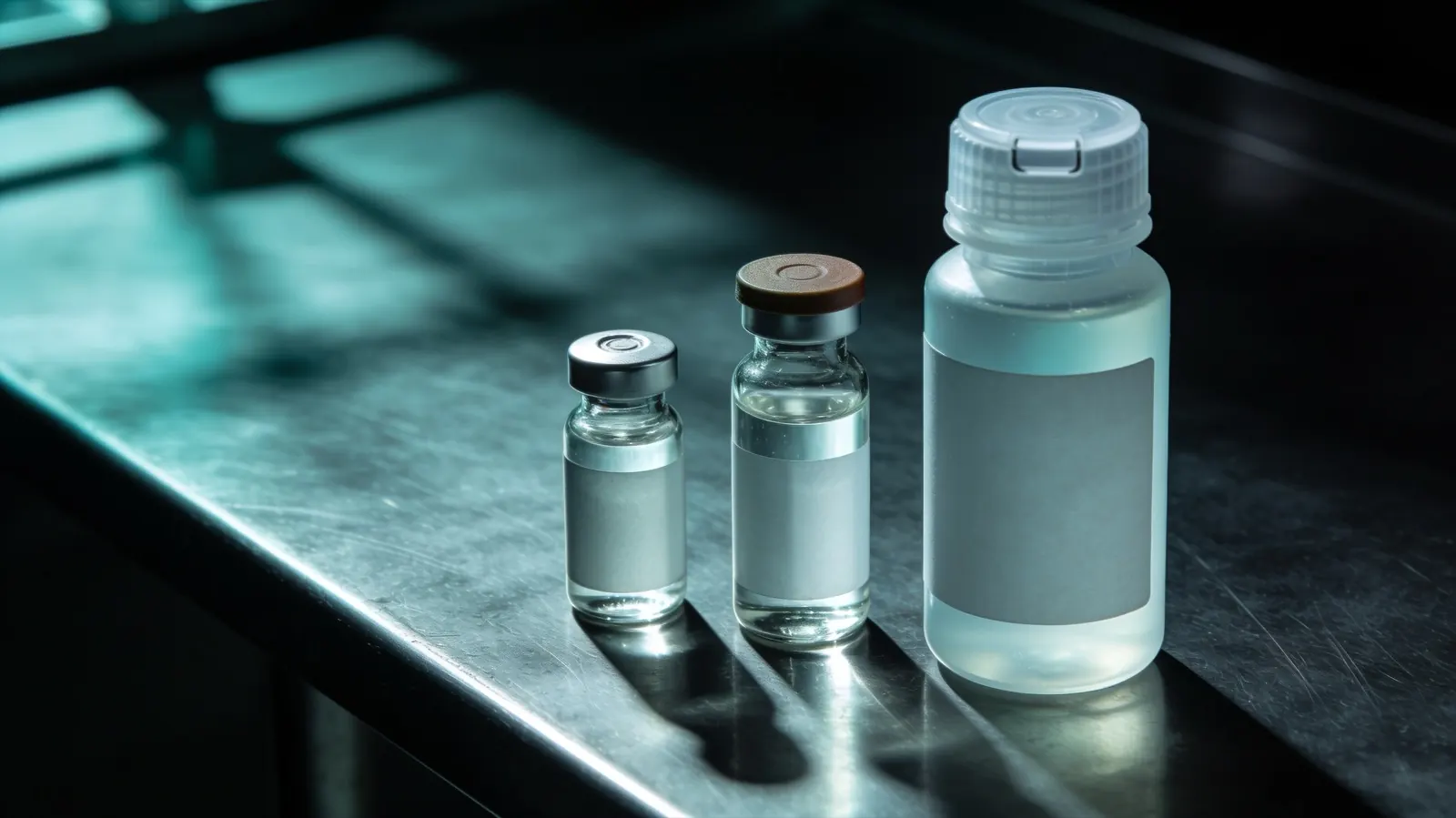
| Format | Volume | Container | Closure | Channel | Price here |
|---|---|---|---|---|---|
| Small vial | 3 ml | Type I glass | Rubber stopper, flip-off cap | Laboratory supply | $9.99 |
| Standard vial | 10 ml | Type I glass | Rubber stopper, flip-off cap | Laboratory supply | $19.99 |
| Reference multiple-dose vial | 30 ml | Semi-rigid polyolefin | Fliptop | US drug product, NDC 0409-3977-01 | Not stocked |
| Institutional tray | 25 × 30 ml | Semi-rigid polyolefin | Fliptop | US drug product, NDC 0409-3977-03 | Not stocked |
Bacteriostatic water, 3 ml and 10 ml
USP grade, 0.9% benzyl alcohol, 0.2 µm filtered, with the lot number and expiry printed on the vial rather than only on the carton. Supplied as a laboratory accessory for in-vitro research use.
See the vialsWhere it is sold, and what is bacteriostatic water labelled as in each channel
One liquid, two regulatory identities, and almost every question about where to buy it resolves once that is clear. In the United States, bacteriostatic water for injection USP is a drug product. It carries an NDC, it is labelled Rx only, and a pharmacy dispenses it against a prescription. That is why it is not sitting on an open shelf next to the saline nasal spray.
Two further channels exist under federal exemptions. A 503A compounding pharmacy compounds against a prescription for a named patient. A 503B outsourcing facility registers with the FDA, works under current good manufacturing practice and supplies batches to institutions. Both are still gated behind either a prescription or an account.
The third channel is not the drug product at all. The same chemistry, USP-grade sterile water with 0.9% benzyl alcohol, filtered and sealed, is supplied as a laboratory reagent, labelled for in-vitro research use only and not for human or veterinary use. That is what a research supplier stocks, and it is what the vials in this catalogue are: an accessory to the material they dissolve, listed alongside it the way pipette tips are.
Taking the question the way people actually ask it, then. Whether a particular CVS, Walgreens or Walmart pharmacy has it in stock is a question for that pharmacy; what is not in question is that it sits on the prescription side of the counter rather than the shelf in front of it. Online marketplaces carry listings, but a marketplace listing is not a grade, because the seller is a third party and the label is the only thing worth reading. Farm and animal-supply retailers stock veterinary products that vary by store and by state and are not the human USP article. And a research supplier stocks it as a laboratory accessory, which is the only one of those routes where the catalogue it belongs to is visible on the same site as the vial.
| Channel | What it supplies | How it is labelled | What it requires |
|---|---|---|---|
| Retail pharmacy counter | The USP drug product | Rx only, with an NDC | A prescription |
| 503A compounding pharmacy | Compounded to a named prescription | Patient-specific | A prescription |
| 503B outsourcing facility | CGMP batches for institutions | Facility label | An institutional account |
| Online marketplace | Third-party listings, mostly laboratory supply | Varies, so read the vial rather than the listing | Nothing, which is the problem |
| Research supplier | USP-grade laboratory accessory | For in-vitro research use only | Nothing: 3 ml and 10 ml vials |
| General and farm-supply retail | Veterinary and general products, not the USP article | Varies by store and state | Nothing |
The two clocks running on every vial
Two clocks run on a vial of bacteriostatic water. They start at different moments, and whichever finishes first finishes the vial.
The first is printed on the glass. A sealed vial has a manufacturer's expiry date, and the storage condition behind that date is USP Controlled Room Temperature: 20 to 25°C, which is 68 to 77°F, with excursions between 15 and 30°C permitted. Ours are stored at room temperature away from light, which is the same instruction stated less formally.
The second starts the moment a needle first passes through the stopper. From that puncture a 28-day in-use period applies, the default beyond-use date USP General Chapter <797> sets for an entered multiple-dose container and the figure CDC injection-safety guidance gives, and it applies to the whole vial regardless of how much liquid is left in it. Write the date on the label at first entry. The vial cannot tell you later, and there is no test at the bench that will recover it.
A third clock is frequently confused with these two and belongs to something else entirely. Once material has been dissolved in the water, the resulting solution is usually held at 2 to 8°C, and how long it holds is a property of the dissolved material rather than of the diluent. That figure comes from the compound's own documentation, and how to store peptides covers the dissolved state, while bacteriostatic water storage sets out the shelf life of the diluent in full.
Freezing extends nothing. Water expands as it freezes, the stress goes into the closure rather than into the liquid, and the closure is the single component the whole product depends on.
- 0 days
- conventional in-use period from first puncture, whatever volume is left
- USP General Chapter <797> default beyond-use date, reinforced by CDC injection-safety guidance
- 0 to 25°C
- USP Controlled Room Temperature for the sealed vial, 68 to 77°F
- FDA label for the reference drug product, HOW SUPPLIED
- 0 to 8°C
- the refrigerated range a reconstituted solution is usually held at
- set by the dissolved material's documentation, not the water's
| State | Storage condition | Clock that applies | Ends when |
|---|---|---|---|
| Sealed vial | 20 to 25°C, excursions 15 to 30°C permitted, away from light | Printed expiry | The date on the glass is reached |
| After first entry | As above, unless the dissolved material dictates otherwise | In-use period | 28 days from the first puncture, whatever is left |
| Holding a reconstituted solution | 2 to 8°C | The dissolved material's own stability | That material's documentation says so |
| Frozen | Not recommended | None, because the risk is not time | Container-closure integrity is in doubt |
Handling a vial without spoiling it
A multiple-dose label describes the container. It does not describe the needle, the stopper or the bench, and the preservative compensates for none of them. The CDC's guidance on multiple-dose vials makes the same point in a sentence: the classification permits repeated entry, and it does not make repeated entry safe on its own.
Swab the stopper with 70% isopropyl and let it dry before entering it. The drying is the active step: alcohol works as it evaporates, and a stopper wiped and immediately punctured has had a cosmetic clean rather than a disinfection.
Use a fresh sterile needle every time. A needle that has been through anything else, including the same stopper five minutes earlier, is the most common route by which a preserved vial becomes a contaminated one, and the preservative will then hold that population in check rather than removing it.
Coring is the failure mode nobody expects. A blunt or oversized needle can punch a disc of rubber out of the stopper rather than parting it; the disc floats in the liquid, and the hole it leaves is a channel straight through the closure. Entering at a slight angle with the bevel facing up, and retiring a needle once it has dulled, is most of the prevention.
The uncomfortable part is that a compromised vial usually looks fine. Suppression is exactly what the preservative is for: a population that would have grown into visible turbidity in plain water is instead held at a level that leaves the liquid clear. Clarity is therefore evidence about particulates and about nothing else, which is why the date written on the label at first entry does more work than any amount of looking at the glass.
Inspect before every entry rather than only on arrival: clear, colourless, no particulates, no haze, stopper flush, cap intact. And never top up a part-used vial from a fresh one or pool two vials into one. Neither resets anything, and both merge two in-use clocks into a single unknowable one.
What is bacteriostatic water confused with, and what it is not
It is not distilled water, which has no sterility guarantee and no pyrogen testing behind it. It is not saline, because there is no sodium chloride in it. It is not a preservative-free product, which matters when a method specifically calls for one. And it is not a substitute for a material's own specified diluent where the documentation names one, which is the distinction drawn in bacteriostatic water for peptides.
It also carries no certificate of analysis, and that is correct rather than a gap. A certificate documents an assayed compound: purity by HPLC, identity by mass spectrometry, content by measurement. Water is the solvent, not the sample, so those measurements have nothing to attach to. Its documentation is the monograph it was made against plus the lot number and expiry on the glass. The certificates published on this site belong to the peptide lots it dissolves, and reading one is a separate skill, set out in how to read a peptide certificate of analysis.
And it is not a therapeutic product. Bacteriostatic water is a diluent: a laboratory reagent for bringing solids into solution, sold and used as such. Everything on this site, including this liquid, is supplied strictly for in-vitro research use.
So, what is bacteriostatic water? Sterile water plus 0.9% benzyl alcohol: 9 mg/mL of one aromatic alcohol, pH around 5.7, and nothing else in the vial. Every other property follows from that single addition, namely the multiple-dose classification, the 28-day in-use period, the room-temperature storage, the slightly higher price, and the reason a bench keeps it on the shelf instead of plain sterile water. If one thing is worth carrying away, it is the pair of clocks, the printed expiry and the one that starts at first puncture, and the fact that only the first of them is written on the vial for you.
Common questions
What is bacteriostatic water made of?
Sterile water for injection with benzyl alcohol added at 0.9% by volume, which is 9 mg/mL. There is no buffer, salt or tonicity agent in it, and the FDA label for the reference product gives the pH as 5.7 against a range of 4.5 to 7.0.
What is bacteriostatic water used for?
It is a diluent. It is supplied as a laboratory reagent for bringing a dry solid into solution, and the preservative in it is what allows one vial to be entered more than once over a defined in-use period. Everything in this catalogue, including the water, is for in-vitro research use only.
Is bacteriostatic water the same as sterile water?
No. Both start as sterile water; only bacteriostatic water contains a preservative. That preservative is what makes it a multiple-dose container rather than a single-use one.
Does bacteriostatic water kill bacteria?
No. It inhibits their growth. Bacteriostatic means it suppresses replication; it does not sterilise a vial that has already been contaminated.
What does USP grade mean on a bacteriostatic water vial?
That the product was manufactured and tested against the United States Pharmacopeia monograph for it. A vial with no grade stated has no published specification behind it.
What does nonpyrogenic mean on the label?
That the liquid has been tested for pyrogens, in practice bacterial endotoxin, and found below a stated limit, usually expressed in endotoxin units per millilitre. It is a separate test from sterility and not a restatement of it: endotoxin is heat-stable, so water can be sterilised and still fail a pyrogen test. It is also the reason laboratory distilled water is not a substitute.
What is the pH of bacteriostatic water?
The FDA label for the reference drug product states 5.7, with a specification range of 4.5 to 7.0. No buffer is added, so the figure is where purified water plus a small quantity of benzyl alcohol naturally sits rather than a target that has been adjusted to.
Is BAC water the same thing as bacteriostatic water?
Yes. BAC water is only shorthand, and both names describe one product: sterile water with 0.9% benzyl alcohol. Shops shorten it because it is quicker to read on a label or in a cart. Ours is the same liquid, listed under a research-neutral name as Reconstitution Solution in 3 ml and 10 ml vials.
What is bac water Hospira?
It is the reference product most US labels are written against: a 30 ml multiple-dose plastic fliptop vial of bacteriostatic water for injection USP, made by Hospira, now part of Pfizer. DailyMed lists it under NDA 018802, with NDC 0409-3977-01 for the single vial and 0409-3977-03 for a tray of 25. The container is semi-rigid polyolefin rather than glass.
Is bacteriostatic water the same as saline?
No. Saline is water with sodium chloride in it, made isotonic for a different purpose; bacteriostatic water contains no salt at all. The 0.9% on both labels is a coincidence of numbers: in one it is salt, in the other it is benzyl alcohol. Plain saline also carries no preservative unless it is sold specifically as bacteriostatic saline.
Is benzyl alcohol the same as rubbing alcohol?
No, they are different molecules doing different jobs. Benzyl alcohol is an aromatic alcohol, C7H8O at 108.14 g/mol, which sits inside the vial at 9 mg/mL and suppresses bacterial growth over an in-use period. Rubbing alcohol, whether isopropyl or ethanol, is a surface disinfectant used on the outside of a stopper, and no amount of it turns sterile water into a preserved diluent.
Why is it 0.9% benzyl alcohol and not some other concentration?
0.9%, or 9 mg/mL, is the concentration at which benzyl alcohol reliably suppresses bacterial growth while staying low enough not to interfere with most of what the water is used to dissolve. It is also only about a quarter of its solubility in water, so nothing comes out of solution. It is the figure the monograph and the whole category are built around, which is why it appears on every legitimate label.
What does multiple-dose vial actually mean on a label?
It means the container is intended to be entered more than once, and it earns that classification by containing a preservative. A single-dose vial has none, so its contents are guaranteed sterile only until the seal is broken. For bacteriostatic water the preservative is benzyl alcohol, and what it permits runs for a defined in-use period, conventionally 28 days from first entry, which is the subject of bacteriostatic water storage.
Why does a peptide need a diluent at all?
Because it is supplied dry rather than in solution. Lyophilized powder is the freeze-dried cake at the bottom of the vial, and it has to be brought back into solution before anything can be measured from it. The diluent is chosen by the material's own documentation, not by habit.
Can you buy bacteriostatic water over the counter?
Not as the drug product. In the United States, bacteriostatic water for injection USP carries an NDC and is labelled Rx only, which puts it behind a pharmacy counter rather than on an open shelf. The same chemistry is separately supplied as a laboratory reagent labelled for in-vitro research use only, which is how a research supplier stocks it and what the vials here are.
Can I buy bacteriostatic water at CVS, Walgreens or Walmart?
Those chains operate pharmacies, and the USP drug product sits on the prescription side of that counter, not on the shelf in front of it. Whether a particular branch holds stock is a question for that branch. What is worth knowing before ringing round is that the same liquid exists in a second channel entirely, as a laboratory accessory rather than a drug.
Does Amazon sell bacteriostatic water?
Listings appear there, almost always from third-party sellers and almost always as laboratory supply rather than the prescription drug product. A marketplace listing is not a grade. The things worth checking are the same wherever it is bought: USP stated on the vial, benzyl alcohol 0.9%, nonpyrogenic, a lot number and an expiry printed on the glass rather than only on the box.
Does Tractor Supply sell bacteriostatic water?
Farm and animal-supply retailers stock veterinary products, and what is on those shelves varies by store and by state. They are not the human USP drug product, and a veterinary label is a different specification with a different monograph behind it. Read the full product name and grade on the container rather than the aisle it was found in.
What else can be used instead of bacteriostatic water?
Plain sterile water for injection, where a method specifies preservative-free diluent or the whole vial will be used in one sitting. That is the only general substitute. Saline introduces a solute, distilled water has neither a sterility test nor a pyrogen test behind it, and a buffered reconstitution solution is for materials whose own documentation calls for one.
Can you make your own bacteriostatic water at home?
No, not in any way that produces the same thing. The recipe is trivial; the product is not the recipe. It is sterility, a verified preservative concentration, a pyrogen test and an intact container closure, and endotoxin in particular survives boiling and autoclaving, so it takes dry heat at around 250°C to destroy. None of that can be achieved or checked on a bench, and the finished article costs less than the glassware.
Does bacteriostatic water come with a certificate of analysis?
Not in the sense a peptide does. Bacteriostatic water is a USP-grade supply, and its documentation is compliance with the monograph plus the lot number and expiry printed on the vial. The certificates we publish cover peptide lots, where HPLC purity and mass spectrometry identity are the figures that matter, and any of those lots can be looked up by its number.
What if a vial of bacteriostatic water arrives frozen or very cold?
Cold does not harm the water, but freezing stresses the container closure, which is the part keeping the contents sterile. Inspect the vial rather than the liquid: flip-off cap intact, stopper sitting flush, no crack in the glass, contents clear and colourless. Anything lifted, cracked or cloudy and the vial is finished whatever the label says. How orders are packed and shipped covers what leaves the warehouse.
Is bacteriostatic water for injection the same thing?
Yes. Bacteriostatic Water for Injection, USP is the full pharmacopoeial name, and it is what the label on a vial actually says. The shorter form is how people search for it and how suppliers list it. Both describe water for injection with 0.9% benzyl alcohol added as a preservative, in a multiple-dose container. If a listing uses the long name and shows a label and a certificate to match, that is a good sign. A listing that uses the short name and shows no label at all is telling you less than it appears to.
- Bacteriostatic Water for Injection, USP: FDA label (DailyMed): the 0.9% benzyl alcohol content at 9 mg/mL, the pH figure, the multiple-dose plastic fliptop container and the controlled room temperature storage
- Sterile Water for Injection, USP: FDA label (DailyMed): the unpreserved, single-dose article this page is compared against throughout
- PubChem CID 244, benzyl alcohol: the molecular formula, molecular weight, CAS number and water solubility quoted for the preservative
Read more
- Sterile water vs bacteriostatic waterSterile water vs bacteriostatic water is a question about one ingredient and one consequence: whether the vial can be opened more than once. The labels answer it in figures.
- Bacteriostatic water storage and shelf lifeBacteriostatic water storage is simpler than most people expect, and the 28-day figure everyone quotes is measuring something quite specific.
- Bacteriostatic water for peptidesBacteriostatic water for peptides is the default diluent for a straightforward reason: it is the only one that lets a multi-milligram vial be used more than once.
- What is in the KLOW peptide blendThe KLOW peptide blend is four separate molecules sharing one vial, which means four identities to describe and four assays to read rather than one of each.
- What is the GLOW peptide blend?The GLOW peptide is not one peptide. GLOW is a product name for three molecules dried into a single vial, 70mg in total, in a ratio fixed before it was sealed.
- NAD+ peptide: a coenzyme, not a peptideNAD+ peptide is how the compound is usually searched for, and the word peptide is the wrong word. NAD+ is a dinucleotide coenzyme with no amino acids in it at all.
For laboratory research use only. All compounds listed on this site are sold strictly as reference materials for in-vitro laboratory research conducted by qualified professionals. They are not drugs, foods, cosmetics, or medical devices. They are not intended for human or veterinary consumption, therapeutic use, diagnostic application, or any in-vivo use whatsoever. These statements have not been evaluated by the Food and Drug Administration. By purchasing, you affirm that you are a qualified researcher and that you will comply with all applicable institutional, local, state and federal regulations governing the handling of research chemicals. Published by SERVIAM BIO LABS.