

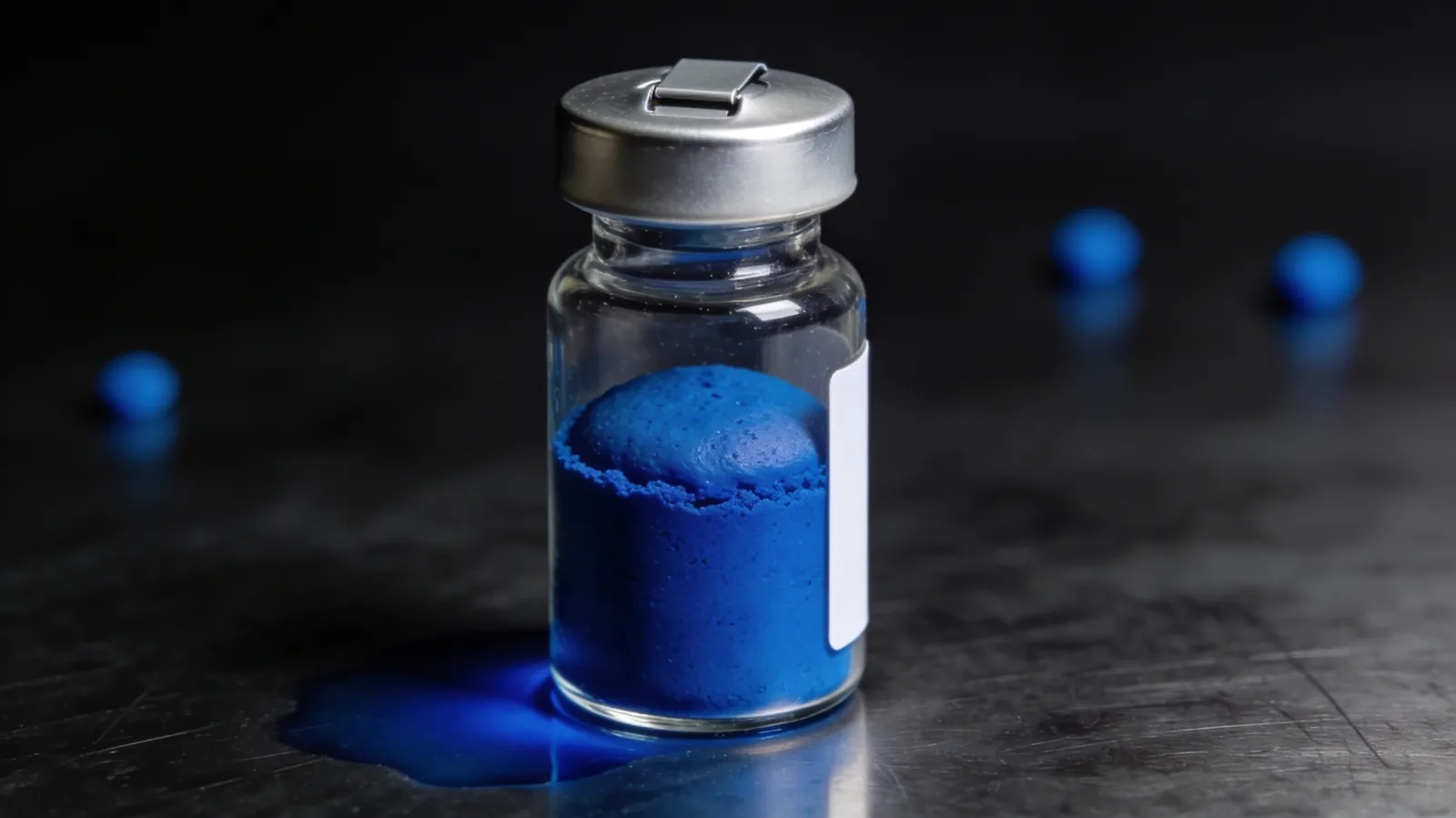
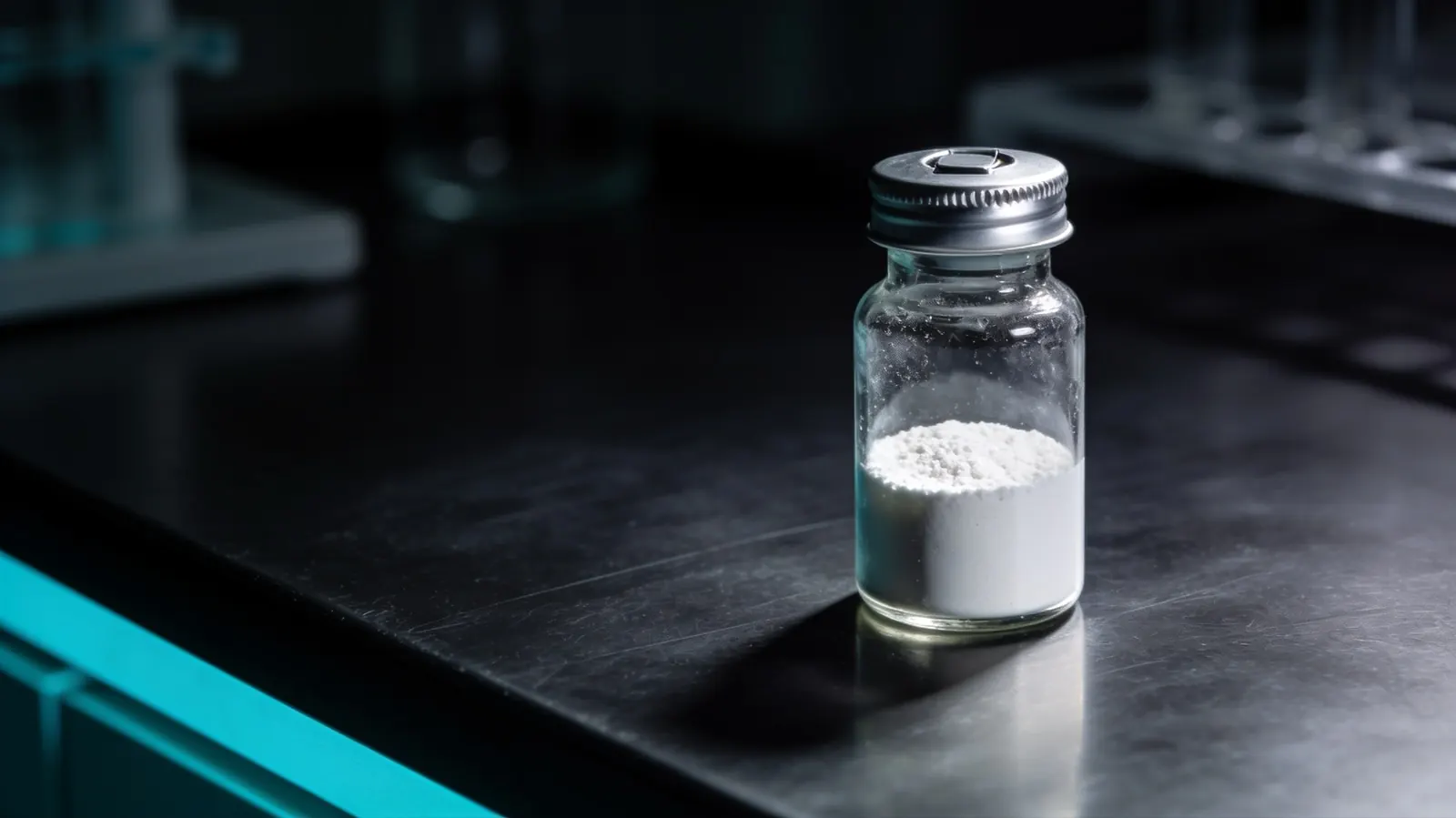
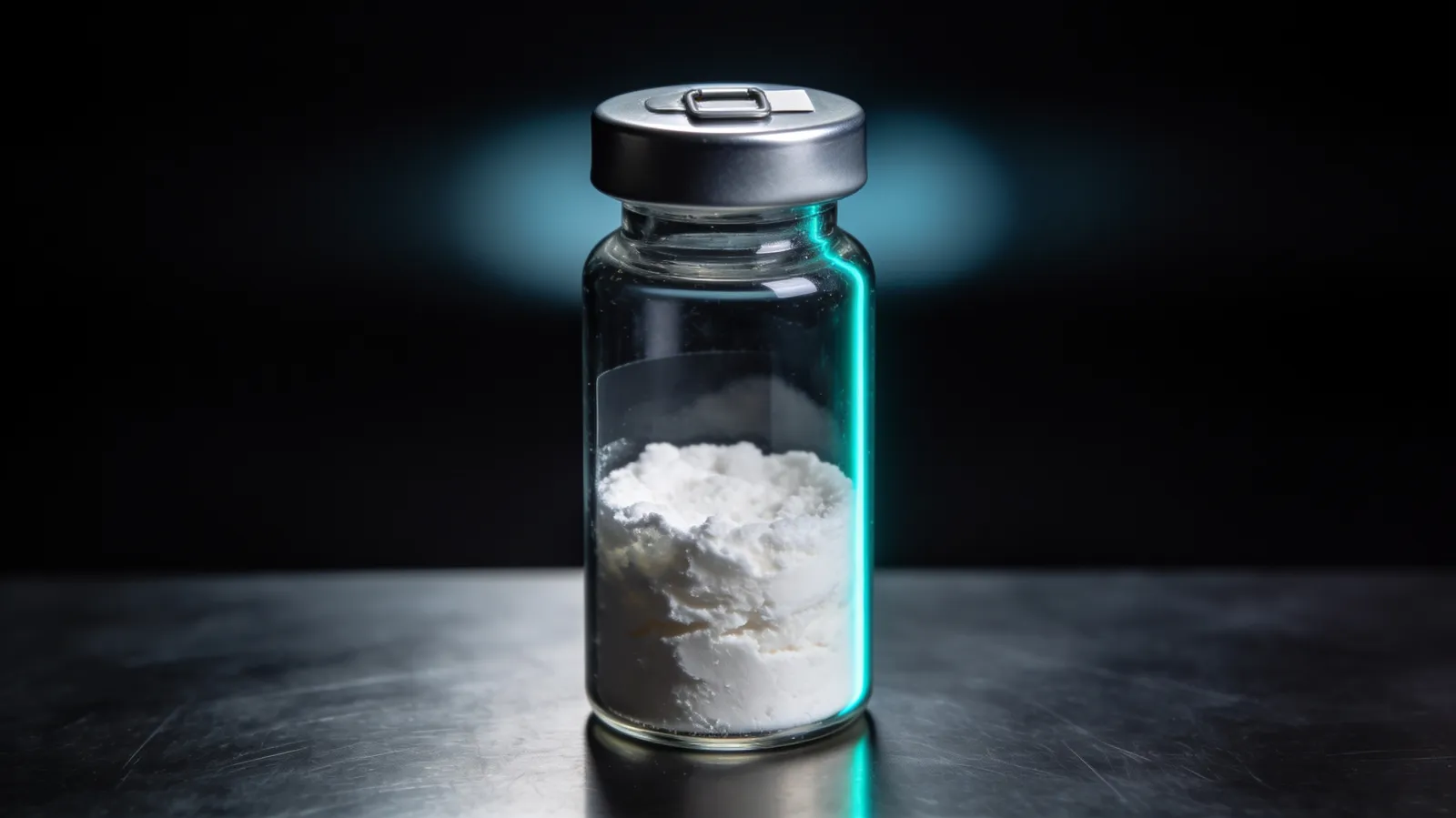
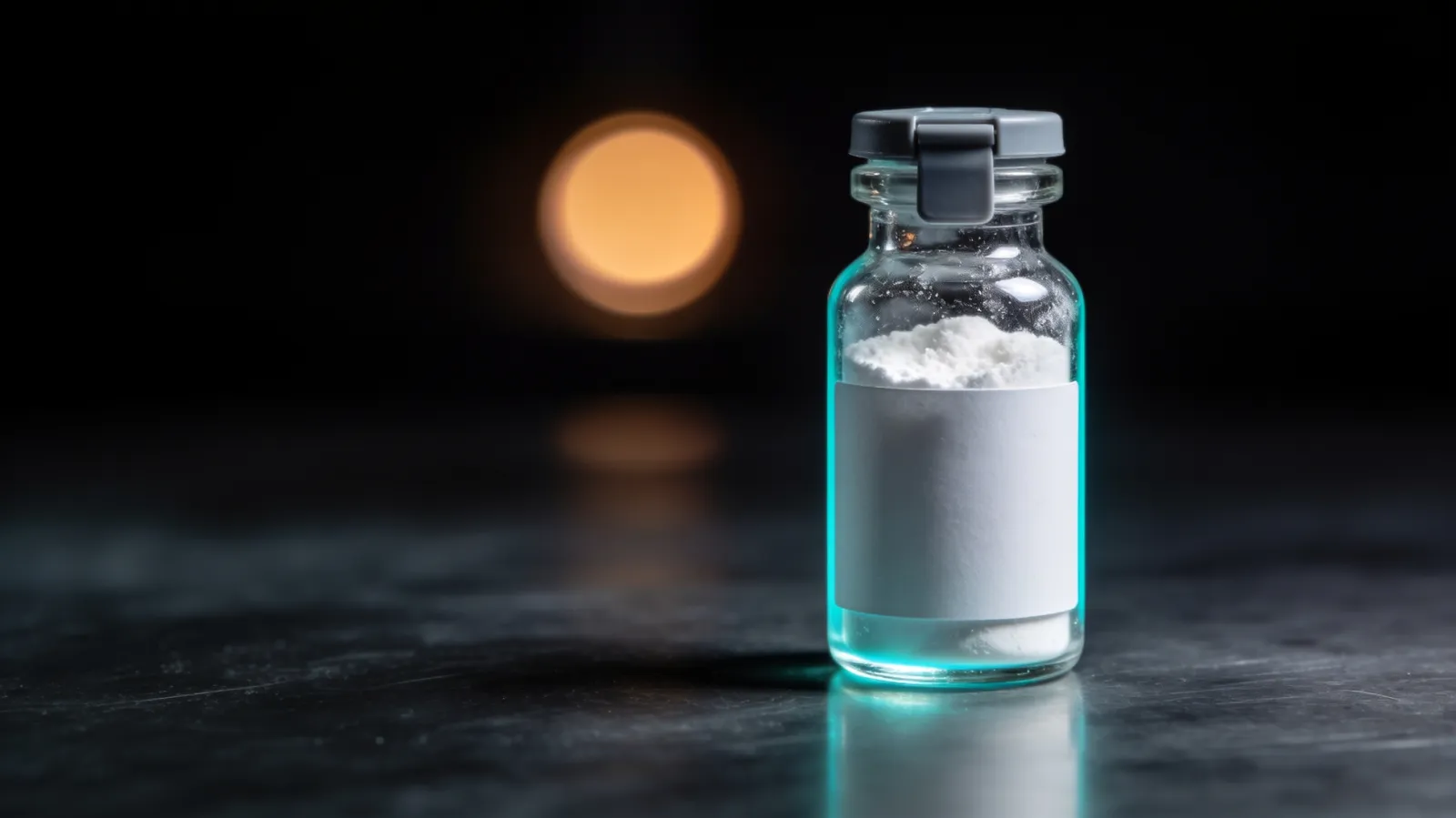
GLOW peptide is a product name, not a molecule. The GLOW peptide blend is three research compounds totalling 70mg: GHK-Cu 50mg, BPC-157 10mg and TB-500 10mg. It is supplied as a blue lyophilised powder, the colour coming from the copper in GHK-Cu, and each component is assayed and reported separately on the certificate.
- The GLOW peptide is a product name covering three separate molecules, so there is no GLOW sequence, no GLOW molecular weight and no single CAS number to look up.
- The fill of a GLOW peptide vial is fixed at 70mg: GHK-Cu 50mg, BPC-157 10mg and TB-500 10mg, weighed and lyophilised together, so the ratio cannot be altered inside one vial.
- The GLOW peptide cake is blue because GHK-Cu is a copper(II) complex and makes up 50 of the 70 milligrams; free GHK, without its copper, is colourless.
- A vial with three targets cannot honestly carry one purity percentage, which is why the certificate of analysis library reports a figure for each component.
- The certificate names the TB-500 component as thymosin beta-4, the protein its sequence corresponds to, so label and report use two names for the same line.
- Equal milligrams are not equal molecules: at 50:10:10 by mass, GHK-Cu is about 87% of the molecules in the vial, because it is the lightest of the three by a wide margin.
What is in the GLOW peptide blend, component by component
The GLOW peptide is a product name, not a molecule. There is no GLOW sequence, no GLOW molecular weight and no single CAS number, because the vial holds three separate synthetic peptides that were weighed and dried together. The total fill is 70mg, and the GLOW three-component blend listing states the split the same way the vial label does: GHK-Cu at 50mg, BPC-157 at 10mg and TB-500 at 10mg.
The three are unrelated to one another. One is a copper-complexed tripeptide, one is a fifteen-residue chain and one is a seven-residue acetylated fragment. They differ in length, in mass, in origin and in the preclinical literature each appears in. What they share is a vial.
That is the whole reason this page exists. A question about the GLOW peptide is really three questions, and anything said about identity, purity or documentation has to be said three times over, once per component, or it has not been said at all.
The table below is the whole specification in one grid. All three components are also stocked here as single-compound vials, so every formula, molecular weight and CAS number in it is the figure published on the corresponding catalogue entry rather than something assembled for this page. The last column is arithmetic: each nominal mass divided by the 70mg fill.
Two figures in that table are worth pausing on, because listings elsewhere routinely get them wrong. The first is the residue count against TB-500. It is seven. Forty-three is the residue count of thymosin beta-4, the full-length protein the fragment corresponds to, and a specification sheet that prints 43 on a line reading TB-500 has quoted the parent instead of the material in the vial. The second is the molecular weight field for the blend as a whole, which some sellers fill in. There is no value that belongs there. A molecular weight identifies one substance, and this vial holds three.
The share-of-fill column is the number that governs most of what follows. GHK-Cu is 50 of 70 milligrams, 71.4% of the material by mass, and more than twice the other two components put together. That single proportion explains the colour of the cake, the shape of the concentration table further down, and why a blended figure averaged across three components mostly describes one of them.
- 0%
- of the 70mg GLOW peptide fill is GHK-Cu, by mass
- 50mg of 70mg nominal
- 0
- components in a GLOW peptide vial, each assayed separately
- GHK-Cu, BPC-157 and TB-500
- 0
- amino-acid residues across the three chains
- 3 + 15 + 7
| Component | Sequence or form | Formula | Molecular weight | CAS | Nominal fill | Share of fill |
|---|---|---|---|---|---|---|
| GHK-Cu | Gly-His-Lys complexed with copper(II), 3 residues | C14H24N6O4 · Cu | 403.94 g/mol | 89030-95-5 | 50 mg | 71.4% |
| BPC-157 | GEPPPGKPADDAGLV, 15 residues | C62H98N16O22 | 1419.53 g/mol | 137525-51-0 | 10 mg | 14.3% |
| TB-500 | Ac-LKKTETQ, 7 residues, N-terminally acetylated | C38H68N10O14 | 889.0 g/mol | 885340-08-9 | 10 mg | 14.3% |
| Whole vial | No single sequence exists; 25 residues across three chains | Multi-component | No single value | Blend, see certificate | 70 mg | 100% |
GHK-Cu: 50mg of the GLOW peptide fill
Glycyl-histidyl-lysine complexed with copper(II). Formula C14H24N6O4 · Cu, molecular weight 403.94 g/mol, CAS 89030-95-5. GHK itself occurs naturally in human plasma. It is 50 of the blend's 70 milligrams, and it is studied in dermal-signalling and matrix-remodelling model systems, as the article on the GHK-Cu copper peptide sets out at greater length. Three residues plus a metal ion, and by mass the largest part of the blend by a distance.
BPC-157: 10mg of the GLOW peptide fill
Sequence GEPPPGKPADDAGLV, 15 residues. Formula C62H98N16O22, molecular weight 1419.53 g/mol, CAS 137525-51-0. The name is short for Body Protection Compound, and the sequence corresponds to a partial sequence of a protein found in gastric juice. It is studied in tissue-repair and cytoprotection models. It is the heaviest molecule in the vial and, for that reason, the one present in the smallest molar amount. It is profiled on its own in the article on the BPC-157 peptide.
TB-500: 10mg of the GLOW peptide fill
Sequence Ac-LKKTETQ, 7 residues, where the Ac- prefix denotes an acetyl group on the N-terminus. Formula C38H68N10O14, molecular weight 889.0 g/mol, CAS 885340-08-9. It is a synthetic fragment corresponding to a region of thymosin beta-4, a 43-residue protein of roughly 4963 g/mol, and is not thymosin beta-4 itself. It is studied in actin-regulation and cell-migration models. The distinction between fragment and parent is set out in the note on what is TB-500, and it is the distinction that makes one line on the GLOW certificate harder to read than it should be.
Why the GLOW peptide cake is blue
A single-compound peptide vial is usually a white or off-white cake. A GLOW peptide vial is blue, and the reason is one component and some arithmetic.
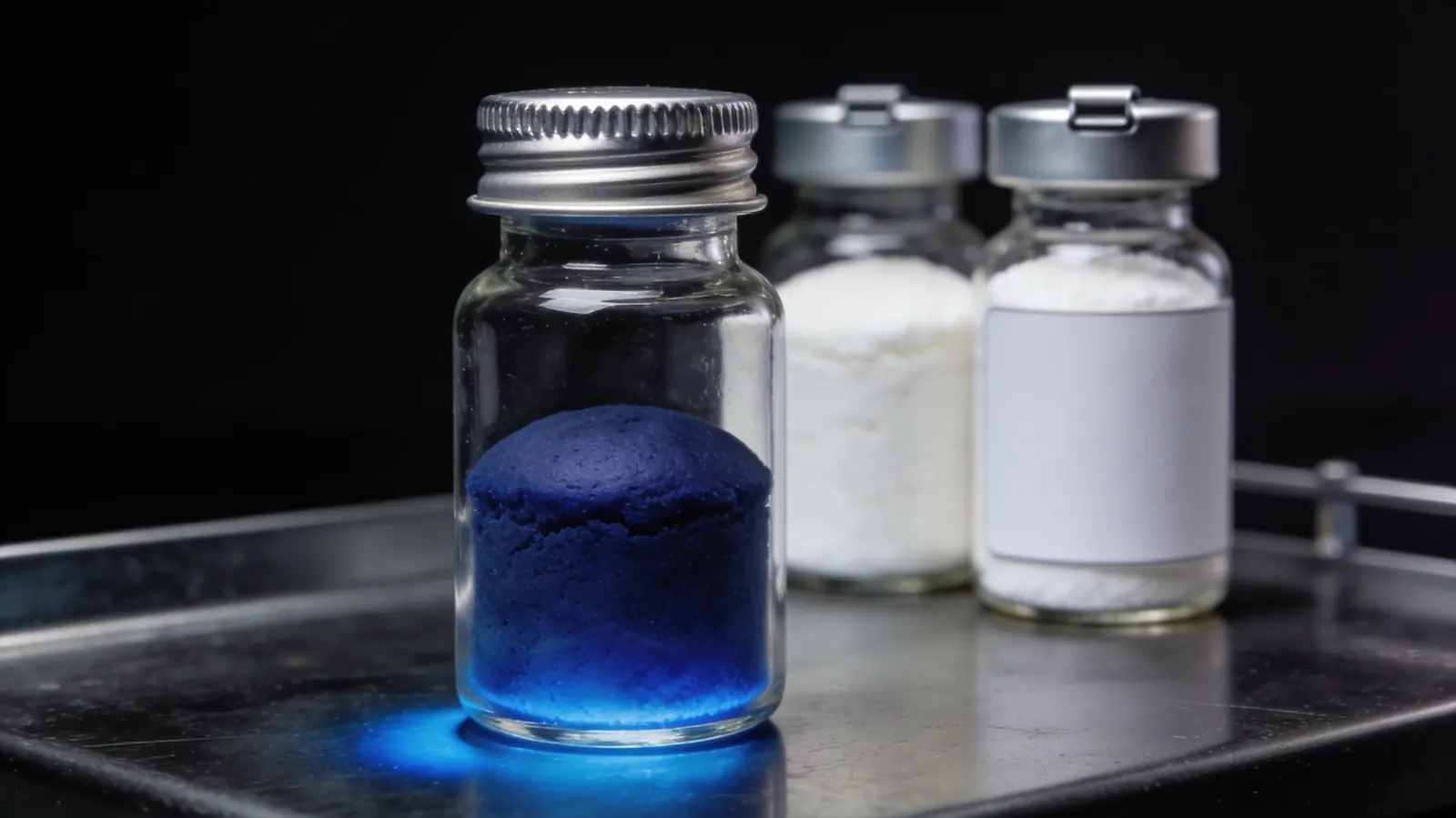
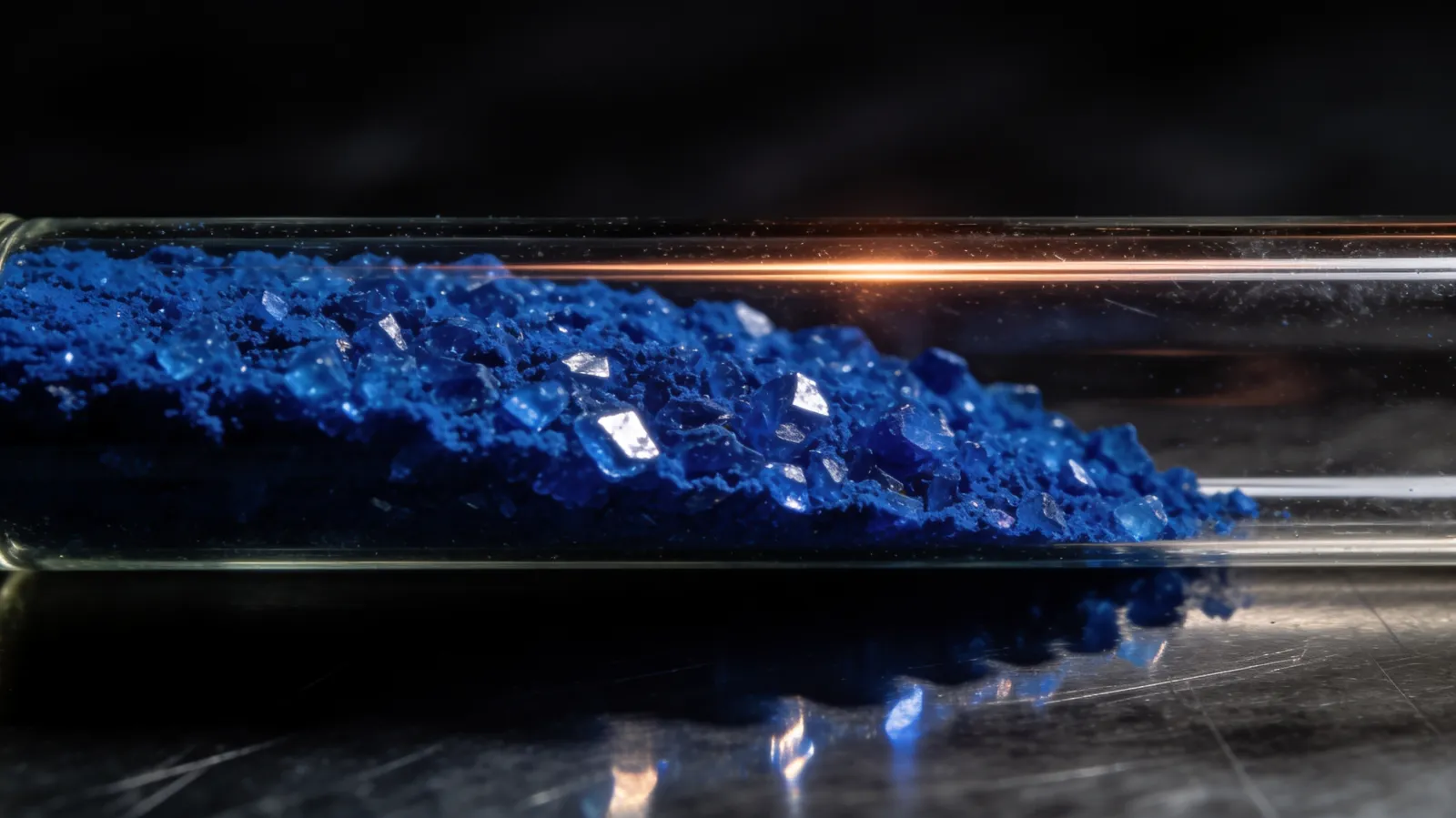
GHK-Cu is glycyl-histidyl-lysine holding a copper(II) ion. The copper is part of the molecule rather than an additive, and copper(II) complexes of this kind carry colour. Free GHK, without its copper, is colourless; the blue belongs to the complex. GHK-Cu is also 50 of the 70 milligrams in the vial, more than twice the other two components put together, so the colour of the largest component is the colour of the whole cake even though BPC-157 and TB-500 are white on their own.
The published formula makes the copper contribution explicit. Of the 403.94 g/mol quoted for GHK-Cu, 63.55 belongs to the copper atom, which is 15.7% of the complex by mass. Applied to a 50mg fill that is about 7.9mg of copper in a 70mg vial, roughly one part in nine of everything in it. The number is arithmetic rather than a measurement, but it is the reason the colour is strong rather than faint.
Blue is therefore the expected appearance for the GLOW peptide blend, and it is what the certificate records under appearance: blue lyophilised powder. It is a useful check at the point of unboxing and nothing more than that. Colour says nothing about purity, and a deeper or paler blue between lots is not a measurement. But a vial sold as GLOW that arrived white would be worth a question before anything else happened to it.
Appearance is a stated specification here rather than an observation somebody made in passing. All four published GLOW certificates carry an appearance line, and on all four it reads the same: blue lyophilised powder. That is what gives the line its only useful property: something to disagree with. A specification that says nothing cannot be failed. What a cake should look like in general, blue or white, is covered in the note on lyophilized powder.
The colour has one practical consequence for everything done afterwards. Every judgement made by eye on this material, the integrity of the cake and the clarity of the solution once bacteriostatic water has been added, is being made against a coloured background rather than a colourless one. Clear here means clear blue, and particulate matter has to be looked for against that rather than against nothing.
Equal milligrams are not equal molecules in a GLOW peptide vial
The GLOW peptide label reads 50:10:10, and that is a ratio of masses. It is not a ratio of molecules, and for this particular blend the two are a long way apart.
A milligram is a weight. The number of molecules in a milligram depends on how heavy each molecule is, and the three components in this vial differ in molecular weight by more than a factor of three. GHK-Cu is 403.94 g/mol, TB-500 is 889.0, and BPC-157 is 1419.53. Divide each nominal mass by its molecular weight and the picture changes shape entirely: GHK-Cu comes to about 124 micromoles, TB-500 to about 11, and BPC-157 to about 7.
Put as a ratio, the GLOW peptide blend is 5:1:1 by mass and roughly 17.6:1.6:1 by amount of substance. GHK-Cu is 71.4% of the vial by weight and about 87% of it by molecule count. BPC-157, which shares a nominal mass with TB-500, is present in about 63% as many molecules, purely because its chain is longer and therefore heavier.
None of this changes what is in the vial. It changes what a sentence about the vial means. A statement about proportions is ambiguous until it says whether it is talking about mass or about moles, and almost every blend listing in this category talks about mass without saying so. The table below does the division once so the two readings can be compared directly.
The same arithmetic is worth doing in reverse when a certificate is read. Content figures on a certificate are reported in milligrams, because milligrams are what a laboratory weighs and what a label claims. Converting them to micromoles is a separate step, and it is the step that makes two components with the same nominal mass look as different as they actually are.
| Component | Nominal mass | Molecular weight | Amount of substance | Share by mass | Share by moles |
|---|---|---|---|---|---|
| GHK-Cu | 50 mg | 403.94 g/mol | 123.78 µmol | 71.4% | 87.1% |
| BPC-157 | 10 mg | 1419.53 g/mol | 7.04 µmol | 14.3% | 5.0% |
| TB-500 | 10 mg | 889.0 g/mol | 11.25 µmol | 14.3% | 7.9% |
| Whole vial | 70 mg | No single value | 142.07 µmol | 100% | 100% |
Why a GLOW peptide blend cannot carry a single purity figure
Purity asks one precise question: of the material present, how much of it was the target compound. Where there is one target there is one answer, and a single percentage by HPLC means something definite: normally area percent, the share of everything the detector saw. What that percentage does and does not measure is set out in the note on peptide purity, and the guide to reading a peptide certificate of analysis walks the document line by line.
A GLOW peptide blend has three targets. The question has to be asked three times, it has three answers, and there is no honest way to average them into one. A single percentage stamped across a three-component vial is one of two things: the figure for one component presented as though it covered the others, or a number with no defined meaning. Neither tells anyone whether the TB-500 in that vial is TB-500.
This is the part of a blend listing most worth reading closely and the part most often skipped. Composition is free to copy: any seller can print 50mg, 10mg and 10mg on a label, and printing it costs nothing whether or not the vial holds it. Per-component assay costs money, has to be repeated for every lot, and is the only thing standing behind the label.
The overall figure on the GLOW peptide product page, 99.68% HPLC for the current lot, is shorthand for per-component work that already exists underneath it. It summarises a grid rather than replacing one, and the grid is published.
It is also worth separating the two instruments, because they answer different questions and are usually printed side by side as though they answered the same one. Reversed-phase HPLC separates whatever is in the sample by how strongly each species sticks to a column and reports what share of the total signal each peak carries. That is purity: it says what proportion of the material is the main species and nothing at all about what that species is. Mass spectrometry weighs the molecule. That is identity: 1419.53 confirms BPC-157 in a way no retention time can, and 889.0 confirms the seven-residue fragment rather than the 43-residue protein. A blend needs both, three times over, because a peak in the right place with the wrong mass is precisely the failure a single overall percentage would hide. The two methods are compared at greater length in the note on peptide purity testing.
The table below sets out the four things a blend listing can tell a reader, in ascending order of what they are worth. The distinction it draws, between a claim, a specification and a measurement, is the same one set out more generally in how to vet a research peptide supplier, and it is worth more than any single number on any of these pages.
| What is published | What it pins down | What it leaves open | How it is closed |
|---|---|---|---|
| Total mass only, e.g. "70mg blend" | How much material is in the vial | The proportion of every one of the three components | Publishing the nominal split |
| Nominal split, e.g. "50/10/10" | The specification the vial was filled to | Whether any particular vial met that specification | Publishing a per-component assay |
| One overall purity figure | That the material is mostly peptide rather than mostly something else | Which component the figure describes, and whether all three are present | Assaying each component separately |
| Per-component content against a lot code | The measured mass of each of the three in that lot | Nothing material about composition | Making the lot code checkable by the reader |
What a per-component GLOW peptide certificate actually reports
The current lot is GLOW-062026-4: 70mg, reported on 7 June 2026 and released on 12 June, assayed by Freedom Diagnostics, an independent laboratory, with identity confirmed by LC-MS and overall purity of 99.68% by HPLC. Beneath that headline the report carries a content figure for each component in milligrams: GHK-Cu 59.92mg, thymosin beta-4 11.71mg, BPC-157 10.86mg. The same report records an endotoxin result, logged as a pass on both replicates.
Two things in that content line repay attention. The first is the naming: the TB-500 component is reported as thymosin beta-4, the protein its sequence corresponds to, so a reader matching label against certificate should expect two names for that one line. The second is the unit. These are measured content figures in milligrams, not purity percentages. They are what the analysis found present, stated per component, alongside the nominal 50/10/10 split printed on the label. Where a measured figure sits above its nominal mass, the certificate is the record of what was found; it is not trimmed to match the label.
The previous lot, WCP32F, released on 30 May 2026 at 99.80%, reports all three components too: GHK-Cu 59.54mg, TB-500 10.80mg and BPC-157 10.20mg. The genuine difference between the two reports is not what they measured but what they called it: WCP32F names the component TB-500, and GLOW-062026-4 names it Thymosin Beta-4. That is visible only because the certificates themselves are published rather than compressed into a badge.
Four GLOW peptide lots are published here in total, and put side by side they make the argument for per-component reporting better than any paragraph can. Read the overall HPLC column first and then set it aside. The four figures are 99.68%, 99.80%, 99.544% and 99.905%. They are near-identical, spanning about a third of a percentage point, and the least informative part of any of the four documents. The per-component columns are where the lots differ, and they differ by margins the overall figure never hints at. GHK-Cu comes in above its nominal 50mg on all four, by 9.5mg on one lot and by nearly 13mg on another. BPC-157 runs from 9.84mg to 13.17mg against a nominal 10mg. The third component runs from 9.18mg to 11.71mg. None of that spread exists on a certificate that treats a blend as one substance.
The two kinds of number on these certificates are worth keeping apart, because they answer different questions. The nominal composition, 50, 10 and 10, is the specification the blend is made to. The per-component content figures are a measurement of what a particular lot actually contained on a particular date. A document that publishes only the first has published a label. A document that publishes the second, component by component, against a stated lot code, has published an analysis.
Both certificates for the recent lots are filed against the lot number printed on the vial, and all four can be pulled up by typing that number into the lot number verifier. Each also carries a laboratory accession number and a search code of its own, 2606030675 and Whol2606030675 on the current lot, so the document can be traced back to the laboratory's own record rather than only to ours. That is the thing to match: not the purity figure on a product page, which is a summary of whichever lot is current, but the number on the label in front of you and the report filed under it.
Endotoxin is a separate test again, and it measures neither identity nor purity. It looks for bacterial endotoxin, a contaminant that survives processes that kill bacteria, and reports a result against a limit. One of the four published GLOW peptide lots carries an endotoxin line, recorded as a pass on both replicates; the other three certificates do not include that test. That asymmetry is worth stating plainly rather than papering over, because an endotoxin line that is absent is different from one that failed.
- 0
- published GLOW peptide lots with content reported per component
- GLOW-062026-4, WCP32F, GLOW12262025-J and 400001
- 0%
- lowest overall HPLC figure across the four released lots
- Lot GLOW12262025-J, released 30 April 2026
- 0
- content lines on a GLOW peptide certificate, one per component
- Against one line on a single-compound certificate
| Lot | Released | Overall HPLC | GHK-Cu | BPC-157 | Third component, as named |
|---|---|---|---|---|---|
| GLOW-062026-4 | 12 Jun 2026 | 99.68% | 59.92 mg | 10.86 mg | 11.71 mg, named Thymosin Beta-4 |
| WCP32F | 30 May 2026 | 99.80% | 59.54 mg | 10.20 mg | 10.80 mg, named TB-500 |
| GLOW12262025-J | 30 Apr 2026 | 99.544% | 62.98 mg | 13.17 mg | 11.59 mg, named Thymosin Beta-4 |
| 400001 | 20 Feb 2026 | 99.905% | 59.50 mg | 9.84 mg | 9.18 mg, named Thymosin Beta-4 |
| Nominal specification | Not applicable | Not applicable | 50 mg | 10 mg | 10 mg |
Read the certificates before the listing
All four GLOW peptide lots are published in full, each with its testing laboratory, release date, identity confirmation and measured content for every one of the three components, including lots no longer in stock.
Open the COA libraryThe thymosin beta-4 line, and why two certificates disagree
One line on the GLOW certificate is harder to read than the rest, and it is better to set out the problem than to smooth it over.
TB-500 and thymosin beta-4 are not the same substance. Thymosin beta-4 is a protein of 43 residues and roughly 4963 g/mol. TB-500 is a synthetic fragment corresponding to a region of it: Ac-LKKTETQ, seven residues, 889.0 g/mol, acetylated at the N-terminus. One is more than five times the mass of the other. A mass spectrometer can tell them apart without difficulty, and no chemist would confuse them in a formula.
The naming, however, is not consistent across the published documents. Three of the four GLOW certificates, GLOW-062026-4, GLOW12262025-J and 400001, name that component Thymosin Beta-4. The fourth, WCP32F, names the same component TB-500. The products are the same, the fill is the same, the laboratory is the same. The word on the line is not.
There are two readings, and this page is not in a position to choose between them. The benign reading is a naming convention: some laboratories report a fragment under the name of the parent protein, exactly as a certificate might name a salt by its free-base identity, and the analyte assayed is the seven-residue fragment throughout. The other reading is that the line means what it says. The measured masses do not settle it either way, because content is reported in milligrams of material rather than in moles, and 11.71mg is 11.71mg whichever molecule it is made of.
What can be said with certainty is what has been published, so it is published rather than paraphrased. The blend is sold as containing TB-500. Three certificates name the line Thymosin Beta-4 and one names it TB-500. We have asked the laboratory which analyte it assayed, and the answer will appear here verbatim when it arrives.
The general lesson survives the specific case. A certificate is a document written by somebody else, and reading it involves noticing where its vocabulary and the label's vocabulary do not line up. The differences are usually conventions; occasionally they are not; and the only way to tell is to have both documents in front of you, which is why the certificates are published in full in the COA library rather than reduced to a percentage on a product page. The habit of reading involved is the one set out in how to read a peptide certificate of analysis.
The GLOW peptide ratio is fixed, and what that rules out
The GLOW peptide is 50:10:10 and cannot be anything else. The three components were weighed and lyophilised together, so there is no way to take more of one and less of another out of a single vial. A design that calls for a different proportion of GHK-Cu to BPC-157 needs the components bought separately, as single-compound vials, and combined at the bench.
What the blend buys in exchange is fewer operations. One vial, one reconstitution and one set of storage decisions instead of three, which for work that wants all three components in the published ratio is a real saving in handling and in glassware.
The cost is attribution, and it is a genuine cost rather than a rhetorical one. Three variables move together and cannot be separated afterwards. Nothing in a blend can be removed to see what changes, nothing can be varied while the other two are held still, and no result obtained with it can be assigned to one component rather than another. Where that matters, separate single-compound vials are the only route, and the three components of this blend are all stocked individually.
There is one adjacent configuration rather than a range of them. KLOW is the same three components plus KPV, the C-terminal tripeptide of alpha-melanocyte-stimulating hormone, at 10mg, totalling 80mg across four. It is not a stronger GLOW or a different ratio of the same thing: it is GLOW's three components with a fourth named peptide added, and a certificate with four lines to carry instead of three. The GLOW vs KLOW comparison sets the two certificates side by side.
It is also worth saying that 50:10:10 is a specification rather than a standard. There is no monograph for GLOW, no pharmacopoeial entry and no reference method defining what the name means, and nothing stops a different supplier filling a 70mg vial in a different proportion and calling it the same thing. The name travels; the composition does not travel with it. That makes the total mass the least informative number on any GLOW peptide listing: 70mg is a weight, not a formula, and a 70mg vial could as honestly be 40:15:15 or 60:5:5.
What the GLOW peptide blend becomes in solution
A lyophilised cake has no concentration. It has a mass, and it acquires a concentration only when a volume of solvent is chosen. For a single-compound vial that is one calculation. For the GLOW peptide it is three, and they are locked to each other.
The arithmetic is simple and worth having written down, because the fixed ratio is the whole point. Whatever volume of bacteriostatic water is added, the three components arrive at concentrations in the same 5:1:1 proportion as the fill, and nothing done afterwards can change it. GHK-Cu will always be five times the concentration of each of the other two in the same solution. The table gives the figures for four volumes a 70mg vial is commonly taken to.
Two consequences follow. The first is that total peptide concentration in a GLOW solution is high relative to a single-compound vial at the same volume, because 70mg is a large fill: a 10mg vial of BPC-157 taken to 2 mL sits at 5 mg/mL, where the GLOW peptide at 2 mL is 35 mg/mL of total peptide. The second is that the component concentrations cannot be chosen independently. Picking a volume that puts GHK-Cu at a given concentration puts the other two at a fifth of it, and that is the trade the blend makes.
The solvent is a material choice with documentation of its own. Bacteriostatic water is sterile water containing 0.9% benzyl alcohol as a preservative, which is what makes a multi-draw container viable where plain sterile water is not; the difference is set out in bacteriostatic water for peptides, and the 3 mL and 10 mL containers carry their own specification. A blue solution is the expected result here, and clarity has to be judged against that background rather than against a colourless one.
One handling point belongs to blends specifically. The three components are distributed through one dried cake, so the solution is only 50:10:10 once the cake is fully in solution. A partially dissolved blend is not the blend on the label, and a portion drawn from it is not a portion of the published ratio. That is the difference worth watching for with a three-component vial, and it has nothing to do with the freezer.
- 0 mg/mL
- total peptide when a 70mg GLOW peptide vial is taken to 2 mL
- 70mg nominal fill divided by 2 mL
- 0:1:1
- the fixed concentration ratio, at every volume
- Follows from the 50:10:10 fill
- 0%
- benzyl alcohol in bacteriostatic water, as supplied
- Catalogue specification for the 3 mL and 10 mL containers
| Volume added | GHK-Cu | BPC-157 | TB-500 | Total peptide |
|---|---|---|---|---|
| 1 mL | 50 mg/mL | 10 mg/mL | 10 mg/mL | 70 mg/mL |
| 2 mL | 25 mg/mL | 5 mg/mL | 5 mg/mL | 35 mg/mL |
| 3 mL | 16.7 mg/mL | 3.3 mg/mL | 3.3 mg/mL | 23.3 mg/mL |
| 5 mL | 10 mg/mL | 2 mg/mL | 2 mg/mL | 14 mg/mL |
How the GLOW peptide blend is supplied and handled
It is supplied as a blue lyophilised powder in a stoppered vial and is soluble in bacteriostatic water. Storage is −20°C for the long term and 2°C to 8°C in use, the same regime as the single-compound vials in this catalogue, and the same reasoning applies as in the guidance on how to store peptides. Being a mixture changes nothing about the temperatures.
It does change one thing about handling, and it is the one genuine difference between a blend and a single peptide. A blend can only be as stable as its least stable component. Each of the three has its own tolerance for temperature, for light and for time in solution, and a vial containing all three is limited by whichever is least tolerant on each axis. Nothing about the other two compensates. There is no such thing as a blend more robust than its components, only one that is easier to carry.
Three handling axes are worth separating, because they fail in different ways. Temperature is the obvious one: the dry cake is stable frozen for far longer than any solution is stable refrigerated, which is why the two storage figures differ rather than being a single number with a margin. Light is the second, and the one most often ignored: a copper complex is exactly the sort of species that ought to be kept dark. The third is freeze-thaw. Cycling a reconstituted solution through freezing and thawing is a different stress from holding it cold, and each cycle is applied to all three components at once.
The lyophilised state is doing the work in all of this. A dry cake is stable because the water that would let chemistry happen has been removed, which is why the storage figure for the powder is generous and the figure for a solution is not. What lyophilized powder is, and what an intact GLOW peptide cake should look like, is worth reading before judging a vial by eye.
The other handling note is documentary rather than physical. Because three names sit behind one product name, the lot number is the only identifier that joins the vial to a measurement, and it is the field that has to be transcribed accurately into a bench record. A note that says GLOW says almost nothing; a note that says GLOW-062026-4 can be checked years later. The table below collects every stated specification in one place, with the source of each figure beside it.
Everything in this catalogue, the GLOW peptide blend included, is supplied for in-vitro laboratory research use only. Nothing here describes use in humans or animals, and the model systems named above are named as models.
| Property | Specification | Where it comes from |
|---|---|---|
| Appearance | Blue lyophilised powder | Recorded on all four published certificates |
| Form | Lyophilised cake in a stoppered vial | Catalogue specification |
| Total fill | 70 mg nominal | GHK-Cu 50mg, BPC-157 10mg, TB-500 10mg |
| Formula | Multi-component | No single formula exists for a blend |
| Molecular weight | Per component; see the certificate | 403.94, 1419.53 and 889.0 g/mol respectively |
| Solubility | Soluble in bacteriostatic water | Catalogue specification |
| Long-term storage | −20°C | Catalogue specification |
| In-use storage | 2°C to 8°C | Catalogue specification |
| Purity field on the listing | 99.68% | Overall HPLC for lot GLOW-062026-4 |
| Identity of a given vial | The lot code printed on its label | Checkable by lot number |
GLOW peptide, KLOW and the BPC-157 + TB-500 pair: what the names mean
None of these names is a chemical name. They are product names for particular combinations, and the only thing separating them is what is in the vial, so it is worth writing the family out once.
KLOW is the like-for-like comparison to GLOW: the same three components plus KPV at 10mg, 80mg in total across four. KPV is a tripeptide of lysine, proline and valine, 342.44 g/mol, corresponding to the C-terminal three residues of alpha-melanocyte-stimulating hormone. The whole difference between the two products is that tripeptide and the fourth line it adds to the certificate. The KLOW blend is stocked here alongside GLOW, and the two are set against each other in GLOW vs KLOW peptide blends.
The third combination in this corner of the category is BPC-157 and TB-500 together, without the copper tripeptide. That pairing is stocked here as the Repair Reference Panel, which is the same two compounds supplied as separate documented vials rather than co-lyophilised into one cake. The distinction is worth holding onto: a panel of two vials and a blend of two peptides are not the same object even when the contents are named identically. A blend has one certificate and one ratio; a panel has two of each, and the ratio is chosen at the bench rather than at the fill line.
The relationship between all three is additive and easy to state. The first is the BPC-157 and TB-500 pair. GLOW is that pair plus GHK-Cu. KLOW is GLOW plus KPV. Every step up adds a named component, a line on the certificate and mass to the fill, and no step changes the components already there. GLOW is the middle term, which is why it is most often confused with the ones on either side of it.
Spellings and formattings vary, GLOW, G-LOW, Glow 70 and GLOW Blend among them, and none of them means anything different. The only variation that matters is the split, and that is a property of the supplier rather than of the name.
| GLOW | KLOW | Repair panel (BPC-157 + TB-500) | |
|---|---|---|---|
| Components | GHK-Cu, BPC-157, TB-500 | GHK-Cu, KPV, BPC-157, TB-500 | BPC-157, TB-500 |
| Total fill | 70mg in one vial | 80mg in one vial | 20mg across two vials |
| GHK-Cu | 50mg | 50mg | None |
| KPV | None | 10mg | None |
| Certificate lines for content | Three | Four | One per vial |
| Appearance | Blue lyophilised cake | Blue lyophilised cake | White to off-white cakes |
| Ratio | Fixed at 50:10:10 | Fixed at 50:10:10:10 | Chosen at the bench |
| Catalogue price | $119.99 | $139.99 | Sold as a panel |
One GLOW peptide vial or three separate vials
The blend and the separate components are two different propositions, and which one suits depends entirely on what is being asked of the material. The comparison is usually made on price, which is the axis where it is least interesting.
All three components are stocked here as single-compound vials at exactly the masses the blend carries: GHK-Cu at 50mg for $39.99, BPC-157 at 10mg for $59.99 and TB-500 at 10mg for $84.99, which is $184.97 for the three. The 70mg GLOW peptide vial is $119.99, or about $1.71 per milligram of peptide. The blend is therefore the cheaper way to obtain those three masses, and by a wide margin. It is cheaper in the way a set menu is cheaper, which is to say by removing the choice.
Price is the smallest part of the difference. The real distinctions are about control and about documentation, and they run in both directions.
The one-vial case: fewer objects to handle, one reconstitution rather than three, one set of storage decisions, one certificate to read, and a composition that cannot drift between preparations because it was fixed at the fill. The three-vial case: every proportion chosen rather than inherited, each component documented on a certificate of its own with its own purity figure, and the ability to remove one variable from a system without disturbing the other two.
There is also a documentation difference that is easy to miss. Three single-compound certificates each carry a purity percentage that means something: one target, one number. A blend certificate carries measured content per component and one overall percentage that spans three targets. The blend documentation is more compact; the separate documentation is more precise. Neither is better in the abstract, and the choice is decided by whether the work needs a fixed ratio or a known one.
| Factor | GLOW peptide, one 70mg vial | Separate single-compound vials |
|---|---|---|
| Ratio | Fixed at 50:10:10, unchangeable | Chosen per preparation |
| Documentation | One certificate carrying three content lines | One certificate per compound, each with its own purity figure |
| Reconstitution | One vial, one volume, one calculation | One per vial, three volumes to track |
| Attribution | Three variables move together | One component can be changed or omitted |
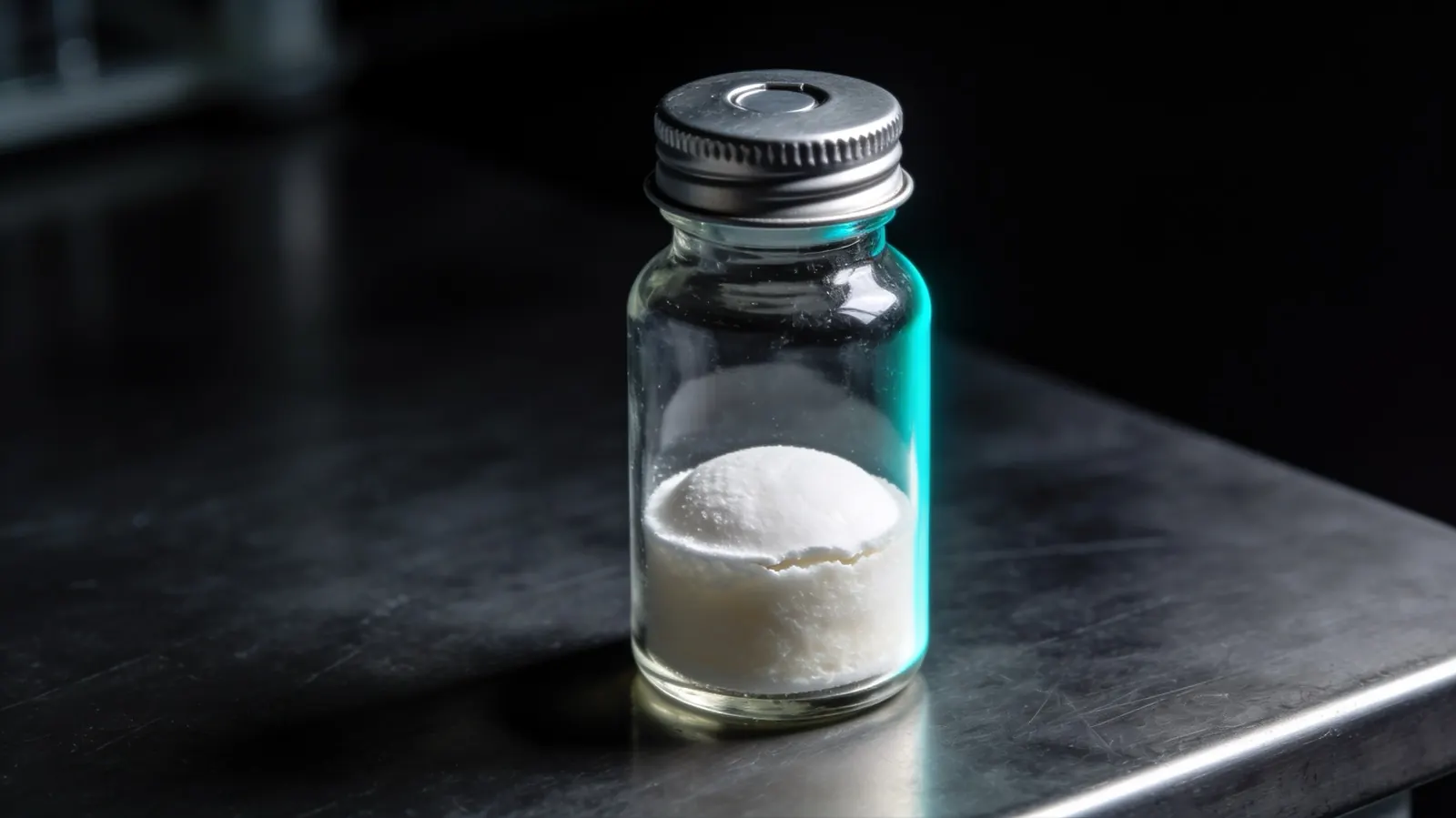
| Appearance | One blue cake | One blue cake and two white ones |
| Catalogue price, matching masses | $119.99, about $1.71/mg | $184.97 for the three |
GLOW peptide, 70mg, documented per component
A single blue lyophilised cake of GHK-Cu, BPC-157 and TB-500, released against a signed certificate reporting all three separately and a lot code you can look up. Supplied for in-vitro laboratory research use only.
See the GLOW peptide vialWhere the GLOW peptide sits with regulators
This is the part most pages in the category leave out, and it is the shortest to write accurately. The GLOW peptide is not an approved drug. It has not been evaluated by the FDA, it is not the subject of an approved application, and none of its three components is an approved drug product either. GHK-Cu, BPC-157 and TB-500 are research compounds. There is no approval attached to any of them for the purposes people search for, and no amount of laboratory documentation creates one.
A research chemical is also not the same thing as a compounded preparation. Compounding pharmacies operating under sections 503A and 503B of the Federal Food, Drug, and Cosmetic Act prepare medicines for identified patients or for office stock under a specific regulatory framework, with the oversight that framework carries. Material supplied for in-vitro laboratory research sits outside that framework entirely. The two are sometimes discussed as though they were points on a spectrum; they are separate categories with separate rules, and a research vial does not become a compounded preparation because it has a certificate.
What a certificate does establish is narrower and worth stating precisely: that a named independent laboratory, on a named date, measured the identity and content of the material in a named lot and recorded the result. That is a statement about a batch of chemical. It is not an approval, not an endorsement, and not a claim about anything beyond the analysis performed. The published certificates should be read in that light.
There is no published study of this three-component combination. Each component has its own preclinical and in-vitro literature, in model systems. GHK-Cu goes back to Pickart and Thaler in 1973, BPC-157 to work on tendon in the Journal of Applied Physiology, and TB-500's parent protein to Sanders, Goldstein and Wang in PNAS in 1992. That literature belongs to the individual molecules rather than to the blend. A combination is not the sum of the literature on its parts, and describing it that way would be a claim nobody has tested.
The GLOW peptide is supplied here for in-vitro laboratory research use only. It is not for human or veterinary use, not for diagnostic use, and not for any form of administration.
The GLOW peptide is not a peptide. GLOW peptide is a product name for 70mg of three separate molecules, GHK-Cu at 50mg, BPC-157 at 10mg and TB-500 at 10mg, in a ratio fixed before the vial was sealed, and blue because 50 of those 70 milligrams are a copper complex. Those masses are not equal amounts of substance: GHK-Cu is 71.4% of the fill by weight and about 87% of the molecules in it. The figure to distrust on any GLOW peptide listing is a lone purity percentage, because three targets cannot share one number. Ask instead for the per-component report filed against the lot on the vial, which is what the certificate of analysis library publishes across four released lots and what the guide to reading a peptide certificate of analysis teaches, and read the three lines rather than the one.
Common questions
Is the GLOW peptide one peptide or a blend?
A blend. GLOW peptide is a product name covering three separate peptides dried into one vial: GHK-Cu 50mg, BPC-157 10mg and TB-500 10mg, 70mg in total. There is no GLOW sequence and no GLOW molecular weight.
What is in the GLOW peptide blend?
GHK-Cu at 50mg (403.94 g/mol, CAS 89030-95-5), BPC-157 at 10mg (GEPPPGKPADDAGLV, 15 residues, 1419.53 g/mol, CAS 137525-51-0) and TB-500 at 10mg (Ac-LKKTETQ, 889.0 g/mol, CAS 885340-08-9). The ratio is fixed at 50:10:10 and the full breakdown is on the GLOW blend product page.
Why is the GLOW peptide blend blue?
GHK-Cu is a copper-complexed tripeptide and makes up 50 of the blend's 70 milligrams. The copper(II) ion gives the lyophilised cake its colour, which is why GLOW is blue where a single-compound vial is white. Free GHK without copper is colourless.
What purity is the GLOW peptide?
The current GLOW peptide lot, GLOW-062026-4, released at 99.68% by HPLC. A blend is properly reported per component, though, and that certificate carries a content figure for each: GHK-Cu 59.92mg, thymosin beta-4 11.71mg, BPC-157 10.86mg. Treat the single headline figure as a summary of those lines, not a substitute for them.
What is the difference between GLOW and KLOW?
KPV. KLOW is GLOW's three components plus KPV at 10mg, totalling 80mg across four. Everything else, the fixed ratio of the first three included, is the same, and the GLOW and KLOW blend comparison puts the two certificates alongside each other.
Can the ratio in a GLOW peptide vial be changed?
No. The three components are weighed and lyophilised together at 50:10:10, so a different proportion means buying single-compound vials and combining them at the bench.
Why does the GLOW certificate say thymosin beta-4 instead of TB-500?
Honestly: we do not yet know, and the certificates do not agree. GLOW-062026-4 names the component Thymosin Beta-4; the previous lot, WCP32F, names the same component TB-500. The two are not the same substance. Thymosin beta-4 is a 43-residue protein of roughly 4963 g/mol, while TB-500 is the synthetic seven-residue fragment Ac-LKKTETQ at 889.0 g/mol, so one of those two labels is loose. We have asked the laboratory which analyte it assayed and will publish the answer here verbatim. The blend is sold as containing TB-500.
How do I check a GLOW peptide lot number against its certificate?
Read the lot number from the vial label, not from the product page, and enter it in the lot number verifier. The certificate filed under that number is the only document that describes the vial in front of you; a purity figure on a listing describes whichever lot happens to be current.
Why is the GHK-Cu figure on the GLOW certificate higher than the 50mg on the label?
The 50mg is the nominal fill printed on the label. The certificate figure, 59.92mg on lot GLOW-062026-4, is measured content, which is what the analysis found present. A certificate reports the measurement rather than being trimmed back to match the label, which is the point of having one.
Does the GLOW peptide have a molecular weight or a CAS number?
No. A molecular weight and a CAS number identify one substance, and the GLOW peptide is three. The individual components each have their own: GHK-Cu 403.94 g/mol and CAS 89030-95-5, BPC-157 1419.53 g/mol and CAS 137525-51-0, TB-500 889.0 g/mol and CAS 885340-08-9. A listing that prints one molecular weight for a blend has printed something meaningless.
Is the GLOW peptide tested for endotoxin?
The certificate for lot GLOW-062026-4 carries an endotoxin line, recorded as a pass on both replicates, alongside the HPLC purity and the per-component content figures. The other three published lots do not include that test, and a line that is absent is not the same as a line that failed. Endotoxin is reported per lot rather than per product, so the answer for any particular vial is on the certificate filed under its own lot number in the certificate of analysis library.
How is a GLOW peptide vial stored?
As a blue lyophilised powder at −20°C for the long term and 2°C to 8°C in use, which is the same regime as the single-compound vials in this catalogue. Being a blend does not change the temperatures; the notes on how to store peptides cover the reasoning.
Is the GLOW peptide the same thing as GHK-Cu?
No, though GHK-Cu is most of it by mass. The GLOW peptide is 50mg of GHK-Cu plus 10mg of BPC-157 and 10mg of TB-500. A vial of GHK-Cu on its own is a single compound with one sequence, one molecular weight and one purity figure, which is exactly what a blend cannot have.
What is the GLOW peptide used for?
It is supplied as laboratory material for in-vitro research use only, and that is the whole of the answer this page can give. It is not an approved drug, it is not for human or veterinary use, and no published study covers this three-component combination. Each component has its own preclinical literature, in model systems, which belongs to the individual molecule rather than to the blend.
Is the GLOW peptide FDA approved?
No. The GLOW peptide has not been approved or evaluated by the FDA, and none of its three components is an approved drug product. It is supplied as a research chemical for in-vitro laboratory use, which is a different category from a medicine compounded under sections 503A or 503B of the Federal Food, Drug, and Cosmetic Act. A certificate of analysis documents what a lot contains; it is not an approval.
How much does GLOW peptide cost?
A 70mg vial is $119.99 here, which works out at about $1.71 per milligram of peptide. For comparison, the same three components bought as single vials at matching masses come to $184.97, and the four-component KLOW blend at 80mg is $139.99. Listings elsewhere for a nominal 70mg vial vary widely, so price is worth reading alongside what documentation the seller publishes rather than on its own.
Where can I buy GLOW peptide?
The 70mg GLOW peptide vial is stocked here, released against a signed certificate of analysis with all three components assayed separately and a lot code that can be looked up. It is supplied for in-vitro laboratory research use only.
How many GLOW peptide lots have certificates published?
Four: GLOW-062026-4 at 99.68%, WCP32F at 99.80%, GLOW12262025-J at 99.544% and 400001 at 99.905%. All four are published in full, including lots no longer in stock, with the testing laboratory, release date, identity confirmation and measured content per component on each.
What concentration does a 70mg GLOW peptide vial reach when reconstituted?
It depends on the volume, and the three components stay locked in a 5:1:1 ratio whatever volume is chosen. At 2 mL of bacteriostatic water a 70mg vial is 35 mg/mL of total peptide: GHK-Cu at 25 mg/mL and the other two at 5 mg/mL each. At 3 mL it is 23.3 mg/mL total, with GHK-Cu at 16.7 mg/mL.
Is there published research on the GLOW peptide blend itself?
No study covers this particular combination. Each of the three components has its own published preclinical literature, in model systems, and that literature belongs to the individual peptides rather than to the blend. A combination is not the sum of the work done on its parts.
What should a GLOW peptide vial look like when it arrives?
A blue lyophilised cake. The colour comes from the copper(II) in GHK-Cu, which is 50 of the 70 milligrams, so a white cake would not be consistent with the stated composition. All four published certificates record the appearance as blue lyophilised powder. Background on what a cake should look like in general is in the note on lyophilized powder.
Do the three peptides in the GLOW peptide blend come in equal molar amounts?
No, and they are not close. 50:10:10 is a ratio of masses, and the three molecules differ in weight by more than a factor of three. Dividing each fill by its molecular weight gives about 123.78 µmol of GHK-Cu, 11.25 µmol of TB-500 and 7.04 µmol of BPC-157. GHK-Cu is 71.4% of the vial by mass and about 87% of it by molecule count.
Why do the measured figures on a GLOW peptide certificate add up to more than 70mg?
Because they are measured content per component rather than a division of the label. On lot GLOW-062026-4 the three figures are 59.92mg, 11.71mg and 10.86mg, and each sits above its nominal mass. A certificate records what the analysis found; it is not reconciled back to the 70mg printed on the vial.
How is the GLOW peptide different from BPC-157 and TB-500 together?
BPC-157 and TB-500 together have no copper tripeptide. The GLOW peptide is those two plus GHK-Cu at 50mg. That pair is stocked here as the Repair Reference Panel, two separately documented vials rather than one co-lyophilised cake, which is a real difference: a panel has two certificates and a ratio you set yourself.
How much copper is in a GLOW peptide vial?
About 7.9mg, as part of the GHK-Cu complex rather than as a separate ingredient. The figure follows from the formula: copper contributes 63.55 of the 403.94 g/mol quoted for GHK-Cu, which is 15.7% of the complex by mass, applied to a 50mg nominal fill. It is arithmetic from the published molecular weight, not a separate measurement on the certificate.
Does the GLOW peptide contain KPV?
No. KPV is the component that distinguishes KLOW from GLOW. A GLOW peptide vial holds three peptides and 70mg; a KLOW vial holds those three plus KPV at 10mg, four peptides and 80mg, with a fourth content line on its certificate.
- PubChem CID 139035031, copper tripeptide (GHK-Cu): GHK-Cu as a glycyl-histidyl-lysine copper(II) complex, the 50mg component of the blend
- PubChem CID 73587, glycyl-L-histidyl-L-lysine (GHK): free GHK without its copper, the colourless form the page contrasts with the complex
- PubChem CID 9941957, BPC-157: the fifteen-residue BPC-157 sequence and molecular weight quoted in the component table
- PubChem CID 62707662, TB-500 (Ac-LKKTETQ): TB-500 as the acetylated seven-residue fragment rather than the full-length protein
- UniProt P62328, thymosin beta-4 (human): the 43-residue length of thymosin beta-4, the parent protein the fragment corresponds to
Read more
- GHK-Cu copper peptideA GHK-Cu copper peptide vial is blue, and every other vial in this catalogue is white. The colour is not a dye. It is the evidence that the complex formed.
- GLP-3 RT peptideThe GLP-3 RT peptide is a 39-residue acylated chain registered under CAS 2381089-83-2. This page states what the molecule is, how a chain that long is built, and what the certificates we publish for it actually say.
- GLP-1 peptideThe GLP-1 peptide this catalogue sells as GLP-1 S is an engineered analogue of the hormone it shares a name with, registered under CAS 910463-68-2. This page states what the molecule is, how the analogue and the hormone differ, and what our single published certificate actually says.
- Tesamorelin peptideThe tesamorelin peptide is the whole 44-residue growth-hormone-releasing hormone sequence with one small group attached at the front. That group is the point of the molecule.
- The BPC-157 peptideThe BPC-157 peptide is fifteen residues long, and seven of those residues are proline or glycine. For a chain this short, that composition is the most interesting thing about it.
- What is the MOTS-c peptide?The MOTS-c peptide has a gene, and the gene is not in the nucleus. That is the first unusual thing about it, and most of the reason 16 amino acids were worth naming.
For laboratory research use only. All compounds listed on this site are sold strictly as reference materials for in-vitro laboratory research conducted by qualified professionals. They are not drugs, foods, cosmetics, or medical devices. They are not intended for human or veterinary consumption, therapeutic use, diagnostic application, or any in-vivo use whatsoever. These statements have not been evaluated by the Food and Drug Administration. By purchasing, you affirm that you are a qualified researcher and that you will comply with all applicable institutional, local, state and federal regulations governing the handling of research chemicals. Published by SERVIAM BIO LABS.