


A peptide certificate of analysis records what a specific lot was measured to contain. Read four things: the lot number, which must match the vial; HPLC purity, usually as area percent; mass spectrometry identity, where observed mass should match theoretical; and who ran the test. A certificate with no lot number and no laboratory named proves nothing.
- A certificate of analysis describes one batch at one moment, so the lot number printed on the document has to match the number on the vial before anything else on the page counts.
- The headline percentage is almost always peptide purity as HPLC area percent, a share of what the detector registered, while net peptide content is the separate figure for how much of the vial's mass is peptide, reported on the certificates here as a measured mass against the label strength rather than as a percentage.
- Purity and identity are different questions answered by different instruments: with no mass-spectrometry result and no molecular weight printed, a certificate says a sample was clean without saying what it was clean of.
- A standard research-use peptide certificate of analysis covers identity, purity and content but not contamination: endotoxin by LAL, sterility, heavy metals by ICP-MS and residual solvents are separately commissioned assays, and silence on them means untested rather than passed.
- A peptide certificate of analysis published before purchase can be checked by anyone, whereas one sent on request can be chosen after the fact. Every lot in this catalogue is published against its number before it ships.
What a peptide certificate of analysis is actually claiming
A certificate is a record of measurement on one batch at one moment. It is not a statement about the seller, the compound in general, or the vial you were sent unless the lot numbers match. That match is the first thing to check and the most commonly missing.
A peptide certificate of analysis answers four questions, and most answer only three. Identity: is this the molecule named? Purity: how much of what the detector saw was that molecule? Content: how much peptide is actually in the vial? Contaminants: what else came along from the synthesis and the fill? The fourth is the one routinely absent, and its absence is not a fault so long as the document does not imply a test that was never run.
Everything else on the page describes how the measurement was made. Read the page in that order: identity, then purity, then content, then provenance. A peptide certificate of analysis becomes quick to judge once it is read that way.
It is worth being blunt about what the document is for. A certificate is a statement about material, not about use. It records what a named laboratory measured in a sample drawn from one batch, on one date, with named instruments. Nothing on it authorises anything. A research-use certificate in particular is not evidence of suitability for any purpose beyond the bench, and a seller that presents it as though it were has told you something about the seller. That limitation is exactly why the analytical fields matter: they are all a certificate can honestly carry, so they should all be there.
How to read a peptide certificate of analysis: every field, and what its absence means
A complete peptide certificate of analysis is short: usually one page, occasionally two once the chromatogram is attached. If any of the following is missing, the gap is the finding.
The sequence line is the field most often skimmed and the easiest to check. It is written in one-letter amino acid code, and the modifications matter as much as the letters: an Ac- prefix marks an acetylated N-terminus, a trailing -NH2 marks an amidated C-terminus, and non-standard residues appear by name, as in ipamorelin's Aib-His-D-2-Nal-D-Phe-Lys-NH2 or tesamorelin's trans-3-hexenoyl-GRF(1-44)-NH2. Two peptides with the same letters and different terminal chemistry are different molecules with different masses. If the sequence on the certificate does not match the sequence on the product page character for character, nothing further down the page is worth reading.
Read the table below by its last column first. For most of these fields, the consequence of an omission is larger than the value of the field when it is present.
| Field | What it states | What it proves | The ten-second check | If it is missing |
|---|---|---|---|---|
| Product name and sequence | The compound tested, written out as residues | That the document and the label describe the same molecule | Compare the sequence against the product page | The certificate has not said what was tested |
| Lot or batch number | The single batch the results belong to | That the document attaches to your vial | Read the number off the label and look it up | The document attaches to nothing at all |
| HPLC purity and method | Area percent, with column, gradient and detection wavelength | How much of the detected material was the target | Check a method is named, not just a figure | The number is not reproducible by anyone |
| Observed against theoretical mass | The measured molecular mass beside the calculated one | Identity: that this is the right molecule | See that the two masses agree | Purity is unanchored to any compound |
| Net peptide content | How much peptide the vial actually holds | The distance between vial mass and peptide mass | Compare it with the label fill weight | Only the flattering figure has been reported |
| Salt form and counter-ion | Whether the peptide is a TFA, acetate or HCl salt | What most of the non-peptide mass is | Look for TFA or acetate beside the name | The purity-to-content gap goes unexplained |
| Appearance and solubility | What the material should look like in the vial | That the lyophilized powder cake in the vial matches the record | Open the vial and look | Nothing on the document is checkable on arrival |
| Molecular weight, formula, CAS | The molecule's physical constants | Which of two similarly named compounds this is | Compare against the product specification | Name ambiguity is left unresolved |
| Laboratory name and accreditation | Who measured it, and under what scheme | Whether the result is evidence or assertion | Search the laboratory's name | The report is anonymous |
| Test date | When the sample was measured | How current the result is | Check it falls within about twelve months | The result has no age and cannot be dated |
| Analyst signature and accession code | The laboratory's own reference for the sample | That the report can be re-checked at source | Quote the code back to the laboratory | The PDF cannot be verified against anything |
HPLC purity on a peptide certificate of analysis, and what area percent leaves out
High-performance liquid chromatography separates the sample and reports each component as a percentage of the total area under the trace. When a certificate says 99%, it almost always means 99% area percent: of everything the detector saw, 99% was the target peptide.
That figure excludes what the detector does not see. Residual water, salts and counter-ions such as trifluoroacetate are real mass in the vial and are not part of an area-percent number. Net peptide content, how much of the vial's mass is peptide, is a different measurement, and it belongs to peptide purity testing rather than to the chromatogram. A peptide certificate of analysis that reports both figures is a more confident document than one that reports only the larger.
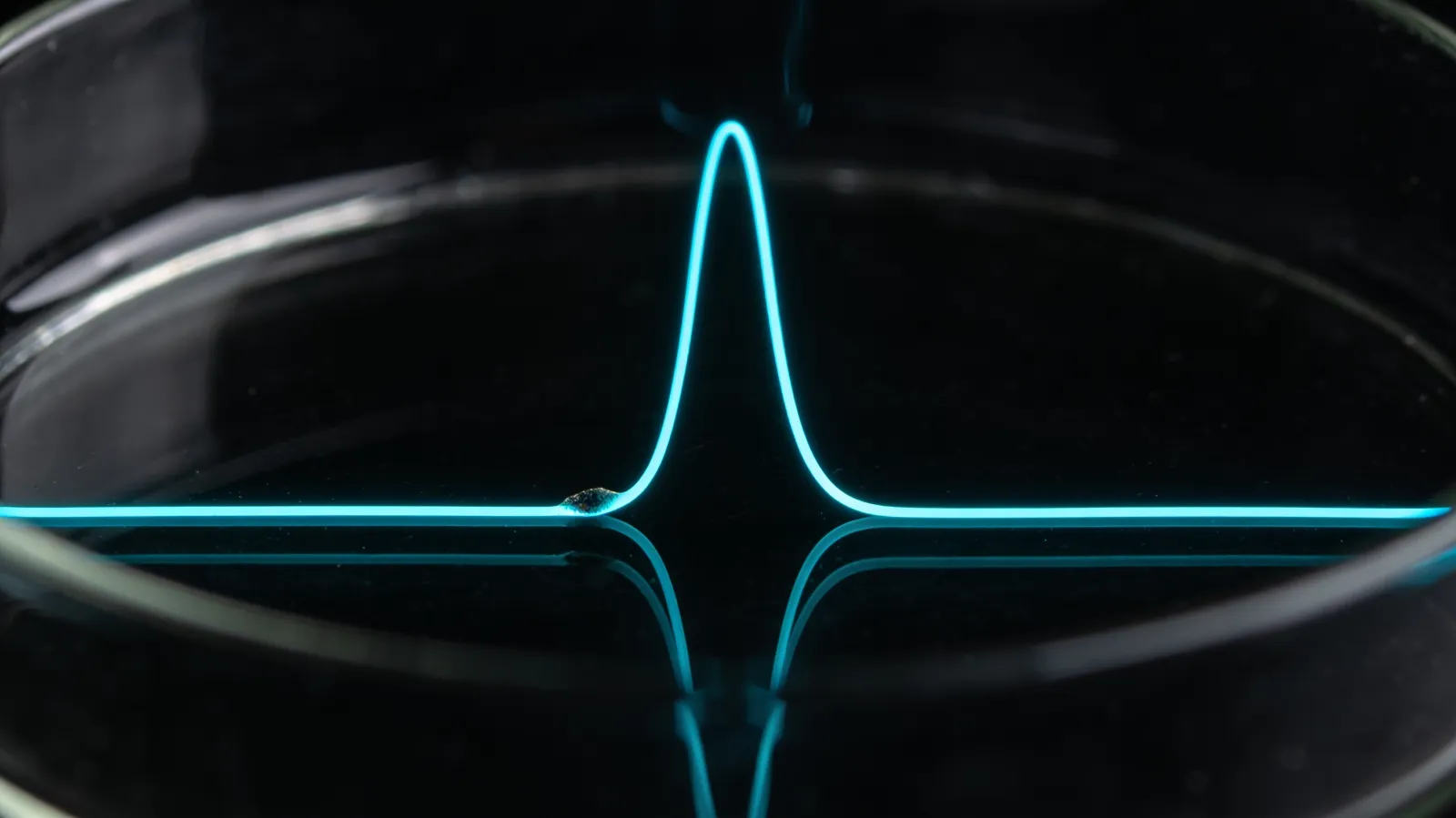
The chromatogram beneath the figure is worth a moment of its own, because the number was derived from it. Time runs along the horizontal axis and detector response up the vertical; the target peptide appears as one dominant peak at a characteristic retention time, and the integration table beside the trace lists every peak the software counted with its own area share. What you are looking for is a peak that returns cleanly to the baseline on both sides, a stated retention time rather than an unlabelled bump, and a small number of minor peaks that are actually resolved from the main one. A shoulder on the leading or trailing edge is co-elution: two components the column did not separate, counted by the software as one. That is how an area-percent figure can be technically correct and still flattering.
Do the arithmetic once and the distinction stops being abstract. The percentage is a ratio between peaks the detector saw; the content figure is a mass in milligrams. Neither can be worked out from the other, they do not average, and the larger one does not stand in for the smaller.
Certificates differ in how they express the second figure. Some give it as a percentage of vial mass. The laboratory that tests most of our lots reports it instead as a measured mass per vial, which is more directly checkable and occasionally surprising. Lot 2FRBRG of BPC-157 was reported at 99.51% by HPLC with 10.68 mg of peptide in a vial labelled 10 mg, because vials are deliberately overfilled to survive the fill tolerance. A content figure above the label is normal, and one a few per cent below it sits within ordinary fill tolerance. A figure well below the label, with no explanation beside it, is worth a question.
- 0%
- HPLC area percent on BPC-157 lot 2FRBRG
- Freedom Diagnostics certificate, reported 29 May 2026
- 0 mg
- peptide measured in that 10 mg vial
- net peptide content line on the same certificate
- 0% to 131.6%
- measured peptide content as a share of label strength across this library
- the 42 published lots here that report a content figure
| Measurement | What is in the numerator | What is in the denominator | On that lot | What it leaves out |
|---|---|---|---|---|
| HPLC area percent | Detector area under the target peak | Detector area under every peak | 99.51% of what the detector saw | Water, salts, counter-ions and anything that does not absorb at the detection wavelength |
| Net peptide content | Mass of peptide in the vial | Total mass of the vial's contents | 10.68 mg of peptide measured | Which peptide it is: that is the identity question, answered elsewhere |
Identity: mass spectrometry, molecular weight and the name on the label
Purity says how much of one thing there is. Identity says whether it is the right thing. Mass spectrometry answers that by measuring the molecular mass and comparing it against the theoretical mass for the sequence.
A certificate showing observed and theoretical mass within a small tolerance has demonstrated identity. One showing purity alone has told you the sample was clean, without saying what it was clean of. Where the two masses are printed side by side, convention for electrospray ionisation on peptides puts acceptable agreement within roughly 0.1 to 0.5 daltons, and a certificate that prints both numbers has shown its working.
Not every laboratory reports it that way, and the alternative is not a weaker test. Freedom Diagnostics, which issues most of the certificates in our library, confirms identity by LC-MS against a certified reference standard and prints a confirmation rather than a pair of masses. That is a genuine identity determination made against a known material; it is simply expressed as a conclusion rather than as the two numbers behind it. What matters is that identity was determined by an instrument at all.
Three constants pin a molecule down where a trade name will not: molecular weight, molecular formula and CAS number. They belong on a certificate and they are trivially checkable against a reference. TB-500 is the clearest case of why. The name is used in this market for two different molecules: the acetylated seven-residue fragment Ac-LKKTETQ at 889.0 g/mol, which is what TB-500 is here, and the full-length 43-residue thymosin β4 protein, several times heavier at around 4,963 g/mol. Both are legitimately supplied. They are not the same material, and the field that separates them at a glance is the molecular weight. The question what is TB-500 is worth settling before comparing two suppliers' purity figures at all.
- 0 g/mol
- theoretical mass of BPC-157
- Serviam product specification, formula C62H98N16O22
- 0 g/mol
- theoretical mass of tesamorelin
- Serviam product specification, formula C221H366N72O67S
- 0 g/mol
- theoretical mass of TB-500 as Ac-LKKTETQ
- Serviam product specification, CAS 885340-08-9
- 0 g/mol
- theoretical mass of GHK-Cu
- Serviam product specification, CAS 89030-95-5
Where the impurities in the other one per cent come from
Peptides at this scale are built by solid-phase peptide synthesis: the chain is assembled one residue at a time on a resin, each coupling driven close to completion but never quite to it. The shortfall at each step is where the impurity profile comes from, and it has a shape worth knowing.
A coupling that fails and is then capped leaves a deletion sequence: the full chain, one residue short. A chain that stops early leaves a truncated fragment. Side reactions on protecting groups leave adducts. All three are structurally close relatives of the target, which is precisely why they are difficult: a deletion sequence differing by one amino acid can elute very close to the target on a C18 column, and on a certificate reporting purity alone it shows up as nothing more alarming than a slightly smaller number. Mass spectrometry is what separates clean from correct.
The rest of the non-peptide mass in the vial is not a synthesis error at all. Reversed-phase purification runs in trifluoroacetic acid, so the peptide leaves the column as a TFA salt unless it is deliberately exchanged to acetate or hydrochloride. The counter-ion is real mass, it is invisible to an area-percent figure, and the salt form is a named field on a well-made certificate rather than something to be inferred. Lyophilised peptides are also hygroscopic, and residual moisture is counted in the vial's mass the moment the seal is broken in a humid room.
Between them, salt form and residual moisture account for most of the distance between a 99% purity figure and the mass of peptide a vial actually holds, which is why a fill is set above the label strength. Neither is a defect. Both are reasons the two numbers were never going to be the same number.
What a standard peptide certificate of analysis does not test
Purity, identity and content are the three measurements almost every research-use certificate carries. Contamination is a fourth category, and it is commissioned separately, charged separately and reported separately. A certificate that says nothing about endotoxin has not failed an endotoxin test. It has not had one, and the distinction is the whole point.
The LAL assay (Limulus amebocyte lysate) detects bacterial endotoxin, the heat-stable cell-wall fragments left behind by Gram-negative bacteria, which survive processes that destroy the bacteria themselves. Results come back either as a figure in endotoxin units per millilitre or as a pass against a stated limit. The lots in our library that carry this test report it as a pass in duplicate against a limit of 0.05 EU/mL or lower, and two cite USP General Chapter <85> as the method.
Sterility is a different question again, and a slower one. The compendial method in USP General Chapter <71> incubates a sample in growth media for 14 days and looks for growth. Fourteen days is why it is rarely run on a research lot released in a week, and why a claim of sterility unsupported by a sterility test is worth nothing on either side of the argument.
Heavy metals are screened by ICP-MS (inductively coupled plasma mass spectrometry), which reports lead, cadmium, arsenic and mercury at parts per billion. Residual solvents are a gas-chromatography question: acetonitrile and DMF from the synthesis and purification, measured in parts per million against the limits set out in ICH Q3C. Neither appears on a standard certificate for this class of material.
It is worth stating plainly what no certificate of analysis establishes, however complete it looks. It does not establish sterility unless a sterility test is printed on it. It does not establish that the impurities it counted are of any particular character: area percent counts them, it does not name them. It says nothing about what happened to the vial between the laboratory bench and yours, which is why how to store peptides is a separate subject. And it is not a manufacturing record: it reports on a sample, not on the controls under which the batch was made.
| Test | Instrument or assay | Question it answers | How the result is reported | Typical acceptance figure | On a standard RUO certificate? |
|---|---|---|---|---|---|
| Purity | RP-HPLC, C18 column | How much of the detected material is the target | Area percent | ≥98% by convention in this market | Yes |
| Identity | LC-MS or ESI-MS | Whether it is the molecule named | Observed against theoretical mass, or a reference-standard match | Agreement within roughly 0.1 to 0.5 Da | Yes |
| Net peptide content | Nitrogen determination or amino acid analysis | How much peptide the vial holds | Milligrams per vial, or a share of vial mass | Reported in milligrams against the label; 93.6% to 131.6% of label across the lots here | Often |
| Endotoxin | LAL (Limulus amebocyte lysate) | Whether bacterial endotoxin is present | EU/mL, or a pass against a stated limit | Pass at ≤0.05 EU/mL on the lots here that carry it | Commissioned separately |
| Sterility | USP <71> growth-media incubation | Whether viable organisms grow from the sample | Pass or fail after 14 days | No growth | Commissioned separately |
| Heavy metals | ICP-MS | Whether lead, cadmium, arsenic or mercury are present | Parts per billion | Below the limit of quantitation | Commissioned separately |
| Residual solvents | Gas chromatography | Whether acetonitrile, DMF or TFA remain | Parts per million | Within ICH Q3C limits | Commissioned separately |
Purity bands, and what a band does not settle
The market sorts HPLC figures into bands, and the bands are genuinely informative about one thing: the size of the impurity fraction. Moving from 95% to 99% is a fivefold cut in everything that is not the target peptide. Moving from 99% to 99.5% halves it again.
What a band cannot do is rank two certificates from different laboratories, because area percent depends on the method: the gradient, the column, the detection wavelength. An impurity that does not absorb where the detector is looking is not in the denominator. Two 99% figures are comparable only when the methods behind them are. That is one more reason the method line matters more than the percentage it qualifies.
Above roughly 99%, the honest answer is that the differences stop being the interesting question. Who measured this lot, whether the report names them, and whether the number belongs to the vial in front of you are all larger variables than the third decimal place.
| HPLC purity band | What it means analytically | What the remainder is likely to be | What the band does not tell you |
|---|---|---|---|
| Below 95% | More than one part in twenty is something other than the target | Deletion sequences, truncated fragments, unexchanged counter-ion | Whether the target is even the molecule named: that needs mass spectrometry |
| 95 to 97% | The impurity fraction is three to five parts in a hundred | Mostly close structural relatives from the synthesis | Which relatives, in what proportion, or whether any single one dominates |
| 98 to 99% | The commonest specification for research-grade material | A small mixed profile, usually unresolved into named components | Anything about contamination: endotoxin, metals and solvents are separate assays |
| Above 99% | One part in a hundred or less outside the target peak | Trace synthesis by-products at or near the detection threshold | How the figure compares with another laboratory's, unless both methods are stated |
Who ran the test named on a peptide certificate of analysis, and under what accreditation
A certificate produced in-house by the seller is an assertion. One produced by an independent laboratory is evidence, and it carries that laboratory's name, the date and the method.
Accreditation is a readable field, and the three abbreviations that appear on these documents do not mean the same thing. ISO/IEC 17025 is the international standard for the competence of testing laboratories: it accredits methods and the quality system behind them, scope by scope, and it is audited by an external body. GLP (Good Laboratory Practice) governs how studies are conducted and recorded rather than the accuracy of any single assay. cGMP applies to manufacture, not to testing at all, so a testing laboratory's credentials say nothing about the conditions the material was made under. An accredited laboratory named on a certificate is a stronger signal than an unaccredited one; an unnamed laboratory is not a signal at all.
Names are worth knowing because names can be checked. The certificates in our library are issued by Freedom Diagnostics and, for two lots, by pH Solutions. Elsewhere in this market you will see Janoshik Analytical, Eurofins BioPharma Product Testing and SGS Life Sciences on documents. An unfamiliar laboratory is not a red flag by itself. An anonymous one is.
A research peptide supplier should publish its certificates before purchase rather than produce them on request. Ours are: every lot's report is on the site, matched to the number printed on the vial, and can be looked up directly.
| Document | What it records | Who produces it | What it cannot establish |
|---|---|---|---|
| Research-use certificate of analysis | Measured identity, purity, net content and appearance for one named lot | An analytical laboratory, ideally independent of the seller | That the batch was made under controlled conditions, or that it is suitable for anything beyond bench research |
| Certificate of conformance | That a lot met a specification, with no measured values shown | Usually the manufacturer or distributor | Anything readable line by line, because the numbers behind the claim are absent |
| GMP batch record | Manufacturing controls, validated processes, qualified equipment and full batch history | The manufacturer, under a regulated quality system | Nothing about a research-use lot, because research-use material is not made under it |
Verifying a certificate against the laboratory's own record
A PDF can be edited. That is the honest starting point, and it is why the strongest check does not involve reading the document more carefully. It involves finding a copy of the same information held by someone other than the seller.
Most contract laboratories assign each sample an accession number when it is booked in, and many print a search code alongside it that resolves in the laboratory's own lookup. Every Freedom Diagnostics certificate in our library carries both. Lot PSNN1N of GLP-3 RT, for instance, shows accession 2607030208 and search code Auth2607030208; lot GHK100-052026-4 of GHK-Cu shows 2605120139 and Whol2605120139. The prefixes vary across our reports according to how the sample was submitted, which is the kind of internal consistency a fabricated document tends not to have.
Two further checks cost nothing. Read the test date: the working convention in this market treats a certificate more than about twelve months old as stale, not because the paper expires but because a lot that has outlived its documentation usually means the seller has stopped testing. And read the lot number off the vial itself, then find that number on the seller's site rather than on the PDF the seller emailed you.
Check a lot number before you read anything else
Every lot released here is published with its signed certificate, its accession number and the laboratory that issued it. Type the number printed on the vial and the document for that batch comes back.
Look up a lot numberCertificates that should not be trusted
The commonest problem is not forgery but vagueness. A report with no lot number attaches to nothing. A report with no laboratory named attaches to nobody. A chromatogram with no axis labels, no scale and no retention times is a picture of a peak rather than a measurement of one.
Then there are the reused documents: one certificate cited across several products, or a date that never moves while lots keep shipping. Synthesis is a per-batch process, and a failure in one batch tells you nothing about the next, which is exactly why a peptide certificate of analysis has to be per batch too.
One widely repeated tell deserves qualifying, because it is repeated more confidently than it deserves. Purity reported as a flat 99% is often said to be suspicious on the grounds that real instruments produce decimals. It is a fair heuristic and it is not a rule. Two lots in our own library, GLP-3 RT lots Y4AWYQ and 2NPVBM, are reported at a flat 99% simply because that is how the issuing laboratory, pH Solutions, prints the figure. The rest of the library, measured by Freedom Diagnostics, runs from 99.247% to 99.984% with two or three decimals. A round number is a reason to read the method and the laboratory name, not a verdict on either.
The check that resolves nearly all of this takes ten seconds: read the lot number off the vial, and find that lot number on the seller's site.
| What you see on the document | Why it happens | Severity | The check that settles it |
|---|---|---|---|
| No lot or batch number | A template reused across every batch | Fatal | There is nothing to check; treat the document as absent |
| No laboratory named | In-house bench data presented as a report | Fatal | Search for the laboratory; if there is none, the figure is an assertion |
| Identical purity and retention time on two different lots | One chromatogram reused under two numbers | Fatal | Open both PDFs side by side and compare the traces |
| One certificate cited across several products | Marketing artwork rather than a record | Fatal | Read the product name and sequence printed on the document |
| Lot number does not resolve on the seller's site | The document and the inventory disagree | Fatal | Quote the number exactly as printed and ask before anything else |
| Chromatogram with no axes, scale or retention times | A screenshot rather than an instrument output | High | Ask for the full report including the method |
| No method named beside the purity figure | A number transcribed without its provenance | High | A reproducible result names the column, the gradient and the wavelength |
| Test date more than twelve months old | The lot has outlived its documentation | Medium | Ask for the certificate covering the lot currently shipping |
| Purity given to zero decimal places | Often a specification rather than a measurement | Low on its own | Check which laboratory issued it and by what method before concluding anything |
Fifty-one certificates, and what a real library looks like
Reading about a peptide certificate of analysis is less useful than reading one. The library on this site holds 51 signed reports covering 11 compounds, each tied to a released lot number, and the figures in it behave the way measurements behave rather than the way marketing copy does.
The purity figures are not all 99.9%. Across the Freedom Diagnostics reports they run from 99.247% on a BPC-157 lot released in April to 99.984% on an ipamorelin lot, which is the ordinary spread of a batch process rather than a quality problem. The measured content moves around more than the purity does, because fill overage is set per run: a 50 mg GHK-Cu lot came back at 65.80 mg of peptide, and a 100 mg lot of the same compound at 94.85 mg.
Blends are where an itemised certificate earns the most. A single combined purity figure on a four-component vial answers almost nothing; what matters is the measured mass of each component. KLOW lot XX1EZC reports GHK-Cu at 58.65 mg, KPV at 8.80 mg, TB-500 at 10.16 mg and BPC-157 at 9.42 mg against an 80 mg label, and that itemisation is the only way to know what the ratio in a given lot actually is. GLOW vs KLOW is a question their certificates answer more precisely than their names do.
- 0
- signed certificates published, one per released lot
- the certificate library at /coa, September 2026
- 0
- compounds with a per-lot certificate history on the site
- same library
- 0%
- the lowest HPLC figure published here, on a BPC-157 lot
- Freedom Diagnostics, reported 21 November 2025
| Compound | Lot | HPLC purity | Peptide measured | Reported |
|---|---|---|---|---|
| BPC-157 | 2FRBRG | 99.51% | 10.68 mg in a 10 mg vial | 29 May 2026 |
| Tesamorelin | TESM-052026-4 | 99.87% | 10.57 mg in a 10 mg vial | 14 May 2026 |
| GHK-Cu | GHK100-052026-4 | 99.86% | 94.85 mg in a 100 mg vial | 14 May 2026 |
| TB-500 | PQ7MWD | 99.58% | 12.16 mg in a 10 mg vial | 29 May 2026 |
| MOTS-c | MOT10-052026-4 | 99.76% | 12.07 mg in a 10 mg vial | 14 May 2026 |
| Ipamorelin | VNA7TB | 99.90% | 13.12 mg in a 10 mg vial | 12 May 2026 |
| NAD+ | NAD1000-052026-1 | 99.94% | 1044.79 mg in a 1000 mg vial | 29 May 2026 |
| GLP-3 RT | PSNN1N | 99.90% | 9.68 mg in a 10 mg vial | 6 July 2026 |
Getting a certificate when a seller will not publish one
Half the questions people ask around this subject are about obtaining a certificate rather than reading one, which is a fair reflection of how much of this market still emails documents on request.
Ask first, and ask for the lot. A request that names the number printed on the vial is much harder to answer with a generic document than a request for "the COA". If what comes back carries a different lot number, or no lot number, that is an answer in itself.
If a seller cannot or will not produce one, material can be tested independently. The analytical laboratories serving this market accept samples from anyone: a few milligrams in the original sealed vial, a submission form naming the compound and the assays wanted, and a report back in days rather than weeks. Pricing is quoted per sample and per assay. HPLC purity and mass-spectrometry identity are the cheapest pair on the list, and each contaminant assay is charged on top of them. Published rates move often enough that a figure quoted in an article is a figure that will be wrong by the time it is read, so ask the laboratory directly rather than trusting a number in a guide.
What commissioning your own test does not do is retrofit provenance. It tells you what is in the vial you sent, which is worth knowing, and nothing about the next vial from the same seller. A seller that publishes per lot has already answered the question for every buyer at once, and whether they do is one of the first things worth checking about a research peptide supplier.
Reading a peptide certificate of analysis takes about a minute once you know the order: match the lot to the vial, check identity by mass or against a reference standard, read purity as area percent and look for the net peptide content beside it, note which contaminant assays are present and which were simply never run, then see who signed it and whether the accession code resolves. A certificate that cannot survive those questions is decoration, and the compound behind it is unmeasured.
Common questions
What does 99% purity mean on a peptide certificate of analysis?
Almost always 99% by HPLC area percent: of everything the detector measured, 99% was the target peptide. It excludes water, salts and counter-ions, which is why net peptide content is a separate and usually lower figure.
Why does the lot number matter?
A peptide certificate of analysis only describes the batch it was made from. If the lot number on the certificate does not match the number printed on your vial, the document says nothing about what you have.
What is net peptide content?
The proportion of the vial's mass that is peptide rather than water, salts or counter-ions. It is reported separately from HPLC purity. Some laboratories, including the one behind most of the certificates here, report it instead as a measured mass per vial against the label strength, which is the more directly checkable form of the same figure.
Should a supplier publish certificates or send them on request?
Publish. A certificate available before purchase, matched to a lot number, can be checked by anyone. One sent on request can be selected after the fact.
How do I know a peptide COA is real and not made up?
Four checks catch nearly everything: the laboratory is named and can be contacted, the report is dated and signed, the chromatogram carries axis labels, a scale and retention times, and the lot number resolves on the seller's own site. Many contract laboratories also print an accession or search code that ties the report to their internal record of the sample. A document that is only an image of a peak, with no method and no laboratory named, can be checked by nobody and is worth treating as if it did not exist.
Is a certificate of analysis the same thing as third-party testing?
No. A certificate is the report; third-party testing describes who produced it. A seller can write a perfectly formatted certificate from its own bench data, which is an assertion rather than evidence. The distinction lives in one field, the laboratory named on the document, and peptide purity testing by an outside laboratory matters more than the percentage the document reports.
Why does my certificate say 99% purity but the measured peptide content is below the label weight?
Because the two numbers answer different questions. HPLC purity compares the target peak against the other peaks the detector saw; net peptide content compares peptide mass against the vial's total mass, which also holds residual water and a counter-ion such as trifluoroacetate. A 10mg vial at 99% purity is not a 9.9mg mass of peptide, and the measured content on the lots published here runs from 93.6% to 131.6% of label, so a figure a little under the label is ordinary fill variation rather than a short vial. A certificate reporting both figures is the more complete document.
Why does my certificate report more peptide than the vial is labelled for?
Fill overage. Vials are deliberately overfilled so that every unit in a run clears its target weight once the filling tolerance is accounted for, so a lot labelled 10 mg may be measured at 10.68 mg and a 50 mg lot at 65.80 mg. A content figure above the label is normal and the certificate is simply reporting what was there. A content figure well below the label, with no explanation beside it, is the one worth asking about.
What is the accession number or search code on a certificate of analysis?
It is the testing laboratory's own reference for the sample, assigned when the material was booked in. It is useful because it ties the report back to a record held by someone other than the seller, so the document can be checked at source rather than taken on trust. Not every laboratory prints one, and its absence is not a fault on its own. An unnamed laboratory is.
Does a certificate of analysis tell me the vial is still good when it arrives?
No. A certificate records what the batch was measured to contain on the date the laboratory tested it, and says nothing about what happened to the vial afterwards. Packing, transit and storage are separate questions, which is why the appearance and solubility lines are worth reading: they describe what the contents should look like when the seal is broken.
Do peptide blends get a certificate of analysis too?
They should, and a blend certificate has more work to do than a single-compound one. As well as purity and identity, it needs to state the measured content of each component in the vial rather than one combined figure. That is the only way to tell what the ratio in a given lot actually is, and it is the first thing to look for when reading the certificates behind GLOW vs KLOW.
What does endotoxin testing mean on a peptide certificate of analysis?
Endotoxins are heat-stable fragments of Gram-negative bacterial cell walls that survive processes which destroy the bacteria themselves, so they are detected rather than assumed absent. The LAL assay (Limulus amebocyte lysate) is the standard method, and results come back either as endotoxin units per millilitre or as a pass against a stated limit. It is a separately commissioned test, so most research-use certificates do not carry it. Where the lots published here do, the result is reported as a pass in duplicate against a limit of 0.05 EU/mL or lower.
What is ISO 17025 accreditation and why does it appear on a certificate?
ISO/IEC 17025 is the international standard for the technical competence of testing and calibration laboratories. An accredited laboratory has had its methods and quality system audited by an external body, scope by scope, so the accreditation attaches to specific tests rather than to the laboratory as a whole. It is not the same as GLP, which governs how studies are conducted and recorded, or cGMP, which applies to manufacture and says nothing about testing at all.
Is a research-use certificate of analysis the same as a GMP batch record?
No, and the gap is large. A research-use certificate reports measured identity, purity, content and appearance for one lot. A GMP batch record documents the manufacturing controls, validated processes, qualified equipment and full history under which a batch was produced, within a regulated quality system. Research-use material is not made under that system, so its certificate cannot stand in for one and should never be presented as though it could.
Are sellers legally required to provide a certificate of analysis?
For research-use material a certificate is a quality document rather than a regulatory one, and it confers no approval of any kind. Pharmaceutical manufacture is a separate regime with its own requirements. In practice the absence of a per-lot certificate tells you about the seller's process, which is why published certificates are the first of the checks worth running on a research peptide supplier.
What is the difference between a certificate of analysis and a certificate of conformance?
A peptide certificate of analysis reports measured values for one named lot: purity, mass and content. A certificate of conformance states only that the lot met a specification, without showing the numbers behind it. Conformance documents are legitimate in their place, but they cannot be read line by line, so a purity claim backed by one alone is still a claim.
How do I get a Certificate of Analysis from a peptide provider?
Ask for it by lot number rather than by product name, quoting the number exactly as it is printed on the vial. A request tied to a specific lot is much harder to answer with a generic document, and what comes back is itself informative: a report with a different lot number, or none, has answered a different question. Sellers that publish per lot remove the exchange entirely: every report held here is on the site before anything ships.
Where can I get a COA for peptides?
From the seller, ideally published on their site and searchable by lot number, or from the testing laboratory directly where the certificate carries an accession or search code that resolves in their system. If neither route produces a document for your lot, the remaining option is to send a sample to an independent analytical laboratory yourself and commission the report.
How much does peptide COA testing typically cost?
It is priced per sample and per assay rather than as a flat fee. HPLC purity and mass-spectrometry identity are the cheapest pair and are usually quoted together; endotoxin, sterility, heavy metals and residual solvents are each charged on top. Published rates at the laboratories serving this market change often, so a figure quoted in an article dates quickly. Ask the laboratory for a current price list and specify the assays you want rather than asking for "a COA".
What should I do if my lot number does not appear on the seller's certificate page?
Stop and ask before doing anything else with the vial, because an unmatched lot number is the one failure that cannot be explained away by formatting. Photograph the label and send it to the seller, quoting the number exactly as printed. Every lot released here is searchable by its number, and anything that does not resolve is worth raising through our contact page.
- ICH Q6A, Specifications: Test Procedures and Acceptance Criteria (FDA): the convention that a specification names the test, the procedure and the acceptance criterion rather than a bare figure
- ICH Q2(R2), Validation of Analytical Procedures (FDA): why a purity result is only reproducible when the analytical procedure behind it is stated
- PubChem CID 62707662, TB-500 (Ac-LKKTETQ): the identity and molecular constants of the acetylated seven-residue fragment sold under the name TB-500
- UniProt P62328, Thymosin beta-4 (human): that thymosin beta-4 is a 43-residue protein, a different molecule from the seven-residue fragment that shares the trade name
- PubChem CID 9941957, BPC-157: the molecular formula and calculated mass a BPC-157 identity line is checked against
Read more
- Peptide purity, and what the percentage measuresPeptide purity is quoted as a single number on every listing in this category. That number is measuring something quite specific, and it is not what most buyers assume.
- Peptide purity testing: the methods, the laboratories and what they costPeptide purity testing is not one test. It is a short panel of quite different measurements run on different instruments, and knowing which is which tells you how much a certificate is worth.
- Sterile water vs bacteriostatic waterSterile water vs bacteriostatic water is a question about one ingredient and one consequence: whether the vial can be opened more than once. The labels answer it in figures.
- What is bacteriostatic water?What is bacteriostatic water, exactly? It is one ingredient away from ordinary sterile water, and that one ingredient is the entire reason it exists.
- What is a peptide?What is a peptide, in the vocabulary that every specification sheet, sequence line and certificate in this library already assumes. This is the page to read first.
- GLP-1 peptideThe GLP-1 peptide this catalogue sells as GLP-1 S is an engineered analogue of the hormone it shares a name with, registered under CAS 910463-68-2. This page states what the molecule is, how the analogue and the hormone differ, and what our single published certificate actually says.
For laboratory research use only. All compounds listed on this site are sold strictly as reference materials for in-vitro laboratory research conducted by qualified professionals. They are not drugs, foods, cosmetics, or medical devices. They are not intended for human or veterinary consumption, therapeutic use, diagnostic application, or any in-vivo use whatsoever. These statements have not been evaluated by the Food and Drug Administration. By purchasing, you affirm that you are a qualified researcher and that you will comply with all applicable institutional, local, state and federal regulations governing the handling of research chemicals. Published by SERVIAM BIO LABS.