

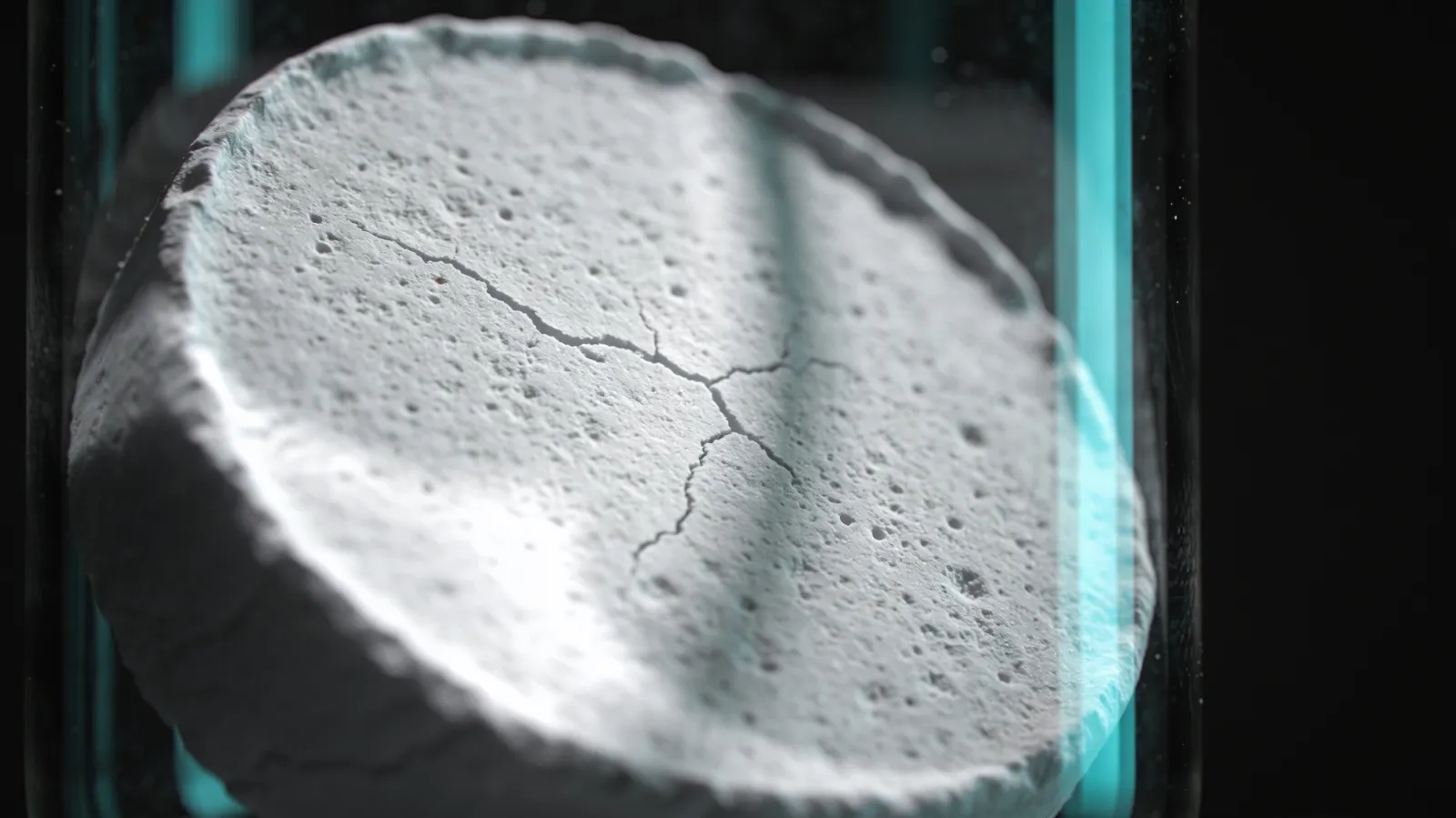
Lyophilized powder is solid material that has been freeze-dried: frozen, then held under vacuum so its ice turns straight to vapour without ever becoming liquid. Removing water this way leaves a dry, porous cake far more stable than a solution, and it dissolves back readily. Peptides ship as lyophilized powder because dry material survives transport and storage that solution does not.
- Lyophilized powder is freeze-dried solid: frozen, then held under vacuum below water's triple point of 4.58 Torr until the ice has passed straight to vapour, so the material never exists as a warm, concentrated solution.
- Removing the water is what buys the shelf life. Sealed dry material lasts months to years at −20°C, where the same compound in solution is measured in weeks.
- Peptide purity and net peptide content are reported as two separate figures because the dry solid also carries the trifluoroacetate counter-ion left by purification and a little residual water, neither of which a chromatography percentage can see.
- Residual moisture, not freezer temperature, is usually what limits how long a vial of lyophilized powder keeps. It is measured by Karl Fischer analysis and reported as a percentage of mass, which is why water content appears on a thorough certificate of analysis at all.
- Cake appearance is an observation, not a measurement: a collapsed or shrunken cake says the drying ran outside its window, not that the lot failed its assay.
How lyophilized powder is made
Three stages, and the order is the point. The solution is frozen solid first, quickly enough to give small ice crystals and slowly enough that the structure holds. Then the pressure is dropped far below atmospheric, and the ice sublimes: it passes directly from solid to vapour without ever passing through liquid water. That is primary drying, and it removes the great majority of the water.
The pressure figure is the part almost nobody states. Water sublimes rather than melts below its triple point, which sits at 0.01°C and 611.7 Pa, or 4.58 Torr. Primary drying is normally run an order of magnitude below that, at chamber pressures of roughly 50 to 200 mTorr, with the shelves somewhere between −40°C and −20°C and a condenser at −50°C to −80°C pulling vapour out of the chamber as fast as the cake gives it up. The condenser, not the vacuum pump, does most of that work.
What remains after primary drying is water bound to the material itself rather than frozen in it. Secondary drying raises the temperature gently under continued vacuum to drive that off, typically to a residual moisture of a few per cent or less.
A full cycle is slow. Twenty-four to seventy-two hours is ordinary for a production run, because the heat of sublimation has to be fed in faster than the cake can lose it and slower than the cake can stand. That duration is most of why a vial of lyophilized powder costs materially more to fill than a liquid one, and why nothing gets freeze-dried that would have survived being sold as a solution.
The vial is sealed at the end of the cycle rather than after it. The stoppers sit half-inserted through the whole run, with slots cut in the side to let vapour escape; at the end of secondary drying the shelves close and push every stopper home at once, while the chamber is still under vacuum or has been backfilled with nitrogen. That is why an intact vial of lyophilized powder often draws a faint hiss of air inwards on first entry.
- 0 Torr
- the triple point of water, below which ice sublimes instead of melting
- 611.7 Pa at 0.01°C; the physical constant the whole process is built around
- 0 to 95%
- of the total water removed in primary drying alone
- The bound remainder comes off in secondary drying
- 0 to 72 hours
- typical length of a production freeze-drying cycle
- Representative of published pharmaceutical cycle designs
| Stage | What happens physically | Typical shelf temperature | Typical chamber pressure | Share of water removed |
|---|---|---|---|---|
| Freezing | Solution frozen solid; ice-crystal size sets the pore structure of the cake | −40°C or below | Atmospheric | None |
| Primary drying | Ice sublimes directly to vapour and is trapped on the condenser | −40°C to −20°C | About 50 to 200 mTorr | About 90 to 95% |
| Secondary drying | Water bound to the solid is desorbed at a raised temperature | +20°C to +40°C | About 50 to 100 mTorr | The remainder |
| Stoppering | Shelves close and seat every stopper while the chamber is still evacuated | Ambient | Vacuum, or an inert backfill | None |
Freezing
Sets the ice-crystal structure, which sets the pore structure of the finished cake and therefore how quickly it will redissolve. Shelves usually go to −40°C or below, and some cycles hold deliberately above that for a while, a step called annealing, to grow crystals of a more uniform size.
Primary drying
Sublimation under deep vacuum, at roughly 50 to 200 mTorr. Slow, often many hours, because the heat of sublimation has to be supplied without letting anything melt. Takes out something like 90 to 95 per cent of the total water.
Secondary drying
Removes bound water at a slightly raised shelf temperature under continued vacuum. This is the stage that takes residual moisture from several per cent down to below one or two, and it is the stage that decides the shelf life.
Why lyophilized powder is made by sublimation, and not by heat
Because peptides are chemically fragile and water is the medium in which most of their degradation happens. Evaporative drying means going through a concentrated liquid phase at raised temperature, precisely the conditions under which hydrolysis, aggregation and oxidation proceed fastest.
Sublimation avoids the liquid phase entirely. The material never gets hot and never gets concentrated in solution, so it arrives at dryness having spent no time in the state that would damage it.
The resulting solid is also porous, which matters at the other end. A dense dried plug redissolves slowly and unevenly; the cake of a lyophilized powder is mostly empty space and takes diluent back almost immediately.
Every other way of removing water passes through one of the two conditions freeze-drying avoids: heat, or a long spell as a concentrated liquid. Each of the alternatives leaves the material at its most concentrated at the moment it is also at its warmest, and each produces a denser solid for it. That is the whole argument, and it is why the answer to 'why not just dry it' is a phase diagram rather than a preference.
| Method | Peak temperature the material sees | Concentrated liquid phase? | Structure produced | Redissolution |
|---|---|---|---|---|
| Freeze-drying (lyophilization) | Below ambient throughout primary drying | No: ice goes straight to vapour | Porous cake at roughly the original fill volume | A minute or two of gentle swirling |
| Spray drying | Inlet gas above 100°C, briefly | Yes, as an atomised droplet | Fine, free-flowing spheres | Fast, but the material has been heated |
| Vacuum or oven drying | Roughly 40 to 80°C, sustained for hours | Yes, and for the whole run | Dense plug or glassy film | Slow and uneven |
| Air drying | Ambient, sustained for days | Yes, for days | Hard, irregular residue | Poor |
Lyophilized powder against pre-mixed liquid
The comparison most people are actually making when they search this term is between lyophilized powder and a vial that arrives already in solution. It is a supply-format question rather than a chemistry one, and it has a clean answer: a dry vial tells you more about itself than a wet one can.
A sealed lyophilized vial carries a known starting state. The certificate says what was in it when the lot was released, and nothing has happened since except storage, because there is no water present for anything to happen in. A pre-mixed liquid arrives having already spent an unknown time in solution: made up on an unknown date, at an unknown concentration, in an unknown diluent, held at unknown temperatures on the way. None of that is visible in the vial, and none of it is on the certificate, because the certificate was written about the powder.
The trade is that the dry format moves a step onto the bench. Lyophilized powder has to be brought back into solution before anything can be measured with it, which means a diluent, a closure entered twice, and a record of when the solution was made. That step is the price of the provenance, and it is worth naming rather than glossing.
It is also why everything in the research catalogue except the diluent ships dry, and why bacteriostatic water is stocked as a separate line rather than pre-loaded into the vial. Two products, two documents, and a start date the buyer sets.
| Compared on | Lyophilized powder | Pre-mixed liquid |
|---|---|---|
| What is in the vial | Dry cake, plus any excipient the formulation carries, with water removed to a stated residual figure | The same solid, already dissolved in a diluent chosen by whoever filled it |
| Time already spent in solution | None | Unknown, and counting from a fill date you did not set |
| Stability as supplied | Months to years, sealed and cold | Weeks, with the clock started before despatch |
| Transit requirement | Tolerates ambient for days | Cold chain, and the window shortens if it lapses |
| Storage | −20°C sealed, dark and dry | 2 to 8°C, and still finite |
| Step before measurement | Reconstitution with a diluent | None |
| What a buyer can verify | Lot number against a published certificate | The same certificate, describing a state the vial is no longer in |
Cake, powder and bulk lyophilizate
The words get used interchangeably and they are not the same thing. A cake is what forms when a solution is frozen and dried in the container it will be sold in: the solid holds the shape of the liquid that made it, standing as a plug in the bottom of the vial. A powder, strictly, is what you get when that lyophilizate is broken up, either deliberately, by milling a bulk tray, or accidentally, by a courier.
Which one is in the vial depends on the fill and the formulation, not on quality. The wording is worth checking against the documents rather than assuming. Across the 51 certificates published here, 49 record the appearance as a lyophilised powder, white or blue, including every BPC-157 peptide lot and every 1,000mg NAD+ peptide lot. Only two use the word cake, and both are GLP-3 RT. Neither word is a grade, and a supplier switching between them across lots is describing what the laboratory saw rather than hedging.
Bulk lyophilization is the third case. Material is dried in open trays and subdivided afterwards, which is how most reference standards and reagents reach a filler as lyophilized powder in the first place. Same physics, no vial around it, which is why a bulk lyophilizate is nearly always a powder and a unit-dried vial is nearly always a cake.
| Form | How it arises | Appearance | Redissolution | Where it is met |
|---|---|---|---|---|
| Cake | Dried in its final container; holds the shape of the frozen fill | Opaque plug with a defined edge, at roughly the original fill volume | Fastest, because the pore structure is intact and continuous | Filled vials, as supplied |
| Powder from a broken cake | A cake shaken apart in transit or handling | Loose granules, with dust on the vial wall or the stopper | Unchanged; the pores survive at granule scale | Any vial that has travelled |
| Milled or bulk lyophilizate | Dried in open trays, then ground and subdivided | Free-flowing and uniform | Fast, though denser than a cake | Reference standards, reagents, pre-fill bulk |
Reading the cake: what lyophilized powder should look like
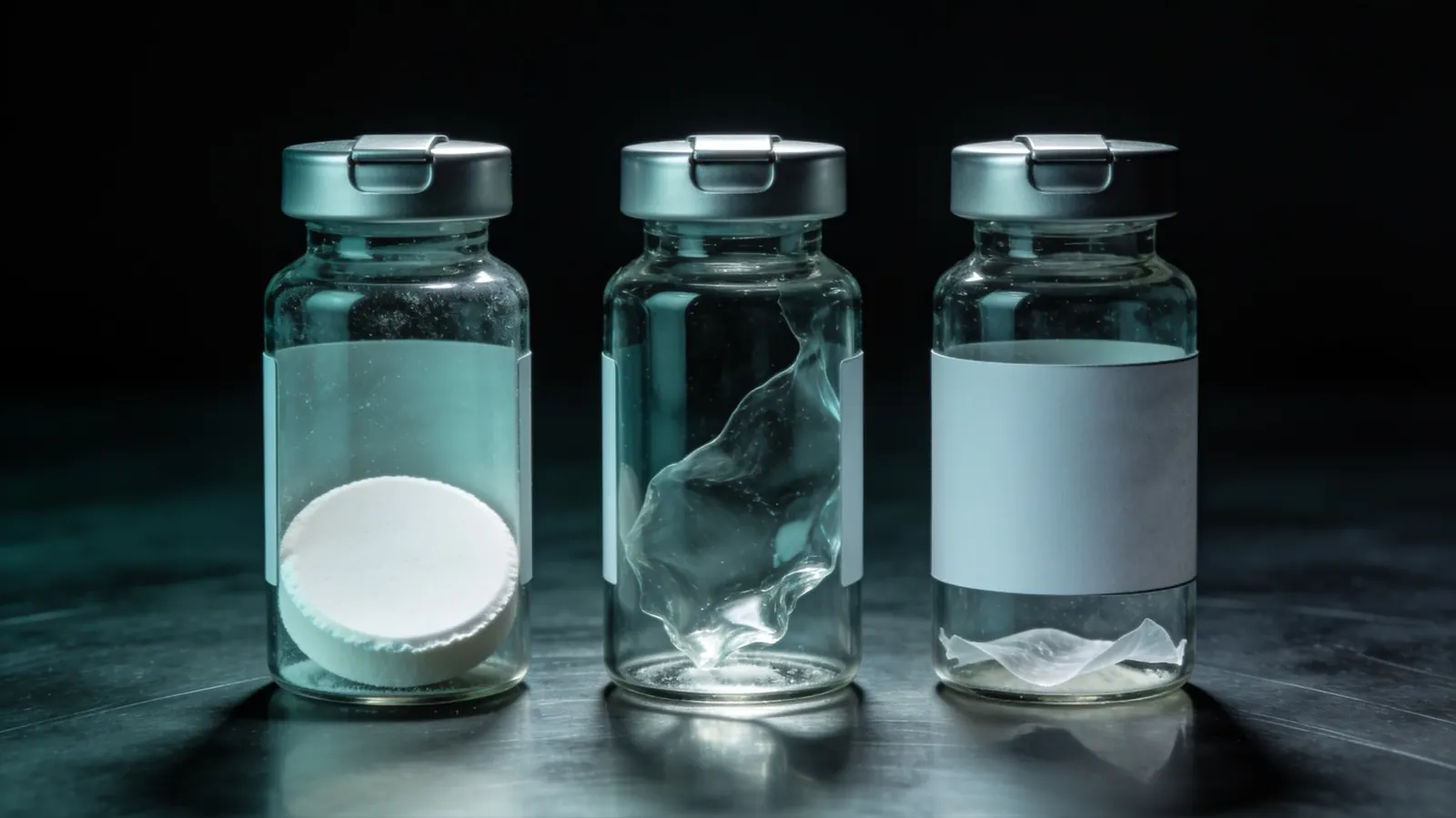
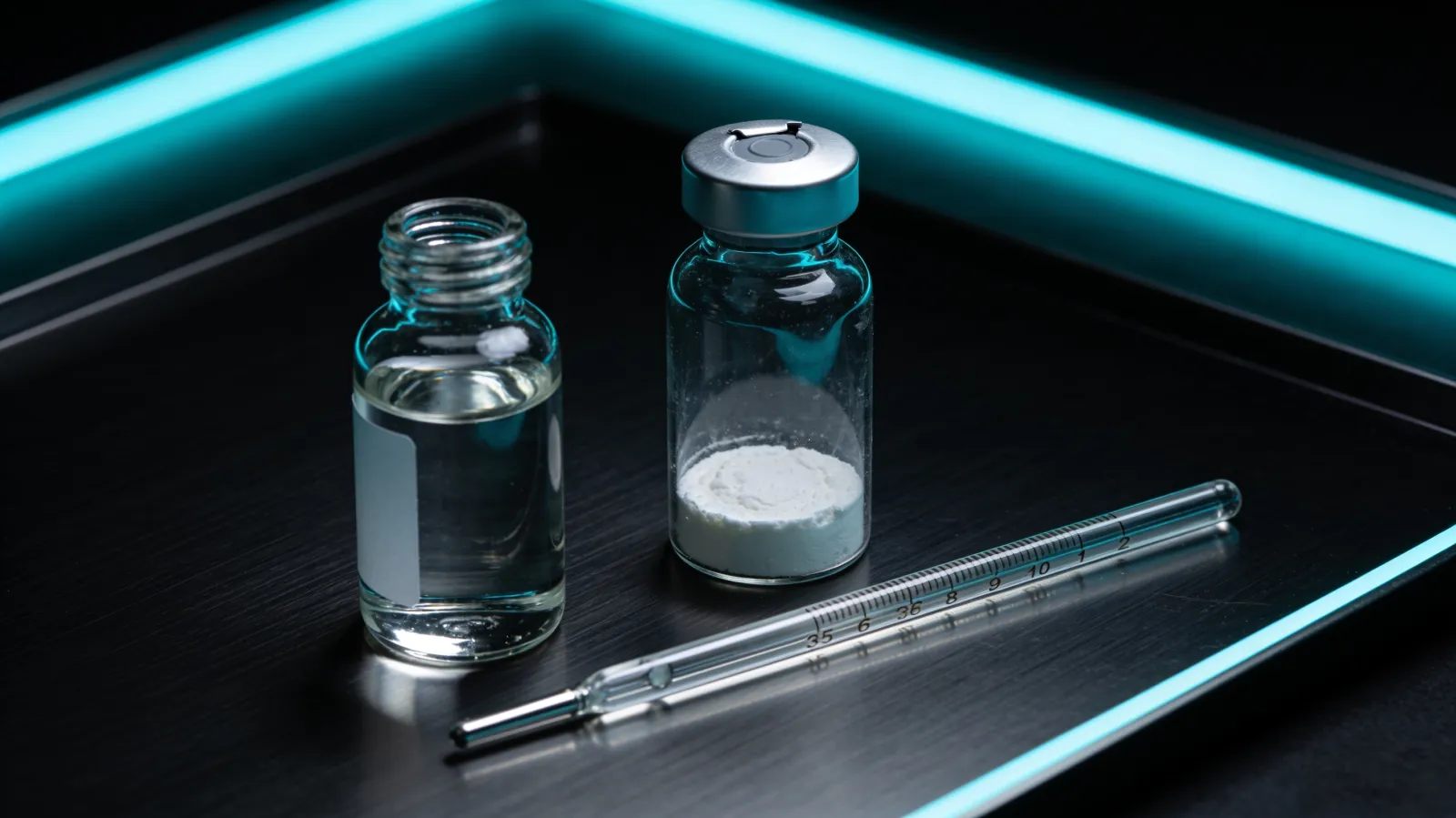
A well-formed cake of lyophilized powder is uniform, opaque, and occupies roughly the volume of the original solution: a white or off-white plug sitting in the bottom of the vial with a defined edge. Colour depends on the compound. Most peptides are white to off-white, while copper-containing material such as the GHK-Cu copper peptide is distinctly blue, and so is anything built on it. GLOW at 70mg and KLOW at 80mg both carry 50mg of GHK-Cu, and both dry to a blue cake; every certificate we hold for them records it that way, so a white cake sold under either name is describing something else.
A collapsed cake, shrunken, glassy, or pulled away into a hard bead, indicates the material warmed above its collapse temperature during drying. It is not necessarily degraded, but it is a sign the process ran outside its window, and it usually redissolves more slowly.
A thin film at the bottom of the vial with no structure, or visible melt-back, is the same signal more strongly. And a cake that has clearly moved or powdered in transit is cosmetic: the material is intact, it has simply been shaken.
Cake size is the observation people misread most often. The plug occupies roughly the volume of the solution that was frozen, not a volume proportional to the mass of peptide in it. A 5mg fill of Ipamorelin and a 10mg fill therefore look much the same, and both look like very little; a 100mg fill of GHK-Cu copper peptide, the largest single-peptide fill in the catalogue, still sits as a shallow disc rather than a heap. Nothing can be inferred about mass from looking.
None of this substitutes for the lot's certificate. The appearance of a lyophilized powder is recorded on a peptide certificate of analysis precisely because it is an observation worth making and not a measurement.
| What you see | What it indicates | Does it bear on the assay | What to do next |
|---|---|---|---|
| Uniform white or off-white plug with a defined edge | The cycle ran inside its window | No: this is the expected appearance | Nothing |
| Deep blue plug | Copper-bound material: GHK-Cu and the blends built on it | No: blue is the specified appearance | Check the certificate records a blue lyophilised powder |
| Shrunken, glassy, or pulled into a hard bead | The solid warmed above its collapse temperature during drying | Not directly; it is a process signal, not a result | Read the lot's HPLC figure rather than the cake |
| Thin film with no structure, or visible melt-back | The same, more strongly | Not directly | As above, and note it against the lot |
| Cake broken loose, on the wall or against the stopper | Shaken in transit | No: nothing has been lost | Tap the vial gently to settle it before opening |
| Sticky, oily, clumped or discoloured | Moisture has reached the solid at some point | Possibly, and invisibly | Stop. Look the lot up and assay before using it |
Bulking agents, and what this catalogue's certificates record
Five milligrams of peptide spread across the base of a vial is very little solid to hold a shape, and left to itself it can dry to a film or a smear: fragile, hard to inspect, and slower to take diluent back than a proper cake. Pharmaceutical formulators answer that by putting a bulking agent into the solution before it is frozen. That is general freeze-drying practice and it is worth saying plainly that it does not describe this catalogue: no certificate and no product record here lists an excipient in any vial. What the vial does hold besides peptide is counter-ion and residual water, and the line between those and the peptide itself is drawn in what is a peptide.
Mannitol, sucrose, trehalose and glycine are the usual four. Mannitol crystallises during freezing and gives a firm, mechanically strong cake. Sucrose and trehalose stay amorphous and protect the molecule through the freezing step, at the cost of a much lower collapse temperature and therefore a longer, colder, more expensive cycle. Glycine is used where a crystalline bulk is wanted at low loading. Typical concentrations in the pharmaceutical literature are a few per cent by volume of the pre-freeze solution. None of those four appears on any certificate published here.
Peptide purity and net peptide content are reported as two separate figures for a different reason on these lots. Purity describes what fraction of the peptide-related material in the vial is the peptide that was ordered. Net peptide content describes how much peptide the vial actually holds, measured in milligrams against the label strength. The gap between the two here is the trifluoroacetate counter-ion left by reversed-phase purification and the residual water in the cake, not an added excipient, and neither figure is concealing anything: they measure different quantities, and a peptide certificate of analysis worth reading states both.
Where a formulation does carry an excipient, that excipient also sets the collapse temperature, and the collapse temperature is the number a whole cycle is designed around: shelf temperature, chamber pressure and cycle length are all chosen to keep the drying solid below it. Exceed it for long enough and the cake loses its structure while it is still wet, which is the mechanism behind every shrunken and glassy plug in the section above.
- −32°C
- the glass transition temperature (Tg′) of a frozen sucrose formulation, above which the cake collapses during drying
- Published value for maximally freeze-concentrated sucrose
- −1.5°C
- the eutectic temperature of mannitol, which is why a mannitol cake tolerates a warmer, shorter cycle
- Published value for the eutectic of mannitol and water
- 0 to 5% w/v
- typical mannitol loading in the solution before it is frozen
- Representative pharmaceutical formulation range
| Excipient | Role | Typical loading | Critical temperature | Cake it produces |
|---|---|---|---|---|
| Mannitol | Crystalline bulking agent | 2 to 5% w/v | Eutectic around −1.5°C | Firm, white, mechanically strong; tolerates a warmer cycle |
| Sucrose | Amorphous stabiliser and bulk | 5 to 10% w/v | Tg′ around −32°C | Elegant but collapse-prone; needs a cold, slow cycle |
| Trehalose | Amorphous stabiliser and bulk | 5 to 10% w/v | Tg′ around −29°C | As sucrose, marginally more forgiving |
| Glycine | Crystalline bulking agent | 1 to 2% w/v | Eutectic around −3°C | Fine crystalline plug at low loading |
Residual moisture, and how it is measured
Residual moisture is the specification that decides how long a sealed lyophilized powder keeps. Temperature matters, but a poorly dried vial at −20°C will drift before a well-dried one at 2 to 8°C, because the water left behind in the solid is what hydrolysis needs to proceed.
It is measured rather than estimated. Karl Fischer analysis, the method described in USP <921>, Water Determination, reacts the water in a weighed sample and reports it as a percentage of mass. Pharmaceutical lyophilizates are commonly specified at one to three per cent or below, and many biologic products are held under one per cent. It is a cheap test by the standards of the panel around it, which is why its absence from a certificate is usually a choice rather than a cost.
Our own certificates report HPLC purity, an identity determination, a measured content figure on most lots, the recorded appearance and, where the laboratory ran it, endotoxin. Water content is a separate determination and not every release panel carries one, so it is worth knowing what a peptide certificate of analysis does and does not tell you before reading a figure into a document that never claimed it. Where the number matters to a piece of work, the honest route is to commission the test.
Moisture is also the variable most easily added after the vial leaves the dryer: by opening a cold vial in a warm room, by a compromised seal, by a stopper left off while something else is dealt with. Everything in the two sections below is about not undoing a seventy-two-hour cycle in ten seconds.
Read the document, not the cake
Appearance is an observation; the certificate is the measurement. Every lot we have released is published with its HPLC result, identity confirmation, net peptide content and recorded appearance, including lots that have long since sold out.
Open the certificate libraryThe seal: vacuum, stopper and crimp
The closure on a vial of lyophilized powder is part of the process rather than packaging applied afterwards, and it is the detail competing pages on this term leave out entirely. The stopper is seated inside the dryer, at the end of secondary drying, while the chamber is still evacuated or has just been backfilled with an inert gas. The crimped aluminium ring goes on afterwards, outside.
That is why the first entry into an intact vial often draws a faint hiss inwards. Air is equalising a pressure difference held since the day the lot was dried, and it is a fair informal sign the vial has not been opened. Air pushing outwards, or no movement at all, means the headspace is already at ambient pressure. That can be legitimate where the cycle finished with an inert backfill rather than under vacuum, and it can equally mean the seal has been compromised somewhere between the dryer and the bench.
The crimp holds the seal; it does not make it. A ring that spins freely on the neck, a stopper sitting proud of the glass, or a flip-cap already loose in the box are all reasons to treat a vial as suspect whatever the cake looks like, because nothing about the appearance of the solid reports on the integrity of the closure. How orders are packed and despatched covers what should reach you intact and what to do when it does not.
Handling a vial of lyophilized powder
Bring it to room temperature before opening. A vial taken straight from −20°C is cold enough to condense atmospheric moisture onto the cake the moment the stopper is lifted, which undoes the one thing the entire process was for.
Add diluent gently down the vial wall rather than directly onto the cake, and swirl rather than shake. Most lyophilized powder dissolves within a minute or two; agitation mainly produces foam, and peptides are surface-active enough to concentrate at the air-liquid interface where foam forms.
The usual diluent is USP bacteriostatic water: sterile water carrying 0.9 per cent benzyl alcohol as a preservative, which is what allows a container to be entered more than once rather than discarded after a single use. The FDA-approved labelling for the reference product gives the solution a pH of 5.7, and the 28-day in-use period usually applied after first entry comes from USP General Chapter <797> rather than from the label itself. It is stocked here in 3ml and 10ml vials, and the choice between bacteriostatic water for peptides and plain water matters considerably more than the price does. Sterile water vs bacteriostatic water is where that difference is set out in full.
Keep the vial dry and dark between uses, and keep the desiccant if the packaging came with any. Residual moisture is the variable that determines how long dry material lasts, and how to store peptides covers the conditions each state needs. It is also the variable most easily added by carelessness.
- 0%
- benzyl alcohol in USP bacteriostatic water, the preservative that permits repeat entry into one container
- Composition stated on our product page and in the USP monograph
- 0 days
- in-use period usually applied after first entry into a multiple-dose bacteriostatic water vial
- USP General Chapter <797> limit on a punctured multiple-dose container, rather than a figure on the FDA label
- pH 5.7
- the pH given for the same reference product on its approved labelling
- FDA label, Bacteriostatic Water for Injection USP
A dry catalogue needs one wet line
Every vial of lyophilized powder on the site has to meet a diluent before it can be measured with. USP-grade bacteriostatic water, 0.9% benzyl alcohol, in 3ml and 10ml.
See bacteriostatic waterWhere else lyophilized powder turns up
Peptides are a small corner of it. Lyophilization is how a large share of injectable biologics reaches its container: monoclonal antibodies, vaccines, clotting factors, enzymes, and a long list of small molecules that are stable dry and unstable wet. One contract manufacturer's overview of the sector puts the growth in pharmaceutical lyophilization at around 13.5 per cent a year over five years, and states that more than 60 per cent of biologics on the market would not exist without it. Those are a vendor's figures on a vendor's page, and worth carrying as an order of magnitude rather than as a measurement.
It is equally routine in the laboratory reagent trade. Proteinase K, bovine serum albumin, restriction enzymes and protein reference standards all ship as lyophilized powder for the reason peptides do: a dry solid survives a courier and a stockroom in a way a chilled solution does not, and it can go by ordinary post.
Not everything dried this way is a peptide, either, and the vocabulary follows the water rather than the molecule. What is sold as NAD+ peptide is a dinucleotide coenzyme rather than a peptide: no amino acids, no sequence, nothing to run an amino acid analysis on. It is supplied as a white lyophilized powder at a 1,000mg fill on precisely the same logic as a 10mg peptide. The format is a statement about hydrolysis, not about class.
Cosmetic lyophilized powder is a different product
Search this term and a good share of the results are skincare. The cosmetic lyophilized powder is a two-bottle set, a freeze-dried pellet in one vial and a solvent essence in the other, mixed by the buyer and applied to the face, usually sold on the claim that the freeze-dried form preserves something a pre-mixed serum loses. The physics is the same physics. Almost nothing else about it is.
A cosmetic lyophilizate is not assayed for purity, carries no lot certificate and is not specified to a residual moisture figure. The guidance that circulates with them says activity is highest in the first three days and gone by the seventh, and that the mixed bottle should be refrigerated once opened. That describes a preparation with no preservative system, and none of it reads across to a sealed research vial.
Freeze-dried food is the third meaning of the phrase, and the one most people have actually held. Instant coffee, camping rations and the strawberries in breakfast cereal are all lyophilized by the definition used here. The distinction worth keeping is not between industries but between material that arrives with a document and material that does not, which is the whole of what a research peptide supplier should be able to show you.
Terms, and where the definitions come from
The vocabulary is small and mostly Greek. Lyophilization means, roughly, making something solvent-loving: the dried solid takes water back readily, which is the entire purpose of the pore structure the freezing step creates.
The definitions below follow standard references rather than house style. The NCI Thesaurus defines a lyophilized powder dosage form as a freeze-dried powder intended for reconstitution with a suitable solvent. That is a regulated pharmaceutical category, which research material is not, but it is the plainest one-line definition in public. The FDA inspection guide Lyophilization of Parenterals, issued July 1993, remains the clearest public account of how a cycle is validated and what goes wrong inside one. USP <921>, Water Determination, is the method behind every residual moisture figure quoted above. Where a number here comes from a manufacturer's own marketing, the sentence carrying it says so.
| Term | What it means |
|---|---|
| Lyophilization | The process itself: freeze the solution, then remove the ice by sublimation under vacuum. Freeze-drying, in plain English. |
| Lyophilizate | The dried solid that results, whatever shape it has taken. |
| Lyophilizer | The machine: a vacuum chamber with temperature-controlled shelves and a cold condenser to trap the vapour. |
| Sublimation | A solid passing straight to vapour with no liquid phase, which below 4.58 Torr is what ice does. |
| Cake | Lyophilizate dried in its final container, holding the shape of the frozen fill. |
| Collapse temperature | The temperature above which the drying solid loses its structure: Tg′ for amorphous formulations, the eutectic for crystalline ones. |
| Annealing | A deliberate hold at a raised temperature during freezing, used to grow ice crystals of a more uniform size. |
| Residual moisture | Water left in the dried solid, reported as a percentage of mass, measured by Karl Fischer analysis. |
| Reconstitution | Returning the lyophilizate to solution with a diluent, at the bench, on a date the user records. |
Lyophilized powder is simply material with its water removed by sublimation rather than heat: frozen, put under vacuum below the triple point, and left until the ice has gone. That single choice is why a peptide can cross a country at ambient temperature and still assay correctly, why the cake looks the way it does, why the mass in the vial is not all peptide, and why the first rule of opening a vial of lyophilized powder is to let it warm up before the stopper comes off. Everything else printed on the label describes the solid that seventy-two hours under vacuum left behind: the purity figure, the lot number, and the certificate standing behind them.
Common questions
What is a lyophilized powder?
A solid that has been freeze-dried: frozen, then held under vacuum so its ice sublimes directly to vapour without melting, leaving a dry porous cake that dissolves back readily. The term covers everything from a peptide vial to instant coffee, because lyophilized powder names a process rather than a class of material.
What does lyophilized mean?
Freeze-dried. The material is frozen, then held under vacuum so its ice sublimes directly to vapour without melting, leaving a dry porous cake.
Why are peptides supplied as lyophilized powder?
Because dry material is far more stable than solution. Water is what allows hydrolysis and oxidation to proceed, so removing it lets material be shipped and stored for months rather than days.
What do you mix lyophilized powder with?
At the bench, a diluent. For research peptides that is normally USP bacteriostatic water, sterile water carrying 0.9% benzyl alcohol as a preservative so the container can be entered more than once. Sterile water vs bacteriostatic water is the comparison worth reading first, because the choice determines whether the closure survives a second entry.
What are the benefits of lyophilizing powder?
Stability, transportability and a documented starting state. Removing the water removes the medium degradation happens in, which turns a shelf life measured in weeks into one measured in months or years; it also lets the material travel at ambient temperature rather than in a cold chain, and leaves the buyer setting the date the solution was made rather than inheriting somebody else's.
What is lyophilization used for?
Anything that is stable dry and unstable wet. In pharmaceuticals that means peptides, monoclonal antibodies, vaccines, clotting factors and many small molecules; in the laboratory it means enzymes, reference proteins and reagents; outside both it means food, from instant coffee to camping rations. The process is identical, and only the specification changes.
What are the disadvantages of lyophilization?
Cost and time, mainly. A production cycle runs twenty-four to seventy-two hours under deep vacuum, which makes a freeze-dried vial materially more expensive to fill than a liquid one. It also adds a reconstitution step before anything can be measured, and at very small fills a formulation may need a bulking agent to form a cake at all, though none is recorded on any certificate published here. What does put mass in these vials that is not the compound is counter-ion and residual water, which is why content is measured and stated separately on the peptide certificate of analysis.
Is a collapsed or shrunken cake a problem?
It indicates the material warmed above its collapse temperature during drying. It is not proof of degradation, but it is a process signal, and the lot's certificate of analysis is where to check what was actually measured.
Is a lyophilized cake the same thing as a lyophilized powder?
Not quite. A cake is lyophilizate dried in its final container, so it holds the shape of the frozen fill and stands as a plug. A powder is that solid broken up, by milling in the case of bulk material, or by a courier in the case of a vial that has travelled. Certificates use both words honestly, and neither is a grade.
What colour should a lyophilized peptide be?
Most are white to off-white. Copper-containing material such as GHK-Cu, and blends built on it, are blue. Appearance is recorded on the certificate of analysis for exactly this reason.
Is lyophilized the same as freeze dried?
Yes. Lyophilization is the technical name for freeze-drying, and lyophilized and lyophilised are simply the American and British spellings of the same word. The physics is identical to freeze-dried food: freeze, then sublime the ice away under vacuum. What differs is the specification, because a peptide vial is dried to a stated residual moisture and then sealed under vacuum or inert gas.
What residual moisture should a lyophilized powder have?
Pharmaceutical lyophilizates are commonly specified at one to three per cent water or below, and many biologic products are held under one per cent. The figure comes from Karl Fischer analysis, the method described in USP general chapter <921>, and it is reported as a percentage of total mass. It is a separate test from purity, so it appears on a certificate only when someone paid for it.
Why is there hardly any powder in my peptide vial?
A 5mg or 10mg fill is a very small amount of solid spread across the base of a vial, and a lyophilized cake is mostly empty space, so it can look like a thin film or like almost nothing at all. That is normal and says nothing about what is in the vial. The mass that was filled is stated on the lot's published certificate, which is what the vial should be read against rather than its appearance.
Does lyophilized powder need to be shipped cold?
No. Dry sealed material tolerates ambient transit for days, which is a large part of why peptides are lyophilized in the first place, so a parcel that arrives warm is not the emergency it looks like. Put it back into cold, dark, dry conditions on arrival; how to store peptides sets out the temperature for each state.
The powder moved around in the vial during shipping: is it ruined?
No. A cake that has broken up, powdered, or ended up on the vial wall or against the stopper has simply been shaken in transit; nothing has been lost and nothing has changed chemically. Tap the vial gently to settle the material back into the base before opening it. It is worth reading how orders are packed and shipped if a parcel arrives looking rough, but cake movement on its own is cosmetic.
How can you tell if a lyophilized peptide has gone off?
Appearance gives the first signal: discolouration, a sticky or oily film where there should be a dry cake, hard clumping, or material that will not redissolve cleanly. None of that is a measurement, though, and a vial can look perfect and still have drifted. The only real answer is measurement: look the lot number up and read a fresh assay against the figures the batch was released on.
What is mannitol doing in a lyophilized peptide vial?
Mannitol, sucrose, trehalose and glycine are the bulking agents used across pharmaceutical freeze-drying, added at small fills to give a cake structure and stop it collapsing during drying. Nothing of the sort is recorded in a vial here: no certificate and no product record in this catalogue lists an excipient. The reason peptide purity and net peptide content are stated as two separate figures on these lots is the trifluoroacetate counter-ion and the residual water in the cake, neither of which a chromatography percentage can see.
What is collapse temperature, and what does Tg′ mean?
Collapse temperature is the temperature above which a drying solid stops holding its structure. For amorphous formulations it is the glass transition of the maximally freeze-concentrated solution, written Tg′: around −32°C for sucrose and −29°C for trehalose. For crystalline agents such as mannitol it is the eutectic instead, around −1.5°C. The whole cycle is designed to keep the product below whichever of those applies, which is why a sucrose formulation takes so much longer to dry than a mannitol one.
Why does a peptide vial hiss when it is first opened?
Because it was sealed under vacuum, or backfilled with an inert gas, after drying. The first entry equalises that pressure and draws air inwards with a brief hiss, which is the seal doing its job and a fair sign the vial has not been entered before. Air pushing outwards, or no movement at all, suggests the seal has been compromised at some point.
How long does lyophilized powder take to dissolve?
A well-formed cake usually takes diluent back within a minute or two of gentle swirling, because its structure is porous rather than dense. A collapsed or glassy cake takes longer. Swirl and wait rather than shake: agitation mainly produces foam, and peptides concentrate at the air-liquid interface where foam forms. The usual diluent is USP-grade bacteriostatic water.
How is lyophilized powder different from spray-dried powder?
Spray drying atomises a solution into hot gas, so the material passes through a concentrated droplet at above 100°C and comes out as dense free-flowing spheres. Lyophilization never lets the material go through a liquid phase at all, and leaves a porous cake at roughly the original fill volume. The lyophilized solid redissolves faster and has seen no heat; the spray-dried one is cheaper and quicker to make.
Can you freeze-dry a peptide again after it has been reconstituted?
In principle yes, with a laboratory lyophilizer; in practice it is not something done at the bench, and every extra freeze, dry and redissolve cycle costs some material. Aliquoting a reconstituted stock into single-use volumes at the point of preparation is the usual answer to having more solution than is needed at once, and it avoids those losses entirely.
Is cosmetic lyophilized powder the same as a research vial?
No, although the process behind both is identical. A cosmetic lyophilized powder is sold as a two-bottle set with its own solvent, is not assayed for purity, carries no lot certificate and is not specified to a residual moisture figure. A research vial is filled, dried, sealed and documented to a stated specification, and can be checked against the certificate published for its lot.
What food cannot be freeze-dried?
High-fat and high-sugar foods do badly, because fat holds almost no water to sublime and sugar syrups will not form a stable frozen structure. Butter, oils, honey, jam and chocolate all come out poorly or not at all. This is the food-industry sense of the term and a different subject from a sealed research vial, but the physics of the failure is the same physics as a collapsed cake: nothing dries properly if it will not stay frozen.
Can bacteria grow in freeze-dried material?
Freeze-drying arrests growth without sterilising: it takes away the water microorganisms need, and many survive the process dormant, which is precisely how bacterial reference cultures are preserved and shipped. Nothing grows while the material is dry, and the question only becomes live again once water is put back, which is why a diluent carrying a bacteriostatic preservative is the standard choice for a container meant to be entered more than once.
Does a lyophilized powder have to be stored in a freezer?
Sealed dry material is far less demanding than a solution, but cold, dark and dry is still the condition it keeps best in, and −20°C is the usual figure for long-term storage of a lyophilized powder. The variable that actually limits the vial is residual moisture rather than temperature, which is why the stopper, the desiccant and letting the vial warm before opening matter as much as the freezer does.
- FDA, Lyophilization of Parenteral: Inspection Technical Guide: the cycle stages, stoppering inside the chamber under vacuum, and what collapse and melt-back indicate
- ICH Q6A, Specifications: Test Procedures and Acceptance Criteria (FDA): why appearance and water content sit on a specification as tests separate from purity
- Bacteriostatic Water for Injection, USP: FDA label (DailyMed): the 0.9% benzyl alcohol content, the pH of 5.7 and the multiple-dose designation of the usual diluent
- Sterile Water for Injection, USP: FDA label (DailyMed): the unpreserved, single-dose article the preserved diluent is compared against
- PubChem CID 5892, NAD+ (nadide): that NAD+ is a dinucleotide coenzyme rather than a peptide, whatever the fill is called
Read more
- How to store peptidesHow to store peptides decides how much of what you paid for is still there when you come to use it. The rules are simple, the chemistry behind them is specific, and the mistakes are expensive.
- Peptide purity testing: the methods, the laboratories and what they costPeptide purity testing is not one test. It is a short panel of quite different measurements run on different instruments, and knowing which is which tells you how much a certificate is worth.
- Peptide purity, and what the percentage measuresPeptide purity is quoted as a single number on every listing in this category. That number is measuring something quite specific, and it is not what most buyers assume.
- How to read a peptide certificate of analysisA peptide certificate of analysis is the only document that connects the vial in your hand to a measurement. Most buyers glance at one number on it and miss the three that matter.
- Bacteriostatic water for peptidesBacteriostatic water for peptides is the default diluent for a straightforward reason: it is the only one that lets a multi-milligram vial be used more than once.
- Bacteriostatic water storage and shelf lifeBacteriostatic water storage is simpler than most people expect, and the 28-day figure everyone quotes is measuring something quite specific.
For laboratory research use only. All compounds listed on this site are sold strictly as reference materials for in-vitro laboratory research conducted by qualified professionals. They are not drugs, foods, cosmetics, or medical devices. They are not intended for human or veterinary consumption, therapeutic use, diagnostic application, or any in-vivo use whatsoever. These statements have not been evaluated by the Food and Drug Administration. By purchasing, you affirm that you are a qualified researcher and that you will comply with all applicable institutional, local, state and federal regulations governing the handling of research chemicals. Published by SERVIAM BIO LABS.