

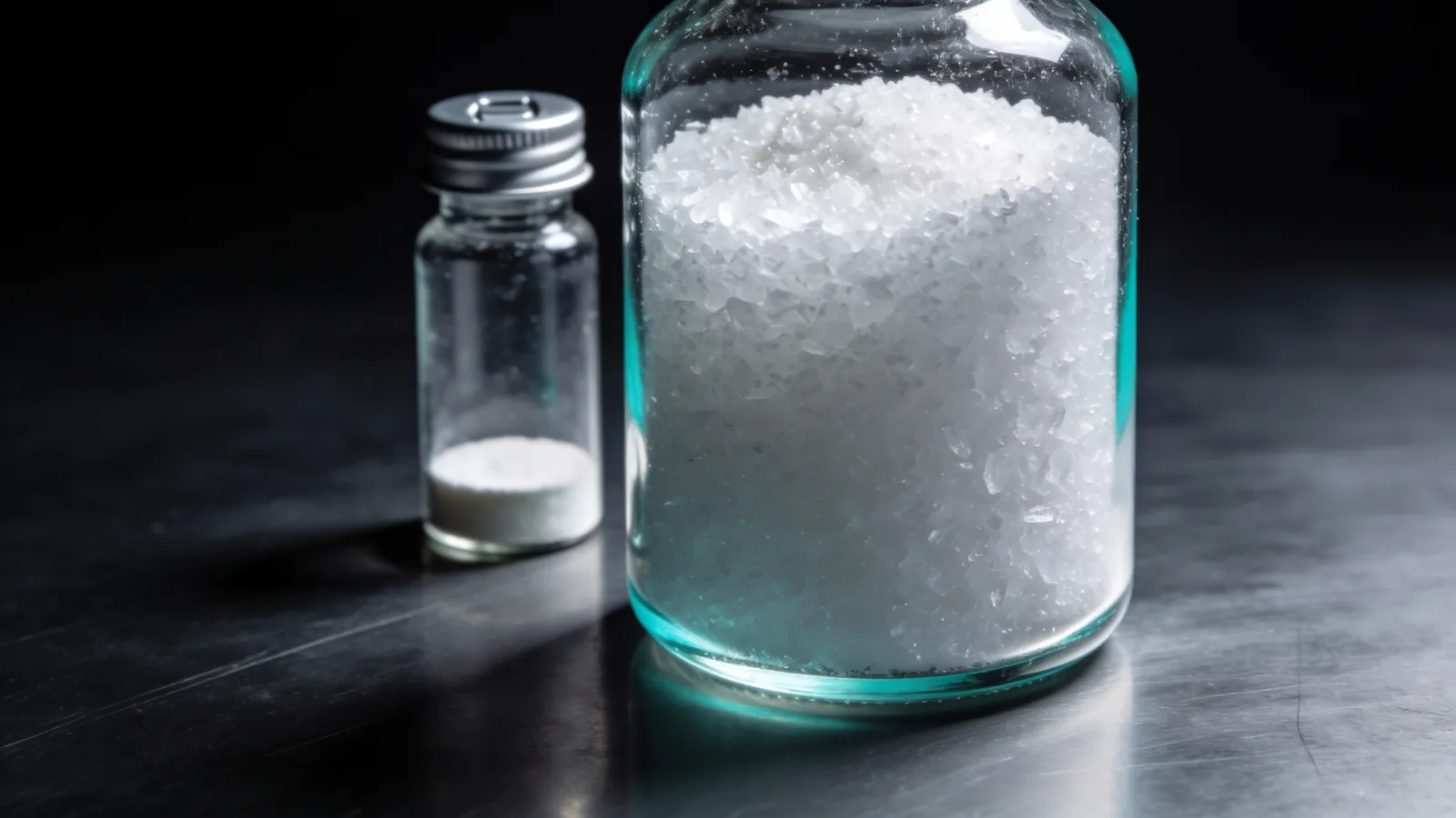
NAD+ is not a peptide. Despite the common search term NAD+ peptide, nicotinamide adenine dinucleotide is a dinucleotide coenzyme: two nucleotides joined by a pair of phosphates, one carrying nicotinamide and the other adenine. Formula C21H27N7O14P2, molecular weight 663.43 g/mol, CAS 53-84-9. It contains no amino acids and no peptide bonds.
- Searches for NAD+ peptide are looking for a coenzyme. NAD+ is nicotinamide adenine dinucleotide, a dinucleotide coenzyme of formula C21H27N7O14P2 and molecular weight 663.43 g/mol, containing no amino acids and no peptide bonds.
- The phrase NAD+ peptide comes from the shelf rather than the chemistry: NAD+ is supplied the way a peptide is, as a lyophilised powder in a sealed vial with a certificate written against its lot number.
- The plus sign is chemical notation for the oxidised form rather than a grade or a brand. NADH is the reduced form of the same molecule, and it is the one of the two that absorbs light at 340 nm, which is what makes the pair measurable on an instrument.
- Because the molecule behind NAD+ peptide has no sequence to confirm, its certificate of analysis states identity as formula, molecular weight, CAS number and an LC-MS confirmation rather than as a string of residues.
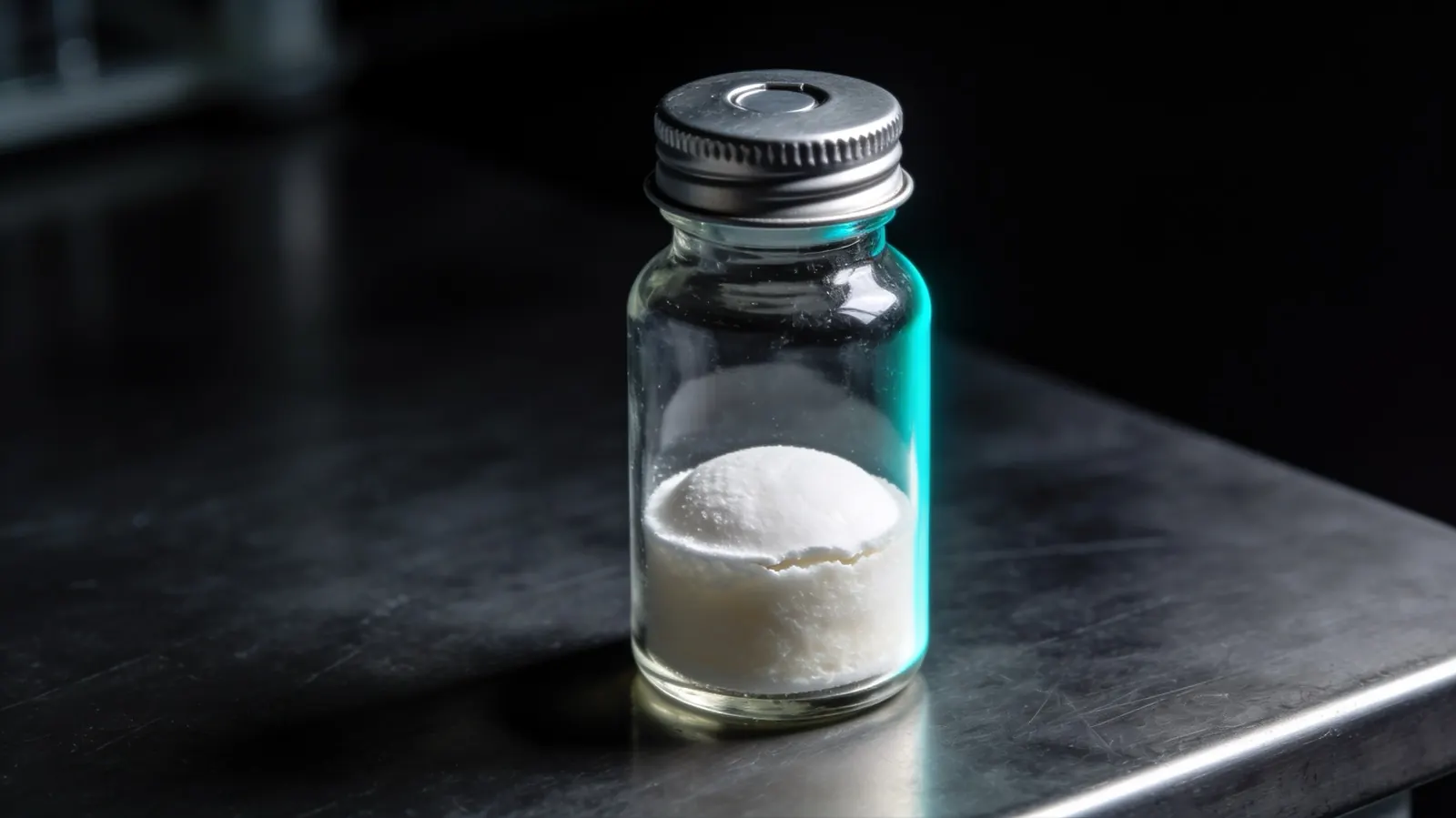
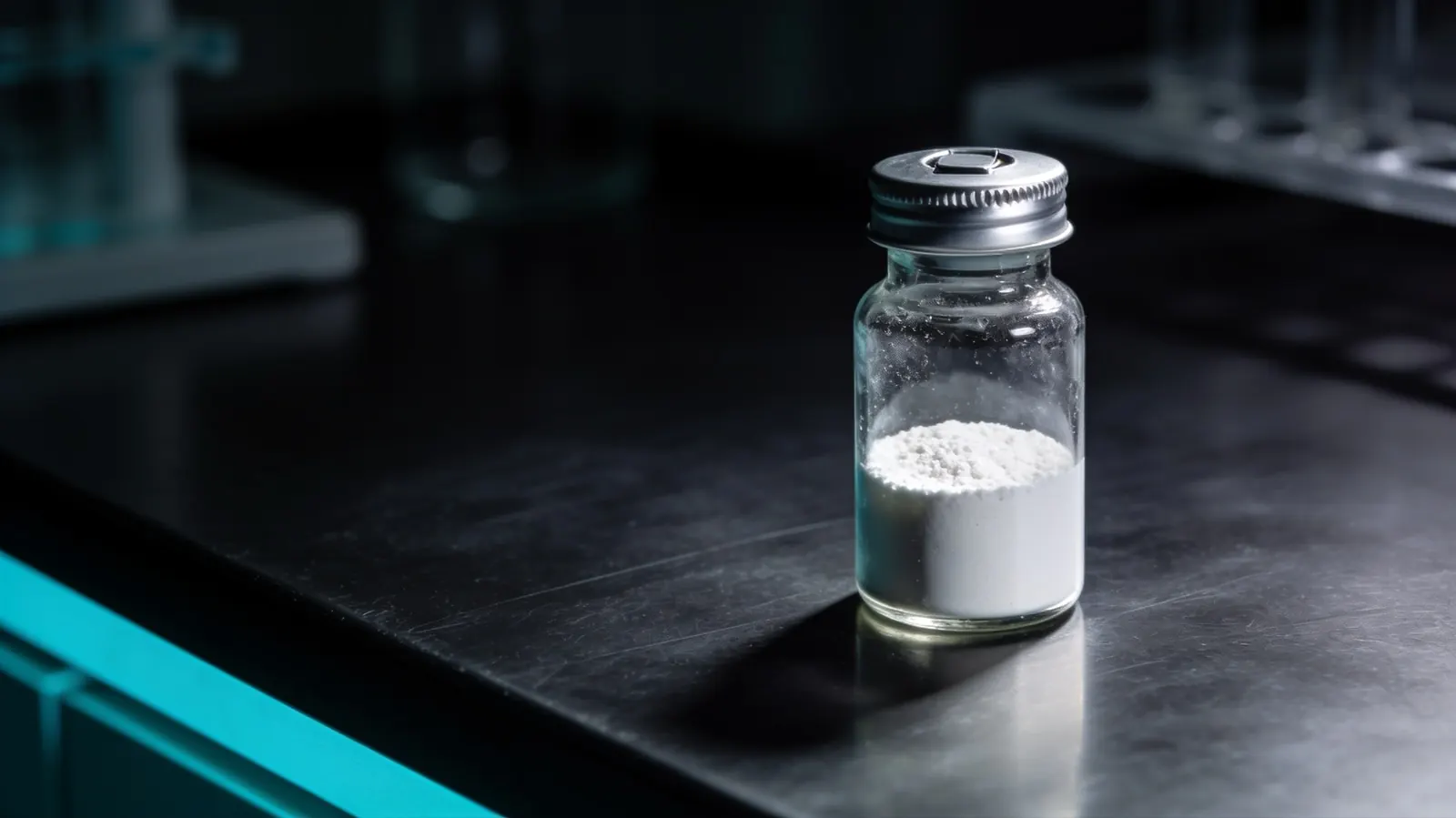
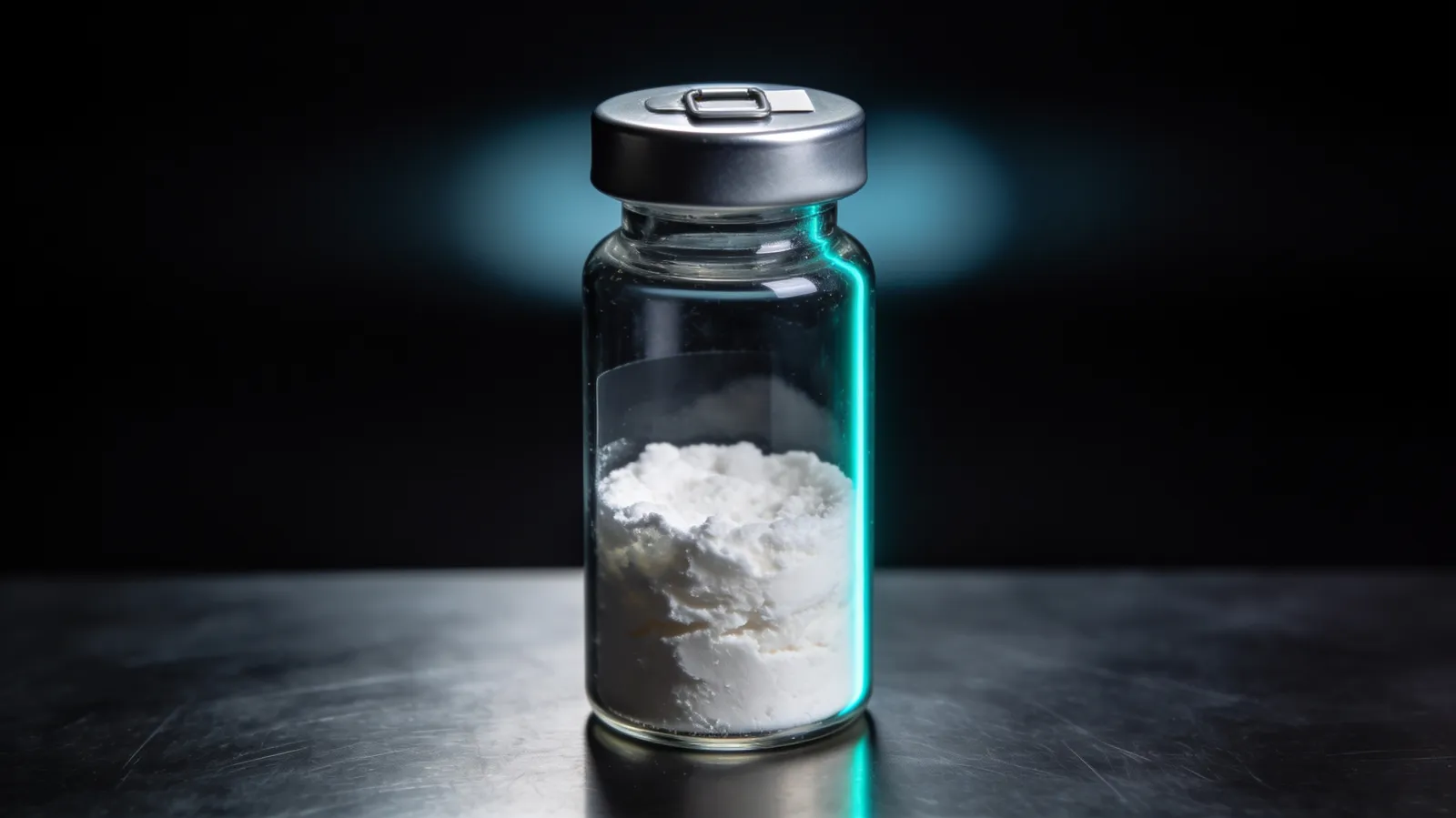
- A search for NAD+ peptide finds a 1000mg vial of white to off-white lyophilised powder here, filed under Longevity Research, where the peptide vials in the catalogue run from 5mg to 100mg.
Why NAD+ peptide is a misnomer worth explaining
NAD+ peptide is one of the most-searched terms in this category, and the molecule behind it is not a peptide. That is worth stating at the top, plainly, and without any suggestion that the person typing it has blundered. The term is doing an honest job. It means the NAD+ that research suppliers sell, in a vial, on the same page as the peptides. Searches for NAD+ peptide are looking for a coenzyme, and a coenzyme is what they find.
The catalogue is what attached the word. Suppliers group material by how it is handled rather than by chemical class, so NAD+ sits alongside BPC-157 and GHK-Cu because all three arrive as a white lyophilised powder in a sealed vial with a certificate written against the lot number. Anything on that shelf becomes a peptide in common usage. Search habits followed the shelving rather than the chemistry, and NAD+ peptide is the phrase that shelving produced.
The molecule has been on record for longer than most of what it is shelved beside. Arthur Harden and William John Young found it in 1906 as a heat-stable fraction of yeast extract that made fermentation run faster and that they could not name, so they called it a coferment. Warburg established what it actually does in 1936, showing that it carries a hydride from one reaction to another. Neither description has anything to do with amino acids, and the two vocabularies have only ever met on a shelf.
The distinction is still worth keeping, and not for the pleasure of correcting anyone. Peptides and coenzymes are different classes of molecule. They are characterised by different analytical methods, described on a certificate in different terms, and handled differently once a vial leaves the freezer. Anyone who arrives at NAD+ peptide expecting a sequence on the certificate will not find one, and the reason for that is structural.
Three practical things change for a NAD+ peptide buyer when the word changes. A buyer looking for a sequence on the certificate finds a formula and a CAS number instead. A buyer expecting the 10mg vial a peptide arrives in finds a gram of powder. And a buyer comparing purity figures across the two is comparing two analytical traditions that happen to share a percentage sign. None of that is a problem once the class is right, and all of it is confusing while the class is wrong.
- 0
- Harden and Young observe a heat-stable coferment in yeast extract
- The first record of what became NAD
- 0
- Warburg establishes its function as a hydride carrier
- The description still used today
What the molecule behind NAD+ peptide is made of
NAD+ stands for nicotinamide adenine dinucleotide, and the name is a description of the structure read from the outside in. It is a dinucleotide, meaning two nucleotides joined together. The join is a pyrophosphate bridge: a pair of phosphate groups set back to back between the two halves. On one side of that bridge is a ribose sugar carrying nicotinamide. On the other is a ribose sugar carrying adenine.
Read from either end, each half is a recognisable compound in its own right. The nicotinamide side is nicotinamide mononucleotide, the molecule sold separately as NMN. The adenine side is adenosine monophosphate, the AMP of basic biochemistry. NAD+ is those two joined through their phosphates, which is worth holding on to, because it explains most of the confusion further down this page: NMN is not a smaller grade of NAD+, it is one of its halves.
Every component in that description is a sugar, a phosphate group or a nitrogenous base. None of them is an amino acid, and there is no peptide bond anywhere in the molecule. A peptide bond is a specific linkage between the carboxyl group of one amino acid and the amino group of the next, formed by a condensation that releases a molecule of water. NAD+ contains neither of the partners that bond needs.
The plus sign belongs to the chemistry rather than to the product name. NAD exists in two interconvertible forms, and the oxidised form carries a positive charge on the nitrogen of the nicotinamide ring. Writing NAD+ rather than NAD states which of the two forms the material is. It is not a trademark flourish and not a grade marker, and it travels into the search term NAD+ peptide intact.
The specification
Formula C21H27N7O14P2, molecular weight 663.43 g/mol, CAS 53-84-9. The two phosphorus atoms in that formula are the back-to-back bridge that holds the two halves together. Those are the terms identity is stated in for anything sold as NAD+ peptide.
The nicotinamide half
A ribose sugar carrying the nicotinamide ring. The positive charge the plus sign records sits on the nitrogen of that ring, and the carbon opposite it is where a hydride is accepted.
The adenine half
A ribose sugar carrying adenine, the same nitrogenous base found in DNA, RNA and ATP. Its presence is what makes the molecule a dinucleotide rather than a single nucleotide.
The pyrophosphate bridge
Two phosphate groups joined to one another and to a ribose on either side. It is the only thing holding the two nucleotides together, and it is the bond an analytical method has to see intact to call the material NAD+ rather than its halves.
A coenzyme and a peptide are different kinds of thing
A peptide is defined by its bonds. Amino acids joined head to tail by peptide bonds form a chain, and that chain has a sequence: a defined order which can be written out one letter per residue and read from one end to the other. That is why a peptide listing quotes a string of capitals. Length, sequence and mass are the terms in which a peptide's identity is stated, and confirming that identity means confirming that the material in the vial matches the sequence claimed for it. That definition is set out in full in what is a peptide, and NAD+ satisfies no part of it: no amino acids, no peptide bonds, nothing to sequence.
A coenzyme is defined by its part in a reaction. It is a small organic molecule, not a protein, that an enzyme requires in order to carry out its chemistry, and its usual job is to carry something between reactions: an electron, a chemical group, a hydride. Coenzymes are not enzymes, and they are not built from amino acids. NAD+, the molecule behind the NAD+ peptide search, is the best known member of the class.
Cofactor is the wider word and it is worth separating from coenzyme, because the two are used interchangeably in product copy and mean different things in a textbook. A cofactor is anything an enzyme needs beyond its own protein, including metal ions such as the copper in GHK-Cu or the zinc in a metalloenzyme. A coenzyme is the organic subset of that, and a coenzyme that is passed between enzymes rather than locked into one of them, as NAD+ is, is sometimes called a cosubstrate. NAD+ answers to redox cofactor, coenzyme and cosubstrate depending on which reaction is being described, and to none of the words used for a chain of amino acids.
So NAD+ has no sequence, because there is nothing in it to sequence. It has a structure, which is drawn rather than spelled. It has no residues, so it cannot be described as long or short. It has no N-terminus and no C-terminus, so none of the questions that follow a peptide around apply to it in any form: acetylation, capping, truncation, which end a fragment was cut from.
That is why the word peptide in NAD+ peptide is not merely imprecise. It points at the wrong set of questions. Purity, identity and stability all mean something for NAD+, and all three are established by different means than they are for a chain of amino acids. A purity figure is the one term the two classes share, and even there the reading is worth doing carefully, because peptide purity, stated as a percentage, is a proportion of what the detector saw rather than a proportion of the vial.
| Property | NAD+ | BPC-157, a peptide |
|---|---|---|
| Class | Dinucleotide coenzyme | Chain of 15 amino acids |
| Built from | Two ribose sugars, two phosphates, nicotinamide, adenine | Amino acid residues |
| Key linkage | Glycosidic bonds and a pyrophosphate bridge | Peptide bonds |
| Has a sequence | No, nothing in it to sequence | Yes: GEPPPGKPADDAGLV, written N-terminus to C-terminus |
| Molecular formula | C21H27N7O14P2 | C62H98N16O22 |
| Molecular weight | 663.43 g/mol | 1419.53 g/mol |
| CAS number | 53-84-9 | 137525-51-0 |
| Identity stated as | Formula, molecular weight, CAS and an LC-MS confirmation | The sequence and the mass that sequence predicts |
| Purity method | RP-HPLC | RP-HPLC |
| Vial fill | 1000mg | 10mg, see the BPC-157 listing |
| Appearance | White to off-white lyophilised powder | White to off-white lyophilised cake |
| Storage | −20°C, protect from light and moisture | −20°C long term, 2°C to 8°C in use |
| Catalogue category | Longevity Research | Recovery & Repair Research |
Where NAD+ sits in metabolism, and the 340 nm readout
Naming the pathways is more useful than describing the chemistry in the abstract. NAD+ is the hydride acceptor in glycolysis, where glyceraldehyde-3-phosphate dehydrogenase reduces it to NADH. It is reduced again three times over in the citric acid cycle, and again in the fatty acid oxidation spiral. The NADH produced by all of that is what feeds electrons into the electron transport chain, which is the front half of oxidative phosphorylation. That is the whole of the classical account, and NAD+ appears in every step of it as the carrier rather than as a product.
The enzymes that do this have a family name worth knowing, because it is the reason the compound is a bench reagent at all. Dehydrogenases are enzymes that remove hydrogen from a substrate, and a large number of them use NAD+ as the acceptor: lactate dehydrogenase, alcohol dehydrogenase, aldehyde dehydrogenase, malate dehydrogenase, isocitrate dehydrogenase, glyceraldehyde-3-phosphate dehydrogenase. An assay for any one of those enzymes is, in practice, an assay for the coenzyme turning over.
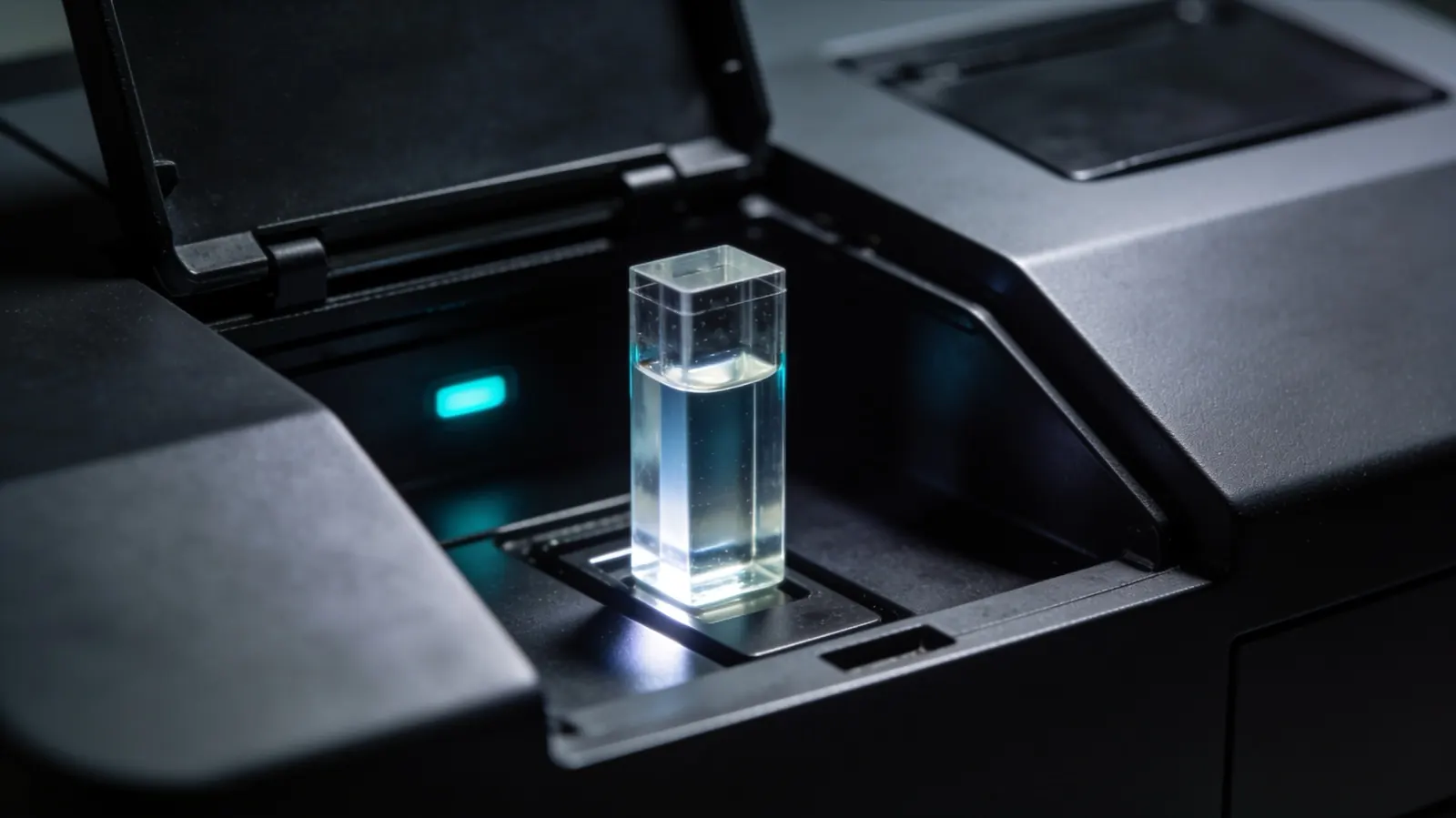
Here is why that can be measured at all. NADH absorbs ultraviolet light strongly at 340 nm and NAD+ does not. The two forms are otherwise the same molecule, so a reaction that converts one into the other changes the absorbance of the solution at that wavelength and at almost no other. Put a cuvette in a spectrophotometer, or a plate on a reader, watch 340 nm, and the trace is a direct record of how fast the enzyme is working. The molar extinction coefficient of NADH at 340 nm is conventionally taken as 6,220 M⁻¹cm⁻¹, which is the constant that turns an absorbance change into a quantity of coenzyme.
It goes further than the NAD-dependent enzymes themselves. A reaction with no optical signal of its own can be linked to one that has: run the product of the first reaction into an NAD-linked dehydrogenase, and the absorbance change at 340 nm reports on both. Coupled assays built that way are how a great many enzyme activities and metabolite concentrations are measured, which is why a laboratory buying what it found under NAD+ peptide is often not studying the coenzyme at all. It is the instrument rather than the subject, and the quality of an instrument is worth knowing.
That single optical property is the practical answer to what a vial bought as NAD+ peptide is for on a bench, and it is the one that is almost never given. It is also the reason purity and identity matter more here than the percentage on the label suggests. When the reagent is the readout, anything in the vial that absorbs near 340 nm, or anything that is not the coenzyme at all, is measured as signal. A lot-matched certificate is not paperwork in that setting; it is the calibration of the experiment, which is why it is worth knowing how to read a peptide certificate of analysis line by line.
None of this is an account of what anything does in a person. It is a description of a coenzyme in the reactions it is studied in, all of them in cells, tissue preparations and model organisms. This material is supplied for in-vitro laboratory research only.
- 0 nm
- Wavelength at which NADH absorbs and NAD+ does not
- The standard spectrophotometric readout for NAD-dependent enzyme assays
- 0 M⁻¹cm⁻¹
- Molar extinction coefficient of NADH at 340 nm
- The conventional value used to convert absorbance into concentration
The NAD+/NADH couple, sirtuins and DNA repair
The chemistry NAD+ is studied for is a two-state one. NAD+ is the oxidised form. It accepts a hydride and becomes NADH, the reduced form. NADH can pass that hydride on and revert to NAD+. Written together as the NAD+/NADH couple, the pair is the central redox carrier of cellular metabolism, and the ratio between the two forms is itself a measurement: it is read as a report on the redox state of the preparation rather than as a quantity of anything.
Because the molecule cycles between the two forms rather than being spent, the same NAD+ can turn over again and again. That is classical coenzyme behaviour: carried, not consumed. Nothing built from amino acids behaves that way, which is the substance of the objection to NAD+ peptide as a name. What such work measures is the quantity present at a given moment and the ratio of one form to the other, not the disappearance of the molecule.
One more distinction belongs with the ratio, because it is where careless readings come from. A cell does not hold one pool of this coenzyme but several, kept apart by membranes: a nuclear and cytosolic pool on one side, a mitochondrial pool on the other, each with its own ratio of the two forms and its own supply. A measurement made on whole-cell lysate averages compartments that behave differently, so published work states which pool was sampled and by what method. A figure quoted without that qualification is missing the part that makes it comparable.
A second set of enzymes treats NAD+ differently. Sirtuins use it as a substrate rather than as a carrier, which means it is consumed in the reaction rather than handed back. There are seven mammalian sirtuins, SIRT1 to SIRT7, and every one of them requires the coenzyme to work at all. Sirtuin work is where NAD+ turns up in cellular ageing research models, and where the terms cellular senescence and oxidative stress enter the literature around it.
The PARP enzymes consume it the same way. PARP is short for poly(ADP-ribose) polymerase, a family that detects breaks in DNA and tags the site by building chains of ADP-ribose, a unit it takes from NAD+ one molecule at a time. DNA repair is therefore a draw on the same pool the sirtuins are drawing from, and PARP1 is generally described as the largest single consumer in a cell. A third enzyme, the ectoenzyme CD38, consumes it again on its own account, and it is named often in the ageing literature for that reason.
That competition between several families for one shared pool is the shape of a great deal of the published work. It is a constraint that model systems are designed around rather than an outcome anyone has measured in a person. All of this literature is preclinical and all of it sits in model systems. This material is supplied for in-vitro laboratory research only.
Used and returned
Dehydrogenases in glycolysis, the citric acid cycle and fatty acid oxidation borrow the coenzyme, reduce it to NADH and get it back. Nothing is lost, and the variable under study is the ratio.
Used and consumed
Sirtuins, poly(ADP-ribose) polymerases and CD38 break the molecule apart to take a piece of it. The variable under study here is availability, because what is taken has to be rebuilt.
The shared pool
Both kinds of enzyme draw on one supply inside a cell. That single fact is why the biosynthesis routes in the next section are studied as closely as the consuming enzymes are. None of the enzymes competing for it is drawing on a peptide, whatever NAD+ peptide suggests.
Where a cell gets its NAD+: three biosynthesis routes
A cell makes NAD+ by three named routes, and the names are worth having because the precursor compounds sold alongside it are named after the steps in them. Nothing in this section describes a supplement or an intake. It is the biochemistry of how the molecule is assembled, which is the context the preclinical literature is written in. No ribosome and no amino acid appears anywhere in it, which is the structural reason NAD+ peptide is the wrong name for the product of these routes.
The de novo route builds it from tryptophan through the kynurenine pathway, a long sequence of steps that arrives eventually at quinolinic acid and from there at the nicotinamide ring. The Preiss-Handler route is shorter and starts from nicotinic acid, one of the two compounds that the name vitamin B3 covers. The salvage route is the busiest of the three: it recovers the nicotinamide released whenever a sirtuin or a PARP enzyme breaks the molecule apart, and recycles it rather than building a new ring from scratch.
Two enzymes carry most of the traffic in that last route. NAMPT, nicotinamide phosphoribosyltransferase, attaches nicotinamide to a ribose phosphate to make NMN, and it is the rate-limiting step. NMNAT, nicotinamide mononucleotide adenylyltransferase, then joins NMN to an AMP unit, which is the reaction that forms the pyrophosphate bridge and finishes the molecule. NMNAT1 does that work in the nucleus, and NMNAT2 and NMNAT3 elsewhere in the cell.
That last step is the clearest way to see what NMN and nicotinamide riboside actually are. They are not weaker versions of NAD+ and they are not a different grade of it. They are the intermediates one and two steps back along the salvage route, which is why they are sold under their own names, with their own formulas and their own CAS numbers, and why they belong in the disambiguation table below rather than in a comparison of strengths. A search for NAD+ peptide returns all three names together, which is what makes the distinction worth drawing.
De novo, from tryptophan
The long route, running through the kynurenine pathway to quinolinic acid and on to the nicotinamide ring. It is the only one of the three that builds the ring rather than reusing one.
Preiss-Handler, from nicotinic acid
A three-step route from nicotinic acid, the form of vitamin B3 that is not nicotinamide. Named for the two researchers who described it in the late 1950s.
Salvage, from nicotinamide
The recycling route, and the busiest. NAMPT makes NMN from recovered nicotinamide, NMNAT joins it to AMP, and the molecule consumed by a sirtuin or a PARP enzyme is rebuilt.
What NAD+ peptide is confused with, and what it is not
Several molecules sit close enough to NAD+ to be mistaken for it, and the NAD+ peptide search term collects all of them. None of them is a peptide either, so the correction in this article travels to every one.
NADH is the same molecule in its reduced state, not a separate compound. NADP+ is NAD+ carrying an additional phosphate group on the adenine-side ribose, which makes it a different coenzyme with its own formula and its own CAS number, used by a different set of enzymes in reductive biosynthesis rather than in energy metabolism. Nicotinamide mononucleotide and nicotinamide riboside are smaller: a single nucleotide in the first case, and a ribose carrying nicotinamide with no phosphate at all in the second. All four are nucleotide chemistry. None of them has an amino acid in it.
The peptides NAD+ is shelved beside are a genuinely different class. MOTS-c is a mitochondrially encoded peptide of sixteen residues; GHK-Cu is a copper-binding tripeptide of three. Both are chains of amino acids with a sequence that can be written out, and both are documented that way, as the MOTS-c peptide profile and the GHK-Cu copper peptide profile set out. NAD+ shares their vial, their powder and their certificate format, and nothing else.
A third kind of confusion arrives from outside the laboratory category entirely. NAD+ peptide serum and NAD+ peptide cream are cosmetic products, formulated and regulated as cosmetics, and they are sold by the bottle with an ingredients list rather than by the lot with a certificate. They are named for the same molecule and they are not the same category of thing as a sealed vial of assayed powder. Nothing on this page describes them.
The last confusion is the smallest and the most common. NAD and NAD+ are not two products. They are one molecule written two ways, and the plus sign simply states that the oxidised form is meant. A listing for a 1000mg NAD+ vial and a listing for NAD 1000mg would be the same material, and both are what a search for NAD+ peptide is looking for.
| Compound | Full name | Class | Molecular weight | CAS | Relationship to NAD+ |
|---|---|---|---|---|---|
| NAD+ | Nicotinamide adenine dinucleotide | Dinucleotide coenzyme, oxidised | 663.43 g/mol | 53-84-9 | The compound itself |
| NADH | Reduced nicotinamide adenine dinucleotide | The same coenzyme, reduced | 665.4 g/mol | 58-68-4 | The same molecule carrying a hydride |
| NADP+ | Nicotinamide adenine dinucleotide phosphate | A separate coenzyme | 743.4 g/mol | 53-59-8 | NAD+ with one extra phosphate on the adenine-side ribose |
| NMN | Nicotinamide mononucleotide | Mononucleotide | 334.22 g/mol | 1094-61-7 | One half of NAD+; the salvage-route step before it |
| NR | Nicotinamide riboside | Nucleoside | 255.25 g/mol | 1341-23-7 (free base) | Nicotinamide on a ribose, no phosphate; two steps back |
How the material sold as NAD+ peptide is supplied, stored and handled
NAD+ is supplied as a white to off-white lyophilised powder in a 1000mg vial. That is the first thing that surprises anyone arriving at NAD+ peptide from the peptide catalogue, where vials run from 5mg to 100mg. The vial holds far more material than a peptide vial does, and the category it sits in here is Longevity Research rather than any of the peptide groupings. Lyophilised is the British spelling; most American listings write lyophilized, and it is the same freeze-drying step either way.
Storage is −20°C for the long term, protected from light and moisture. That protection clause is not boilerplate carried across from a peptide label. NAD+ is light-sensitive and hygroscopic, and it is readily soluble in water, which together mean that the air a vial is opened into is a real variable rather than a theoretical one. Hygroscopic has a visible consequence: a dry cake exposed to room air takes up water from it, and a cake that has slumped, gone glassy at the edges or darkened has been telling you something about how it was kept. Keeping it dark, keeping it sealed and keeping its time at room temperature short is the whole of the handling story, and it is the same discipline set out in the guide to how to store peptides at −20°C.
In water it behaves like most lyophilised material and rather worse than some. An aqueous solution of NAD+ is measurably less stable than the dry solid, which is the reason the compound ships dry and is lyophilised in the first place. Once it is in water it is held cold, at 2°C to 8°C, and dark for whatever in-use period the work allows. Bacteriostatic water is the diluent held alongside the catalogue for lyophilised research material, and what it is and how it differs from plain sterile water is set out in the note on bacteriostatic water for peptides. Repeated freeze-thaw cycles are the other thing worth avoiding once material is in solution, for the ordinary reason that each cycle is another chance for the compound to come apart.
Purity is quoted by HPLC, as it is for the peptides, and the released figure is 99.94%. Identity is where the two part company. A peptide certificate reports a sequence and the mass that sequence predicts, and the analysis confirms the two agree. NAD+ has no sequence to confirm, so its documentation speaks in the compound's own terms rather than in a string of residues: formula, molecular weight, CAS number, and an LC-MS identity confirmation.
| Condition | Lyophilised solid | In aqueous solution |
|---|---|---|
| Temperature | −20°C long term | 2°C to 8°C for the in-use period |
| Light | Protect from light | Protect from light |
| Moisture | Hygroscopic, so keep the vial sealed and dry | Not applicable |
| Relative stability | The stable state, which is why it ships dry | Measurably less stable than the solid |
| Freeze-thaw | Not applicable while sealed and dry | Avoid repeated cycles |
| What to look at | Cake intact, white to off-white, no slumping | Clear, no visible particulate, no colour |
NAD+, 1000mg vial
White to off-white lyophilised powder, released at 99.94% by RP-HPLC with identity confirmed by LC-MS, and a certificate published against the lot number printed on the vial. It is the listing a search for NAD+ peptide is looking for.
See the NAD+ listingWhy a vial is labelled NAD 500 or NAD 1000
NAD 500 and NAD 1000 are searched almost as often as NAD+ peptide itself, and the number in each is the fill mass in milligrams. It is not a concentration, not a strength and not a grade. A vial marked NAD 1000 holds a nominal one gram of the same powder a vial marked NAD 500 holds half a gram of, assayed by the same method against the same specification.
The listing here is a single 1000mg vial at $99.99. The certificate archive is wider than the listing, because it records what the laboratory tested rather than what is currently in stock: lots of 100mg, 500mg and 1000mg are all on file, and they stay on file after a lot has sold through. That is the reason the table below carries fills the shop does not sell.
Reading several lots side by side is the reason for publishing them all. A single figure on a website is a claim. Eight lots, each named, each dated, each assayed by an independent laboratory, are a record that can be checked against the vial in hand. The number printed on the label goes into the lot number checker and the certificate for that exact batch comes back. A nominal fill mass is the one thing a NAD+ peptide listing and a peptide listing state in the same terms.
- 0%
- RP-HPLC purity of the current 1000mg lot, NAD1000-052026-1
- Assayed by Freedom Diagnostics, released 2 June 2026
- 0 mg
- Measured content of that lot against a nominal 1000mg fill
- Stated on the certificate for the lot
- 0
- NAD+ lots with a published certificate, in fills of 100mg, 500mg and 1000mg
- Certificate library, including lots no longer in stock
| Lot | Nominal fill | HPLC purity | Measured content | Released |
|---|---|---|---|---|
| NAD1000-052026-1 | 1000mg | 99.94% | 1044.79mg | 2 June 2026 |
| 0FF93Q | 1000mg | 99.97% | 1051.90mg | 15 May 2026 |
| 8A0BSG | 500mg | 99.94% | 520.96mg | 15 May 2026 |
| NAD10001225-J | 1000mg | 99.936% | 957.53mg | 30 April 2026 |
| NAD12102025-J | 500mg | 99.879% | 490.46mg | 30 April 2026 |
| KVPNWJ | 500mg | 99.96% | 492.03mg | 27 April 2026 |
| J4Q90F | 100mg | 99.85% | 109.52mg | 27 April 2026 |
| VQ8D05 | 500mg | 99.40% | 540.92mg | 27 April 2026 |
What a certificate states when there is no sequence
A certificate for a peptide and a certificate for a coenzyme carry the same fields and fill two of them differently. Anyone who reached this page through NAD+ peptide is reading the coenzyme column. Both name the lot, the laboratory, the date, the appearance, the purity method and the figure it returned. The difference is in the identity line, and it follows directly from the chemistry: a peptide's identity is its sequence and the mass that sequence predicts, and NAD+ has no sequence, so identity is stated as the formula, the molecular weight, the CAS number and an LC-MS confirmation against a reference standard.
It is worth being specific about what the LC-MS line establishes for a molecule of this shape. Mass spectrometry weighs what comes off the column, so a confirmation at the expected mass says the intact dinucleotide is what is present, bridge included. The failure modes it would catch are the obvious ones: a molecule that has come apart at the pyrophosphate bridge appears as its two halves, nicotinamide mononucleotide at 334.22 g/mol and adenosine monophosphate, at masses nowhere near 663.43. The chromatography and the mass measurement answer different questions, which is why a certificate carries both and neither one on its own.
Grade is the other thing people try to read off a certificate, and it is worth being exact about. Research grade, pharmaceutical grade and food grade are descriptions of the specification a material was made and tested against, not properties a vial has in itself. A grade word on a label is a claim; the certificate is the evidence for it, and the only certificate that evidences anything about a particular vial is the one written against the lot number printed on that vial. Everything sold here is laboratory research material, documented lot by lot, and the archive is published in full rather than by exception.
That is also why a lot that is no longer for sale stays in the library. A certificate archive with only current stock in it is a marketing page. One that keeps every lot, including the one that measured 99.40% and the one that came in at 957.53mg against a nominal gram, is a record. The same reasoning is set out at greater length in the note on how to vet a research peptide supplier. That archive, rather than the word peptide in NAD+ peptide, is what any claim about a particular vial rests on.
| Certificate field | NAD+ entry | Peptide entry |
|---|---|---|
| Identity | LC-MS confirmation against a reference standard | Mass spectrometry against the mass the sequence predicts |
| Sequence | None, the molecule has no residues | Written out, N-terminus to C-terminus |
| Molecular weight | 663.43 g/mol | Calculated from the sequence |
| CAS number | 53-84-9 | Compound-specific |
| Purity method | RP-HPLC, area percent | RP-HPLC, area percent |
| Content | Measured net mass against the nominal fill | Measured net mass against the nominal fill |
| Appearance | White to off-white lyophilised powder | White to off-white lyophilised cake |
| Lot and laboratory | Named on every certificate | Named on every certificate |
NAD+ peptide is the phrase people search, so it is the phrase this page is filed under, but the molecule underneath it is a coenzyme. Nicotinamide adenine dinucleotide, C21H27N7O14P2, 663.43 g/mol, CAS 53-84-9: two nucleotides bridged by a pair of phosphates, one end carrying nicotinamide and the other adenine, with no amino acids and no peptide bonds anywhere in it. It is the hydride carrier of glycolysis, the citric acid cycle and fatty acid oxidation, measured at 340 nm because NADH absorbs there and NAD+ does not; it is the substrate that sirtuins, the poly(ADP-ribose) polymerases of DNA repair and CD38 all draw from one shared pool; and it is rebuilt by the salvage route through NAMPT and NMNAT. Anyone shopping for a NAD+ peptide will find NAD+ instead: a 1000mg vial of white lyophilised powder, released at 99.94%, documented as a coenzyme rather than as a chain, and published lot by lot in the certificate of analysis library.
Common questions
Is NAD+ a peptide?
No. NAD+ is nicotinamide adenine dinucleotide, a coenzyme built from two nucleotides joined by a pair of phosphate groups. It contains no amino acids, no peptide bonds and no sequence. It is sold alongside peptides, which is where the term NAD+ peptide comes from.
Why is NAD+ sold under the term NAD+ peptide?
Because NAD+ peptide is what people type, and because suppliers shelve material by how it is handled rather than by chemical class. NAD+ arrives as a lyophilised powder in a sealed vial with a lot-matched certificate, exactly as a peptide does, so it is listed beside the peptides and searched for in the same words. The listing is honest. The word peptide in NAD+ peptide is not a description of the molecule.
What is the difference between NAD and peptides?
They are different classes of molecule. A peptide is a chain of amino acids joined by peptide bonds, with a sequence that can be written out and confirmed. NAD is a dinucleotide coenzyme: two ribose sugars, two phosphates, nicotinamide and adenine, with no amino acids in it. The practical consequences are a certificate with no sequence line, a 1000mg vial rather than a 10mg one, and a different set of questions about identity. NAD+ peptide crosses the line between the two classes without meaning to.
What does the plus sign in NAD+ mean?
It marks the oxidised form. NAD cycles between two states, and the oxidised one carries a positive charge on the nitrogen of its nicotinamide ring. NAD+ specifies that form; NADH is the reduced form that has accepted a hydride.
What is the difference between NAD+ and NADH?
They are the two halves of one redox couple. NAD+ accepts a hydride and becomes NADH; NADH gives it up and becomes NAD+ again. The NAD+/NADH couple is a common study point in energy-metabolism endpoints in preclinical models, and the ratio between the two forms is what such work usually reports.
Why does NADH absorb light at 340 nm and NAD+ not?
Because accepting a hydride changes the electronic structure of the nicotinamide ring, and the reduced ring absorbs ultraviolet light at 340 nm where the oxidised one does not. It is the single most useful property the molecule has in a laboratory: any reaction that converts one form into the other can be followed in real time on a spectrophotometer or a plate reader, using the conventional extinction coefficient of 6,220 M⁻¹cm⁻¹ to turn absorbance into a quantity.
Is NAD+ a protein or an amino acid?
Neither. Proteins and peptides are chains of amino acids; NAD+ has none in it. NAD+ peptide is a shelving habit rather than a chemical description. It is a dinucleotide, built from two ribose sugars, two phosphate groups and two nitrogenous bases: nicotinamide on one side and adenine on the other.
What is the difference between a coenzyme and a cofactor?
Cofactor is the wider word: anything an enzyme needs beyond its own protein, including metal ions. Coenzyme is the organic subset of that. NAD+ is a coenzyme, and because it is passed between enzymes rather than held by one, it is also described as a cosubstrate or a redox cofactor depending on the reaction. None of those words applies to a chain of amino acids.
Which enzymes use NAD+?
Two groups, and they treat it differently. The dehydrogenases borrow it, reduce it to NADH and hand it back: lactate, alcohol, aldehyde, malate, isocitrate and glyceraldehyde-3-phosphate dehydrogenase among them. Sirtuins, the poly(ADP-ribose) polymerases and CD38 consume it instead, breaking the molecule apart to take a piece of it.
Where does a cell get NAD+ from?
Three routes. De novo synthesis builds it from tryptophan through the kynurenine pathway. The Preiss-Handler route starts from nicotinic acid. The salvage route, which carries most of the traffic, recycles the nicotinamide released when a sirtuin or a PARP enzyme consumes the molecule. NAMPT makes NMN from it, and NMNAT joins that to an AMP unit to finish the coenzyme.
Why is NAD+ studied in ageing research?
Because the sirtuin enzymes central to that literature cannot function without it, and because they consume it rather than recycle it, which makes its availability itself a variable. The poly(ADP-ribose) polymerases of DNA repair and the ectoenzyme CD38 draw on the same pool, so several processes compete for one supply. All of that work is preclinical and sits in model systems.
Is NMN the same thing as NAD+?
No. Nicotinamide mononucleotide is a single nucleotide of 334.22 g/mol and it is literally one half of NAD+: the nicotinamide side, before it is joined to an AMP unit. NAD+ is the finished dinucleotide at 663.43 g/mol. Nicotinamide riboside is smaller again, a ribose carrying nicotinamide with no phosphate group. All three are nucleotide chemistry, and none of them is a peptide, whatever the NAD+ peptide search term suggests.
Is NADP+ the same as NAD+?
No. NADP+ is NAD+ carrying one additional phosphate group on the adenine-side ribose, which makes it a separate coenzyme with its own molecular weight of about 743.4 g/mol and its own CAS number, 53-59-8. Different enzymes use it, mostly in reductive biosynthesis rather than in energy metabolism, and it is not a form or a grade of NAD+.
Is NAD 500 the same material as NAD 1000?
Yes. The number is the nominal fill mass in milligrams, not a strength, a concentration or a grade. The listing here is a single 1000mg vial, and the certificate archive holds 100mg, 500mg and 1000mg lots of the same material, each assayed by the same methods.
Why is the NAD+ vial 1000mg when peptide vials are so much smaller?
Because it is a different class of material. The peptide vials in this catalogue run from 5mg to 100mg. NAD+ is supplied as a 1000mg vial of white to off-white lyophilised powder, filed under Longevity Research rather than with the peptides.
How should NAD+ be stored?
At −20°C for long-term storage, protected from light and moisture. NAD+ is both light-sensitive and hygroscopic, and it is readily soluble in water, so keeping the vial dark, dry, sealed and cold is the substance of handling it. The same conditions cover the rest of the catalogue, as set out in the notes on how to store peptides.
What is NAD+ soluble in?
Water. The specification records it as readily soluble, and bacteriostatic water is the diluent kept alongside lyophilised research material for that purpose. An aqueous solution is less stable than the dry solid, which is why the compound is lyophilised and shipped dry, and why in-use material is held cold and dark.
What purity is NAD+ released at?
The most recent lot, NAD1000-052026-1, released on 2 June 2026 at 99.94% by HPLC with a net content of 1044.79mg, assayed by Freedom Diagnostics against a report dated 29 May 2026. The lot before it, 0FF93Q, released at 99.97% with a content of 1051.90mg on 15 May 2026. Eight lots in total are published, the lowest of them at 99.40%.
What does a NAD+ certificate of analysis show if there is no sequence?
It states identity in the compound's own terms: formula, molecular weight and CAS number, with an LC-MS confirmation in place of the sequence check a peptide certificate carries. Alongside that it records the lot number, the HPLC purity figure, the measured net content, the appearance, the testing laboratory and the date. Every certificate held is published in the certificate of analysis library.
How do I check the lot number printed on my NAD+ vial?
Type it into the batch verifier and the certificate for that exact lot comes back, with its HPLC purity, its LC-MS identity confirmation, the laboratory that ran the test and the date. The lot number verification page is the whole of the process. If a number does not resolve, that is worth taking seriously rather than assuming a typing error.
Why does the NAD+ certificate say the net content is more than 1000mg?
Because 1000mg is the nominal fill and the certificate reports what was actually measured. Lot NAD1000-052026-1 came in at 1044.79mg and lot 0FF93Q at 1051.90mg, both a little over the nominal figure, while an earlier 1000mg lot measured 957.53mg. A certificate that reports measured content rather than repeating the label is the more informative document.
Is this NAD+ research grade or pharmaceutical grade?
Grade words describe the specification a material was made and tested against, not a property the vial has in itself. Everything here is laboratory research material, and the evidence for what any particular vial contains is the certificate written against its lot number: purity by RP-HPLC, identity by LC-MS, measured content, appearance, laboratory and date. That document is the thing worth reading rather than the adjective on the label.
What does lyophilised mean on a NAD+ label?
It means the material was freeze-dried: frozen, then held under vacuum so the ice passes straight to vapour, leaving a dry powder or cake. American listings spell it lyophilized. It is how peptides and coenzymes alike are supplied for storage, and the background is set out in the note on what lyophilized powder is.
What colour should NAD+ powder be?
White to off-white. That appearance is recorded on the certificate for each lot, so the vial in hand can be compared against the document written for its batch. A cake that has slumped or darkened has usually met moisture or warmth, and either is a reason to stop and query the lot rather than to proceed.
Is NAD+ peptide serum the same thing as this?
No. NAD+ peptide serum and NAD+ peptide cream are cosmetic products, formulated and sold as cosmetics with an ingredients list on the carton. What this page describes is a sealed vial of assayed laboratory material, supplied by the lot with a certificate of analysis against it. The molecule shares a name; the category does not.
Who tests the NAD+ lots sold here?
Freedom Diagnostics, an independent laboratory, assayed every published lot. Each certificate names the laboratory, the lot, the date the sample was reported and the date the lot was released, and each one is filed in the certificate library whether or not that lot is still in stock.
- PubChem CID 5892, NAD+ (nadide): the formula C21H27N7O14P2, the molecular weight of 663.43 g/mol and CAS 53-84-9 quoted throughout
- PubChem CID 9941957, BPC-157: the sequence, formula and mass of the peptide set against NAD+ in the comparison table
- PubChem CID 146675088, MOTS-c: MOTS-c as a peptide with a written amino acid sequence, the contrast drawn with nucleotide chemistry
- FDA, Lyophilization of Parenteral, Inspection Technical Guide: freeze-drying as the step that leaves the dry cake in a sealed vial, and moisture as the thing it is protected from
- ICH Q6A, Specifications: Test Procedures and Acceptance Criteria (FDA): identity, appearance, assay and impurity as the specification fields a certificate reports against
Read more
- GHK-Cu copper peptideA GHK-Cu copper peptide vial is blue, and every other vial in this catalogue is white. The colour is not a dye. It is the evidence that the complex formed.
- What is in the KLOW peptide blendThe KLOW peptide blend is four separate molecules sharing one vial, which means four identities to describe and four assays to read rather than one of each.
- GLP-3 RT peptideThe GLP-3 RT peptide is a 39-residue acylated chain registered under CAS 2381089-83-2. This page states what the molecule is, how a chain that long is built, and what the certificates we publish for it actually say.
- GLP-1 peptideThe GLP-1 peptide this catalogue sells as GLP-1 S is an engineered analogue of the hormone it shares a name with, registered under CAS 910463-68-2. This page states what the molecule is, how the analogue and the hormone differ, and what our single published certificate actually says.
- Tesamorelin peptideThe tesamorelin peptide is the whole 44-residue growth-hormone-releasing hormone sequence with one small group attached at the front. That group is the point of the molecule.
- The BPC-157 peptideThe BPC-157 peptide is fifteen residues long, and seven of those residues are proline or glycine. For a chain this short, that composition is the most interesting thing about it.
For laboratory research use only. All compounds listed on this site are sold strictly as reference materials for in-vitro laboratory research conducted by qualified professionals. They are not drugs, foods, cosmetics, or medical devices. They are not intended for human or veterinary consumption, therapeutic use, diagnostic application, or any in-vivo use whatsoever. These statements have not been evaluated by the Food and Drug Administration. By purchasing, you affirm that you are a qualified researcher and that you will comply with all applicable institutional, local, state and federal regulations governing the handling of research chemicals. Published by SERVIAM BIO LABS.