

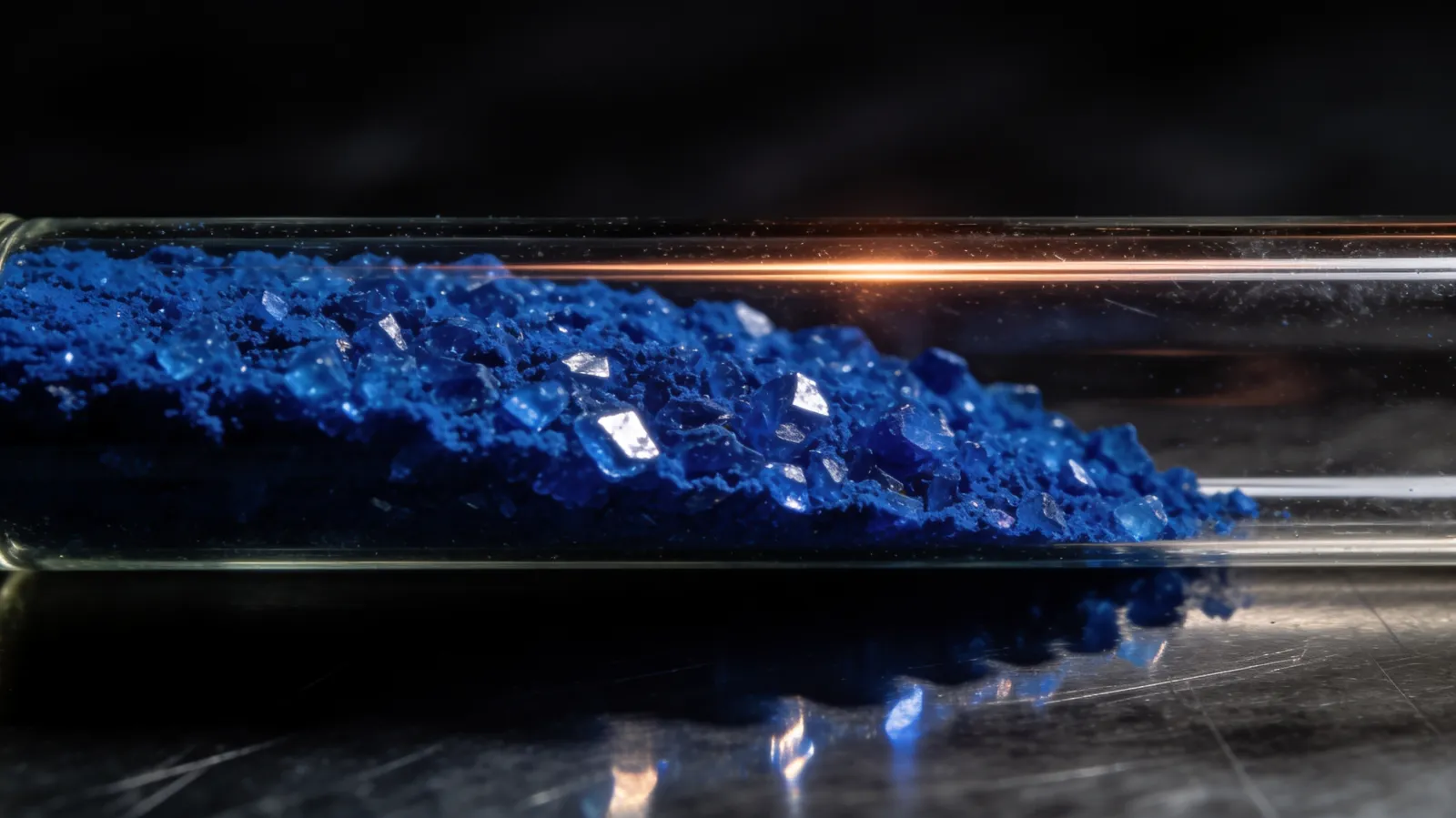
GHK-Cu copper peptide is the tripeptide glycyl-L-histidyl-L-lysine, Gly-His-Lys, holding one copper(II) ion. Formula C14H24N6O4 with Cu, molecular weight 403.94 g/mol, CAS 89030-95-5. GHK occurs naturally in human plasma and is colourless; the copper complex is a deep blue lyophilised powder. Certificates report HPLC purity and net peptide content per lot. Supplied for in-vitro laboratory research only.
- GHK-Cu copper peptide is a coordination complex rather than a mixture: the tripeptide Gly-His-Lys holding a single copper(II) ion, 403.94 g/mol against the free peptide's 340.38 g/mol, with its own registration, CAS 89030-95-5.
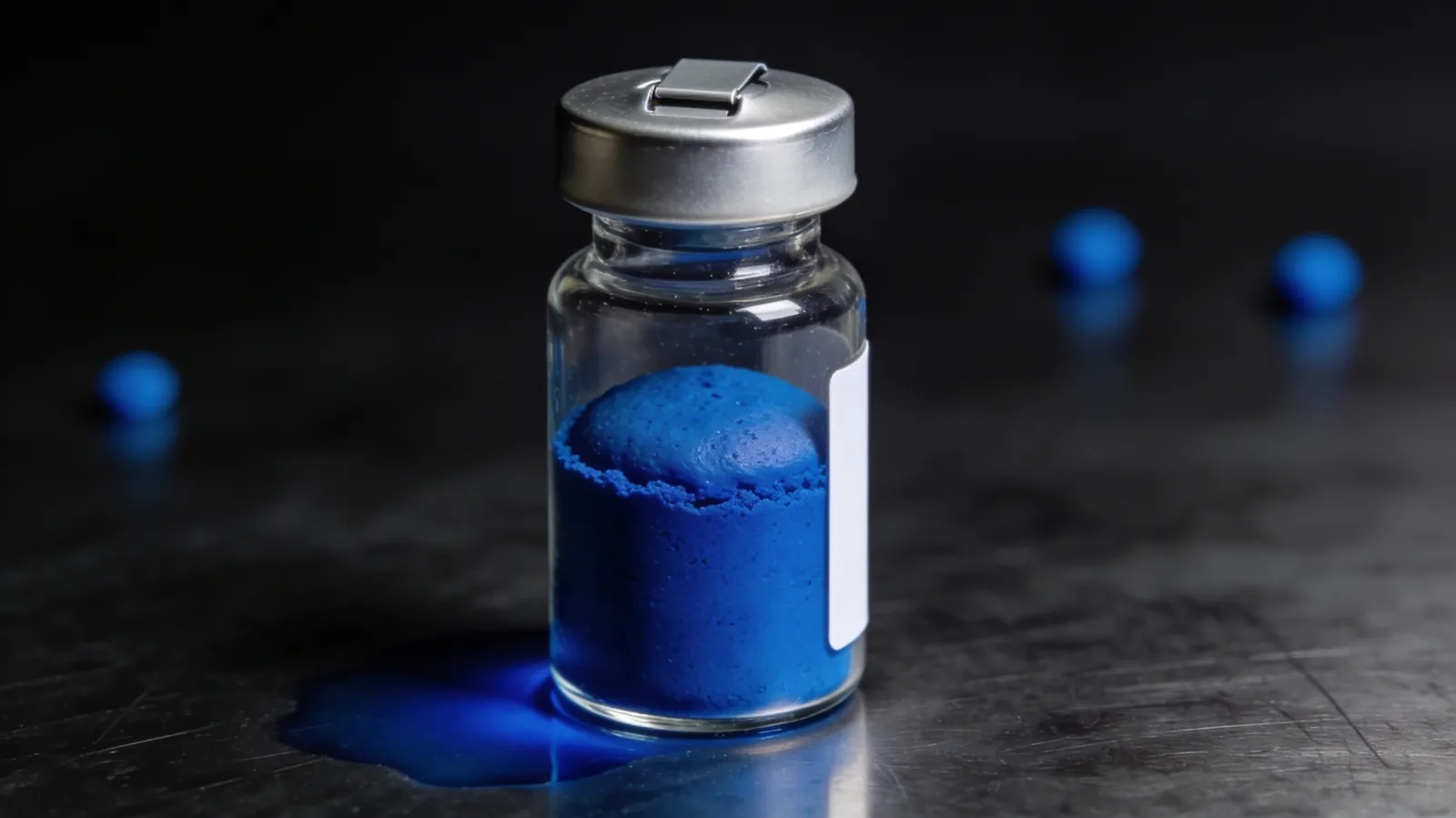
- The blue is the complex reporting on itself, because free GHK is colourless, so material sold as a GHK-Cu copper peptide that arrives as a white cake is GHK whatever the label says.
- Histidine is the residue that makes a three-amino-acid chain a copper ligand, which is why the order Gly-His-Lys matters and the same three amino acids in another arrangement would not be the same ligand.
- The copper alone is 15.7% of the complex's molecular mass, so a GHK-Cu copper peptide certificate has to state measured net peptide content next to HPLC purity: the certificate for every lot we have released reports both, for all eight lots.
- The GHK-Cu copper peptide is 50mg of the 70mg GLOW blend and 50mg of the 80mg KLOW blend, which is the whole reason those cakes are blue as well.
GHK-Cu copper peptide, in specification terms
Three amino acids and one metal ion. Glycine, L-histidine and L-lysine in that order, written Gly-His-Lys, holding a single copper(II) ion. The molecular formula is C14H24N6O4 with Cu, the molecular weight 403.94 g/mol, and the complex is registered under CAS 89030-95-5.
It is supplied as a deep blue lyophilised powder, readily soluble in water, stored at −20°C for the long term and 2 to 8°C in use. Vial sizes are 50mg and 100mg, and the GHK-Cu vials in this catalogue were released at 99.86% purity by HPLC on the current lot.
Three residues is short. BPC-157 and TB-500 are both longer chains, and both are simpler products than this one. What complicates a GHK-Cu copper peptide vial is not the length of the chain. It is the metal held inside it, which has to be accounted for in the handling, in the assay and in the mass printed on the label.
The name it carries depends on who is writing. In a research catalogue it is GHK-Cu. On a cosmetic ingredient list it is Copper Tripeptide-1, which is an INCI designation rather than a chemical one. In a registry it is CAS 89030-95-5. In a paper it may be glycyl-L-histidyl-L-lysine copper(II). Four names, one substance, and only the CAS number is unambiguous, which is why a certificate names it.
- 0 g/mol
- Molecular weight of the GHK-Cu copper peptide, which is the substance in the vial
- Catalogue specification; identity confirmed per lot by LC-MS
- 0 g/mol
- Molecular weight of the free tripeptide GHK, which is a different substance
- Standard reference data for glycyl-L-histidyl-L-lysine
- 0 residues
- Chain length: glycine, L-histidine and L-lysine, in that order
- Catalogue specification, Gly-His-Lys
The peptide
Gly-His-Lys. Three residues, a sequence that occurs naturally in human plasma. On its own it is colourless and weighs 340.38 g/mol.
The metal
A single copper(II) ion, coordinated by the peptide rather than merely mixed with it. At 63.55 g/mol it is 15.7% of the finished complex by mass.
The complex
The two as one substance: C14H24N6O4 with Cu, 403.94 g/mol, CAS 89030-95-5, deep blue. This is what is in the vial.
The free peptide and the GHK-Cu copper peptide are different substances
GHK and GHK-Cu are written almost everywhere as though they were one thing with an optional suffix. They are not. GHK is a colourless tripeptide. GHK-Cu is a coordination complex with its own formula, its own mass and its own CAS registration. The three amino acids are common to both. The substance is not.
The two sets of numbers are the quickest way to see it. Sixty-three and a half grams per mole separates them, which is one copper atom, and that atom is not an impurity or an additive. It is a constituent. A certificate that reports one substance while the vial holds the other is not a certificate of anything.
The colour is the clearest way to tell them apart in practice, and it is not cosmetic. A copper(II) ion surrounded by donor atoms absorbs part of the visible spectrum, and which part it absorbs depends on the atoms doing the surrounding. That is why copper(II) compounds are coloured at all, and why the shade moves when the ligands change. A colourless solution of the free tripeptide turns blue when copper(II) is introduced, because the complex has formed. The colour is the reaction reporting on itself.
So the blue cake in a GHK-Cu vial is evidence rather than decoration. Material sold as a GHK-Cu copper peptide that arrives white is GHK, whatever the label says. Material that arrives pale, patchy or green is a question worth putting to the supplier before it goes near an experiment. Nothing else in this catalogue offers a check that can be made by eye; the lyophilized powder every other vial here holds is white, and one white cake looks exactly like another.
| Property | GHK (free tripeptide) | GHK-Cu (copper complex) |
|---|---|---|
| Sequence | Gly-His-Lys, three residues | Gly-His-Lys, three residues, holding one copper(II) ion |
| Molecular formula | C14H24N6O4 | C14H24N6O4 with Cu, also written C14H22CuN6O4 |
| Molecular weight | 340.38 g/mol | 403.94 g/mol as this catalogue and its certificates state it |
| CAS registration | Its own separate registration, not 89030-95-5 | 89030-95-5 |
| INCI name | Tripeptide-1 | Copper Tripeptide-1 |
| Appearance | Colourless in solution, white as a solid | Deep blue lyophilised powder |
| Water solubility | Soluble | Readily soluble; public chemical data records roughly 131 g/L |
| What a certificate must report | HPLC purity, identity, net peptide content | The same three, with the metal accounted for in the fill weight |
Why two different formulae are printed for the same complex
Look the GHK-Cu copper peptide up in three places and you may get three formulae. This catalogue writes C14H24N6O4 with Cu at 403.94 g/mol. Public chemical reference pages commonly write C14H22CuN6O4, which comes out at about 401.91 g/mol. The difference is two hydrogen atoms, roughly 2.03 g/mol, and it is not a typographical error in either direction.
It is a difference of convention, and the convention encodes a piece of chemistry. The first form sums the neutral tripeptide and the copper atom and leaves the coordination implicit: this much peptide, plus this much metal. The second describes the coordinated species itself, in which two protons have been displaced from the ligand when the metal bound to it. Both refer to the same material. One is written as an inventory, the other as a structure.
Which matters in exactly one situation: when a number on a certificate is being compared with a number from somewhere else. Two figures a couple of grams per mole apart look like a discrepancy and are not one. A figure sixty-three grams per mole apart is a discrepancy, because that is the metal. Knowing which convention a document uses is the difference between reading a certificate and second-guessing it.
It is also the reason identity is settled by mass spectrometry against a reference standard rather than by comparing formula strings. A formula written two ways is still one substance; LC-MS reports what is actually there. That is the logic behind every identity line in the certificate of analysis library, and it is set out at more length in the guide to reading a peptide certificate of analysis.
| Written as | Molecular weight | What the string describes |
|---|---|---|
| C14H24N6O4 with Cu | 403.94 g/mol | The neutral tripeptide and the copper atom summed. The convention this catalogue and its certificates use. |
| C14H22CuN6O4 | About 401.91 g/mol | The coordinated species, with two protons displaced from the ligand by the metal. Common in chemical reference data. |
| C14H24N6O4 | 340.38 g/mol | The free tripeptide GHK, with no metal at all. A different substance, not a different convention. |
What the histidine is doing
A tripeptide is not, as a rule, a copper ligand. The GHK-Cu copper peptide is one, and the reason sits in the middle residue.
Histidine carries an imidazole ring on its side chain, and imidazole nitrogen is one of the donor atoms that copper sites in proteins are commonly built from. Put a histidine in the second position of a very short chain, next to a free N-terminal amine, and the chain can fold around a single ion and present several nitrogen donors from the same molecule.
The donor set usually described for this complex comes from the glycine end and from the histidine: the terminal amine, the backbone amide nitrogen between the first two residues, and the imidazole nitrogen of the histidine side chain. Holding a metal with several donors from one molecule is chelation, and it is what allows the complex to be treated as a discrete substance that can be weighed, filled and stored rather than separating back into a peptide and a copper salt.
The lysine sits outside that set. Its side-chain amine is left free and charged, which is consistent with a complex recorded as readily soluble in water. Each of the three residues occupies a different position, and the order is not interchangeable: the same three amino acids in another arrangement would not be the same ligand.
Two things follow from that donor set, and neither appears on a label. The first is pH. Coordination through a backbone amide nitrogen requires that amide to give up its proton, and whether it does depends on the pH of whatever the complex is in. Copper-peptide complexes therefore have a pH window in which the species described above is the dominant one, and outside it the metal is held differently or not at all. A dry cake does not raise the question. A solution does, and the pH of that solution is part of the identity of what is in it rather than a detail of the container.
The second is that the literature rarely discusses this complex as a molecule on its own. Copper in blood plasma is carried very largely on serum albumin, which has a high-affinity copper site of its own at its N-terminus, and the work on GHK describes ternary arrangements involving peptide, metal and albumin together rather than a free complex moving about by itself. That is a description of copper chemistry in a biological medium. It is not a description of the material in a vial, which is a dry, characterised solid with a stated stoichiometry of one copper ion per tripeptide.
What the preclinical literature studies, and in what systems
A profile of a molecule has to say what has been looked at. It also has to say what kind of looking it was. Everything below is in-vitro and animal work on the GHK-Cu copper peptide, described as work that was done, in the systems it was done in. None of it describes an effect in a person, none of it is a reason to use this material for anything, and none of it is repeated here with an outcome attached. The material is supplied for in-vitro laboratory research only.
The coordination chemistry is the part of the literature that is genuinely about the molecule itself: copper(II) binding, the donor set, the stability of the complex, and its behaviour alongside albumin at physiological pH. That work is the reason the copper-bound form, rather than the free peptide, is the species most of the rest of the literature examines.
Beyond it sits a body of cell-culture and animal work in dermal and connective-tissue model systems. The vocabulary is worth having, because it is the vocabulary a reader will meet in the source papers and in every summary written from them. What follows is that vocabulary and nothing more.
Extracellular-matrix gene expression
Investigated in dermal fibroblast cultures for signals associated with matrix remodelling, including collagen and glycosaminoglycan synthesis markers and the small proteoglycan decorin. Cell-culture endpoints, reported as such.
Metalloproteinase balance
Examined against matrix metalloproteinases and their tissue inhibitors, the MMP and TIMP families, which are the enzymes that break matrix down and the proteins that restrain them.
Oxidative-stress models
Explored in oxidative-stress endpoints, alongside copper-dependent enzymes such as superoxide dismutase. The copper-bound form rather than the free peptide is the species examined.
Angiogenesis and repair models
Studied in new-vessel-formation model systems, and applied topically to impaired-healing skin in animal work on the enzymes that remodel wound tissue (Parker and colleagues, 2013).
Copper transport
Characterised as a copper carrier in the plasma chemistry literature, which is where the ternary complexes with serum albumin are described.
Where GHK comes from, and how the vial is made
GHK is endogenous. It is a well-documented human tripeptide, found in plasma, and it was identified there rather than drawn on a bench. That sets it apart from most of this catalogue, where the compound is a synthetic chain corresponding to a region of a larger protein, as the BPC-157 vs TB-500 comparison sets out. GHK occurs as itself.
It was isolated in 1973 by Loren Pickart and Margaret Thaler, working on human plasma and reporting in Biochemical and Biophysical Research Communications. The tripeptide came out of work on liver cells in culture, as a plasma factor that altered how they behaved, and it was named for its sequence once that sequence was established. The copper-bound form was characterised later, through the 1980s, as the species the research examines. The history is unusually well documented for a three-residue peptide, and it is history rather than anything else: a date, a laboratory and a journal.
One figure from that literature is worth carrying, with its source attached and nothing concluded from it. Plasma GHK concentration is reported at roughly 200 ng/mL at around age twenty and roughly 80 ng/mL at around age sixty, a figure attributed to Pickart and repeated in the general reference literature. It is a property of the endogenous peptide in human plasma. It says nothing about the material in a vial, and no inference is drawn from it here.
None of which describes the material in a vial. Research-grade GHK-Cu copper peptide is manufactured, not extracted. Peptides of this kind are assembled by solid-phase synthesis, with the C-terminal residue anchored to a resin bead and the chain extended one residue at a time. The finished chain is cleaved from the resin, purified by preparative HPLC, complexed with a copper(II) source and lyophilised. The blue appears at the complexation step.
Short chains are the forgiving end of peptide synthesis. Coupling failures compound with length, and there is very little length here for them to compound over, which is part of why peptide purity figures at this end of the catalogue sit where they do. The difficulty in a copper peptide is not building the chain. It is controlling how much metal ends up bound to it, and then proving it.
Being endogenous changes nothing about how the material is supplied. The GHK-Cu copper peptide here is for in-vitro laboratory research only. That the sequence occurs in human plasma is a fact about the molecule and nothing more.
- 0
- Year GHK was isolated from human plasma and reported by Pickart and Thaler
- Pickart & Thaler, Biochem Biophys Res Commun, 1973
- 0 ng/mL
- Plasma GHK concentration reported in the literature at around age twenty
- Figure attributed to Pickart. A property of the endogenous peptide, not of this material
- 0 ng/mL
- The same literature figure reported at around age sixty
- As above. Quoted as provenance; no conclusion is drawn from it here
GHK-Cu copper peptide stability, oxidation and what a change of colour means
Storage for GHK-Cu is the same as for the rest of the catalogue: −20°C as a lyophilised powder for the long term, 2 to 8°C in use, and the general handling set out in how to store peptides. What the copper adds is not a different regime. It is a failure mode that can be seen.
Four things act on this complex, and all four are chemistry rather than housekeeping. pH, because the amide coordination described above depends on a proton having been given up, and a solution well outside the window in which that happens is not holding the metal the same way. Oxygen, because copper is redox-active and cycles between the two and one oxidation states, which is precisely why the antioxidant model-system literature exists and precisely why a reconstituted solution is a less stable object than a dry cake. Light, which drives that chemistry faster. And water, whether it arrives as residual moisture in a poorly sealed vial or as repeated freeze-thaw across a cake that keeps being taken out and put back.
Each of those shows up the same way. The colour is a direct readout of the copper's coordination environment, so anything that changes that environment changes the colour. A white peptide gives no such signal: it can degrade a long way before it looks any different. A blue one announces the problem through the glass.
The comparison to make is not against memory or against a photograph on a product page. It is against the appearance line on the certificate for that specific lot, which for every GHK-Cu lot we have released reads: blue lyophilised powder. That line is on the certificate for exactly this reason.
Solvent is a separate question from storage. The complex is recorded as readily soluble in water, and the blends built on it are recorded as soluble in bacteriostatic water; bacteriostatic water for peptides is covered in its own article, and the water itself is stocked separately. Nothing in this article is a preparation instruction.
| What arrives | What it indicates | What to do next |
|---|---|---|
| Deep, even blue | Consistent with the appearance recorded on every GHK-Cu certificate we hold | Record it on receipt against the lot number and file the certificate with it |
| Pale or washed-out blue | Less colour than a fully complexed material accounts for; possible incomplete complexation | Photograph the vial, quote the lot number and raise it before the material is used |
| White or colourless | Free GHK rather than the copper complex, whatever the label says | Stop. The contents do not match the name on the vial |
| Green or blue-green | A copper species other than the one specified | Query the lot against its certificate; do not treat it as GHK-Cu |
| Patchy, mottled or collapsed | An uneven cake, or moisture ingress past the stopper | Check the seal and the appearance line on that lot's certificate before anything else |
Why the certificate has to account for the metal
For an ordinary peptide a certificate answers two questions. Is this the right molecule, which mass spectrometry settles, and how much of the material present is the target, which HPLC reports as a purity percentage. For a GHK-Cu copper peptide both are still necessary and neither is sufficient.
The problem is mass. A vial of lyophilised material weighs what it weighs, and that weight includes the copper, any counter-ion carried through from purification, and residual water. Trifluoroacetate is the usual counter-ion left by preparative HPLC. None of those is peptide. Some of it is not even optional: on the molecule itself, before any counter-ion or moisture is counted, the copper is 63.55 g/mol of 403.94, which is 15.7% of the mass of the complex. So a third figure is required: net peptide content, measured for that lot, stating how much peptide the vial actually holds. Most of reading a peptide certificate of analysis is finding that line and checking it against the fill.
It is worth being precise about what that figure is not. It is not the fill weight minus a fixed correction. The number on the label is a nominal fill, and across the eight GHK-Cu lots in the certificate library the measured content lands both under and over it: 94.85mg and 95.56mg on 100mg fills, 109.135mg on another, 47.11mg and 65.80mg on 50mg fills. That spread is the argument for measuring each lot rather than publishing a single figure and reusing it. A supplier quoting one content number for a product rather than one per lot is quoting something that was true of a batch that has since been sold.
How that figure is arrived at is worth one sentence, because it is the line on a certificate most often read as though it were free. Net peptide content is a measurement in its own right, established by quantifying the peptide against a reference standard rather than calculated from the purity percentage. Amino-acid analysis after hydrolysis and quantitative HPLC against a characterised standard are the usual routes. Purity is a proportion of what was detected. Content is an amount. A certificate that reports only the first has not measured the second.
Handling follows from the same chemistry, and the certificate carries the reference point for it. The appearance recorded on every lot we have released is blue lyophilised powder, and that line is what a cake should be compared against.
- 0%
- Of the complex's molecular mass is the copper atom rather than peptide
- 63.55 g/mol of 403.94 g/mol
- 0%
- Lowest HPLC purity of any GHK-Cu copper peptide lot released, against a ≥99% specification
- Lot GHK50-02062026-J, assayed by Freedom Diagnostics
- 0 lots
- GHK-Cu certificates published, including lots long out of stock
- The COA library at /coa
| Test | What it settles | What it cannot tell you | Ordinary peptide | Copper complex |
|---|---|---|---|---|
| HPLC purity | What proportion of the material detected is the target | How much material is in the vial at all | Required, and usually the headline figure | Required, and no longer sufficient on its own |
| LC-MS identity | That the molecule present is the intended one | How much of it there is | Required; settles the chain | Required; must resolve the complexed species, not just the chain |
| Net peptide content | How much peptide the vial actually holds | Whether that peptide is the right one | Required; the gap is counter-ion and water | Required; the gap also includes a metal that is 15.7% of the molecule |
| Appearance | The gross state of the cake, before it is opened | Anything quantitative | A white cake looks like every other white cake | Blue is a real check, available through the glass |
Every GHK-Cu copper peptide lot released, and what its certificate says
Eight lots of GHK-Cu have been released and every one of them has a certificate published against its lot number, including lots that sold out months ago. Identity on all eight is recorded as confirmed by LC-MS, and all eight were assayed by Freedom Diagnostics, an independent laboratory, with the appearance recorded in each case as blue lyophilised powder.
The table is the argument for lot-level publication, made without a word of argument. Purity across the eight runs from 99.538% to 99.95% against a ≥99% specification, a narrow band, and still eight different numbers. Net peptide content varies more, and in both directions against the nominal fill. Neither column could be replaced by a single figure on a product page without the figure being wrong for seven lots out of eight.
Which is also the reason a certificate is looked up rather than trusted. The number printed on the vial in front of you is the only one that matters, and entering that lot number returns the certificate for that batch rather than the most flattering one on file.
| Lot | Fill | HPLC purity | Net peptide content | Reported | Released |
|---|---|---|---|---|---|
| GHK100-052026-4 | 100mg | 99.86% | 94.85mg | 14 May 2026 | 2 Jul 2026 |
| 8ZVN1B | 50mg | 99.95% | 65.80mg | 24 Jun 2026 | 25 Jun 2026 |
| GHK100-042026-2 | 100mg | 99.90% | 109.135mg | 22 Apr 2026 | 2 Jun 2026 |
| GHK100-032026-4 | 100mg | 99.786% | 97.21mg | 11 Mar 2026 | 21 May 2026 |
| C3M9KQ | 50mg | 99.75% | 53.86mg | 12 May 2026 | 13 May 2026 |
| GHK100-032026-1 | 100mg | 99.634% | 95.56mg | 25 Mar 2026 | 30 Apr 2026 |
| GHK50-02062026-J | 50mg | 99.538% | 47.11mg | 11 Feb 2026 | 30 Apr 2026 |
| 900001 | 50mg | 99.79% | 57.06mg | 20 Feb 2026 | 20 Feb 2026 |
Check the lot before the vial is opened
Every GHK-Cu copper peptide certificate is published against its lot number, including for lots long out of stock. Enter the number printed on the label and the certificate for that batch comes back: purity, identity, net peptide content and the laboratory that measured them.
Verify a lot numberResearch powder and cosmetic serum are different material states
Most people typing this molecule's name into a search box are looking at a bottle of serum, not a vial of powder. It is worth being direct about the difference, because the two are documented under different systems and the vocabulary does not carry across.
A cosmetic product names its ingredients under INCI, the international nomenclature used on ingredient lists, where this complex is Copper Tripeptide-1. That name identifies an ingredient in a formulation. It carries no purity figure, no lot number, no identity confirmation and no measured content, because an ingredient list is not an analytical document and was never meant to be one. A research vial is documented the other way round: one substance, one lot, one certificate, with HPLC purity, LC-MS identity and measured net peptide content attached to a number printed on the label. Neither system is a deficient version of the other. They answer different questions.
The material state differs too. What this catalogue supplies is a dry lyophilised GHK-Cu copper peptide cake in a sealed vial, stored at −20°C, for in-vitro laboratory research only. It is not a cosmetic, it is not formulated, and nothing in this article describes preparing or applying it to anything.
The units are where the confusion usually starts, so here is the arithmetic. Concentrations on consumer labels are often given in parts per million: 10,000 ppm is 1% by weight, so a label reading 2,400 ppm is 0.24% by weight, or 2.4mg of the ingredient per gram of product. For a dilute aqueous solution, where a millilitre weighs roughly a gram, 1mg per mL works out at roughly 1,000 ppm. That is unit conversion and nothing else. It is not a recommendation about any concentration, and the material described on this page is supplied as dry powder by the milligram rather than as a solution.
Copper ingredients that are not copper peptides
The phrase almost everyone writes is plural: copper peptides. The plural does real work, because the category it names is wider than this one complex and several things sold under a copper heading contain no peptide at all. The distinction is chemical and it is easy to state.
What separates them is how the metal is held. In a salt, a copper(II) ion is paired with a counter-ion and the two come apart in water; nothing is built around the metal. In a chelate, a single molecule wraps the ion and offers it several donor atoms at once, and the result behaves as one substance that can be weighed, filled and assayed. The GHK-Cu copper peptide is the second kind. Most of the copper on a cosmetic ingredient list is the first.
That difference decides what a document has to say. A certificate for a copper salt reports an assay of the salt, and there is no peptide in it to purify or count. A certificate for a copper peptide has to do three jobs: confirm the chain, measure how much of the material detected is that chain, and state how much peptide the vial actually holds with the metal accounted for. A supplier that cannot tell you which of those it has measured is a supplier worth reading about in the guide to vetting a research peptide supplier.
Copper gluconate
The copper(II) salt of gluconic acid, a sugar acid. No amino acids, no chain, no peptide bond. A copper compound, not a copper peptide.
Copper PCA
The copper salt of pyrrolidone carboxylic acid, a cyclised derivative of the amino acid glutamic acid. One ring derived from one amino acid is not a chain, so this is not a peptide either.
Copper sulfate and copper chloride
Simple inorganic salts that dissociate in water. The ion is free rather than held, which is the opposite of what a chelate does.
Other copper-binding peptides
There are several, and they are not variants of this one. The best-known motif puts the histidine third in the chain, which is the arrangement at the N-terminus of serum albumin. GHK carries its histidine second, which gives a different chelate ring and a different complex. Position, not just composition.
Where the GHK-Cu copper peptide sits across the catalogue
The GHK-Cu copper peptide is sold on its own in 50mg and 100mg vials, and it is the largest component by mass of both research blends. In the GLOW blend it is 50mg of a 70mg fill, which is 71% of the cake. In the KLOW blend it is 50mg of 80mg, which is 63%. The rest of GLOW is BPC-157 and TB-500 at 10mg each, the same two compounds sold together as the Repair Reference Panel, and KLOW adds KPV on top of those.
That composition is the whole explanation for their colour. A blend of white peptides with a blue one at more than sixty per cent of the mass gives a blue cake. It is one of the few cases where the appearance of a multi-component product can be predicted from its formulation, and a GLOW or KLOW vial that arrives white is inconsistent with the label on it. What actually separates the two, as the GLOW vs KLOW comparison sets out, is what is added around that shared copper core.
It also raises the documentation stakes. A blend's certificate has to report each component separately, because a single purity percentage across three or four targets is not a measurement of any of them, and one of those components is a copper complex carrying its own content question. Both blends here are assayed per component and published against the lot, which is why a GLOW certificate lists a GHK-Cu figure, a BPC-157 figure and a thymosin figure rather than one number for the vial.
For anyone deciding which of the four to read about next, the profiles of the GLOW peptide and the KLOW peptide blends cover their own formulations in the same detail this page gives the copper complex.
| Product | Total fill | GHK-Cu in it | Other components | Cake colour | Price |
|---|---|---|---|---|---|
| GHK-Cu, 50mg | 50mg | 50mg, the whole fill | None | Deep blue | $39.99 |
| GHK-Cu, 100mg | 100mg | 100mg, the whole fill | None | Deep blue | $59.99 |
| GLOW | 70mg | 50mg, 71% by mass | BPC-157 10mg, TB-500 10mg | Blue | $119.99 |
| KLOW | 80mg | 50mg, 63% by mass | KPV 10mg, BPC-157 10mg, TB-500 10mg | Blue | $139.99 |
GHK-Cu, 50mg and 100mg vials
The GHK-Cu copper peptide is a deep blue lyophilised powder, released at 99.86% by HPLC on the current lot, with net peptide content measured for that lot rather than carried over from the one before. Supplied for in-vitro laboratory research only.
See the GHK-Cu specificationGHK-Cu copper peptide, stated plainly: the tripeptide glycyl-L-histidyl-L-lysine holding one copper(II) ion, C14H24N6O4 with Cu, 403.94 g/mol, CAS 89030-95-5, supplied as a deep blue lyophilised powder in 50mg and 100mg vials and released at 99.86% by HPLC on the current lot. The free peptide is colourless, weighs 340.38 g/mol and is a different substance. The blue is the complex, the histidine is why the complex holds together, and the certificate has to report measured net peptide content as well as purity, because 15.7% of what is in the vial is not peptide at all, which is why the lot number on the label can be looked up before the vial is used for anything.
Common questions
What is GHK-Cu?
A copper complex of the tripeptide glycyl-L-histidyl-L-lysine: three residues, Gly-His-Lys, holding one copper(II) ion. Formula C14H24N6O4 with Cu, molecular weight 403.94 g/mol, CAS 89030-95-5. It is supplied as a deep blue lyophilised powder, readily soluble in water, for in-vitro laboratory research only.
What does GHK stand for?
The three amino acids in the chain, in order: glycine, histidine and lysine, written Gly-His-Lys. The Cu in GHK-Cu is copper, added because the tripeptide holds a copper(II) ion. So the name is the sequence plus the metal, which is unusually literal as peptide names go.
What does GHK copper peptide do?
Chemically, it holds a copper(II) ion: the tripeptide wraps a single Cu(II) through its terminal amine, a backbone amide nitrogen and the histidine imidazole, and that coordination is what makes it a distinct substance rather than a mixture. In the preclinical literature it is studied in cell-culture and animal model systems: copper binding, extracellular-matrix gene expression in fibroblast cultures, oxidative-stress endpoints. What a molecule does in a person is outside what this catalogue documents, and this material is supplied for in-vitro laboratory research only.
Why is GHK-Cu blue?
Because of the copper. A copper(II) ion held by donor atoms absorbs part of the visible spectrum, so the GHK-Cu copper peptide is coloured while the free tripeptide is not. The blue is direct evidence that the complex has formed. GHK on its own is colourless.
What is the difference between GHK and GHK-Cu?
One is the peptide, the other is the copper complex of it. GHK is the colourless tripeptide at 340.38 g/mol. GHK-Cu is that same chain with a copper(II) ion bound to it: a separate substance at 403.94 g/mol with its own registration, CAS 89030-95-5. Sixty-three and a half grams per mole of the difference is one copper atom.
What is the molecular weight of GHK-Cu?
403.94 g/mol as this catalogue and its certificates state it, summing the neutral tripeptide and the copper atom. Chemical reference data often writes the coordinated form instead, C14H22CuN6O4 at about 401.91 g/mol, which is the same substance with two protons displaced by the metal. The free peptide GHK, without copper, is 340.38 g/mol.
Why does Wikipedia give a different formula for GHK-Cu?
Convention, not disagreement. Vendors and certificates commonly write C14H24N6O4 with Cu, summing the neutral peptide and the metal. Chemical reference pages write C14H22CuN6O4, describing the coordinated species after two protons have been displaced from the ligand. The gap is two hydrogen atoms, about 2.03 g/mol. A gap of sixty-three would be the metal, and that would be a real discrepancy.
Is GHK-Cu the same as Copper Tripeptide-1?
Same substance, different naming system. Copper Tripeptide-1 is the INCI designation used on cosmetic ingredient lists; GHK-Cu is how research catalogues and the literature name it; CAS 89030-95-5 is the registry identifier. The free peptide without copper is Tripeptide-1 under INCI, and that is a different substance rather than a different name for the same one.
Is GHK-Cu the same as copper peptide?
“Copper peptide” is a category and GHK-Cu is the one almost everybody means by it, but the two are not interchangeable terms. Any peptide holding a copper ion is a copper peptide, and copper gluconate and copper PCA are copper compounds that are not peptides at all. GHK-Cu is the specific complex of Gly-His-Lys with copper(II), registered under CAS 89030-95-5, and that registration is what a certificate names.
Who discovered GHK-Cu?
GHK was isolated from human plasma in 1973 by Loren Pickart and Margaret Thaler, reporting in Biochemical and Biophysical Research Communications, out of work on liver cells in culture. The copper-bound form was characterised through the 1980s as the species the research examines. A date, a laboratory and a journal. The provenance is unusually well documented for a three-residue peptide.
Is GHK-Cu natural or synthetic?
The sequence is natural. GHK is a well-documented human tripeptide found in plasma, reported at roughly 200 ng/mL at around age twenty in the literature attributed to Pickart. The research material is synthetic: a GHK-Cu copper peptide vial holds a chain built by solid-phase synthesis, then purified, complexed with a copper(II) source and lyophilised. It is supplied for in-vitro laboratory research only.
Why is my GHK-Cu powder white and not blue?
A white cake is not a GHK-Cu copper peptide. Free GHK is colourless and the copper complex is deep blue, so white material sold under the GHK-Cu name is the uncomplexed tripeptide whatever the label says. Pale, patchy or green material is worth querying too. Compare what is in the vial against the appearance recorded on its certificate before anything else.
What does net peptide content mean on a GHK-Cu certificate?
How much of the material in the vial is actually peptide. The fill weight also includes the copper, the counter-ion left by purification and residual water, and on the molecule alone the copper is 15.7% of the mass. Net peptide content is measured for the individual lot: the current GHK-Cu lot reports 94.85mg, and another 100mg lot in the library reports 109.135mg. One number could not cover both.
How much copper is in GHK-Cu?
One copper(II) ion per tripeptide, which is what makes it a complex rather than a mixture of peptide and copper salt. By mass that ion is 63.55 g/mol of the complex's 403.94 g/mol, or 15.7%. A certificate does not state a copper percentage; it states HPLC purity, identity and net peptide content for the lot.
How do I check which GHK-Cu lot I have?
Read the lot number printed on the vial label and look it up: entering a lot number returns the certificate for that batch. The certificate names the testing laboratory, the HPLC purity, the identity confirmation and the measured net peptide content. If a lot number does not resolve, stop and send us a photograph of the label.
How is GHK-Cu identity confirmed?
By mass spectrometry. Identity on all eight released lots is recorded as confirmed by LC-MS, which establishes that the material is the intended molecule; HPLC then reports how much of what is present is that target. Purity without identity, or identity without purity, answers only half the question, which is also why a formula written two different ways settles nothing on its own.
What purity is GHK-Cu released at?
Against a specification of ≥99% by reversed-phase HPLC. Across the eight GHK-Cu copper peptide lots published in the certificate library the measured figures run from 99.538% to 99.95%, with the current lot at 99.86%. The number that applies to a given vial is the one on its own certificate, not the range.
Does GHK-Cu dissolve in bacteriostatic water?
The complex is recorded as readily soluble in water, and the GLOW and KLOW blends that contain it are recorded as soluble in bacteriostatic water. Bacteriostatic water for peptides is covered separately; nothing here is a preparation instruction.
Why are the GLOW and KLOW blends blue?
The GHK-Cu copper peptide is the largest component of both: 50mg of GLOW's 70mg, which is 71% by mass, and 50mg of KLOW's 80mg, which is 63%. A copper complex at that share of the fill colours the whole cake, and each component is assayed and reported separately on the blend's certificate.
How should GHK-Cu be stored?
As a lyophilised powder at −20°C for long-term storage, and at 2 to 8°C in use. It is readily soluble in water and is supplied in 50mg and 100mg vials. The blue cake also gives a visual check that a white powder cannot: colour that has drifted from deep blue is visible before the vial is opened, and the line to compare it against is the appearance recorded on that lot's certificate.
What does 2,400 ppm mean on a copper peptide label?
It is a unit, not a grade. Parts per million converts directly to percentage by weight: 10,000 ppm is 1%, so 2,400 ppm is 0.24% by weight, or 2.4mg per gram of product. For a dilute aqueous solution 1mg per mL is roughly 1,000 ppm. That is arithmetic about units only. This catalogue supplies dry lyophilised powder by the milligram in sealed vials, not formulated solutions.
How much does GHK-Cu cost?
$39.99 for a 50mg vial and $59.99 for 100mg in the current catalogue. The blends built on it are priced separately, GLOW at $119.99 for 70mg and KLOW at $139.99 for 80mg, and each carries its own per-component certificate.
- PubChem CID 73587, glycyl-L-histidyl-L-lysine (GHK): the free tripeptide as its own registered substance, with the C14H24N6O4 formula and 340.38 g/mol weight this page gives it
- PubChem CID 139035031, copper tripeptide (GHK-Cu): the copper-bound complex recorded as a coordinated species with the metal held by the peptide, which is the structure this page describes rather than the mass convention it states
- ICH Q6A, Specifications: Test Procedures and Acceptance Criteria (FDA): identity, purity and content as separate specification tests, which is why one HPLC percentage is not the whole certificate
- ICH Q2(R2), Validation of Analytical Procedures (FDA): the distinction between an assay that measures an amount and one that measures a proportion, which is the difference between content and purity
- FDA, Lyophilization of Parenteral, Inspection Technical Guide: cake appearance and residual moisture as things a lyophilised vial is assessed on
Read more
- Tesamorelin peptideThe tesamorelin peptide is the whole 44-residue growth-hormone-releasing hormone sequence with one small group attached at the front. That group is the point of the molecule.
- The BPC-157 peptideThe BPC-157 peptide is fifteen residues long, and seven of those residues are proline or glycine. For a chain this short, that composition is the most interesting thing about it.
- What is the MOTS-c peptide?The MOTS-c peptide has a gene, and the gene is not in the nucleus. That is the first unusual thing about it, and most of the reason 16 amino acids were worth naming.
- Ipamorelin peptideThe ipamorelin peptide contains three pieces no natural protein would supply. Read the sequence and the rest follows: this is a designed molecule, not a fragment of anything, and its identity is a matter of registry record.
- NAD+ peptide: a coenzyme, not a peptideNAD+ peptide is how the compound is usually searched for, and the word peptide is the wrong word. NAD+ is a dinucleotide coenzyme with no amino acids in it at all.
- What is the GLOW peptide blend?The GLOW peptide is not one peptide. GLOW is a product name for three molecules dried into a single vial, 70mg in total, in a ratio fixed before it was sealed.
For laboratory research use only. All compounds listed on this site are sold strictly as reference materials for in-vitro laboratory research conducted by qualified professionals. They are not drugs, foods, cosmetics, or medical devices. They are not intended for human or veterinary consumption, therapeutic use, diagnostic application, or any in-vivo use whatsoever. These statements have not been evaluated by the Food and Drug Administration. By purchasing, you affirm that you are a qualified researcher and that you will comply with all applicable institutional, local, state and federal regulations governing the handling of research chemicals. Published by SERVIAM BIO LABS.