

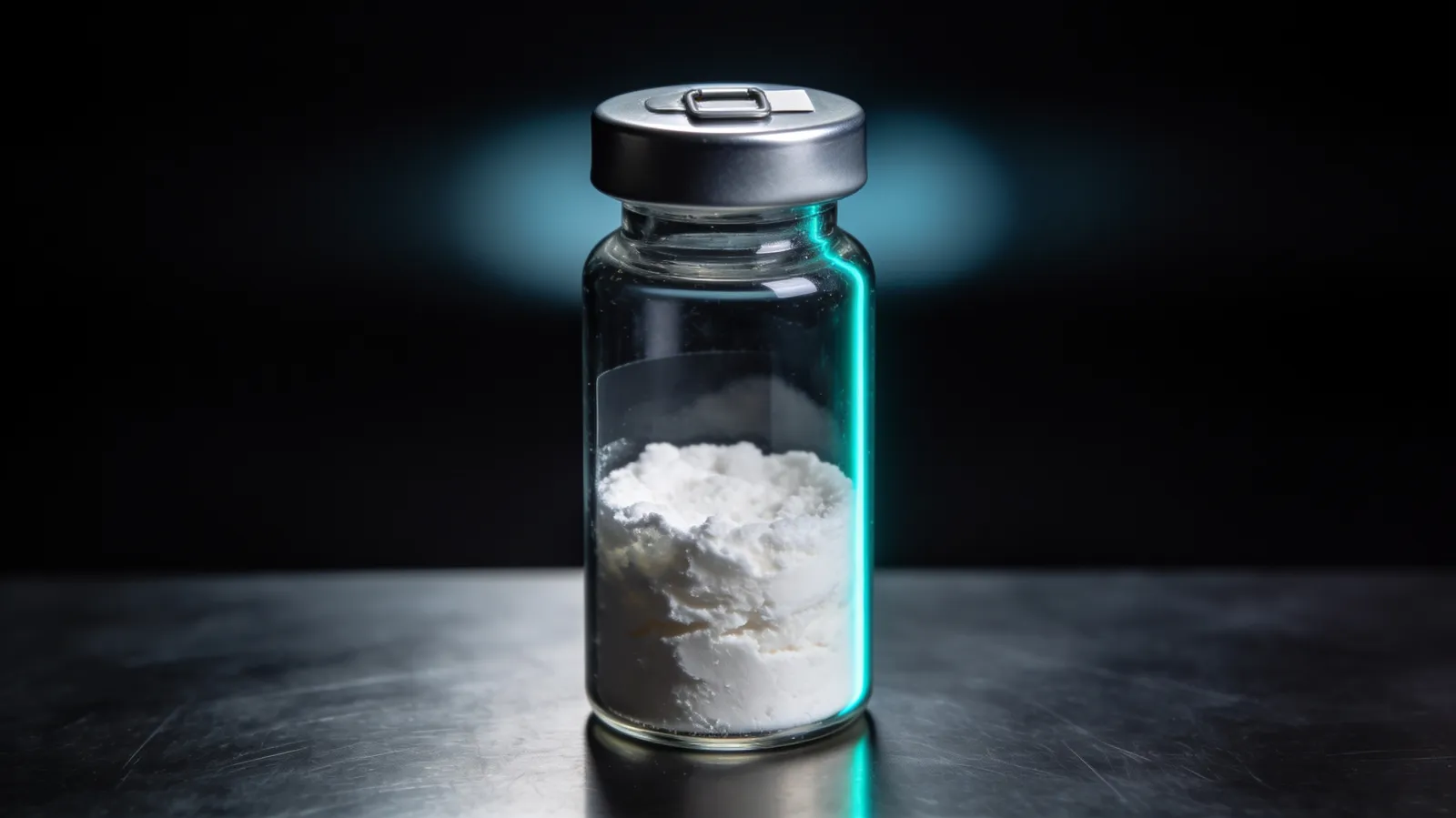
The tesamorelin peptide is a synthetic 44-residue chain, trans-3-hexenoyl-GRF(1-44)-NH2, molecular weight 5135.89 g/mol, formula C221H366N72O67S, CAS 218949-48-5, development code TH9507. It is the full growth-hormone-releasing hormone sequence with a trans-3-hexenoyl group on its N-terminus, a modification the literature describes as extending half-life relative to native GHRH(1-44). Supplied as a white lyophilised cake in 10mg and 20mg vials.
- The tesamorelin peptide is trans-3-hexenoyl-GRF(1-44)-NH2: the complete 44-residue growth-hormone-releasing hormone sequence, amidated at the C-terminus, with a trans-3-hexenoyl group bonded to the N-terminus. Its development code, still used in the literature and on some catalogues, is TH9507.
- Its molecular weight is 5135.89 g/mol and its formula C221H366N72O67S. The single sulphur atom in that formula is methionine at position 27, the only sulphur-bearing residue in the chain, and it is one of the features an LC-MS identity check has to account for.
- The first two residues are Tyr-Ala, and an alanine in the second position is the motif dipeptidyl peptidase-4 recognises. The acyl cap sits directly on that end of the chain.
- Sermorelin is a different molecule built from the same hormone, GRF(1-29)NH2 at roughly 3358 g/mol, and it is not part of this catalogue; the side-by-side is in tesamorelin vs sermorelin vs ipamorelin.
- Five lots have been released and published, from 99.253% to 99.93% by HPLC, each with its own net peptide content and its own independent certificate. The current lot on the 10mg and 20mg vials is TESM-052026-4 at 99.87%, and every certificate is in the COA library.
What the tesamorelin peptide is, in specification terms
A synthetic chain of 44 amino acids carrying one chemical modification at its front end. Written in full it is trans-3-hexenoyl-GRF(1-44)-NH2: the complete sequence of human growth-hormone-releasing hormone, amidated at the C-terminus, with a trans-3-hexenoyl group bonded to the N-terminus. Catalogues and papers also call it TH9507, the development code it carried before it had a name, and GRF(1-44) analogue.
Its molecular formula is C221H366N72O67S and its molecular weight 5135.89 g/mol. It is registered under CAS 218949-48-5. The formula carries a single sulphur atom, so exactly one residue in the chain is sulphur-bearing, which is one of the features a mass-spectrometry identity check has to account for.
Physically it arrives as a white lyophilised cake, soluble in bacteriostatic water, stored at −20°C for the long term and kept out of the light. A cake is not a powder that has been tipped into a vial; it is what remains after the frozen solution has had its water drawn off under vacuum, which is why the material sits as a disc at the bottom rather than as loose granules, and why a cake of lyophilized powder can look cracked or shrunken without anything being wrong with it. It is stocked in 10mg and 20mg tesamorelin vials, released at 99.87% purity by HPLC on the current lot.
By the standards of this catalogue that is a long molecule. Most research peptides sold alongside it are short chains of a few residues, and almost everything difficult about the tesamorelin peptide follows from its length: the synthesis, the purification, the handling and the price. Forty-four residues also sits just under the roughly fifty-residue line at which the word protein takes over, a convention explained in what is a peptide.
- 0
- amino-acid residues in the tesamorelin peptide chain, the full length of the hormone
- Formula C221H366N72O67S, our label and certificate
- 0 g/mol
- molecular weight, quoted as an average mass
- Serviam Bio Labs specification for lot TESM-052026-4
- 0
- sulphur atom in the formula, and therefore one sulphur-bearing residue
- The unsubscripted S in C221H366N72O67S
| Property | Value |
|---|---|
| CAS number | 218949-48-5 |
| Molecular formula | C221H366N72O67S |
| Molecular weight | 5135.89 g/mol (average mass) |
| Residue count | 44 |
| Sequence notation | trans-3-hexenoyl-GRF(1-44)-NH2 |
| N-terminal group | trans-3-hexenoyl, amide-linked |
| C-terminus | Amidated (-NH2) |
| Synonyms | TH9507; GRF(1-44) analogue; GHRH(1-44) analogue |
| Class | GHRH analogue |
| Appearance | White lyophilised cake |
| Solubility | Soluble in bacteriostatic water |
| Storage as supplied | −20°C long term, protected from light |
| Sizes stocked | 10mg and 20mg vials |
Sequence
trans-3-hexenoyl-GRF(1-44)-NH2. The 44-residue growth-hormone-releasing hormone chain, amidated at the C-terminus, with a trans-3-hexenoyl group on the N-terminus. That string is the complete written identity of the tesamorelin peptide.
Mass and identity
Formula C221H366N72O67S, molecular weight 5135.89 g/mol, CAS 218949-48-5, development code TH9507. Class: GHRH analogue, studied at the GHRH receptor in the preclinical literature.
Supply and handling
White lyophilised cake, 10mg and 20mg vials, soluble in bacteriostatic water, released at 99.87% by HPLC on lot TESM-052026-4. Stored at −20°C long term and protected from light.
The tesamorelin peptide sequence, written out residue by residue
Most catalogues stop at GRF(1-44), which tells a reader the length and nothing else. The chain in full, in three-letter code, is:
trans-3-hexenoyl-Tyr-Ala-Asp-Ala-Ile-Phe-Thr-Asn-Ser-Tyr-Arg-Lys-Val-Leu-Gly-Gln-Leu-Ser-Ala-Arg-Lys-Leu-Leu-Gln-Asp-Ile-Met-Ser-Arg-Gln-Gln-Gly-Glu-Ser-Asn-Gln-Glu-Arg-Gly-Ala-Arg-Ala-Arg-Leu-NH2
In one-letter code the same 44 residues read YADAIFTNSYRKVLGQLSARKLLQDIMSRQQGESNQERGARARL, with the acyl group on the front and the amide on the back.
Two things in that string are worth checking against the formula rather than taking on trust. The first is the methionine at position 27. It is the only sulphur-bearing residue in the chain, and there is no cysteine anywhere in the sequence, which is exactly why the molecular formula ends in a single unsubscripted S rather than S2 or S3. A sequence and a formula that disagree on sulphur count is one of the cheapest errors to catch on a specification sheet, and it is worth catching, because it usually means one of the two was copied from a different molecule.
The second is the start of the chain: Tyr-Ala. An alanine in the second position is the motif dipeptidyl peptidase-4 recognises, and it is the reason the modification sits where it does rather than somewhere else on the molecule. That is covered in the next section.
The trailing -NH2 is not decorative either. An amidated C-terminus means the chain ends in a carboxamide rather than a free carboxylic acid, which changes the mass by about one dalton and the charge state at neutral pH. On a molecule of this size that difference is well inside what LC-MS resolves, so an identity result either confirms the amide or does not.
| Part of the name | What it states |
|---|---|
| trans-3-hexenoyl- | The acyl group bonded to the N-terminal amine. Six carbons, one double bond in the trans configuration. |
| GRF | Growth-hormone-releasing factor, an older name for growth-hormone-releasing hormone. GHRH and GRF are the same hormone. |
| (1-44) | Which residues of that hormone are present: one to forty-four, meaning all of them. A truncated analogue would read (1-29). |
| -NH2 | The C-terminus is amidated rather than left as a free acid. |
| TH9507 | The development code, still the name used in much of the primary literature and on several supplier catalogues. |
Why the N-terminus is capped
Native growth-hormone-releasing hormone carries a free amine at the start of its chain, and a free N-terminal amine is the most exposed point on any peptide. It is the end of the molecule that enzymatic attack is described in the literature as reaching first, and the unmodified hormone is characterised there as short-lived for that reason.
The enzyme usually named is dipeptidyl peptidase-4, which removes two residues from the front of a chain when the second of them is an alanine or a proline. Native GHRH begins Tyr-Ala, so it presents that motif directly. Naming the enzyme is worth doing because it explains the geometry of the molecule: the modification is at position one, not somewhere in the middle, because position one is where the cut would be made.
The trans-3-hexenoyl group exists to remove that handle. It is a short unsaturated acyl group joined by an amide bond to the nitrogen that would otherwise be free, so the amine is occupied rather than exposed. The preclinical literature describes this N-terminal modification as extending half-life relative to native GHRH(1-44), and characterises the modified chain as more resistant to that cleavage in plasma-stability preparations.
Two things follow. The sequence underneath is unchanged, so the molecule is still the full 44-residue hormone chain rather than a redesign of it. And the modification is structural, not incidental: a certificate that confirms mass is confirming the capped molecule, because the uncapped chain would weigh something else entirely. An identity check on the tesamorelin peptide is therefore a check on the cap as much as on the sequence.
This is the same logic that puts an acetyl group on much shorter research peptides. The chemistry is modest and the reason is always the same: the free end of a peptide is the part that is easiest to get at.
The tesamorelin peptide against the other molecules on the same shelf
Sermorelin is the compound tesamorelin is most often confused with, and the difference is a matter of how much of the hormone each one keeps.
Sermorelin is GRF(1-29)NH2, the first 29 residues of growth-hormone-releasing hormone, amidated at the C-terminus, roughly 3358 g/mol. The chain simply stops there. The remaining residues of the hormone are not present in the molecule at all, and nothing is attached in their place. Sermorelin is not part of this catalogue.
Tesamorelin keeps all 44 residues and modifies the front of the chain instead of shortening it. One is a fragment of the hormone, the other is the full-length hormone with a cap on it, and the gap between roughly 3358 g/mol and 5135.89 g/mol is the mass of the residues sermorelin does not carry.
CJC-1295 is the third name in this family and it belongs on the sermorelin side of the line, not the tesamorelin side: it is built on the GRF(1-29) scaffold with amino-acid substitutions in the chain, and in its DAC form carries a linker group that is not part of the hormone sequence at all. It is not stocked here either. The structural point is that shortening-plus-substitution and full-length-plus-acylation are two different design answers to the same problem, and a table that lists them side by side makes that visible in a way that three paragraphs do not.
Ipamorelin gets swept into the same paragraph and does not belong there on structure at all. It is a five-residue chain of 711.85 g/mol classed as a ghrelin-receptor agonist rather than as a GHRH analogue. That is a different receptor, a different scaffold, and a molecule roughly one seventh the mass of the tesamorelin peptide. It is stocked, as 5mg and 10mg ipamorelin vials, and the two are dispatched together in the Growth Reference Panel for work that needs both. The three-way comparison in prose is in tesamorelin vs sermorelin vs ipamorelin. Further along the same shelf the gap is wider still: the GHK-Cu copper peptide is three residues at 403.94 g/mol against the 44 residues and 5135.89 g/mol of the tesamorelin peptide.
| Compound | Notation | Residues | Molecular weight | Modification | Class |
|---|---|---|---|---|---|
| Tesamorelin | trans-3-hexenoyl-GRF(1-44)-NH2 | 44 | 5135.89 g/mol | N-terminal trans-3-hexenoyl; C-terminal amide | GHRH analogue |
| Native GHRH | GHRH(1-44)-NH2 | 44 | Not stocked | None; free N-terminal amine | Endogenous hormone |
| Sermorelin | GRF(1-29)-NH2 | 29 | ≈3358 g/mol | None; chain truncated at residue 29 | GHRH analogue |
| CJC-1295 | GRF(1-29) analogue | 29 (30 with the DAC linker) | Not stocked | Substitutions in the chain; DAC linker in one form | GHRH analogue |
| Ipamorelin | Aib-His-D-2-Nal-D-Phe-Lys-NH2 | 5 | 711.85 g/mol | C-terminal amide; non-natural residues | Ghrelin-receptor (GHS-R1a) agonist |
What the preclinical literature studies
Three study points recur for the tesamorelin peptide, and all of them are model systems rather than statements about people.
The first is receptor pharmacology. Tesamorelin is characterised as an agonist at the growth-hormone-releasing hormone receptor, and that binding is measured in GHRH-receptor-expressing cell lines and in pituitary preparations, the somatotrophs of the anterior pituitary being the tissue the receptor is native to. The mechanism of interest is indirect: the molecule is studied as something that acts on the tissue which makes growth hormone, rather than as growth hormone itself.
The second is visceral adipose tissue, which is the endpoint the compound has been studied against most widely. It appears throughout the literature as a measured tissue endpoint in model systems.
The third is the molecule rather than its pharmacology: comparisons of stability and half-life between the capped peptide and native GHRH(1-44), usually run in plasma preparations and read out by LC-MS fragmentation. That is the work that explains why the N-terminal group is there at all.
There is a fourth use that has nothing to do with pharmacology and is worth naming because it is the one this material is actually sold for. A well-characterised 44-residue peptide with a published mass, a published formula and a lot-matched identity result is a useful reference standard when developing analytical methods for long chains. Most method-development work in this category is done on peptides of five to fifteen residues, which behave differently on a column; the tesamorelin peptide is one of the few compounds on the shelf that sits above forty.
Everything above describes preclinical model systems and laboratory method work. Nothing here describes an effect in a person, and this material is supplied strictly for in-vitro laboratory research.
Why 44 residues is a harder synthesis than a short chain
The tesamorelin peptide, like others of its kind, is built by solid-phase synthesis. The final residue is anchored to a resin bead and the chain grows one residue at a time. Each cycle runs deprotect, couple, wash, repeat, with the bead holding the work in place throughout. Every residue in the sequence has its own cycle, so a chain this long is a long run of them.
No coupling is perfect. Each cycle leaves behind a small proportion of chains that failed to extend, and those failures accumulate with every step, so the fraction of material that made it through untouched falls away as the chain gets longer. This is why purity figures across the short end of this category run so uniformly high, and why a long chain is a genuinely different manufacturing problem rather than the same problem repeated.
The failures are also awkward to remove. A chain missing one residue out of 44 differs from the target by a small fraction of its mass and behaves almost identically on a column, so reversed-phase preparative HPLC has to separate species that are chemically very similar to the thing being purified. Longer chains are more prone to folding and aggregating on the resin as well, which slows the couplings in the middle of a synthesis and makes the problem worse rather than better as the run goes on.
Purification leaves its own mark on the finished vial. Preparative HPLC is normally run with trifluoroacetic acid in the mobile phase, so the peptide comes off the column as a trifluoroacetate salt, and that counter-ion is still in the cake when it is weighed out. It is real mass and it is not peptide, which is the whole reason net peptide content is measured separately from purity.
The last step is the lyophilisation itself. The purified fractions are pooled, frozen, and the water is removed by sublimation under vacuum, which is what leaves the porous disc at the bottom of the vial rather than a dense powder. That porosity is functional: it is why the cake takes up diluent quickly. It is also why the cake's appearance varies between lots without saying anything about the material.
The conclusion people usually draw from all this is backwards. A long peptide is not a reason to accept a softer purity figure; it is the reason the figure has to be measured on the actual lot. On a short chain a high number is close to routine. On a 44-residue chain it is evidence about that specific synthesis, and it says nothing about the next one. What a purity percentage does and does not measure, set out in peptide purity, is worth reading before comparing two catalogue numbers.
Reconstitution, treated as a handling procedure
The cake has to go into solution before it can be assayed, and this is the step at which most laboratory material is damaged. It is worth stating as chemistry rather than as ritual.
The diluent normally used for a lyophilised research peptide is bacteriostatic water: sterile water carrying 0.9% benzyl alcohol as a preservative. The benzyl alcohol is what makes a multi-withdrawal container tolerable at all. Plain sterile water has no preservative and a container of it is a single-use proposition, and the difference between the two diluents is set out in sterile water vs bacteriostatic water. The tesamorelin peptide is specified as soluble in bacteriostatic water, and the reasoning behind that choice, including where it does not apply, is set out in bacteriostatic water for peptides.
Direct the diluent down the inside wall of the vial rather than onto the face of the cake. A stream landing squarely on a porous disc drives it apart mechanically and generates foam, and foam at an air-liquid interface is where peptides denature. Then swirl the vial gently, or roll it between the fingers, until the cake clears. Do not shake it. Shaking is the single most common way a correctly manufactured vial is degraded before it is ever measured.
A properly lyophilised cake usually clears in under a minute. If it does not, the answer is time and gentle agitation rather than force; warming the vial is not the fix, and neither is vortexing.
The arithmetic afterwards is straightforward and it is arithmetic, nothing more. The concentration of the resulting solution is the vial's net peptide content divided by the volume of diluent added. Net peptide content, not the number on the label: the label states a nominal mass and the certificate states the measured peptide fraction, and on lot TESM-052026-4 those are 10mg and 10.57mg respectively. A vial reconstituted in 2mL of diluent therefore yields a stock at 5.29 mg/mL, and a solution prepared from the label figure alone would be quoted about 5% low.
Everything in this section is the preparation of a laboratory stock solution for in-vitro work. It is not a preparation procedure for anything else, and nothing here should be read as one.
- 0%
- benzyl alcohol in bacteriostatic water, the preservative that makes a multi-withdrawal container viable
- Serviam Bio Labs bacteriostatic water specification
- 0mg
- measured net peptide content in a 10mg vial, the figure the concentration is calculated from
- Lot TESM-052026-4, Freedom Diagnostics
| Diluent added | Resulting concentration (from measured content) | If calculated from the 10mg label instead |
|---|---|---|
| 1.0 mL | 10.57 mg/mL | 10.00 mg/mL |
| 2.0 mL | 5.29 mg/mL | 5.00 mg/mL |
| 2.5 mL | 4.23 mg/mL | 4.00 mg/mL |
| 5.0 mL | 2.11 mg/mL | 2.00 mg/mL |
The diluent is not an afterthought
The tesamorelin peptide is specified as soluble in bacteriostatic water, and a stock solution is only as clean as the water it is made in. Ours is USP-grade sterile water with 0.9% benzyl alcohol, in 3mL and 10mL vials.
Reconstitution Solution, 3mL and 10mLTesamorelin peptide storage and stability, by form
A sealed lyophilised vial and an open reconstituted one are two different materials with two different storage problems, and treating them as one is how a good lot is wasted.
The sealed cake is stable because the water has been taken out of it. Hydrolysis needs water; a dry, sealed, light-protected vial at −20°C has very little of it and very little to react with. That is the whole reason the material is lyophilised rather than shipped as a solution.
Once diluent is added, all of that is undone. The peptide is now in water, at a pH set by the diluent, in a container that has been entered at least once. Refrigeration at 2 to 8°C slows the chemistry down; it does not stop it. Repeated freeze-thaw cycles are worse than either extreme, because each cycle concentrates solutes at the ice front and puts the peptide through a phase boundary it does not need to cross.
We do not publish a shelf-life figure in months for the reconstituted tesamorelin peptide, and the reason is that we have not measured one on this material. Other catalogues print a number; ours would be a guess dressed as data, and the check we would rather a reader ran is the one in how to store peptides, which is written around what actually degrades rather than around a date. The diluent has its own in-use period, which is a separate question and is covered in bacteriostatic water storage.
One practical note about transit, because it is asked constantly: a sealed lyophilised vial is not a cold-chain item. It travels at ambient temperature without harm, which is why vials arrive without dry ice and why that is not a sign of a corner cut. The −20°C figure is a storage condition, not a shipping one.
| Form | Temperature | Light and container | Handling note |
|---|---|---|---|
| Sealed lyophilised, long term | −20°C | Protect from light; keep sealed, stopper intact | Stable as a dry solid; this is the condition on our label |
| Sealed lyophilised, short-term handling | 2 to 8°C | Protect from light | Acceptable while in use on the bench |
| Sealed lyophilised, in transit | Ambient | Original carton | Not a cold-chain item; no dry ice required |
| Reconstituted stock | 2 to 8°C | Protect from light; keep the stopper clean | In water from this point on; no shelf-life figure is published because none has been measured here |
| Any form, repeated freeze-thaw | Avoid | Not applicable | Aliquot rather than re-freeze a single container |
Five lots, five certificates
Each lot is assayed independently and the certificate is published against the lot number printed on the vial. Five lots have been released and all five certificates are on the site, including for lots long out of stock, which is the part most catalogues quietly skip.
The current lot is TESM-052026-4, a 10mg vial released on 7 Jul 2026 at 99.87% by HPLC, with net peptide content of 10.57mg, identity confirmed by LC-MS and endotoxin passing on both replicates, tested by Freedom Diagnostics. The full history is below.
The lot number is the part that makes the rest of the document mean anything. A certificate for a different batch is somebody else's measurement. Typing the code from the label into the batch lot verifier returns the certificate for that exact vial, and if a number does not resolve, that in itself is the finding.
Net peptide content is the figure most worth understanding, and it is the one most often left off a certificate altogether. Lyophilised peptide is not pure peptide by mass: the cake also contains the trifluoroacetate counter-ion left over from purification and whatever water the material holds. Gross vial mass therefore overstates how much peptide is present, unless somebody has measured the peptide fraction and said so. Every lot above is stated above its 10mg label, between 10.33mg and 11.08mg.
Purity and content are separate measurements and answer separate questions. Purity says what proportion of the peptide present is the intended molecule rather than a deletion sequence or a by-product. Content says how much peptide there is at all. A vial can be excellent on one and unremarkable on the other, which is why the two numbers belong on the same page. Identity is a third question again, and on a molecule of this mass it is the one LC-MS is there to settle.
The spread across those five lots, 99.253% at the bottom and 99.93% at the top, is the ordinary variation of a real manufacturing process reported honestly. It would have been trivial to publish only the two best and call the specification 99.9%. A supplier publishing one figure for the tesamorelin peptide across every batch, year after year, is publishing a specification rather than a measurement, and the two are not the same document.
- 0
- lots of the tesamorelin peptide released and published, including those no longer in stock
- Serviam Bio Labs COA library
- 0%
- the lowest purity we have released and published, not the highest
- Lot NWPBJ4, 13 Mar 2026, Freedom Diagnostics
- 0mg
- the highest net peptide content measured in a 10mg vial
- Lot AV2C30, 15 May 2026, Freedom Diagnostics
| Lot | Released | HPLC purity | Net peptide content | Identity | Endotoxin |
|---|---|---|---|---|---|
| TESM-052026-4 | 7 Jul 2026 | 99.87% | 10.57mg | Confirmed (LC-MS) | Pass, both replicates |
| TESM-042026-4 | 2 Jun 2026 | 99.93% | 10.67mg | Confirmed (LC-MS) | Pass, both replicates |
| AV2C30 | 15 May 2026 | 99.93% | 11.08mg | Confirmed (LC-MS) | See certificate |
| TESM12172025-J | 30 Apr 2026 | 99.413% | 10.33mg | Confirmed (LC-MS) | See certificate |
| NWPBJ4 | 13 Mar 2026 | 99.253% | 10.73mg | Confirmed (LC-MS) | See certificate |
Check the vial in front of you, not the page
Every vial carries a lot code, and every lot code resolves to its own signed certificate with the HPLC purity, the LC-MS identity result, the net peptide content, the laboratory and the date.
Tesamorelin, 10mg and 20mgWhat each test on the certificate actually answers
A certificate is a set of separate answers to separate questions, and a reader who treats it as one number is reading about a fifth of it. The table below is the honest version, including the two lines where the answer is that we do not publish the test.
The column that matters most is the fourth one. Every analytical method has a blind spot, and a certificate that lists five passes without saying what each pass excludes is a marketing document. Purity by RP-HPLC, for instance, reports the proportion of the material the detector sees at a given wavelength. It is silent about anything that does not absorb there, and silent about how much material is in the vial at all.
We publish four results per lot of the tesamorelin peptide and we do not publish three others. Heavy metals by ICP-MS, sterility by PCR and a controlled-substance screen appear on some competing certificates and not on ours, and rather than let a reader assume, it is better to say so plainly and let them weigh it. How to read a peptide certificate of analysis goes through a real document line by line, and peptide purity testing covers what the methods themselves can and cannot resolve.
| Test | Method | What it establishes | What it does not tell you | On our COA |
|---|---|---|---|---|
| Purity | RP-HPLC | What proportion of the detected peptide is the intended molecule | How much peptide is in the vial, or whether it is the right molecule at all | Yes |
| Identity | LC-MS | That the measured mass matches 5135.89 g/mol for the capped, amidated chain | How much of it there is, or how clean it is | Yes |
| Net peptide content | Nitrogen or amino-acid analysis | How much of the vial's mass is peptide rather than counter-ion and water | Whether that peptide is the right one | Yes |
| Endotoxin | Replicate assay against a threshold | That bacterial endotoxin is below the stated limit | Anything about chemical purity or identity | Yes |
| Heavy metals | ICP-MS | Elemental contamination from reagents or hardware | Not applicable; we do not publish this test | Not published |
| Sterility | PCR or culture | Absence of viable organisms in the sealed vial | Not applicable; we do not publish this test | Not published |
Sizes, price and buying the tesamorelin peptide as research material
The tesamorelin peptide is stocked in two sizes and no others: a 10mg vial at $99.99 and a 20mg vial at $189.99. There is no 5mg size. Every certificate on file is for a 10mg lot, which is worth saying outright rather than implying that a 20mg certificate exists somewhere.
It is the most expensive compound per vial in the catalogue, and the reason is the one set out above: 43 coupling cycles, a purification problem that gets harder rather than easier with length, and a yield that falls away accordingly. A short chain at the same price would be a question worth asking; a 44-residue chain at the same price as a pentapeptide would be the more alarming number.
Who it is sold to, and on what terms, is not a formality. This is in-vitro laboratory material. It is not a pharmaceutical, it is not manufactured or released as one, and it is not for human or veterinary use in any form. Handling belongs inside an institutional chemical hygiene plan. If you are weighing one supplier against another, how to vet a research peptide supplier sets out the checks that are worth running before the first order rather than after it.
For work that needs a GHRH analogue and a ghrelin-receptor agonist in the same run, the Growth Reference Panel ships tesamorelin and ipamorelin lot-matched in one dispatch at a 10% discount on the separate vials. Otherwise the tesamorelin product page carries both sizes and the current lot's certificate.
| Size | Price | Certified lot | HPLC purity | Net peptide content |
|---|---|---|---|---|
| 10mg vial | $99.99 | TESM-052026-4 | 99.87% | 10.57mg |
| 20mg vial | $189.99 | Certificates on file are 10mg lots | Not published for this size | Not published for this size |
| Growth Reference Panel | 10% off the separate vials | Lot-matched at dispatch | Per lot | Per lot |
The tesamorelin peptide, stated plainly: trans-3-hexenoyl-GRF(1-44)-NH2, also written TH9507, 44 residues, formula C221H366N72O67S, molecular weight 5135.89 g/mol, CAS 218949-48-5. It is the complete growth-hormone-releasing hormone sequence with its N-terminus capped, a modification the literature describes as extending half-life relative to native GHRH(1-44), and it is not sermorelin, which is GRF(1-29)NH2 at roughly 3358 g/mol and is not stocked here. It is a long chain by the standards of research peptides, which is why five lots have been released between 99.253% and 99.93% rather than at one advertised number, and why the figures worth reading are the ones on the certificate for the lot in front of you rather than the ones on a catalogue page. The material itself is stocked as 10mg and 20mg vials and supplied for in-vitro laboratory research use only.
Common questions
What is tesamorelin?
The tesamorelin peptide is a synthetic 44-residue chain, trans-3-hexenoyl-GRF(1-44)-NH2, of molecular weight 5135.89 g/mol and CAS 218949-48-5, also known by its development code TH9507. It is the full growth-hormone-releasing hormone sequence with a trans-3-hexenoyl group on the N-terminus, and it is classed as a GHRH analogue. It is supplied for in-vitro laboratory research only.
What does peptide tesamorelin do?
This page does not answer that question, and deliberately so. What can be stated is molecular: tesamorelin is characterised in the preclinical literature as an agonist at the growth-hormone-releasing hormone receptor, measured in GHRH-receptor-expressing cell lines and pituitary preparations. Nothing on this site describes an effect in a person, because the material is in-vitro laboratory material and not a medicine.
What is the molecular weight of tesamorelin?
5135.89 g/mol, with the molecular formula C221H366N72O67S. That makes the tesamorelin peptide one of the larger molecules sold as a research peptide, most of which are chains of a few residues.
Why do different catalogues quote slightly different molecular weights for tesamorelin?
Because they are rounding an average mass differently, and in a few cases quoting a monoisotopic mass instead. Figures between 5135.76 and 5135.9 g/mol appear across supplier pages for the same molecule. Ours is 5135.89 g/mol, an average mass, and it is the figure on our label and certificate. A disagreement in the second decimal is a convention difference; a disagreement in the first digit would be a different molecule.
What is the full amino acid sequence of tesamorelin?
trans-3-hexenoyl-Tyr-Ala-Asp-Ala-Ile-Phe-Thr-Asn-Ser-Tyr-Arg-Lys-Val-Leu-Gly-Gln-Leu-Ser-Ala-Arg-Lys-Leu-Leu-Gln-Asp-Ile-Met-Ser-Arg-Gln-Gln-Gly-Glu-Ser-Asn-Gln-Glu-Arg-Gly-Ala-Arg-Ala-Arg-Leu-NH2. In one-letter code the 44 residues read YADAIFTNSYRKVLGQLSARKLLQDIMSRQQGESNQERGARARL, with the acyl cap on the N-terminus and an amide on the C-terminus. That string is the whole of the tesamorelin peptide.
What does TH9507 mean?
It is the development code tesamorelin carried before it was named, and it is still the identifier used in much of the primary literature and on several supplier catalogues. TH9507, GRF(1-44) analogue and tesamorelin all refer to the same molecule, CAS 218949-48-5.
Is tesamorelin the same as sermorelin?
No. Sermorelin is GRF(1-29)NH2, the first 29 residues of the same hormone, amidated, roughly 3358 g/mol. Tesamorelin keeps all 44 residues and caps the N-terminus instead. Sermorelin is not stocked here; the two are compared in tesamorelin vs sermorelin vs ipamorelin.
Is tesamorelin the same as CJC-1295?
No. CJC-1295 is built on the shorter GRF(1-29) scaffold with substitutions in the chain, and in one form carries a DAC linker that is not part of the hormone sequence. Tesamorelin is the full 44-residue chain with an acyl cap and no substitutions. Both are called GHRH analogues; structurally they are different answers to the same stability problem, and CJC-1295 is not stocked here.
Is tesamorelin a growth hormone?
No. Tesamorelin is a 44-residue analogue of growth-hormone-releasing hormone (GHRH), CAS 218949-48-5, about 5.1 kDa. Growth hormone itself is a 191-residue protein of roughly 22 kDa with a different sequence and a different receptor. That is a statement about structure; this page makes no statement about what either molecule does in a person.
Why does tesamorelin have a group attached to the N-terminus?
Because the N-terminus is the exposed end of a peptide chain, and native GHRH begins Tyr-Ala, which is the motif dipeptidyl peptidase-4 recognises. The trans-3-hexenoyl group occupies the amine that would otherwise be free, and the preclinical literature describes that modification as extending half-life relative to native GHRH(1-44).
How is the tesamorelin peptide reconstituted?
With bacteriostatic water, directed down the inside wall of the vial rather than onto the cake, then swirled gently until clear. Never shaken, because foaming at the air-liquid interface is where peptides denature. The resulting stock concentration is the vial's measured net peptide content divided by the diluent volume: 10.57mg in 2mL gives 5.29 mg/mL. This is the preparation of a laboratory stock solution and nothing else.
How is the tesamorelin peptide stored?
As supplied it is a white lyophilised cake, held at −20°C for long-term storage and protected from light, and 2 to 8°C is acceptable for short-term handling. Reconstituted stock goes to 2 to 8°C and repeated freeze-thaw cycles should be avoided. It is stocked in 10mg and 20mg vials.
Does tesamorelin need to ship cold?
No. A sealed lyophilised vial of the tesamorelin peptide is a dry solid and travels at ambient temperature without harm, so it arrives without dry ice or cold packs. The −20°C on the label is a storage condition for the long term, not a shipping requirement, and a vial that arrives warm to the touch is not a vial that has been damaged.
What purity is tesamorelin supplied at?
The current lot, TESM-052026-4, released at 99.87% by HPLC with net peptide content of 10.57mg in a 10mg vial, tested by Freedom Diagnostics. Across all five published lots of the tesamorelin peptide the released figures run from 99.253% to 99.93%. The figure for the vial you hold is on its own certificate, reachable from the product page or the COA library.
What does GRF(1-44) mean on a tesamorelin label?
GRF is growth-hormone-releasing factor, another name for growth-hormone-releasing hormone, and (1-44) states which part of that sequence is present: residues one to forty-four, meaning the whole of it. The trailing NH2 says the C-terminus is amidated, and trans-3-hexenoyl at the front names the group attached to the N-terminus. The same notation on our 10mg and 20mg vials is the complete identity of the molecule.
How do I check a tesamorelin lot number myself?
Read the lot code printed on the vial label and enter it on the lot number verification page. The certificate for that specific batch comes back with its HPLC purity, its LC-MS identity result, the testing laboratory and the date. A lot code that returns nothing is worth stopping over.
What does net peptide content mean on a tesamorelin certificate?
How much of the vial's mass is actually peptide, as opposed to trifluoroacetate counter-ion and residual water. It is a different measurement from purity, which describes only the peptide fraction it finds. Lot TESM-052026-4 states 10.57mg of net peptide content in a 10mg vial; across the five published lots the range is 10.33mg to 11.08mg.
Why is there a sulphur atom in the tesamorelin formula?
Because one residue in the 44-residue chain is sulphur-bearing: the methionine at position 27. There is no cysteine in the sequence at all. The formula C221H366N72O67S carries a single unsubscripted S, which says exactly one such residue is present, and an identity check by mass spectrometry has to account for it.
Who tests tesamorelin, and is the laboratory independent?
Freedom Diagnostics, an independent analytical laboratory with no stake in the sale. All five published lots of the tesamorelin peptide were assayed there, and the reports sit in the certificate of analysis library under their own lot numbers, including lots no longer in stock.
What sizes of tesamorelin are sold, and is there a 5mg vial?
Two sizes: a 10mg vial at $99.99 and a 20mg vial at $189.99. There is no 5mg size. Every certificate on file is for a 10mg lot. Both sizes are on the tesamorelin product page, and the Growth Reference Panel pairs it with ipamorelin in one lot-matched dispatch.
Is tesamorelin legal to buy for research?
It is supplied as in-vitro laboratory material, not as a pharmaceutical, and it is not for human or veterinary use in any form. Purchasers are responsible for compliance with the rules that apply where they are and within their own institution; handling belongs inside a chemical hygiene plan. We make no claim about any use other than laboratory research.
Is tesamorelin a peptide or a protein?
There is no sharp line between the two, only a convention that short amino-acid chains are called peptides and long folded ones proteins. At 44 residues and 5135.89 g/mol, the tesamorelin peptide sits near the top of the range normally called peptide, and it is far longer than the short chains that make up most of this category.
What does a tesamorelin certificate show besides the purity percentage?
Identity, content and cleanliness. For lot TESM-052026-4 the certificate reports identity confirmed by LC-MS, net peptide content of 10.57mg, appearance as a white lyophilised powder, and an endotoxin test passing on both replicates, alongside the 99.87% HPLC figure. Heavy metals and sterility are not among the tests we publish, which is stated here rather than left to be assumed.
Are all tesamorelin peptides the same?
Chemically they should be. Tesamorelin peptides are a 44-residue chain carrying a trans-3-hexenoyl group on the N-terminus, and that acylation is part of the molecule rather than an additive. Where they differ is in what the synthesis left behind. A 44-residue chain is a long one to build, and every coupling that stops short of completion leaves a deletion sequence that a purity figure counts but does not name. That is why how to read a peptide certificate of analysis matters more here than on a seven-residue fragment, and why identity by mass spectrometry is the line to read first.
- PubChem CID 16137828, tesamorelin: the trans-3-hexenoyl-GRF(1-44)-NH2 structure, the C221H366N72O67S formula, the 5135.89 g/mol average mass and CAS 218949-48-5
- Tesamorelin prescribing information, FDA label (DailyMed): cited for chemistry and formulation only: the 44-amino-acid GRF analogue description, the trans-3-hexenoyl group and the lyophilised presentation of that separate approved product, which this research material is not
- PubChem CID 16132413, sermorelin: the GRF(1-29)NH2 identity and the roughly 3358 g/mol mass that the comparison table quotes
- FDA, Lyophilization of Parenteral, Inspection Technical Guide: the sublimation step that leaves a porous cake rather than a loose powder, and why cake appearance varies between lots
- Bacteriostatic Water for Injection, USP, FDA label (DailyMed): the benzyl alcohol preservative and the multiple-dose container it permits, against the single-use character of plain sterile water
Read more
- GHK-Cu copper peptideA GHK-Cu copper peptide vial is blue, and every other vial in this catalogue is white. The colour is not a dye. It is the evidence that the complex formed.
- What is the MOTS-c peptide?The MOTS-c peptide has a gene, and the gene is not in the nucleus. That is the first unusual thing about it, and most of the reason 16 amino acids were worth naming.
- Ipamorelin peptideThe ipamorelin peptide contains three pieces no natural protein would supply. Read the sequence and the rest follows: this is a designed molecule, not a fragment of anything, and its identity is a matter of registry record.
- NAD+ peptide: a coenzyme, not a peptideNAD+ peptide is how the compound is usually searched for, and the word peptide is the wrong word. NAD+ is a dinucleotide coenzyme with no amino acids in it at all.
- What is the GLOW peptide blend?The GLOW peptide is not one peptide. GLOW is a product name for three molecules dried into a single vial, 70mg in total, in a ratio fixed before it was sealed.
- What is in the KLOW peptide blendThe KLOW peptide blend is four separate molecules sharing one vial, which means four identities to describe and four assays to read rather than one of each.
For laboratory research use only. All compounds listed on this site are sold strictly as reference materials for in-vitro laboratory research conducted by qualified professionals. They are not drugs, foods, cosmetics, or medical devices. They are not intended for human or veterinary consumption, therapeutic use, diagnostic application, or any in-vivo use whatsoever. These statements have not been evaluated by the Food and Drug Administration. By purchasing, you affirm that you are a qualified researcher and that you will comply with all applicable institutional, local, state and federal regulations governing the handling of research chemicals. Published by SERVIAM BIO LABS.