

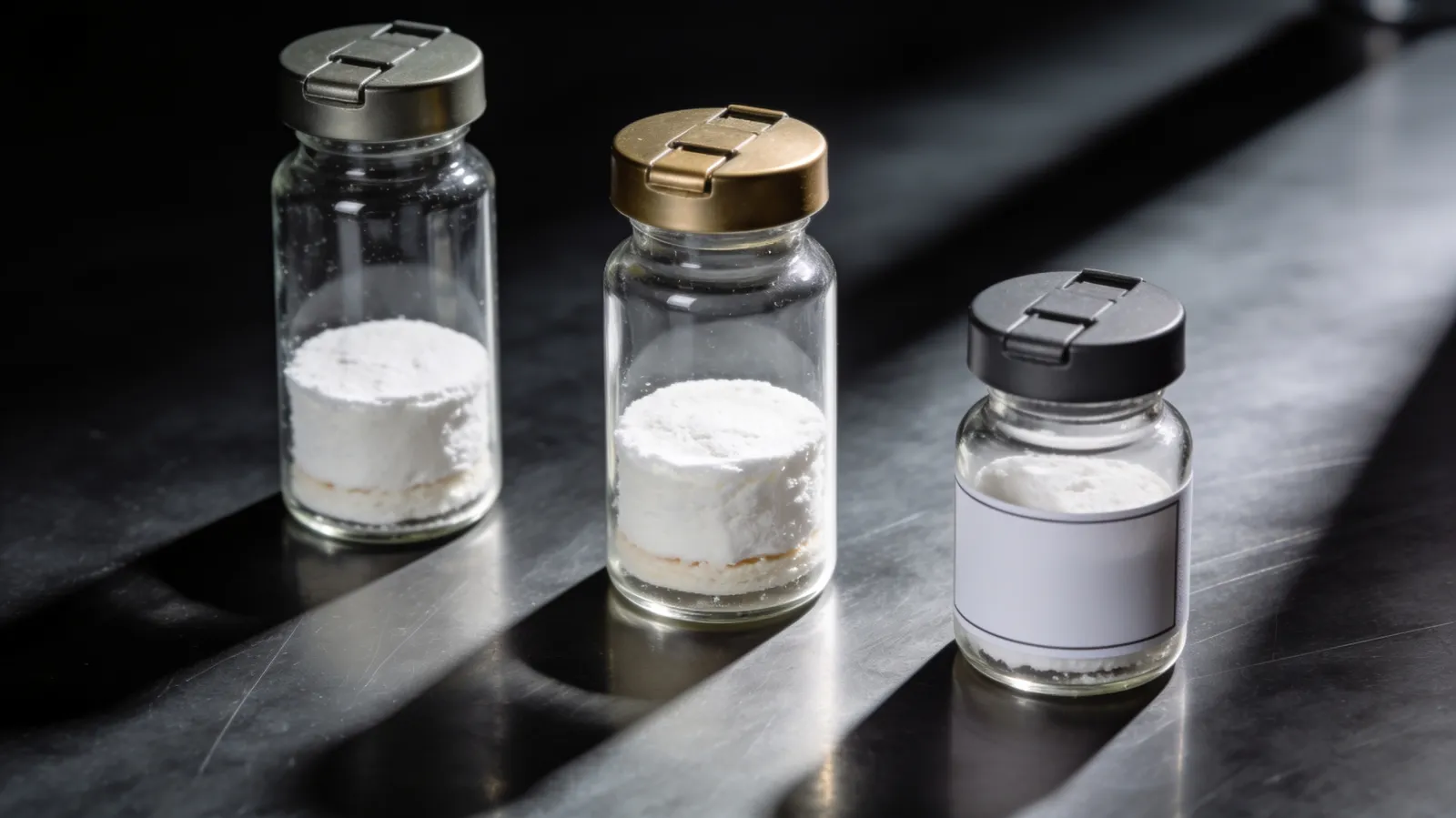
Tesamorelin vs sermorelin is a comparison inside one family: tesamorelin is the full 44-amino-acid growth hormone-releasing hormone sequence with an N-terminal cap, sermorelin the first 29 residues, and both bind the GHRH receptor. Ipamorelin is not in that family. It is a five-residue peptide acting at the ghrelin receptor, GHS-R1a.
- Tesamorelin vs sermorelin is one family at two lengths: sermorelin is the first 29 amino acids of growth hormone-releasing hormone, tesamorelin the full 44 with a trans-3-hexenoyl cap on the N-terminus, and both bind the GHRH receptor.
- The ipamorelin peptide is not a GHRH analogue at all. Five residues acting at GHS-R1a, the ghrelin receptor, put it outside that family, so the honest comparison on this page is between two classes of molecule rather than three versions of one.
- The N-terminal modification on the tesamorelin peptide is about stability rather than mechanism: it caps the bond that dipeptidyl peptidase-4 clips first, and the receptor the molecule binds is unchanged. Tesamorelin vs sermorelin turns on that cap and on fifteen residues.
- Aminoisobutyric acid and two D-amino acids in ipamorelin's sequence are the structural tell that it is a synthetic construct rather than a fragment of any hormone the body makes.
- The three span roughly sevenfold in mass: 711.85 g/mol, about 3358 and 5135.89. That is why the identity figure on a peptide certificate of analysis separates them far more reliably than the names do.
Tesamorelin vs sermorelin: same family, different lengths
Human growth hormone-releasing hormone is a 44-amino-acid peptide, usually written GRF(1-44). Both sides of tesamorelin vs sermorelin are built from it.
Sermorelin is its first 29 amino acids, amidated at the C-terminus, written GRF(1-29)NH2, about 3358 daltons. That truncation is not arbitrary: the first 29 residues are the portion that retains receptor activity, so sermorelin is the shortest fragment that still behaves like the parent hormone at its receptor.
The tesamorelin peptide is the full 44-amino-acid chain with a trans-3-hexenoyl group attached at the N-terminus, 5135.89 daltons, CAS 218949-48-5, formula C221H366N72O67S. Written out in full the modification is trans-3-hexenoic acid, joined to the N-terminal tyrosine as an amide. It exists to slow enzymatic degradation rather than to change what the molecule binds.
The mechanism it defends against is specific. Native growth hormone-releasing hormone is clipped between its first and second residues by dipeptidyl peptidase-4, and the shortened chain left behind no longer activates the receptor. Sermorelin, being the same sequence at the front end, carries the same exposed bond. Tesamorelin's hexenoyl cap sits exactly on it. That is the whole of the design.
So the difference in tesamorelin vs sermorelin is length and stability, not mechanism. Both bind the GHRH receptor; one is a short fragment and one is a stabilised full-length analogue.
The paired integers are the thing to hold on to: 29 of 44. The fifteen residues sermorelin leaves off are not required for activity at the receptor, which is why a fragment works as a fragment at all. What they contribute is to the behaviour of the whole molecule: its solubility, its folding, its resistance to being taken apart. That is a different question from whether it fits the receptor.
One thing is worth settling before the tables. Tesamorelin vs sermorelin is not a comparison between two things on this catalogue, because only one of them is on it. Sermorelin appears here as the reference point the literature keeps returning to, described from published chemical sources, and nothing supplied by us is assayed against it.
- 0
- Amino acids in tesamorelin, the full GRF(1-44) scaffold and the longer side of tesamorelin vs sermorelin
- Serviam Bio Labs product specification, formula C221H366N72O67S
- 0
- Amino acids in sermorelin, GRF(1-29)NH2, the amidated N-terminal fragment of the same hormone
- Standard chemical description; sermorelin is not stocked here
- 0
- Molecular weight of tesamorelin in g/mol, the largest peptide in this catalogue
- Serviam Bio Labs product specification, confirmed lot-by-lot by LC-MS
Tesamorelin vs sermorelin vs ipamorelin in one table, with CJC-1295 in the fourth row
Everything that actually separates these compounds is in their sequences and their masses, and both are short enough to tabulate. CJC-1295 is included because it is the name most often added to the list by readers who have already got this far, and because it demonstrates the point: it sits beside sermorelin, not beside tesamorelin, however the three are usually grouped.
Read the molecular weight column first. Tesamorelin and ipamorelin differ by a factor of about 7.2 in mass. Two compounds that far apart are not variants of one another, and no amount of shared naming convention makes them so.
The first two rows are tesamorelin vs sermorelin set out in full, and they agree on four of the six columns. The third row is the one that breaks the series: a different receptor, a different origin, and a mass seven times smaller.
The figures for tesamorelin and ipamorelin are our own product specifications, confirmed lot-by-lot by LC-MS against a certified reference standard. The figures for sermorelin and CJC-1295 are the standard published chemical descriptions of compounds we do not stock, do not assay and make no representation about.
| Compound | Sequence or fragment | Amino acids | Molecular weight | CAS | Receptor |
|---|---|---|---|---|---|
| Tesamorelin | trans-3-hexenoyl-GRF(1-44)-NH2 | 44 plus N-terminal cap | 5135.89 g/mol | 218949-48-5 | GHRH receptor |
| Sermorelin (not stocked) | GRF(1-29)NH2 | 29 | about 3358 g/mol | 86168-78-7 | GHRH receptor |
| Ipamorelin | Aib-His-D-2-Nal-D-Phe-Lys-NH2 | 5 | 711.85 g/mol | 170851-70-4 | GHS-R1a, the ghrelin receptor |
| CJC-1295 (not stocked) | GRF(1-29) with four substitutions; the DAC form adds an albumin-binding linker | 29 | about 3.4 kDa without DAC, higher with it | Varies with the DAC linker | GHRH receptor |
Tesamorelin vs ipamorelin: 44 amino acids against five
This is the comparison people mean when they put all three names in one search box, and it is the one with the clearest answer. A 5135.89-dalton modified hormone analogue and a 711.85-dalton designed pentapeptide have almost nothing in common except the axis their literature sits in. Where tesamorelin vs sermorelin is an argument about fifteen residues and one acyl group, this one is an argument about everything.
Tesamorelin is derived. Every residue in it corresponds to a residue in a hormone the body makes, with one acyl group added at the front. Ipamorelin is invented. Its five residues include aminoisobutyric acid, which is not one of the twenty standard amino acids, and two D-amino acids, which are the mirror images of the forms ribosomes use. Nothing assembles that sequence biologically.
The receptors are different proteins. Tesamorelin binds the GHRH receptor; ipamorelin binds GHS-R1a, the growth hormone secretagogue receptor type 1a, usually called the ghrelin receptor. Those are the terms a classification turns on, and they are why one of these is filed as a GHRH analogue and the other as a growth hormone secretagogue.
The practical consequence, for anyone handling the material rather than reading about it, is that the two behave differently in the vial. A five-residue peptide with no secondary structure to lose and a 44-residue chain with a great deal of it are not equally forgiving of freeze-thaw cycles or of sitting in the light on a bench.
| Property | Tesamorelin | Ipamorelin |
|---|---|---|
| Amino acids | 44, plus an N-terminal acyl cap | 5 |
| Molecular weight | 5135.89 g/mol | 711.85 g/mol |
| Molecular formula | C221H366N72O67S | C38H49N9O5 |
| Origin of the sequence | Derived from human growth hormone-releasing hormone | Designed; corresponds to no natural sequence |
| Non-standard residues | None; the modification is an added acyl group | Aminoisobutyric acid plus two D-amino acids |
| Receptor | GHRH receptor | GHS-R1a, the ghrelin receptor |
| Class | GHRH analogue | Growth hormone secretagogue |
| Stocked here | 10mg and 20mg vials, released at 99.87% | 5mg and 10mg vials, released at 99.90% |
Ipamorelin is a different class of molecule
The ipamorelin peptide is five residues: Aib-His-D-2-Nal-D-Phe-Lys-NH2, 711.85 daltons, CAS 170851-70-4. It contains non-standard residues, aminoisobutyric acid and two D-amino acids, which is already a structural signal that it is not a fragment of anything natural.
It is a growth hormone secretagogue acting at GHS-R1a, the ghrelin receptor. That is a different receptor from the GHRH receptor, reached by a different pathway, and it is why ipamorelin is grouped with the secretagogues rather than with the GHRH analogues however often the three names appear in the same sentence.
Selectivity is the property most studied in its preclinical literature. It was reported in 1998, from work at Novo Nordisk, as the first selective compound of its class, and what the source paper describes is what did not move alongside growth hormone in those model systems: cortisol, ACTH and prolactin. That is a statement about cross-activity at other axes in an animal model, and it is the reason the compound has the reputation it has.
The residue count is worth stating carefully, because published summaries get it wrong. Five is what the formula C38H49N9O5 corresponds to and what the source paper reports; catalogues elsewhere sometimes print nine. If a supplier's own page disagrees with its own formula, that is a useful thing to have noticed before you read anything else it says.
It is also why tesamorelin vs sermorelin is the more tractable half of the question on this page. Two molecules cut from one hormone, differing by a cap and fifteen residues, can be compared column by column. A designed pentapeptide at another receptor can only be contrasted.
Tesamorelin
trans-3-hexenoyl-GRF(1-44)-NH2. 44 amino acids plus N-terminal modification, 5135.89 g/mol, CAS 218949-48-5. GHRH receptor. Stocked in 10mg and 20mg vials at 99.87% purity.
Sermorelin
GRF(1-29)NH2. 29 amino acids, roughly 3358 g/mol, CAS 86168-78-7. GHRH receptor. Included here for comparison; not part of this catalogue.
Ipamorelin
Aib-His-D-2-Nal-D-Phe-Lys-NH2. 5 residues, 711.85 g/mol, CAS 170851-70-4. Ghrelin receptor, GHS-R1a. Stocked in 5mg and 10mg vials at 99.90% purity.
Pulsatile signalling, and why two receptor classes end up in the same study
Both receptors sit on the same cell. The somatotroph, in the anterior pituitary, carries the GHRH receptor and GHS-R1a, and each is a G-protein-coupled receptor wired to a different second messenger: the GHRH receptor through cyclic AMP, GHS-R1a through the phospholipase C and calcium route. Two doors, one room.
The word the literature uses for what follows is pulsatile. Growth hormone release in model systems is not a steady output that a stimulus raises and lowers; it comes in bursts, and a receptor agonist acting upstream shapes those bursts rather than replacing them. That is the structural argument for studying secretagogues at all instead of the hormone itself, and it applies equally to a GHRH analogue and to a ghrelin-receptor agonist.
It is also why preclinical work pairs the two classes. If one compound enters through the cyclic-AMP door and the other through the calcium door, and both are read out on the same downstream measure, then running them separately and together tells you something about the pathway that neither tells you alone. The downstream measure is usually growth hormone itself, sometimes insulin-like growth factor-1 as the slower analyte. That is an experimental design question about model systems. It is not a protocol, and nothing on this page suggests one.
Receptor desensitisation is the other reason the pairing appears. A receptor exposed continuously to an agonist responds less over time, and the two receptors here do not desensitise on the same terms, which is exactly the sort of thing a comparative study is built to measure.
Tesamorelin vs sermorelin sits entirely on one side of that split. Both go through the cyclic-AMP door, which is why nothing in their comparison is a comparison of pathways. It is a comparison of how long a molecule lasts on the way to the same door.
The classification, then, is not a filing convention. Two upstream receptors converging on one cell type is a real structural difference with real consequences for how an experiment reads, and it is what the GHRH analogue against ghrelin-receptor agonist pairing in this catalogue exists to support.
Half-life in tesamorelin vs sermorelin, and what a half-life figure does not say
Half-life is a measured property of a molecule in plasma: how long its concentration takes to fall by half once it is in circulation. It describes the molecule's persistence, not what the molecule does, and it is the one dynamic number that belongs on a comparison page like this one.
The prescribing information for the approved tesamorelin product reports a plasma half-life in the region of 26 to 38 minutes, the shorter figure from healthy subjects and the longer from the trial population. The published pharmacokinetic literature puts sermorelin at roughly 11 to 12 minutes, with a wider range of 10 to 20 minutes quoted across reviews. For ipamorelin, the figure most often cited is around two hours, and it comes from murine work.
Those three numbers are not comparable with one another and should not be read as a ranking. They were measured in different species, by different assays, at different times, and a longer half-life is not a better one. It is a different property, relevant to how a molecule is studied rather than to how well it works. The species label on the ipamorelin figure matters more than the figure.
What the half-life column does explain is the shape of the tesamorelin molecule. An N-terminal cap on a chain that dipeptidyl peptidase-4 would otherwise open is a piece of engineering aimed at exactly this parameter, and the gap between a capped and an uncapped GRF sequence is the clearest illustration on the page of a structural modification doing one job. Read that way, the half-life row is the one line in tesamorelin vs sermorelin where the cap shows up as a number.
- 0 to 38 min
- Reported plasma half-life of tesamorelin
- Prescribing information for the approved reference product
- 0 to 12 min
- Reported plasma half-life of sermorelin, the shorter figure of the two GHRH analogues
- Published pharmacokinetic reviews
- 0×
- Mass ratio between tesamorelin and ipamorelin, 5135.89 against 711.85 g/mol
- Serviam Bio Labs product specifications
| Compound | Reported half-life | Where the figure comes from | What it does not tell you |
|---|---|---|---|
| Tesamorelin | about 26 to 38 minutes | Prescribing information for the approved reference product | Nothing about the research material supplied here, which is not that product |
| Sermorelin | about 11 to 12 minutes, 10 to 20 across reviews | Published pharmacokinetic literature | Not assayed by us; sermorelin is not stocked |
| Ipamorelin | around 2 hours | Murine pharmacokinetic work | Animal data; not transferable between species |
Regulatory status in tesamorelin vs sermorelin
Regulatory history is a matter of public record and it separates these three as cleanly as the sequences do.
Tesamorelin has an approved prescription product in the United States, on the market since 2010. Sermorelin had a United States product that was discontinued in 2008. Ipamorelin has no approved product anywhere; it went through clinical development and stopped, and the FDA's later review of bulk substances for pharmacy compounding placed it in Category 2. CJC-1295 has never been approved in any jurisdiction.
Read as a regulatory question, then, tesamorelin vs sermorelin is one product still on the market against one withdrawn eighteen years ago, and neither fact reaches the material described on this page.
None of that applies to material in this catalogue, and it is worth being exact about why. An approval attaches to a specific drug product: a named formulation, made to a particular specification, released by a particular manufacturer, for a particular labelled use. It does not attach to a molecule, and it does not travel to a research chemical that happens to share the sequence. Material supplied here is released against a certificate of analysis for in-vitro laboratory work. It carries no approval of any kind and is not supplied for human or animal use.
Stating the regulatory position plainly strengthens that boundary rather than blurring it. A supplier that leaves the approval history vague is inviting the reader to assume the wrong thing, which is one of the several habits worth checking for when vetting a research peptide supplier.
Why the three get confused, and the names that cause it
Partly the names. Three compounds ending in -relin, all associated with the growth-hormone axis, read as a series. They are not one.
The -relin ending is a naming stem, not a classification. The international non-proprietary name system assigns it to peptides associated with pituitary hormone release, which is why tesamorelin, sermorelin and ipamorelin scan as versions of one thing. The stem tells you what a compound is named after; the sequence and the receptor tell you what it is.
Partly the literature. All three appear in studies of growth hormone release, so a search returns them together, and the shared endpoint obscures that two act at one receptor and the third at another.
And partly because the useful distinction is structural rather than nominal. A 44-amino-acid modified hormone analogue, a 29-amino-acid fragment of the same hormone, and a five-residue synthetic pentapeptide with two D-amino acids in it are three quite different objects, and the sequences say so immediately.
The confusion is not unique to this family. BPC-157 vs TB-500 is the same problem among the repair compounds, where two peptides cut from two unrelated parent proteins are routinely read as one class.
Tesamorelin vs sermorelin survives that confusion better than most pairings on this axis, because those two genuinely are related. The damage is done when ipamorelin is folded into the same sentence and read as a third length of the same chain.
The synonyms compound the problem. One molecule can appear in a catalogue under a sequence notation, a research code and a stem name, and a reader comparing two suppliers may be comparing two spellings of the same thing, or two different things under one spelling. The table below is the fastest way to tell which.
| Common name | Written in full | Also written as | INN stem | Regulatory note |
|---|---|---|---|---|
| Tesamorelin | trans-3-hexenoyl-GRF(1-44)-NH2 | TH9507, GRF(1-44) analogue | -relin | US prescription product since 2010 |
| Sermorelin | GRF(1-29)NH2 | GHRH(1-29), GRF 1-29, sermorelin acetate | -relin | US product discontinued 2008 |
| Ipamorelin | Aib-His-D-2-Nal-D-Phe-Lys-NH2 | NNC 26-0161 | -relin | None |
| CJC-1295 | GRF(1-29) with four substitutions | Modified GRF(1-29) without DAC; CJC-1295 DAC with the linker | None; a development code | None |
Both are made the same way, and one is far harder to make
Tesamorelin and ipamorelin are both assembled by solid-phase peptide synthesis: the chain is built one residue at a time on a resin bead, each cycle removing a protecting group and coupling the next amino acid, with the finished chain cleaved off and purified at the end. The method is the same. The difficulty is not.
The arithmetic is the reason. A five-residue peptide takes four couplings. A 44-residue chain takes forty-three. If every coupling ran at 99%, which is a good day, the pentapeptide would come off the resin about 96% full-length and the 44-mer about 65%. Nothing about that is a defect in the process; it is what chain length costs, and it is why crude peptide from a long synthesis needs far more purification to reach a releasable figure.
The impurities are also of a different kind. What survives a long synthesis is mostly deletion sequences: chains missing one residue somewhere in the middle. A 44-mer missing one amino acid is still a 44-mer to the naked eye and sits very close to the target on both mass and retention time, which is exactly why identity has to be measured rather than assumed. A pentapeptide has almost nowhere to hide a deletion.
Ipamorelin's difficulty sits elsewhere. Aminoisobutyric acid and D-2-naphthylalanine are specialist building blocks rather than catalogue amino acids, and the cost of the molecule is in the raw materials rather than in the length of the chain. Tesamorelin needs an amide resin for its C-terminal amidation and a further acylation step at the N-terminus once the chain is complete.
In manufacturing terms tesamorelin vs sermorelin is a difference of fifteen coupling cycles and one extra reaction at the end. Twenty-eight couplings against forty-three, the same amide resin for the same C-terminal amidation, and only the longer chain carrying an acylation step after it. Fifteen cycles is a great deal of yield on a chain already that long, which is the whole of why the two compounds have never cost the same.
Our own certificate history shows the difference plainly. Tesamorelin lots have released between 99.253% and 99.93% by RP-HPLC; ipamorelin lots between 99.657% and 99.984%. The band is wider on the longer molecule, which is what a longer synthesis predicts, and it is one reason a 10mg vial of tesamorelin is $99.99 where a 10mg vial of ipamorelin is $79.99. What peptide purity testing is actually measuring matters more, not less, as the chain gets longer, and so does knowing whether you are handling peptides made in the USA.
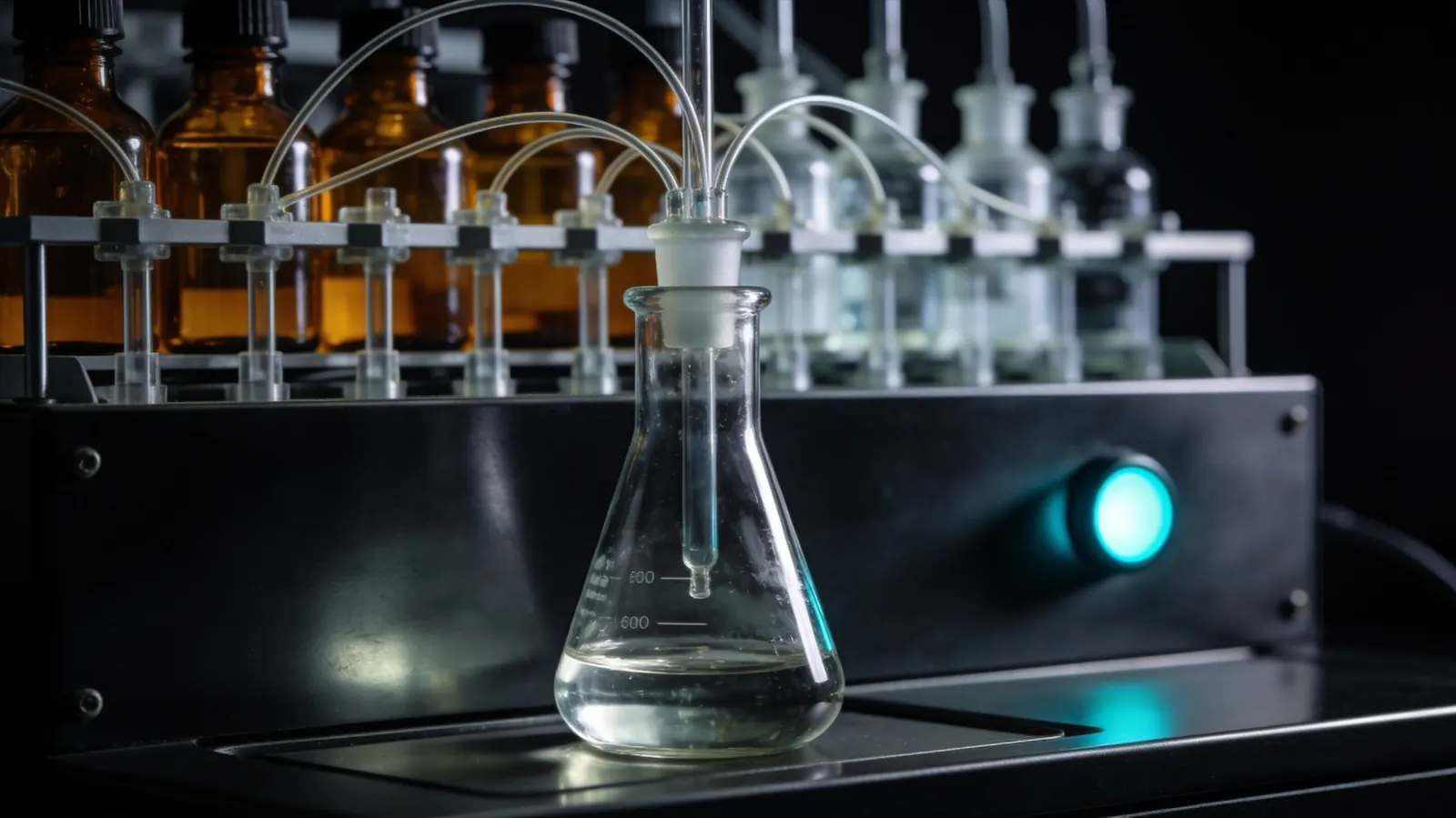
Telling them apart on a certificate of analysis
This is where a comparison stops being a reading exercise and becomes something you can check. Purity and identity are two different measurements, and only one of them can tell you which of these three molecules is in the vial.
A purity figure by RP-HPLC says what proportion of the material is the main peak. It says nothing at all about what that peak is. A 99.9% pure vial of the wrong peptide is 99.9% pure. Identity is the separate test: mass spectrometry against a certified reference standard, reporting an observed mass to compare against the expected one.
The expected masses here are far enough apart that no assay ambiguity survives them. Tesamorelin should come in at 5135.89, sermorelin at about 3358, ipamorelin at 711.85. A certificate that reports an HPLC percentage and no mass has told you how pure something is without telling you what it is, which is the single most common gap in the documents this industry circulates. How to read a peptide certificate of analysis goes through the rest of the lines in order, and what peptide purity actually measures is worth reading alongside it.
On paper, tesamorelin vs sermorelin is decided by one line and one number. An observed mass near 5135.89 is the 44-mer; an observed mass near 3358 is the 29-residue fragment. Nothing in the purity column distinguishes them, because a clean lot of either would be reported the same way.
Every lot released here is assayed by an independent laboratory, with identity confirmed by LC-MS and purity by RP-HPLC. Tesamorelin lots on file have measured between 99.253% and 99.93%, ipamorelin lots between 99.657% and 99.984%, and the figure for the lot in your hand is the one printed on its own certificate rather than the best of the set. The certificates also carry measured content against the label mass. The tesamorelin lot currently on file reports 10.57mg in a 10mg vial, and for tesamorelin there is an endotoxin result on both replicates as well.
All of those documents are published, including for lots no longer in stock, in the certificate library, and any lot can be looked up by the number printed on its vial.
- 0%
- RP-HPLC purity of the tesamorelin lot currently released
- Lot TESM-052026-4, independent laboratory, identity confirmed by LC-MS
- 0%
- RP-HPLC purity of the ipamorelin lot currently released
- Lot VNA7TB, independent laboratory, identity confirmed by LC-MS
- 0
- Expected observed mass of ipamorelin in g/mol, the figure that separates it from everything else on this page
- Serviam Bio Labs product specification, formula C38H49N9O5
What is stocked, how it is handled, and what ships with it
Sermorelin and CJC-1295 are described above for comparison only and are not part of this catalogue, which is the practical limit of tesamorelin vs sermorelin as a purchasing question. Tesamorelin and ipamorelin are stocked, and the handling that follows from their structures is not identical.
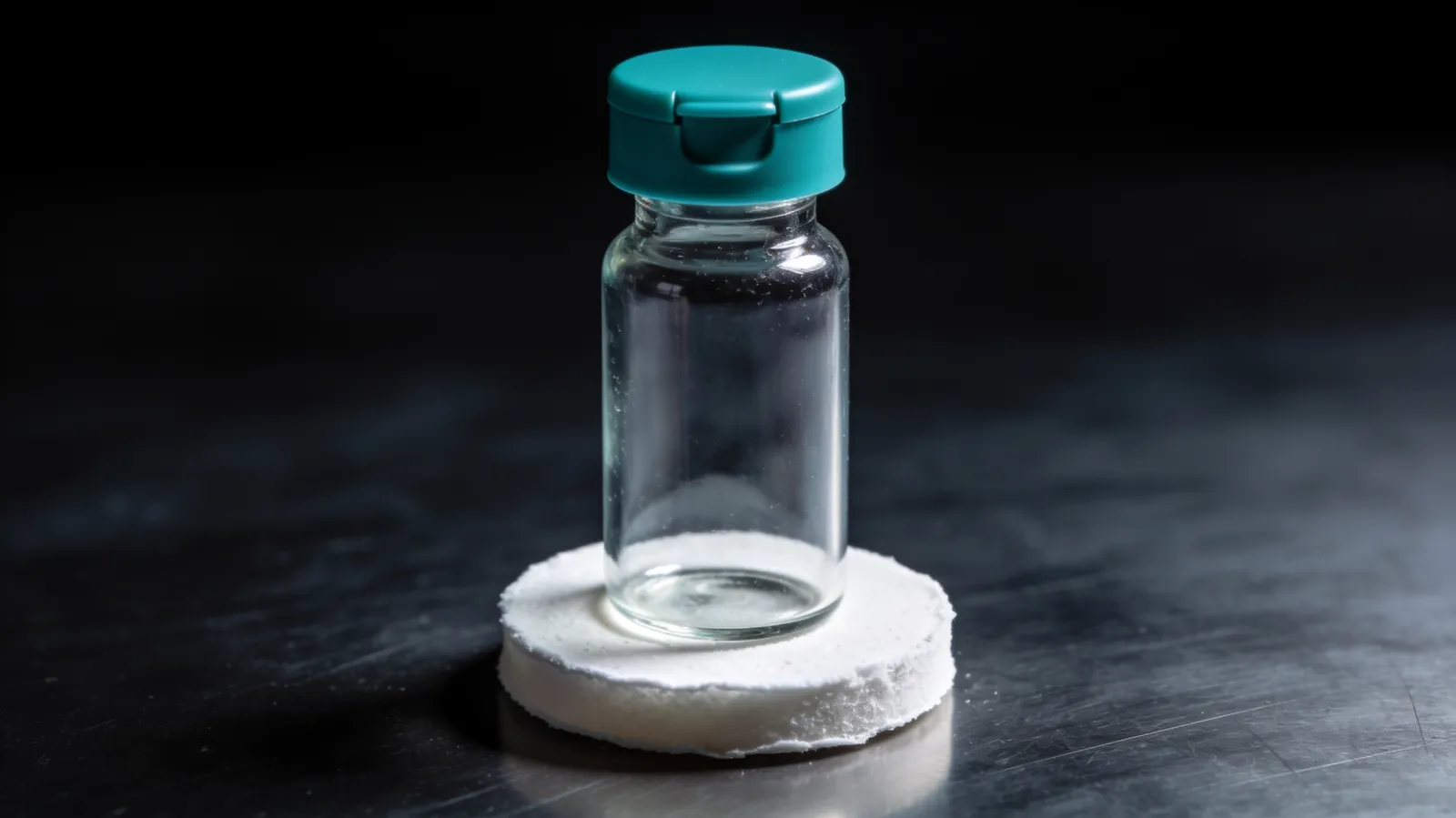
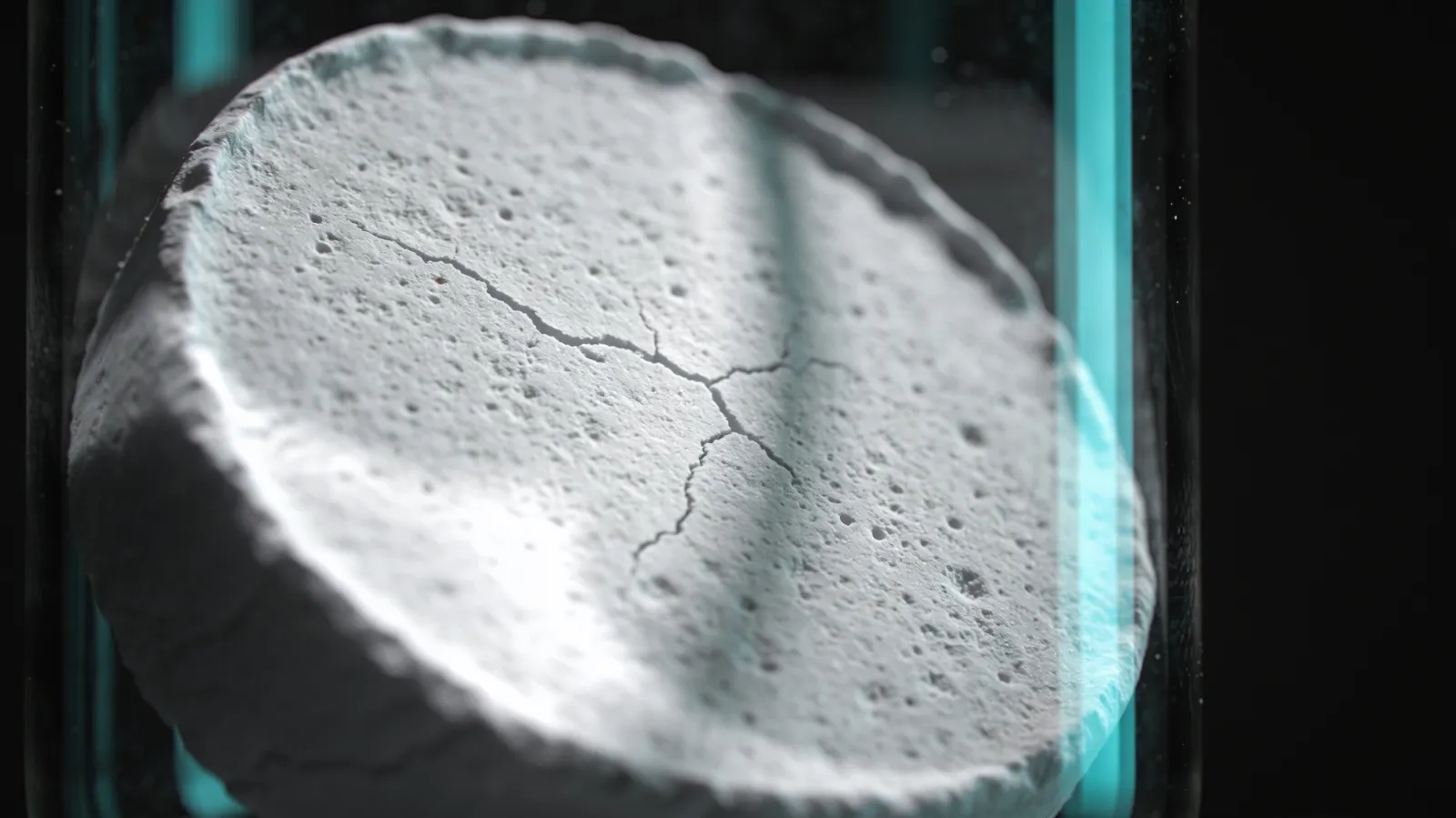
Both arrive as a white cake of lyophilized powder, soluble in bacteriostatic water, stored at −20°C long term and protected from light. Beyond that they diverge. Tesamorelin is the largest and most modified molecule in this catalogue: a 44-residue chain carrying an acyl group, with more structure to lose and more bonds to lose it at. Ipamorelin is a five-residue peptide with two D-amino acids, which is a far more stable object by construction. D-amino acids are exactly what a designer puts in a sequence to make it harder to take apart.
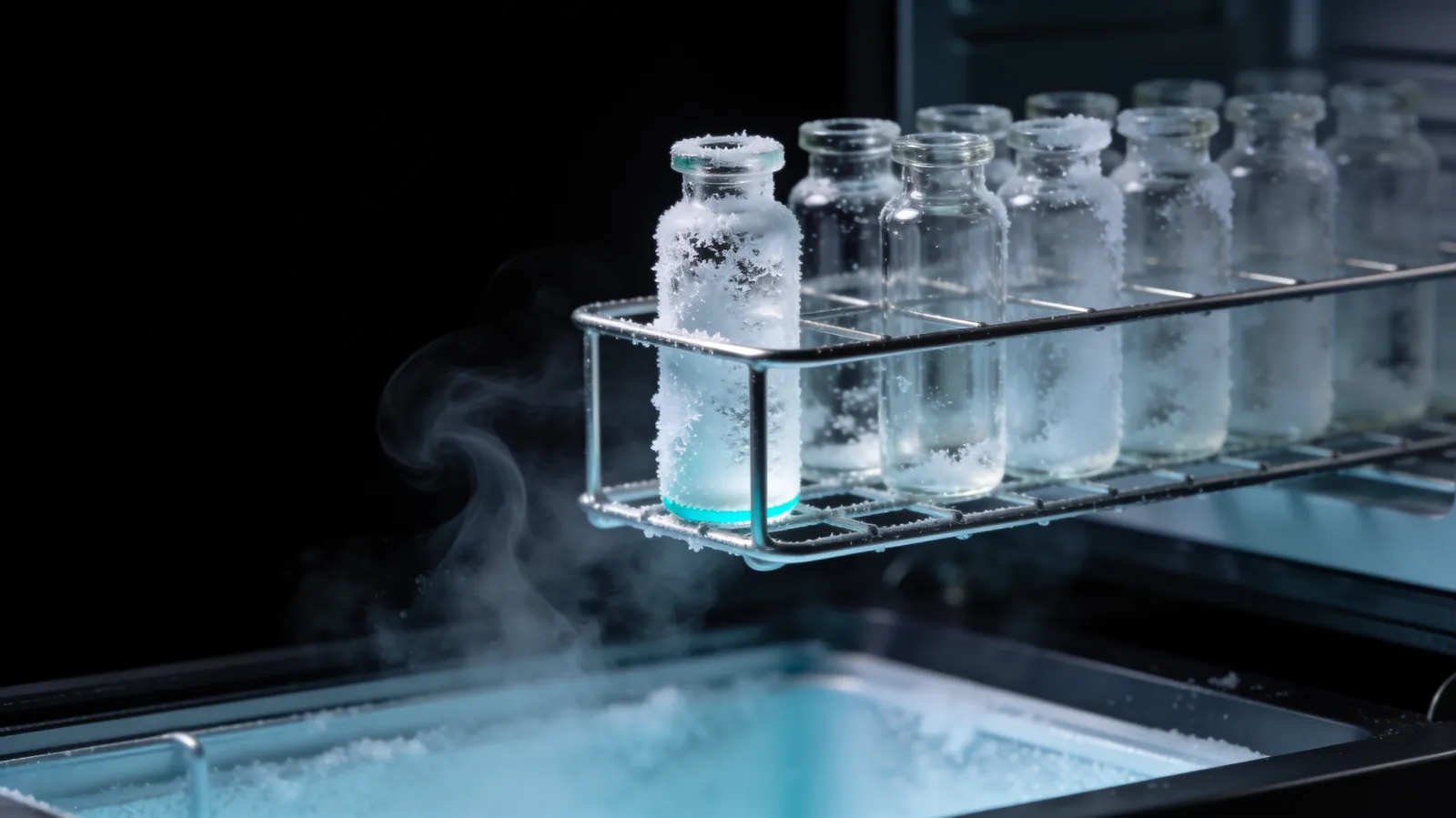
In practice that means how to store peptides is least worth improvising on for tesamorelin, and that repeated freeze-thaw cycling is a bigger risk to the large molecule than to the small one. Reconstitution arithmetic is its own subject and does not change between the two: mass over volume, in that vial, worked through in bacteriostatic water for peptides.
Sermorelin's absence from the table below is not a judgement about the molecule. It is not stocked, not assayed here, and nothing on this page should be read as a specification for it.
Everything in this catalogue is supplied for in-vitro research use. The receptor descriptions on this page are structural pharmacology drawn from preclinical literature, and the half-life figures are properties reported in regulatory and pharmacokinetic documents for other products. None of it is a statement about effect in humans, and none of it is guidance for use in humans.
| Compound | Vial sizes | Released purity | Storage | In use | Documentation |
|---|---|---|---|---|---|
| Tesamorelin | 10mg at $99.99, 20mg at $189.99 | 99.87% by RP-HPLC | −20°C, protect from light | 2 to 8°C once reconstituted | Five lots published, identity by LC-MS, endotoxin tested |
| Ipamorelin | 5mg at $49.99, 10mg at $79.99 | 99.90% by RP-HPLC | −20°C, protect from light | 2 to 8°C once reconstituted | Three lots published, identity by LC-MS |
| Sermorelin | Not stocked | Not assayed here | Not applicable | Not applicable | None |
| Diluent | Bacteriostatic water, 10ml | USP-grade, 0.9% benzyl alcohol | Room temperature, sealed | 28-day in-use period from first entry | USP General Chapter <797> default beyond-use date, with CDC guidance |
A GHRH analogue and a ghrelin-receptor agonist, lot-matched
The Growth Reference Panel pairs tesamorelin with ipamorelin in a single dispatch, each vial with its own certificate against its own lot number. One molecule from each receptor class, which is the distinction this whole page turns on.
See the Growth Reference PanelTesamorelin vs sermorelin is a comparison within one family: a stabilised 44-amino-acid GHRH analogue against the 29-amino-acid fragment of the same hormone, both acting at the GHRH receptor, separated by an N-terminal cap and a reported half-life of tens of minutes rather than ten. Ipamorelin belongs in a different column altogether: five residues, two of them D-amino acids, acting at the ghrelin receptor. Read the sequences, check the mass on the certificate, and the classification answers itself, which is more than can be said for the names.
Common questions
What is the difference between tesamorelin and sermorelin?
Tesamorelin vs sermorelin comes down to length and stability. Sermorelin is the first 29 amino acids of growth hormone-releasing hormone, amidated. Tesamorelin is the full 44-amino-acid chain with a trans-3-hexenoyl group on the N-terminus that caps the bond dipeptidyl peptidase-4 clips first. Both act at the GHRH receptor.
Is ipamorelin a GHRH analogue?
No. Ipamorelin is a five-residue synthetic peptide acting at the ghrelin receptor, GHS-R1a, which is a different receptor from the one tesamorelin and sermorelin bind. It is classed as a growth hormone secretagogue.
Is tesamorelin better than sermorelin?
Better is not a property a molecule has on its own, and this catalogue makes no comparison of potency or outcome in tesamorelin vs sermorelin. What can be said is structural: tesamorelin is the full 44-amino-acid sequence with an N-terminal cap and a reported half-life in the region of 26 to 38 minutes; sermorelin is the 29-amino-acid fragment, reported at 11 to 12 minutes. Which matters depends entirely on what is being studied.
What is the difference between tesamorelin and ipamorelin?
Almost everything. Tesamorelin is 44 amino acids at 5135.89 g/mol, derived from a human hormone, binding the GHRH receptor. Ipamorelin is five residues at 711.85 g/mol, designed rather than derived, containing aminoisobutyric acid and two D-amino acids, and binding GHS-R1a. They are about 7.2-fold apart in mass and belong to two different pharmacological classes. Both are stocked: tesamorelin in 10mg and 20mg and ipamorelin in 5mg and 10mg.
Which of the three is the largest molecule?
Tesamorelin, at 5135.89 g/mol across 44 amino acids plus its N-terminal modification. Sermorelin is roughly 3358 g/mol and ipamorelin 711.85 g/mol.
How long is the half-life of each of these peptides?
The prescribing information for the approved tesamorelin product reports roughly 26 to 38 minutes in plasma. Published pharmacokinetic reviews put sermorelin at about 11 to 12 minutes. Ipamorelin is most often cited at around two hours, from murine work. The three figures come from different species and different assays and are not a ranking of the compounds.
Does Serviam stock sermorelin?
No. Tesamorelin is stocked in 10mg and 20mg vials and ipamorelin in 5mg and 10mg vials. Sermorelin is described here for comparison because it is the reference point the other two are usually measured against.
What does the -relin ending on these peptide names actually mean?
It is a naming stem, not a classification. The international non-proprietary name system assigns -relin to peptides associated with pituitary hormone release, which is why tesamorelin, sermorelin and ipamorelin read as a series. The stem tells you what a compound is named after; the sequence and the receptor tell you what it is.
Does an approved product make research tesamorelin a medicine?
No. An approval attaches to a specific drug product and not to a molecule, and material supplied here is a research chemical released against a certificate of analysis for in-vitro work.
Is CJC-1295 the same as tesamorelin or sermorelin?
Neither, though it sits far closer to sermorelin. CJC-1295 is a 29-amino-acid GRF fragment with four amino-acid substitutions, and the DAC version carries an added linker that binds albumin; tesamorelin is the full 44-amino-acid chain with a hexenoyl cap instead. All three bind the GHRH receptor, which is why they get filed together, but they are three different sequences. CJC-1295 is not part of this research catalogue.
Is ipamorelin a peptide or a hormone?
A peptide, and a synthetic one. Its five residues include aminoisobutyric acid and two D-amino acids, which is not a sequence anything in the body assembles. It is filed as a growth hormone secretagogue because of the receptor it binds, GHS-R1a, and not because it is a hormone itself.
What is GHS-R1a and why does it matter in this comparison?
GHS-R1a is the growth hormone secretagogue receptor type 1a, usually called the ghrelin receptor. It is the receptor ipamorelin binds, and it is a different protein from the GHRH receptor that tesamorelin and sermorelin bind. The two are coupled to different second messengers on the same pituitary cell type, which is what splits these names into two classes rather than one series.
Does the receptor differ at all in tesamorelin vs sermorelin?
No. Both bind the GHRH receptor, and that is the point of calling them one family. The N-terminal cap on tesamorelin is aimed at an enzyme rather than at the receptor, so what separates the two is chain length and resistance to being clipped, not where they dock.
What does pulsatile mean in the literature on these compounds?
It describes the pattern of growth hormone release in model systems: bursts rather than a steady output. A receptor agonist acting upstream shapes those bursts rather than replacing them, which is the structural argument for studying secretagogues at all. It is a description of a signalling pattern, not of an effect in a person.
Why do studies use a GHRH analogue and a ghrelin-receptor agonist together?
Because they are two separate upstream inputs onto the same cell. The GHRH receptor signals through cyclic AMP and GHS-R1a through the calcium route, and both are read out on the same downstream measure, so running them separately and together resolves something about the pathway. That is an experimental design point about model systems. This page carries no protocol, schedule or quantity of any kind.
How do I know a vial actually contains tesamorelin and not something shorter?
Read the identity figure, not the purity figure. Mass spectrometry on the lot should put tesamorelin at 5135.89 daltons and ipamorelin at 711.85, and a certificate reporting HPLC purity with no mass has told you how pure something is without telling you what it is. How to read a peptide certificate of analysis goes through the figures line by line, and any lot we release can be looked up by the number on its vial.
Does tesamorelin need to be kept in the fridge?
The sealed lyophilised vial wants −20°C for long-term storage rather than a fridge, kept dark and dry, and it tolerates ambient transit for days, which is why it ships dry rather than frozen. Once reconstituted, solution goes to 2 to 8°C. Tesamorelin is the largest and most modified of these three molecules, so the storage rules are the least worth improvising on.
Can I use the same bacteriostatic water for tesamorelin and ipamorelin?
The same vial of diluent will serve both, but each compound is reconstituted in its own vial so its concentration stays its own arithmetic of mass over volume. One 10ml vial of bacteriostatic water covers several preparations within the 28-day in-use period that starts at first entry.
Can I order tesamorelin and ipamorelin together?
Yes. They are stocked separately and also as the Growth Reference Panel, which pairs a GHRH analogue with a ghrelin-receptor secretagogue in one order so both arrive with their own certificates against their own lot numbers. Sermorelin is not included, because it is not part of this catalogue.
Why is tesamorelin more expensive than ipamorelin?
Chain length. Tesamorelin takes forty-three couplings on the resin against ipamorelin's four, needs an acylation step at the end, and loses more material to purification, so a 10mg vial is $99.99 where a 10mg vial of ipamorelin is $79.99. Both are released against an independent certificate of analysis.
What is the most powerful peptide of the three?
Potency is not something this catalogue compares, and it is not a question a research-use supplier should be answering. What is comparable is structure: molecular weight, amino-acid count, receptor and reported half-life, all of which are in the tables above and on the certificate for the lot in front of you.
Is tesamorelin FDA approved?
Tesamorelin has a regulatory history as a prescription medicine in the United States, and none of that applies to what is supplied here. Material in this catalogue is a research chemical released against a certificate of analysis for in-vitro laboratory work. It is not a medicine, carries no approval of any kind, and is not supplied for human or animal use.
- PubChem CID 16137828, tesamorelin: the 44-residue GRF(1-44) sequence with its trans-3-hexenoyl N-terminal modification, the C221H366N72O67S formula and the 5135.89 g/mol mass
- PubChem CID 16132413, sermorelin: the GRF(1-29)NH2 identity of sermorelin and the approximate 3358 g/mol mass quoted throughout the tesamorelin vs sermorelin comparison
- PubChem CID 9831659, ipamorelin: the five-residue Aib-His-D-2-Nal-D-Phe-Lys-NH2 sequence, the C38H49N9O5 formula and the 711.85 g/mol mass that set ipamorelin apart from the other two
- Tesamorelin prescribing information, FDA label: the approved United States tesamorelin product and the plasma half-life of roughly 26 to 38 minutes reported in its prescribing information
Read more
- BPC-157 vs TB-500BPC-157 vs TB-500 is usually asked as though the two were variants of one thing. They are unrelated molecules with different lengths, masses and origins.
- GLOW vs KLOWGLOW vs KLOW is a question with a precise answer, because the difference between the two blends is a single named component. There is a larger question underneath it, because neither name is a formulation standard.
- What is TB-500?What is TB-500, and why is it constantly confused with the protein it comes from? The answer is a matter of seven amino acids against forty-three.
- What lyophilized powder isLyophilized powder, lyophilised in British spelling, is what almost every peptide arrives as. The process behind it explains most of how the vial should be treated.
- How to store peptidesHow to store peptides decides how much of what you paid for is still there when you come to use it. The rules are simple, the chemistry behind them is specific, and the mistakes are expensive.
- Peptide purity testing: the methods, the laboratories and what they costPeptide purity testing is not one test. It is a short panel of quite different measurements run on different instruments, and knowing which is which tells you how much a certificate is worth.
For laboratory research use only. All compounds listed on this site are sold strictly as reference materials for in-vitro laboratory research conducted by qualified professionals. They are not drugs, foods, cosmetics, or medical devices. They are not intended for human or veterinary consumption, therapeutic use, diagnostic application, or any in-vivo use whatsoever. These statements have not been evaluated by the Food and Drug Administration. By purchasing, you affirm that you are a qualified researcher and that you will comply with all applicable institutional, local, state and federal regulations governing the handling of research chemicals. Published by SERVIAM BIO LABS.