

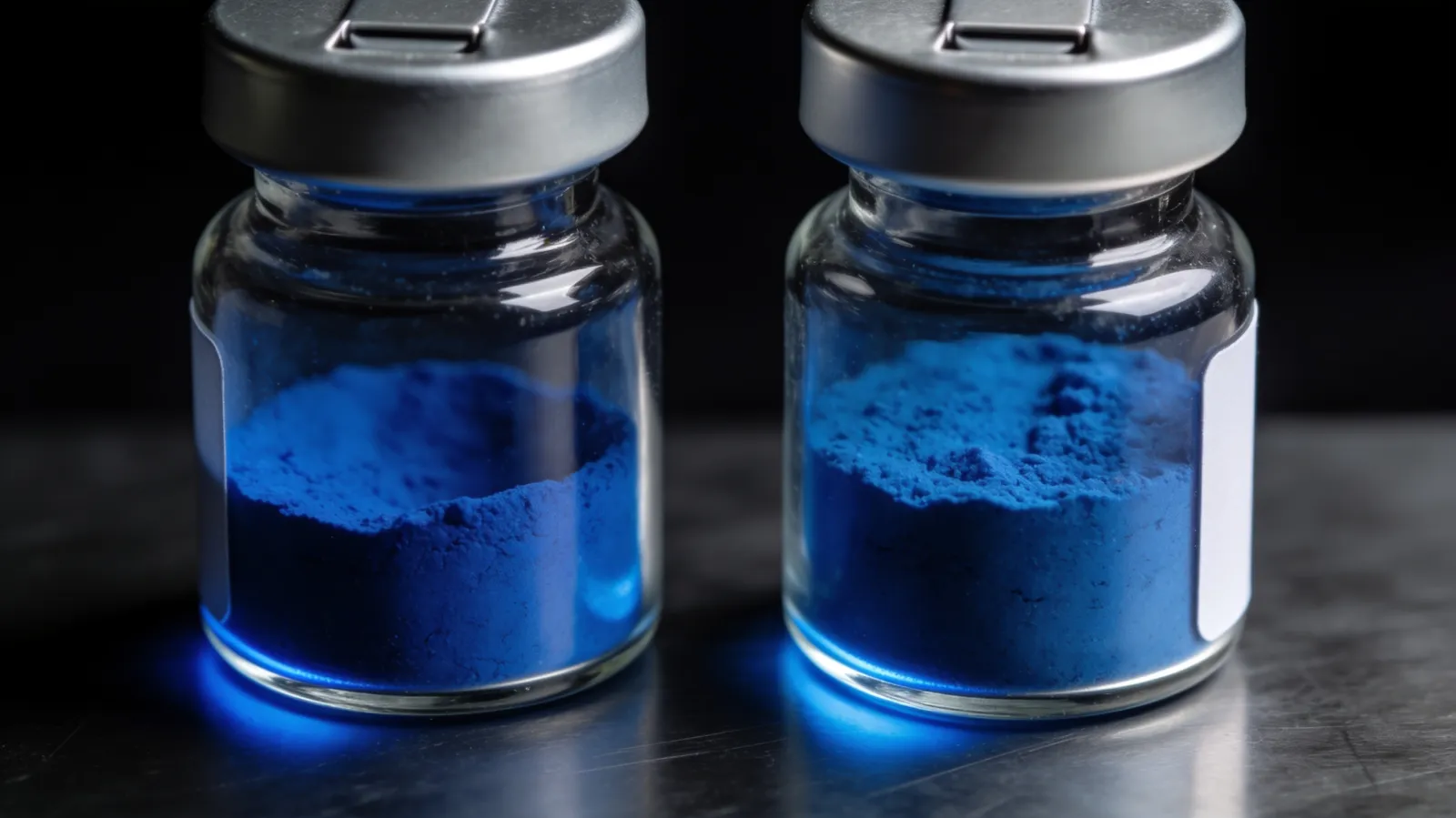
GLOW vs KLOW comes down to one component. GLOW is a three-component blend totalling 70mg: GHK-Cu 50mg, BPC-157 10mg and TB-500 10mg. KLOW is the same three plus KPV 10mg, totalling 80mg across four components. The difference between them is exactly 10mg of KPV. Both are supplied as blue lyophilised material, assayed per component.
- GLOW vs KLOW comes down to a shared base, GHK-Cu 50mg with BPC-157 10mg and TB-500 10mg, and the 10mg of KPV that the KLOW vial adds and the GLOW vial does not. The fill goes from 70mg to 80mg, a 14.3% rise in peptide mass.
- On a mass basis the GHK-Cu copper peptide is 71.4% of a GLOW vial and 62.5% of a KLOW vial. On a molar basis it is 87.1% and 72.3%, outnumbering BPC-157 about 17.6 to one. The printed 50:10:10 ratio understates how completely one component dominates.
- GLOW and KLOW are vendor names rather than formulations. Public listings for GLOW run from 50:10:10 to 30:20:20 to a 30mg vial, so the certificate for the lot in hand is the only thing that says what is in a given vial.
- A blend cannot honestly carry one purity figure: with three or four targets in the vial, purity has to be measured by RP-HPLC and identity confirmed by LC-MS for each component on its own, which is the ground peptide purity testing covers.
- The ratio inside a blend is fixed, 50:10:10 for GLOW and 50:10:10:10 for KLOW, so a design that needs one component at a different proportion needs single-compound vials instead.
GLOW vs KLOW, component by component
Both blends are built on the same base: 50mg of GHK-Cu with 10mg each of BPC-157 and TB-500. KLOW adds a fourth, KPV, at 10mg. That is the entire difference in composition, and it accounts for the 10mg difference in total mass.
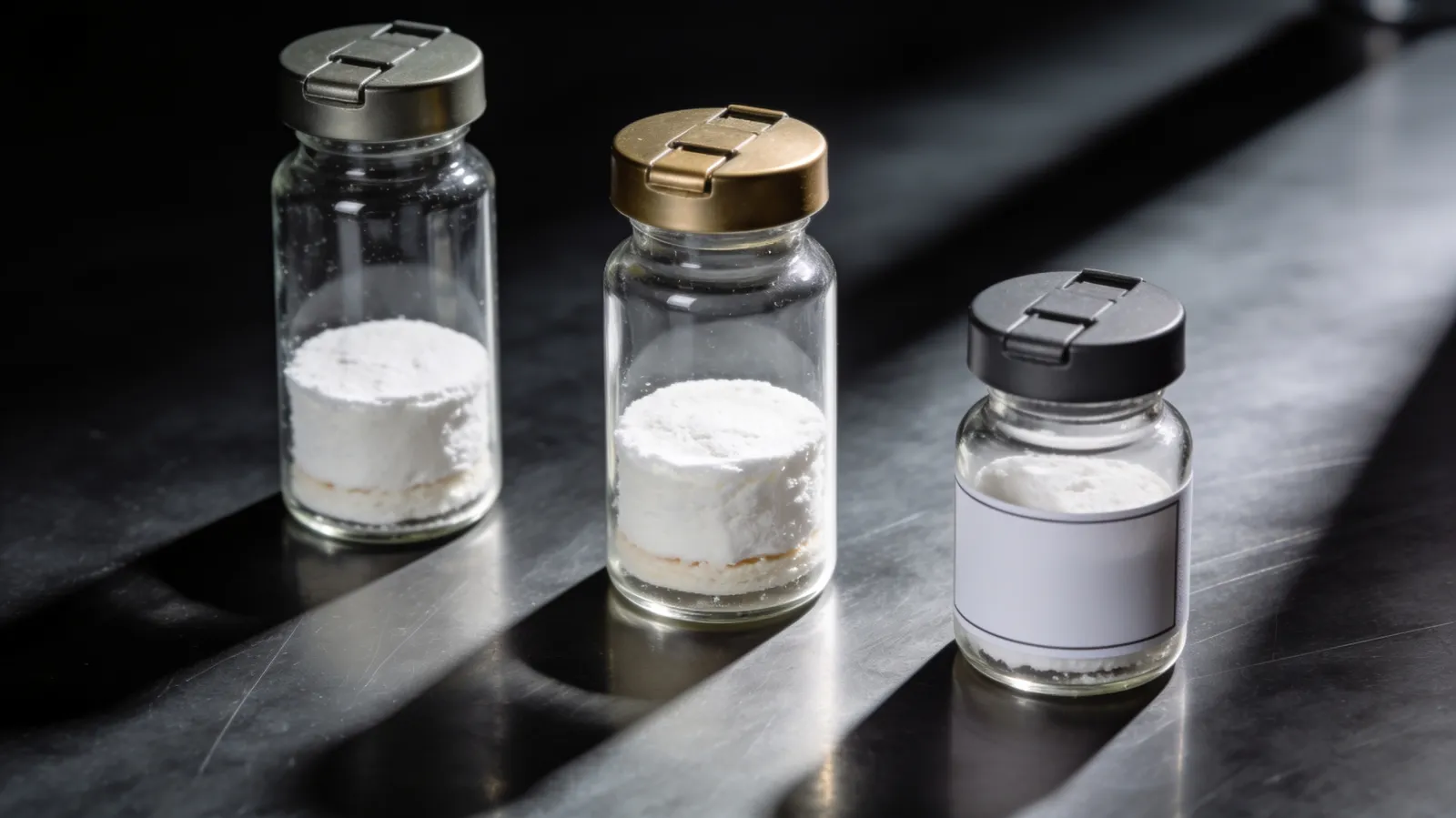
Both arrive as a blue cake of lyophilized powder. The colour comes from the copper in the GHK-Cu copper peptide, which is by a wide margin the largest component of either blend, and it is why neither of these looks like the white cake of a single-compound vial.
The arithmetic is worth stating rather than leaving implied. An 80mg vial against a 70mg vial is a 14.3% rise in peptide mass. GHK-Cu is 71.4% of a GLOW vial by mass and 62.5% of a KLOW vial, so the extra KPV does not change how much GHK-Cu is present, only what proportion of the vial it represents. Three of the four named components are common to both, which is where the often-repeated claim that the two blends share 75% of their composition comes from: that figure counts components, not mass. By mass the shared base is 87.5% of a KLOW vial and all of a GLOW one.
Set out that way, the comparison is of four named molecules in which three are held constant. Everything further down this page follows from that. The molar picture, the certificate, the price per milligram and the fixed ratio all behave the same way in both vials, because most of the list is the same list.
| Component | GLOW | KLOW | Identity | MW (g/mol) | Share of vial, GLOW / KLOW |
|---|---|---|---|---|---|
| GHK-Cu | 50mg | 50mg | Gly-His-Lys, copper(II) complex | 403.94 | 71.4% / 62.5% |
| BPC-157 | 10mg | 10mg | GEPPPGKPADDAGLV, 15 residues | 1419.53 | 14.3% / 12.5% |
| TB-500 | 10mg | 10mg | Ac-LKKTETQ, 7 residues | 889.0 | 14.3% / 12.5% |
| KPV | Not present | 10mg | Lys-Pro-Val, 3 residues | 342.4 | Not present / 12.5% |
| Total fill | 70mg | 80mg | Three or four distinct molecules | Per component | 100% / 100% |
GHK-Cu, 50mg in both
A copper-complexed tripeptide, glycyl-histidyl-lysine, CAS 89030-95-5, formula C14H24N6O4 with copper(II), molecular weight 403.94. The largest component of each blend by mass and by mole, and the source of the colour. Its literature is the oldest of the four, running from the plasma-fraction work of the early 1970s through the extracellular-matrix and gene-expression model systems associated with Pickart and Margolina.
BPC-157, 10mg in both
A 15-residue synthetic peptide, GEPPPGKPADDAGLV, CAS 137525-51-0, formula C62H98N16O22, molecular weight 1419.53. Often described as a gastric pentadecapeptide after the protein fragment it derives from. Studied in rodent connective-tissue and cytoprotection models.
TB-500, 10mg in both
A 7-residue acetylated fragment, Ac-LKKTETQ, CAS 885340-08-9, formula C38H68N10O14, molecular weight 889.0, corresponding to a region of thymosin beta-4, a 43-residue protein. Studied in actin-regulation and cell-migration model systems. The question of what is TB-500 separates the fragment from the parent protein in full.
KPV, the 10mg that separates GLOW vs KLOW
A tripeptide, lysine-proline-valine, formula C16H30N4O4, molecular weight 342.4 computed from its residues. It corresponds to the C-terminal three residues of alpha-melanocyte-stimulating hormone, alpha-MSH. The one component that distinguishes the two blends, and the smallest molecule in either vial.
GLOW vs KLOW: the molar picture the mass ratio hides
Every listing in this category quotes a mass ratio, 50:10:10 for GLOW and 50:10:10:10 for KLOW, and every listing stops there. Mass is the wrong unit for a mixture of molecules with very different weights, because what a bench assay meets is a number of molecules, not a number of milligrams. Converting is one division: micromoles equal milligrams divided by molecular weight in grams per mole, times a thousand.
Done for GLOW, the result is not close to 50:10:10. GHK-Cu, at 403.94 g/mol, contributes 123.8 micromoles. BPC-157, at 1419.53, contributes 7.04. TB-500, at 889.0, contributes 11.25. GHK-Cu is therefore 87.1% of the molecules in a GLOW vial and outnumbers BPC-157 by about 17.6 to one. The label ratio of five to one understates the real dominance by a factor of three and a half.
KPV changes the picture more than its mass suggests. At 342.4 g/mol it is the lightest of the four, so 10mg of it is 29.2 micromoles, more than four times the molar contribution of the 10mg of BPC-157 sitting beside it. On a mass basis KPV and BPC-157 are equal at 12.5% of a KLOW vial each. On a molar basis KPV is 17.0% and BPC-157 is 4.1%. In molar terms, then, GLOW vs KLOW is a larger change than the 10mg printed on the label suggests.
None of this is a claim about anything. It is division applied to published molecular weights, and it is the figure a protocol working in molar concentrations needs before it can use either vial. It is also the reason a blend's fixed ratio is a harder constraint than it looks: the mass ratio a vendor chose to print is not the ratio the material is actually in.
- 0 µmol
- of GHK-Cu in either vial, the largest molar contribution by a wide margin
- 50mg ÷ 403.94 g/mol
- 0:1
- molar ratio of GHK-Cu to BPC-157, the same in both blends, against a 5:1 mass ratio
- computed from the molecular weights on the product pages
- 0%
- of the molecules in a GLOW vial are GHK-Cu
- 123.8 of 142.1 µmol
| Component | Mass in vial | MW (g/mol) | µmol per vial | Molar share, GLOW | Molar share, KLOW |
|---|---|---|---|---|---|
| GHK-Cu | 50mg | 403.94 | 123.8 | 87.1% | 72.3% |
| BPC-157 | 10mg | 1419.53 | 7.04 | 5.0% | 4.1% |
| TB-500 | 10mg | 889.0 | 11.25 | 7.9% | 6.6% |
| KPV (KLOW only) | 10mg | 342.4 | 29.2 | Not present | 17.0% |
| Total | 70mg / 80mg | Per component | 142.1 / 171.3 | 100% | 100% |
GLOW vs KLOW: two vendor names, not two formulations
There is no standards body for research blends. GLOW and KLOW are trade names that vendors apply to whatever they have decided to put in a vial, and the listings currently ranking for this query do not agree with one another about what either name means.
The table below is composition as published, taken from live listings surveyed in September 2026. Four of the six carry a 50:10:10 base of GHK-Cu, BPC-157 and TB-500, one of those four with KPV added as a fourth component. One states 30:20:20, also totalling 70mg: the same mass, a completely different formulation. One sells a 30mg product under the same name and itemises nothing at all. Every one of them is sold as GLOW.
The vendors are described by type rather than named, and deliberately so. A composition read on one date is a statement about a page that can be edited the following morning, so a survey pinned to a company name goes stale without anyone being told. What is durable is the pattern rather than the roster: one four-letter name sitting above three different answers to the question of what is in the vial, and a fourth listing that declines to answer it. Naming the vendors would add nothing to that pattern and would date this page the first time one of them edited a product description.
The conclusion is uncomfortable but simple. The name on a blend vial carries no information about composition, and the mass on the label carries very little: 70mg of peptide can be three quite different things. The only document that says what is in a given vial is a certificate that reports each component separately and matches the lot number printed on the glass.
There is a practical test that costs nothing. Before comparing two blends on price, check whether each listing itemises its components in milligrams. A listing that names a total and not a breakdown has not told anyone what is being bought, and a listing that names a breakdown can at least be checked against the certificate for the lot in hand.
It is also why GLOW vs KLOW is only a meaningful comparison between two vials whose composition is published in milligrams. Our own profiles of the GLOW peptide and the KLOW peptide state that breakdown for each, and the certificate for the lot does the rest.
| Listing | GHK-Cu | BPC-157 | TB-500 | KPV | Stated total |
|---|---|---|---|---|---|
| Serviam Bio Labs, GLOW | 50mg | 10mg | 10mg | Not present | 70mg |
| Serviam Bio Labs, KLOW | 50mg | 10mg | 10mg | 10mg | 80mg |
| A vendor listing GLOW as three components totalling 70mg | 50mg | 10mg | 10mg | Not present | 70mg |
| A second vendor listing GLOW at the same three components | 50mg | 10mg | 10mg | Not present | 70mg |
| A vendor listing GLOW at a different ratio, same stated total | 30mg | 20mg | 20mg | Not present | 70mg |
| A vendor listing a 30mg GLOW Blend with components not itemised | not itemised | not itemised | not itemised | Not present | 30mg |
Why a blend cannot have one purity figure
A purity percentage answers the question 'of the material present, how much was the target'. In a blend there are three or four targets, so the question has to be asked separately for each one. A single number across a mixture is not a measurement of anything in particular.
This is where blends in this category most often go wrong. A listing that states one purity figure for a four-component product has either assayed one component and applied its number to the whole vial, or has quoted a figure with no defined meaning. Neither tells anyone whether the KPV in a KLOW vial is what it claims to be.
Our certificates for both blends report each component separately, identity and purity one line at a time, and the overall figures shown on the product pages, 99.68% for GLOW and 99.76% for KLOW, are summaries of those per-component results rather than substitutes for them. The full report is published against the lot number on the vial.
The methods are worth naming, because almost nothing written on this subject does. Purity is measured by reversed-phase HPLC, which separates the contents of the vial in time and integrates the area under each peak. Identity is confirmed by LC-MS, which measures the mass of what came off the column and compares it with the calculated mass of the intended molecule. The first method says how much; the second says what. A blend needs both, once per component, which is what peptide purity testing sets out at length.
That is also why a mass-spectrometry result is not transferable between blends. An LC-MS run confirms the molecules it was set up to look for. A GLOW certificate confirming GHK-Cu, BPC-157 and TB-500 says nothing whatever about KPV, because KPV was not among the masses sought. A KLOW vial therefore needs four confirmations, not three plus an assumption.
On documentation, then, GLOW vs KLOW is a difference of one line rather than of one molecule: three identity results and three purity results on one side, four of each on the other.
| Certificate line | GLOW | KLOW | Why one figure cannot substitute |
|---|---|---|---|
| Identity, by LC-MS | 3 confirmations | 4 confirmations | A run confirms only the masses it was set up to seek |
| Purity, by RP-HPLC | 3 results | 4 results | A single percentage does not say which peak it belongs to |
| Measured content, mg | 3 figures | 4 figures | Only a per-component mass shows KPV is present at all |
| Appearance | One entry | One entry | Colour is set by GHK-Cu in both, so it distinguishes nothing |
| Lot number | One | One | A certificate is evidence only about the vial it matches |
| Date of analysis | One | One | An undated result is not a measurement |
What our own certificates report, line by line
Naming a standard is easy; publishing the results is the part that can be checked. Every lot released under both names is filed in the certificate library, including lots long out of stock, and the table below is what those documents actually say. All of them were reported by Freedom Diagnostics, a third-party laboratory, with identity confirmed by LC-MS.
Three things in that table are worth pointing at, and none of them would be visible under a single blended figure. First, measured content is not label content. A GLOW lot labelled 50mg of GHK-Cu measured 59.92mg; a KLOW lot labelled 10mg of KPV measured 8.80mg. Released lots run at or slightly above label on the large component and close to it on the small ones, and only a per-component assay can show that at all.
Second, the certificates are not consistent about what they call the thymosin component. Some lots report it as TB-500 and some as Thymosin Beta-4, which is the parent 43-residue protein rather than the seven-residue acetylated fragment. That inconsistency belongs to the analysing laboratory's naming rather than to the material, and it is published as written rather than tidied up, because a certificate edited for presentation is no longer a certificate.
Third, the overall figures move from lot to lot: 99.544% to 99.905% across four published GLOW lots, and 99.613% to 99.76% across three KLOW lots. A vendor quoting one fixed purity number for a blend, forever, is quoting a marketing figure rather than a measurement. The lot number on the glass is what resolves to a specific document, and it can be read before anything is ordered rather than after.
Read across both names, the published lots carry the same structure: one line per component, the analysing laboratory named, a method named and a date. The number of lines is the only thing that changes between the two.
- 0
- blend lots with certificates published against their lot numbers
- four GLOW, three KLOW, including lots no longer in stock
- 0%
- lowest overall HPLC figure across four published GLOW lots
- lot GLOW12262025-J, reported 29 December 2025
- 0%
- highest overall HPLC figure across the same four lots
- lot 400001, reported 20 February 2026
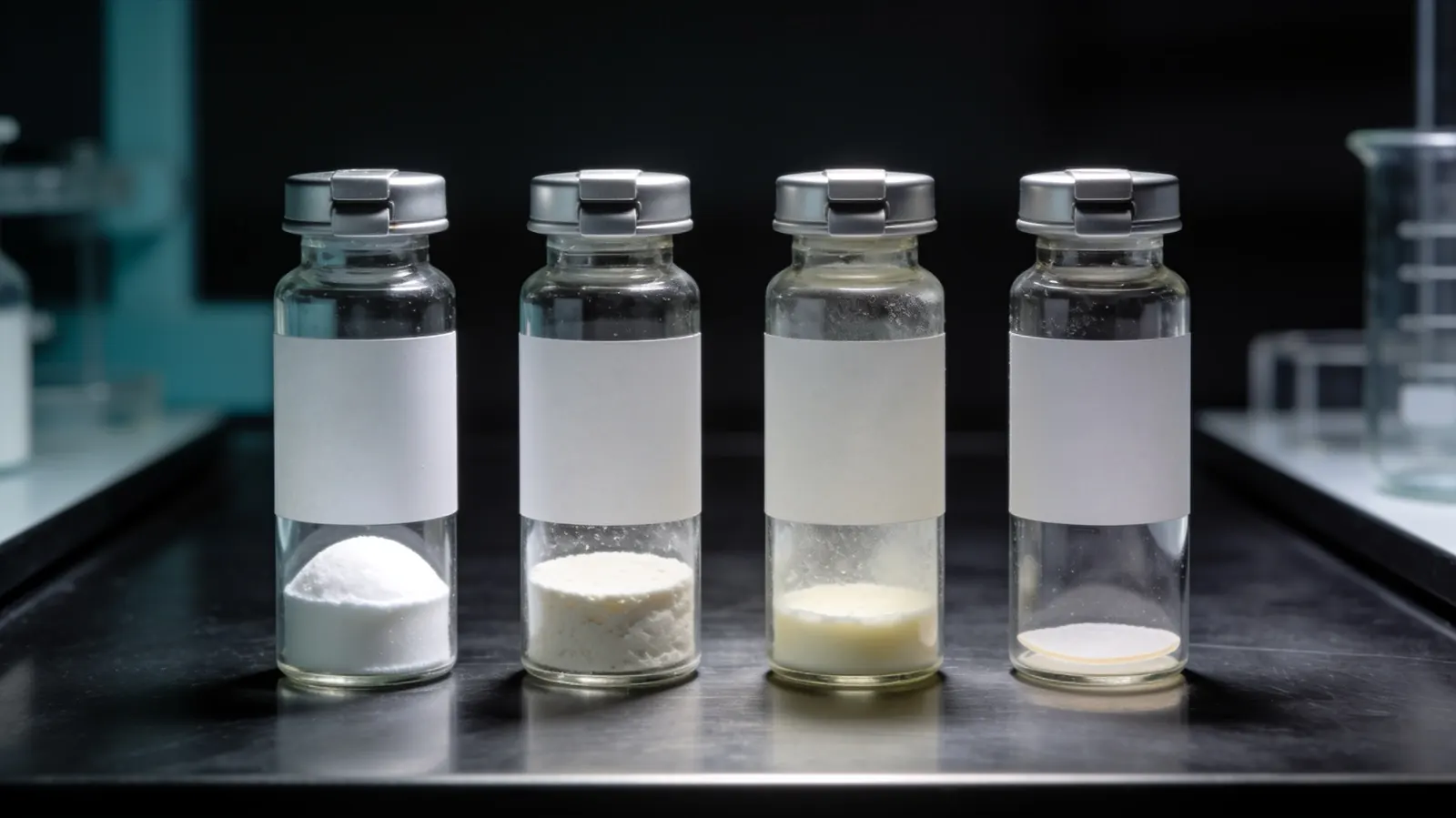
| Lot | Released | Overall HPLC | Measured content, per component | Identity |
|---|---|---|---|---|
| GLOW-062026-4 | 12 Jun 2026 | 99.68% | GHK-Cu 59.92mg · Thymosin β4 11.71mg · BPC-157 10.86mg | Confirmed, LC-MS |
| WCP32F (GLOW) | 30 May 2026 | 99.80% | GHK-Cu 59.54mg · TB-500 10.80mg · BPC-157 10.20mg | Confirmed, LC-MS |
| XX1EZC (KLOW) | 30 May 2026 | 99.76% | GHK-Cu 58.65mg · KPV 8.80mg · TB-500 10.16mg · BPC-157 9.42mg | Confirmed, LC-MS |
| KLOW-032026-4 | 21 May 2026 | 99.755% | GHK-Cu 53.33mg · KPV 7.99mg · TB-500 9.61mg · BPC-157 10.57mg | Confirmed, LC-MS |
| KLOW-032026-1 | 1 May 2026 | 99.613% | GHK-Cu 50.25mg · KPV 8.74mg · BPC-157 10.46mg · Thymosin Beta-4 8.49mg | Confirmed, LC-MS |
Read the certificate before the vial ships
Every GLOW and KLOW lot is published against its lot number, with the per-component content lines intact and the analysing laboratory named.
Look up a lot numberWhy blends exist at all
A blend is a convenience and a constraint at the same time. The convenience is obvious: one vial, one reconstitution, one set of handling decisions instead of three or four. For a model system that calls for all of the components together, that is a real saving in time and in glassware.
The constraint is that the ratio is fixed. GLOW is 50:10:10 and KLOW is 50:10:10:10, and nothing about either can be varied without buying the components separately. Where a design needs one component at a different proportion, single vials are the only option.
There is a documentation consequence too. A blend can only be as well characterised as its weakest component, and the report has to cover each of them. That is why the per-component certificate matters more here than it does on a single-compound vial.
The constraint compounds once a vial is in solution. A single-compound vial can be diluted to whatever concentration a design calls for, and every other variable stays where it was. Diluting a blend moves all three or four concentrations at once, in the fixed proportion the vendor chose. There is no way to halve the GHK-Cu in a GLOW vial without halving the BPC-157 and the TB-500 with it.
On that constraint GLOW vs KLOW behaves identically. Both fix their ratio, both move every concentration together on dilution, and both leave a design that needs one component on its own with no option but a single vial.
GLOW vs KLOW: what a millilitre of each contains
Concentration is arithmetic, and it is the one figure a blend makes slightly awkward, because a vial holds several concentrations at once rather than one. The sums below divide the label mass of each component by the volume of solvent added. They are not a protocol and they carry no recommendation: this catalogue is supplied for in-vitro laboratory work, and nothing here describes administration of any kind.
Taking 2mL as a round number, a GLOW vial gives 25 mg/mL of GHK-Cu and 5 mg/mL each of BPC-157 and TB-500, for 35 mg/mL of peptide in total. A KLOW vial gives the same three plus 5 mg/mL of KPV, for 40 mg/mL. Because the components differ so much in molecular weight, the molar concentrations are much further apart than the mass concentrations: 61.9 mM of GHK-Cu against 3.52 mM of BPC-157 in the same millilitre.
Both blends dissolve in the same solvent, and the case for bacteriostatic water for peptides is the same here as it is for a single-compound vial. The water itself is the same product; the difference is only that the answer applies to four molecules at once.
In solution, then, GLOW vs KLOW differs by one line of the table below and by nothing else in it.
| Component | GLOW, mg/mL | KLOW, mg/mL | GLOW, mM | KLOW, mM |
|---|---|---|---|---|
| GHK-Cu | 25 | 25 | 61.9 | 61.9 |
| BPC-157 | 5 | 5 | 3.52 | 3.52 |
| TB-500 | 5 | 5 | 5.62 | 5.62 |
| KPV | Not present | 5 | Not present | 14.6 |
| Total peptide | 35 | 40 | 71.0 | 85.6 |
Copper chemistry and the stability of a blend
GHK-Cu is not a peptide with copper added. It is a coordination complex in which a copper(II) ion is held by the glycyl-histidyl-lysine backbone, and that copper is the reason the cake is blue and the reason the complex behaves differently from the three ordinary peptides beside it. Copper complexes are more sensitive to oxidation and to shifts in pH than plain peptide chains, and they can exchange their metal ion with other ligands present in solution.
For a blend this matters more than it would for a single vial, because stability is set by the least stable component and here that component is 62.5% to 71.4% of the mass. Whatever handling a blend receives is effectively handling designed around GHK-Cu, and the other three inherit it.
Solvent chemistry is part of that. The FDA label for the reference bacteriostatic water product gives a pH of 5.7, mildly acidic, which is the environment a reconstituted blend sits in. That is a property of the solvent rather than a warning about it, and it is one of the few numbers in this subject that can be looked up rather than inferred. A separate note on what is bacteriostatic water sets out the rest of that label.
Nothing in the handling table below distinguishes the two, which is the point. On handling, GLOW vs KLOW is not a choice at all: the base is identical, so how to store peptides is one decision rather than two, and only the number of components that have to be re-verified changes.
| Parameter | GLOW | KLOW |
|---|---|---|
| Appearance | Blue lyophilised cake | Blue lyophilised cake |
| Lyophilised storage | −20°C, long term | −20°C, long term |
| In use, in solution | 2 to 8°C | 2 to 8°C |
| Solvent | Bacteriostatic water | Bacteriostatic water |
| Most oxidation- and pH-sensitive component | GHK-Cu, 71.4% of mass | GHK-Cu, 62.5% of mass |
| Components requiring separate re-verification | 3 | 4 |
GLOW vs KLOW vs the other ways to buy the same molecules
Three other things are routinely compared against these two: the two-peptide BPC-157 and TB-500 pairing, stocked here as the Repair Reference Panel; GHK-Cu on its own; and the individual vials taken together. The comparison is entirely compositional, and it fits in one table.
Read down the first two columns and the difference is KPV. Read across and a second question appears, which is whether a blend is the right container at all. The BPC-157 and TB-500 pairing carries 20mg of peptide against GLOW's 70mg, but 20mg of the two components most listings describe as the expensive ones, and how those two differ from each other, BPC-157 vs TB-500, is its own question. GHK-Cu alone carries the same 50mg found in either blend, in a vial that costs a third of what the blend does.
That is not an argument against the blends. It is the reason the per-milligram question in the next section is the one worth asking, because total mass in a vial is dominated by whichever component is cheapest per milligram, and in both of these, it is.
Widened that far, GLOW vs KLOW stops being the only comparison on the table and becomes two columns of four.
| Attribute | GLOW | KLOW | Repair Reference Panel | GHK-Cu alone |
|---|---|---|---|---|
| Components | 3 | 4 | 2, in separate vials | 1 |
| Total peptide | 70mg, one vial | 80mg, one vial | 20mg across two vials | 50mg or 100mg |
| GHK-Cu | 50mg | 50mg | Not present | 50mg or 100mg |
| BPC-157 | 10mg | 10mg | 10mg | Not present |
| TB-500 | 10mg | 10mg | 10mg | Not present |
| KPV | Not present | 10mg | Not present | Not present |
| Ratio | Fixed, 50:10:10 | Fixed, 50:10:10:10 | Free | Not applicable |
| Certificate lines to read | 3 | 4 | 2, one per vial | 1 |
| Appearance | Blue cake | Blue cake | Two white cakes | Blue cake |
| Price and page | $119.99, GLOW | $139.99, KLOW | $129.99, Repair Reference Panel | $39.99 / $59.99, GHK-Cu |
GLOW vs KLOW: the cost per milligram of the component that matters
Comparing blends on price per milligram of total peptide produces a figure that looks precise and means almost nothing. GLOW works out at $1.71 per mg and KLOW at $1.75 per mg, which makes them look near-identical and both look cheap. They look cheap because two-thirds to three-quarters of the mass being divided into is GHK-Cu, the least expensive peptide in this catalogue per milligram.
The useful comparison is against the component the work actually concerns. A 100mg GHK-Cu vial is $0.60 per milligram and the 50mg vial is $0.80. BPC-157 is $6.00 per milligram and TB-500 is $8.50. Those three numbers explain the blend prices completely: the 10mg of BPC-157 and 10mg of TB-500 inside a GLOW vial would cost $144.98 as single vials, or $129.99 bought as the two-vial panel, against $39.99 for the 50mg of GHK-Cu beside them.
Set against that, GLOW at $119.99 is less than the $169.98 the same three quantities cost as a panel plus a GHK-Cu vial, and considerably less than the $184.97 they cost as three separate single vials. The saving is real; it is bought with the fixed ratio and with three certificate lines to read instead of one per vial.
Between the two blends the premium is $20, and it buys 10mg of KPV. There is no single-component KPV vial in this catalogue to price it against, so unlike every other component in either blend, the KPV premium cannot be checked against a standalone figure. Stating that plainly is more useful than an invented comparison.
On price, then, GLOW vs KLOW is a $20 question with one variable in it, and that variable is the only component of the four that cannot be priced on its own.
| Component of interest | In GLOW | In KLOW | Cheapest single-component source | Price per mg |
|---|---|---|---|---|
| GHK-Cu | 50mg | 50mg | GHK-Cu 100mg, $59.99 | $0.60 |
| BPC-157 | 10mg | 10mg | BPC-157 10mg, $59.99 | $6.00 |
| TB-500 | 10mg | 10mg | TB-500 10mg, $84.99 | $8.50 |
| KPV | Not present | 10mg | No single-component vial in this catalogue | Not comparable |
| Whole vial | 70mg, $119.99 | 80mg, $139.99 | Not applicable | $1.71 / $1.75 |
KLOW, 80mg across four components
GHK-Cu 50mg with BPC-157, TB-500 and KPV at 10mg each, each one documented on its own line of the certificate for the lot in the box.
See the KLOW vialWhat neither blend has
Neither blend is a new molecular entity. Neither has an International Nonproprietary Name, a pharmacopoeial monograph or a CAS number of its own, which is why the CAS field on both product pages reads 'Blend, see COA' rather than a number. Both are mixtures of separately known molecules, and that is the whole of their regulatory identity.
Neither has been studied as a formulation. There are no controlled studies of GLOW as GLOW or KLOW as KLOW; the count is zero, and every page on this subject that appears to cite evidence for a blend is in fact citing evidence for one of its components. Four of the eight best-ranked pages for this query say so themselves, which is to their credit.
What does exist is a separate preclinical literature for each of the four, in defined model systems, at concentrations and in preparations that have nothing to do with a blended vial. The table below names what those literatures study and one primary source for each, so a reader can go to the paper rather than to a vendor's summary of it.
The gap between that table and a vial of blend is the important thing on this page. Evidence gathered in a cell-culture model, for one molecule, at one concentration, does not transfer across a change of concentration, a change of preparation, or the addition of three other molecules. Everything in this catalogue is supplied for in-vitro laboratory research only, and nothing on this page describes use in humans or animals.
GLOW vs KLOW is therefore a comparison of composition and of documentation. It cannot be a comparison of evidence, because there is no evidence about either mixture as a mixture.
- 0
- controlled studies of either blend as a formulation
- per-component literature only; four of the eight ranking pages state the same
- 0
- residues in thymosin beta-4, against 7 in the TB-500 fragment
- Sanders, Goldstein & Wang, PNAS, 1992
- 0
- separate molecules in a KLOW vial, each with its own literature and its own certificate line
- three in a GLOW vial
| Component | Model systems in the literature | Representative primary source |
|---|---|---|
| GHK-Cu | Dermal fibroblast culture, extracellular matrix remodelling, gene-expression microarray | Pickart & Thaler, Nature New Biology, 1973; Pickart & Margolina, Int J Mol Sci, 2018 |
| BPC-157 | Rodent tendon and connective-tissue repair models | Chang CH et al., J Appl Physiol, 2011 |
| TB-500 / thymosin β4 | Actin polymerisation and cell-migration assays in cultured cells | Sanders, Goldstein & Wang, PNAS 89(10):4678 to 4682, 1992 |
| KPV | NF-κB signalling, epithelial-barrier and PepT1-uptake models in intestinal cell lines | Dalmasso AP et al., Peptides, 2014 |
| GLOW or KLOW as a blend | None | No published study covers either combination |
GLOW vs KLOW: how the two compare in practice
Because the base is identical, anything true of GLOW's handling is true of KLOW's. Both are stored at −20°C for the long term and 2 to 8°C in solution. Both dissolve in bacteriostatic water. Both are blue.
The choice between them is therefore a choice about whether a model system calls for KPV alongside the other three. Where it does not, GLOW is the same three components at a lower total mass and a lower price; where it does, KLOW supplies it in the same vial rather than requiring a separate one.
A related question people ask is what combining the two vials would give. Compositionally the answer is a 150mg mixture: 100mg of GHK-Cu, 20mg each of BPC-157 and TB-500, and 10mg of KPV. That is not either blend at a larger scale. It is a different ratio, with GHK-Cu rising to 66.7% of mass and KPV falling to 6.7%. Whatever proportion a blend was designed around, combining the two does not preserve it.
Put at its shortest, GLOW vs KLOW is settled by one question about KPV and by two certificates, and by nothing else in either vial.
As with everything in this catalogue, both are supplied for in-vitro research use only, and nothing here describes use in humans or animals.
GLOW vs KLOW comes down to one component and 10mg. GLOW is GHK-Cu 50mg with BPC-157 and TB-500 at 10mg each, 70mg in total; KLOW is that same set plus KPV 10mg, 80mg in total, which is 14.3% more peptide and, on a molar basis, a vial in which the smallest molecule present contributes four times the micromoles of BPC-157. The more important difference between any two blends on sale is not composition but documentation. GLOW and KLOW are names rather than standards, and public listings disagree about what either one contains, so the only thing that establishes what a particular vial holds is a certificate reporting each component on its own line against the lot number on the glass.
Common questions
What is the difference between GLOW and KLOW peptide blends?
KPV. GLOW vs KLOW comes down to that one component: GLOW is GHK-Cu 50mg, BPC-157 10mg and TB-500 10mg, totalling 70mg, and KLOW is those three plus KPV 10mg, totalling 80mg. Everything else about the two is the same.
Are GLOW and KLOW the same peptide?
Neither is a single peptide. Both are blends, GLOW of three components and KLOW of four, sharing the same GHK-Cu, BPC-157 and TB-500 base.
Why are GLOW and KLOW blue?
GHK-Cu is a copper-complexed tripeptide and makes up 50mg of both blends. The copper gives the lyophilised cake its colour, which is why neither looks like a white single-compound vial.
How is a blend's purity measured?
Per component. A single percentage across a mixture has no defined meaning, so each component is assayed separately, purity by reversed-phase HPLC and identity by LC-MS, and reported on its own line of the certificate of analysis.
Is KLOW just GLOW with KPV added?
In composition, that is exactly what GLOW vs KLOW amounts to. Both start from GHK-Cu 50mg, BPC-157 10mg and TB-500 10mg; KLOW carries a fourth component, KPV, at 10mg, which takes the vial from 70mg to 80mg. The other three are unchanged in identity and in mass.
What is KPV in the KLOW blend?
KPV is a tripeptide, lysine, proline and valine, corresponding to the C-terminal three residues of alpha-melanocyte-stimulating hormone. Its formula is C16H30N4O4 and its molecular weight, computed from those residues, is 342.4. In a KLOW vial it is present at 10mg, and it is the one component not also found in GLOW. Like every other component, it should carry its own identity and purity result on the certificate.
Does GLOW contain thymosin beta-4, or TB-500, and are they the same thing?
They are not the same thing, and both blends contain TB-500. TB-500 is Ac-LKKTETQ, a seven-residue acetylated fragment of molecular weight 889.0 that corresponds to one region of thymosin beta-4, a 43-residue protein. A separate note on what is TB-500 sets the two apart in full.
How do I check the per-component results for the exact vial I have?
Take the lot number printed on the vial and look it up against the published report. A GLOW lot shows three sets of results and a KLOW lot shows four, each with its own identity and purity line. The report is published against the lot rather than sent out on request, so it can be read before anything is ordered.
What does the 99.68% figure on the GLOW page actually refer to?
It is a summary of that product's per-component results, not one measurement taken across the whole vial. For a blend the figures that matter are the individual ones: GHK-Cu, BPC-157 and TB-500 each reported on their own line. Reading a peptide certificate of analysis covers which lines carry the meaning.
Is a GLOW vial the same as buying GHK-Cu, BPC-157 and TB-500 separately?
The components are the same ones. What differs is that the blend fixes the ratio at 50:10:10 and gives one cake, one reconstitution and one lot to document. Separate vials of GHK-Cu, BPC-157 and TB-500 allow any proportion, at the cost of three certificates to read instead of one.
Do GLOW and KLOW need to be stored or reconstituted differently from each other?
No. Storage is the one place GLOW vs KLOW makes no difference at all. The base is identical, so both are held at −20°C for the long term and 2 to 8°C once in solution, and both dissolve in bacteriostatic water. The extra 10mg of KPV in KLOW changes nothing about how to store peptides.
why is my glow vial a different shade of blue than the last one
Shade varies with how the cake collapsed during lyophilisation, how much of the vial's volume it occupies and how light reaches it through the glass. Colour is a consequence of the copper in GHK-Cu, not a grade. The per-component result filed against that lot number answers the question colour cannot.
How do I know a four-component blend actually contains all four?
Only the certificate can show it, and only if it reports each component on its own: four identity results and four purity results for a KLOW vial. One percentage quoted across the vial cannot demonstrate that KPV is present at all, let alone at 10mg. Vetting a research peptide supplier comes down to whether that per-component report exists for the lot in hand.
Is KLOW better than GLOW?
Neither is a better-made version of the other; they differ by one named component. The choice follows whether a model system calls for KPV alongside GHK-Cu, BPC-157 and TB-500, and nothing else about the two vials differs. Where two suppliers' blends differ in any way that matters, it is in the documentation rather than the composition.
Can you use KLOW and GLOW together?
That is a question about protocol rather than product, and nothing here describes use of any kind. Compositionally, though, the arithmetic of combining one vial of each is worth knowing: 100mg of GHK-Cu, 20mg each of BPC-157 and TB-500, 10mg of KPV, 150mg in total. GHK-Cu rises to 66.7% of the mass and KPV falls to 6.7%, so the result is not either blend at a larger scale. It is a third ratio that neither vial was built around.
Is KLOW peptide worth the extra money?
As arithmetic: KLOW is $139.99 against $119.99 for GLOW, a $20 premium buying 10mg of KPV and nothing else. Whether that is worth it depends entirely on whether a model system calls for KPV. This catalogue carries no standalone KPV vial, so unlike every other component in either blend the premium cannot be checked against a single-compound price.
Which GLOW peptide is the best one?
The question assumes GLOW is a defined formulation, and it is not. Public listings under that name run from 50:10:10 to 30:20:20 to a 30mg vial. Comparison therefore has to be between certificates rather than between names: which components, what measured content for each, which methods, which lot, what date. Peptide purity testing covers what a usable result looks like.
Why does my GLOW certificate say Thymosin Beta-4 instead of TB-500?
Because the analysing laboratory names it that way on some lots and not others. Across our published GLOW and KLOW lots the same component appears as TB-500 on some certificates and Thymosin Beta-4 on others. The naming belongs to the laboratory's report and is published as written rather than tidied up, since an edited certificate is no longer a certificate. The difference between the fragment and the parent protein is set out separately.
Do GLOW and KLOW have a CAS number?
No, and no blend does. A CAS number identifies a substance, not a mixture, which is why the CAS field on both product pages reads 'Blend, see COA'. The four components each have one, GHK-Cu 89030-95-5, BPC-157 137525-51-0 and TB-500 885340-08-9, and those are what a certificate identifies against.
Are GLOW and KLOW approved medications?
No. Neither is a new molecular entity, neither has an International Nonproprietary Name or a pharmacopoeial monograph, and neither has been studied as a formulation. Everything in this catalogue is supplied for in-vitro laboratory research only.
How many micromoles of each peptide are in a GLOW vial?
Dividing label mass by molecular weight: 50mg of GHK-Cu at 403.94 g/mol is 123.8 µmol, 10mg of BPC-157 at 1419.53 is 7.04 µmol, and 10mg of TB-500 at 889.0 is 11.25 µmol, for 142.1 µmol in total. A KLOW vial adds 10mg of KPV at 342.4 g/mol, which is 29.2 µmol, for 171.3 µmol.
- PubChem CID 139035031, copper tripeptide (GHK-Cu): the identity and molecular weight of the copper-complexed tripeptide that makes up 50mg of both blends
- PubChem CID 9941957, BPC-157: the 15-residue sequence and molecular weight used in the molar arithmetic for both vials
- PubChem CID 62707662, TB-500 (Ac-LKKTETQ): the seven-residue acetylated fragment sold under the name TB-500, and its molecular constants
- UniProt P62328, Thymosin beta-4 (human): that thymosin beta-4 is a 43-residue protein, a different molecule from the fragment that shares the trade name
- Bacteriostatic Water for Injection, USP, FDA label (DailyMed): the pH of 5.7 quoted for the solvent a reconstituted blend sits in
Read more
- BPC-157 vs TB-500BPC-157 vs TB-500 is usually asked as though the two were variants of one thing. They are unrelated molecules with different lengths, masses and origins.
- What is TB-500?What is TB-500, and why is it constantly confused with the protein it comes from? The answer is a matter of seven amino acids against forty-three.
- Tesamorelin vs sermorelin vs ipamorelinTesamorelin vs sermorelin is a comparison between two versions of the same idea. Add ipamorelin and the comparison changes category entirely.
- How to store peptidesHow to store peptides decides how much of what you paid for is still there when you come to use it. The rules are simple, the chemistry behind them is specific, and the mistakes are expensive.
- Peptide purity testing: the methods, the laboratories and what they costPeptide purity testing is not one test. It is a short panel of quite different measurements run on different instruments, and knowing which is which tells you how much a certificate is worth.
- Peptide purity, and what the percentage measuresPeptide purity is quoted as a single number on every listing in this category. That number is measuring something quite specific, and it is not what most buyers assume.
For laboratory research use only. All compounds listed on this site are sold strictly as reference materials for in-vitro laboratory research conducted by qualified professionals. They are not drugs, foods, cosmetics, or medical devices. They are not intended for human or veterinary consumption, therapeutic use, diagnostic application, or any in-vivo use whatsoever. These statements have not been evaluated by the Food and Drug Administration. By purchasing, you affirm that you are a qualified researcher and that you will comply with all applicable institutional, local, state and federal regulations governing the handling of research chemicals. Published by SERVIAM BIO LABS.