

Peptides made in the USA is a claim about four separable stages: synthesis, testing, packing and shipping. Each can happen in a different country, so the phrase may describe any one of them. The FTC reserves an unqualified Made in USA claim for products that are all or virtually all domestic, which is uncommon here. Ask which stage a seller means.
- "Peptides made in the USA" covers four separable stages: synthesis, analytical testing, packing and shipping. A seller can satisfy the last three while the molecule itself was built somewhere else.
- The FTC reserves an unqualified Made in USA claim for products that are all or virtually all domestic, and for a peptide the significant input is the peptide, so synthesis outside the US leaves only a qualified claim such as "assayed in the USA" or "ships from the USA".
- The companies that genuinely synthesise peptides in the United States, namely AmbioPharm, Bachem, CordenPharma, PolyPeptide, Phoenix and Biosynth, almost all sell kilograms to pharmaceutical buyers rather than vials to researchers, so a research-vial storefront is very rarely a manufacturer.
- cGMP, API-grade and research-grade are three different regulatory tiers, and a research vial is none of the first two whatever flag is on the homepage. Country of origin is not a measurement either; peptide purity testing on the specific lot is.
- Serviam makes no unqualified claim to peptides made in the USA. It states where material is assayed, warehoused and dispatched, names no synthesis facility because it cannot evidence one, and publishes every figure it does claim: 51 archived certificates, mean HPLC purity 99.72%, and a lot number on the vial that has to resolve.
What peptides made in the USA can mean
Peptides made in the USA resolves into four stages, and they come apart cleanly. Synthesis is where the chain is actually built, almost always by solid-phase peptide synthesis in a facility with the equipment and the chemists to do it. Analytical testing is where peptide purity and identity are measured. Packing is where material goes into labelled vials. Shipping is where the parcel leaves from.
Each of these can sit in a different country, and in this category they routinely do. A vial can be synthesised in one country, shipped in bulk, tested by a laboratory in one US state, filled and labelled in another, and dispatched from a third. Every one of those last three steps is domestic while the molecule itself was not made here.
None of that is improper. It is how most of the global peptide supply chain works, including for material that ends up in pharmaceutical use. What is improper is describing the whole chain by its last link.
The four stages separate because their costs are nothing like each other. Building a forty-residue chain by solid-phase synthesis needs a plant, resin, protected amino acids, purification columns and chemists who have done it before; filling vials needs a clean room and a filling line; dispatching a parcel needs a warehouse and a label printer. A seller can own the last two outright and have no relationship at all with the first: not even a contract, just a purchase order to a broker.
So the useful question is never "is this American?" It is "which stage are you describing, and what will you put in writing?" The table below is that question in reference form: every wording in common use, the stage it actually describes, and the thing a buyer can ask for to test it.
| Claim wording | Stage it describes | What must be true | FTC status | How a buyer checks it |
|---|---|---|---|---|
| "Made in the USA" | All four | All or virtually all of the product and its significant inputs are domestic | Unqualified, the highest bar | Ask for the synthesis site and look it up in FDA's establishment register |
| "American-made peptides" | Ambiguous | Read as an unqualified origin claim unless it is qualified in the same breath | Treated as unqualified | As above; the informality of the phrase does not lower the standard |
| "Synthesized in the USA" | Synthesis | The chain was built in a named US facility | Qualified, and the strongest qualified claim | A company and a city, in writing |
| "Third-party tested in the USA" | Analytical testing | A US laboratory measured the lot you will receive | Qualified | Laboratory name, method and date on the certificate |
| "Packed in the USA" | Fill and finish | Bulk material was filled and labelled domestically | Qualified | Rarely documented anywhere; ask, and note whether an answer arrives |
| "Ships from the USA" | Dispatch | The parcel leaves a US warehouse | Qualified, and the weakest | The origin scan on your own tracking number |
Synthesised
The chain is built here. The strongest version of the claim, the rarest, and the most expensive. Ask for the manufacturing site if a seller makes it: a city and a company, not a country.
Assayed
Purity and identity measured by a US laboratory. Verifiable: the laboratory is named on the peptide certificate of analysis, with a method and a date, and its accreditation can be checked independently.
Packed and labelled
Bulk material filled into vials domestically, usually called fill and finish. Real work, and not a statement about where the molecule came from.
Shipped
The parcel leaves a domestic warehouse. The weakest version, the easiest to satisfy, and the one most often implied by a flag on a homepage.
What the FTC standard requires of peptides made in the USA
The Federal Trade Commission holds unqualified "Made in USA" claims to a demanding line: the product must be all or virtually all made in the United States, meaning that final assembly happens here and that all or virtually all of the significant inputs and processing are domestic too.
For a peptide, the significant input is the peptide. If the chain was synthesised outside the US, an unqualified claim is not available, and what the seller has is a qualified claim instead. "Assayed in the USA", "packed in the USA" and "ships from the USA" are each perfectly respectable when stated as themselves.
Since August 2021 this has not only been policy. The Made in USA Labeling Rule, 16 CFR Part 323, puts the all-or-virtually-all standard into a rule the Commission can enforce directly with civil penalties, and it reaches labels, mail-order catalogues and online advertising alike, which is to say the product page and the homepage banner, not just the sticker on the box.
Qualified claims are the pressure valve, and they are permitted when they are truthful and the qualification is clear and conspicuous rather than buried. "Assembled in USA", "Filled in the USA" and "Tested in the USA" are all available to a seller willing to say what actually happened. The problem with peptides made in the USA as a category is not that sellers cannot describe their chain accurately. It is that describing it accurately is less impressive than a flag.
One more distinction worth holding onto: this is a labelling standard, not a quality standard. Where a chain was synthesised does not by itself make material purer or worse. What decides quality is whether the specific lot was measured and by whom, which is a question about documents rather than geography.
- 0
- the year the FTC's Made in USA Labeling Rule took effect
- 16 CFR Part 323, Federal Trade Commission
- 0
- separable stages one three-word origin claim can describe
- Synthesis, analytical testing, fill and finish, dispatch
Who really manufactures peptides made in the USA
There is a real answer to this, and it is worth knowing because it reframes the whole question. The United States does host serious peptide manufacturing capacity. It is just almost entirely business-to-business, and almost none of it sells vials to researchers.
The names behind genuine peptides made in the USA are a short list. AmbioPharm runs peptide API manufacture at North Augusta, South Carolina, at multi-kilogram scale and publishes its FDA inspection history. Bachem, a Swiss company, operates US sites at Torrance and Vista in California. CordenPharma has a peptide plant at Boulder, Colorado, and PolyPeptide Group one at Torrance. Phoenix Pharmaceuticals in California has supplied catalogue and custom peptides to research laboratories for decades. Biosynth states US sites at Gardner, Massachusetts and Louisville, Kentucky.
Look at what those companies sell. Kilograms of active pharmaceutical ingredient, custom syntheses on contract, catalogue reagents against a purchase order and a quote. None of them is the entity behind a storefront selling 10mg vials with a research-use label, because the storefront is a different business: it buys bulk, has it filled, has it tested and sells it in units of one.
That is not a criticism, and it is not hidden. It is simply the structure of the market. But it means a research-peptide site claiming domestic manufacture is claiming a relationship with one of a small number of identifiable plants, and that is a claim which can be tested. Ask for the company and the city. Then check whether a facility of that name is registered with FDA as a drug establishment, which is a public register anyone can search. A named site that does not appear anywhere is a different kind of answer from no answer at all, and both are more informative than a flag.
The table below is the list, with what each company actually does. It is compiled from the companies' own published material, which is the appropriate standard of proof for corporate facts and the wrong standard of proof for anything in a vial.
| Company | US site | What it makes | Standard it works to | Sells single vials to researchers? |
|---|---|---|---|---|
| AmbioPharm | North Augusta, South Carolina | Peptide APIs, multi-kilogram scale | cGMP; publishes FDA inspection history | No |
| Bachem | Torrance and Vista, California | APIs and catalogue peptides | cGMP | Catalogue supply, not consumer vials |
| CordenPharma | Boulder, Colorado | Peptide APIs and custom synthesis | cGMP | No |
| PolyPeptide Group | Torrance, California | Peptide APIs | cGMP | No |
| Phoenix Pharmaceuticals | California | Catalogue and custom research peptides | ISO 9001 | Catalogue reagents, against a quote |
| Biosynth | Gardner, Massachusetts; Louisville, Kentucky | Custom synthesis and catalogue supply | cGMP and research grades | Catalogue supply |
| Research-vial retailers | Fill, testing and dispatch, various states | Vials of purchased bulk material | No manufacturing standard of their own | Yes, this is the segment |
cGMP, API-grade and research-grade are three different things
Every commercial page that ranks for this subject uses the letters GMP. Most research-vial buyers have no clear idea what they refer to, and the gap between the impression and the meaning is where a lot of this category's marketing lives.
cGMP, Current Good Manufacturing Practice, is a body of US regulation, 21 CFR Parts 210 and 211, governing how a drug is made, and FDA inspects facilities against it. It covers premises, equipment, records, personnel, change control and release. Note what it is not: it is not a test result, and it says nothing about the purity of any individual batch. A cGMP facility can make a batch that fails specification. The point of cGMP is that the failure is detected, documented and quarantined, not that it never happens.
API-grade sits just below that: material intended to be the active ingredient of a finished drug, made under cGMP and the ICH Q7 guideline. It is the grade the companies in the previous section actually sell.
Research-grade is the third thing, and it is the one in the vial. A research peptide is not a drug, not an API, and not a compounded preparation. No manufacturing regulation attaches to it, no agency inspects the operation that filled it, and the entire quality argument therefore rests on a single artefact: an analytical report on that specific lot, produced by somebody with no stake in selling it.
This is why a "cGMP" badge on a research-peptide storefront needs reading carefully. At best it describes a facility somewhere upstream, which may be true and may be relevant. It is not a statement about the vial, and it cannot be, because the vial is not a regulated product. A certificate for the lot is a statement about the vial. That is the whole difference.
| Tier | What it is | Rule it works under | Who inspects it | Can a research vial be this? |
|---|---|---|---|---|
| Finished drug product | A medicine made for human use | 21 CFR Parts 210 and 211 | FDA | No |
| API | The active ingredient of a finished drug | 21 CFR 210/211, ICH Q7 | FDA | No |
| Compounded preparation | Prepared by a pharmacy or outsourcing facility against a prescription | FDCA sections 503A and 503B | State boards of pharmacy; FDA for 503B | No |
| ISO 9001 certified maker | A quality-management certification held by a company | ISO 9001 | A private certification body | Possible, and it says nothing about purity |
| Research-grade reagent | Laboratory material sold for in-vitro work | No manufacturing standard; sold under research-use labelling | Nobody | Yes, this is what a research vial is |
The tests that actually separate one vial from another
If country of origin does not predict what is in a vial, something has to. It does, and it is a short, boring list of measurements with standard methods and published reference chapters. This is where a buyer's attention is worth more than it is anywhere on a map.
Purity is measured by reversed-phase HPLC, on our certificates at 214 nm. The number it produces is an area percentage: of everything the detector registered, that proportion was the target peptide. It does not see water, salts or counter-ions, which are real mass in the vial. That is why net peptide content is reported separately where a certificate covers it, and why a peptide purity figure alone is an incomplete description of a bottle.
Identity is a different measurement and needs saying separately, because most storefronts quote purity and never mention it. Purity tells you how much of the sample was one substance. Identity tells you whether that substance is the one on the label. It is established by mass spectrometry, LC-MS on 48 of our 51 certificates and MALDI on some others, by checking the measured mass against the theoretical mass of the sequence. A vial can be 99.9% pure and 100% the wrong molecule, and only the mass spectrum catches it.
Endotoxin is the third, measured by the Limulus Amebocyte Lysate assay against USP chapter <85>. It is a contamination measurement on the material, reported as a pass against a limit, ≤0.05 EU/mL where our certificates state one. It appears on 17 of the 51 certificates in our library, which is a figure worth publishing precisely because it is not all of them. Sterility, USP <71>, is a fourth test and a genuinely slow one: the compendial method incubates for 14 days, which is why a supplier advertising a same-week "sterility check" is describing something else.
The two laboratories whose reports we publish do not run the same panel. Freedom Diagnostics covers HPLC purity, identity by LC-MS on 48 of its 49 lots here, and on some lots LAL endotoxin. pH Solutions, which is ISO/IEC 17025 accredited, reports fill-weight conformance vial by vial and additionally covers microbials, mycotoxins, residual solvents and elemental impurities. Two labs, two panels, both published. That is the honest way to show it, and across 51 lots it gives a mean HPLC purity of 99.72%.
- 0%
- mean HPLC purity across every lot we have archived
- Computed from the 51 signed certificates in the COA library
- 0
- lots with a published, signed certificate
- One PDF per lot, including lots no longer in stock
- 0
- of those lots also carry an endotoxin result
- LAL against USP <85>, where the certificate covers it
| Test | What it measures | Method and reference | Passing result | On our certificates |
|---|---|---|---|---|
| Purity | Proportion of detector response that is the target peptide | RP-HPLC, 214 nm | ≥99% area | All 51 lots |
| Identity | Whether the molecule is the one named on the label | LC-MS against a certified reference standard | Mass and retention time match | 48 of 51 lots; reference-standard match on three |
| Net peptide content | How much of the vial mass is peptide rather than water and salts | Reported by the testing laboratory | Stated in mg against the label fill | 42 of 51 lots |
| Endotoxin | Bacterial endotoxin contamination of the material | LAL assay, USP <85> | Pass, ≤0.05 EU/mL | 17 of 51 lots |
| Sterility | Whether viable organisms grow from the sample | USP <71>, 14-day incubation | No growth at 14 days | Not carried on research vials |
| Residual solvents, elemental impurities | Manufacturing residues left in the material | GC headspace; ICP-MS | Within compendial limits | The two ISO 17025 lots only |
ISO/IEC 17025 is about the laboratory
It is the accreditation standard for the technical competence of a testing laboratory: methods, calibration, personnel and results, audited by an accreditation body that publishes a searchable register. It applies to whoever signed the certificate, not to whoever made the peptide.
cGMP is about the manufacturer
A different standard, a different subject and a different inspector. A supplier that cites one when asked about the other is answering a question nobody asked.
"Third-party tested" is about neither, until it is specific
The phrase carries no definition and anyone may print it. What carries weight is the four fields underneath it: which laboratory, which method, which date, and which lot number, matched against the number on the vial in your hand.
Read the report before you read the flag
Every lot Serviam has released has a signed certificate in the library: purity by RP-HPLC, identity by LC-MS on 48 of the 51 and by reference-standard match on the other three, the laboratory named, the date printed, and a lot number that has to match the one on the vial.
Open the certificate libraryWhy bulk peptide crosses a border at all
Sellers rarely explain this, and the explanation is unglamorous rather than sinister. Solid-phase peptide synthesis at scale is capital-heavy and skill-heavy, the plants that do it well are few, and a facility running kilograms is cheaper per gram than one running grams. The economics point at concentration, and concentration has happened: in the United States, in Switzerland, in India and in China. Bulk moves; vials do not.
What follows is a customs entry, and the mechanics are worth knowing because they are where "ships from the USA" is genuinely earned. Somebody has to be the importer of record: the party that files the entry with Customs and Border Protection, classifies the goods, pays any duty and is the one held responsible if the paperwork is wrong. A seller several steps downstream of that filing often does not know who it was. A seller who is the importer of record can say so in a sentence.
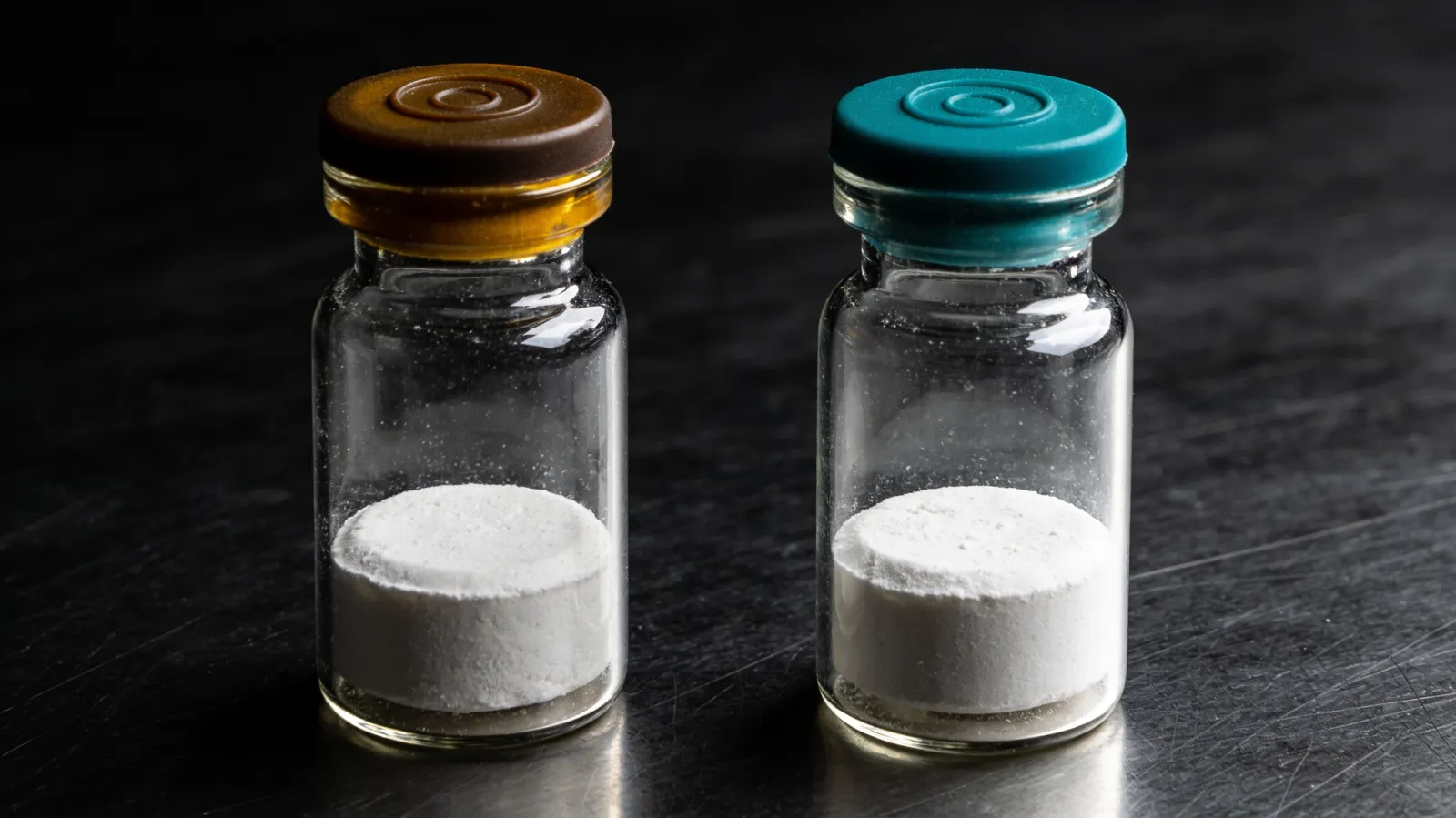
Once the bulk is domestic, the fill and finish that earns most domestic origin claims is ordinary work: material is weighed into vials, filled and dried as lyophilized powder, stoppered, capped and labelled with a lot number. Testing may happen before the fill, after it, or both. None of this is concealed in the industry. It is concealed only in the marketing.
The transit point is real and it is logistical rather than chemical. Material crossing a border can sit in customs for a stretch nobody can predict from the outside; a parcel selected for examination waits on the examination, not on a schedule. A research peptide that arrives a month late has failed regardless of its purity, and a diluent that arrives after the material it was bought to dissolve has failed at its one job. That is why bacteriostatic water, cheap and heavy and slow to clear, is the item most worth buying domestically.
Peptides made in the USA against the signals that are actually checkable
Two sensible reasons to ask where a peptide comes from, and one weak one.
The first is transit, covered above: domestic dispatch removes the border step entirely, which is a verifiable operational benefit.
The second is recourse. A research peptide supplier with a real address, domestic terms and a domestic warehouse is answerable in a way that an anonymous shipper is not. Again, this is about the business, not the molecule.
The weak reason is an assumption that peptides made in the USA means peptides that were tested. It does not. Plenty of material synthesised in the United States is sold with no certificate at all, and plenty synthesised elsewhere arrives with full independent peptide purity testing. Country of origin is not a proxy for testing, and treating it as one is how buyers end up with a flag on the website and no document in the box.
The table below is the whole argument of this article in one grid: every signal a seller can put in front of you, whether it is a measurement, who verifies it, and whether you can check it before you spend money. Only two rows survive all three tests, and neither of them is a country.
| Signal | Is it a measurement? | Who verifies it | Checkable before you order? | What it actually predicts |
|---|---|---|---|---|
| Flag on the homepage | No | Nobody | No | Nothing at all |
| "Made in the USA", unqualified | No, a claim about origin | The FTC, after the fact | No | Where the seller says value was added |
| "cGMP facility" | No, a claim about systems | FDA, if the facility is registered | Partly, via the establishment register | That someone upstream runs quality systems |
| FDA establishment registration | No | FDA | Yes, in a public register | That a facility exists and registered, not that your material came from it |
| Price | No | Nobody | Yes | Very little, until you divide it by milligrams |
| ISO/IEC 17025 accreditation of the testing lab | No, a claim about competence | The accreditation body's register | Yes | That the laboratory's methods are audited |
| A third-party certificate for your lot | Yes | The named laboratory | Yes, if it is published rather than promised | Purity and identity of the batch you will receive |
| Lot number printed on the vial | It is the key, not the lock | You, on arrival | Yes, if the seller runs a lookup | Whether the document and the object agree |
Price per milligram, and the arithmetic nobody publishes
Every storefront in this category prices per vial, and per vial is not a comparable unit. A 5mg vial at $49.99 and a 10mg vial at $79.99 are the same material at $10.00 and $8.00 per milligram, and the second is 20% cheaper by the only measure that describes the contents. The comparison takes one division and almost nobody does it, including, usually, the seller.
The habit is worth forming because it also defends against the opposite error. A cheaper vial is not a cheaper milligram, and a cheaper milligram of unassayed material is not cheap at all: if the purity figure is a claim rather than a document, the denominator is unknown and the arithmetic is meaningless. Price per milligram is only a fair comparison between two lots that both come with a certificate.
Our own catalogue, worked through: GHK-Cu is $39.99 for 50mg and $59.99 for 100mg, which is $0.80 and $0.60 per milligram. Ipamorelin is $49.99 for 5mg and $79.99 for 10mg, which is $10.00 against $8.00. Tesamorelin is $99.99 for 10mg and $189.99 for 20mg, $10.00 against $9.50, a narrower gap because the material is more expensive to make. BPC-157 ships in one size, 10mg at $59.99, which is $6.00 per milligram with the certificate for its current lot published against the number on the label.
Do the same division on any seller's page before comparing them to each other, and do it on the multi-vial sets too. The reference panels are priced as sets, so the per-milligram figure is the only way to see what the bundle is actually worth against the same vials bought singly. Then check that the figure you are dividing is attached to a lot certificate rather than to a marketing page. Two sellers quoting 99% purity, one with a signed report per lot and one without, are not selling the same thing at different prices. They are selling different things.
- 0%
- less per milligram at the 100mg GHK-Cu vial than the 50mg
- $0.60 against $0.80 per mg at catalogue prices
- 0%
- less per milligram at the 10mg Ipamorelin vial than the 5mg
- $8.00 against $10.00 per mg at catalogue prices
Ships from the USA: the numbers, published
"Ships from the USA" is the weakest of the four claims bundled inside peptides made in the USA, and it is also the only one of the four that can be reduced entirely to numbers. So here are ours, in one place, all of them stated on the shipping page rather than invented for an article.
Orders paid before 2pm ET on a business day are dispatched the same day; later orders and weekend orders go the next business day. Carriage is a flat $15 by FedEx 2Day and free over $250. Single vials ship in a padded mailer and larger orders in a small box, tracking is issued at dispatch, and damage is reportable for 72 hours from delivery with photographs of the packaging. Delivery is within the United States only for now, and every parcel leaves from the same US facility in Miami.
Lyophilised material is stable in transit, which is why it ships without cold packs. Storage once it arrives is the same wherever the material was made and has nothing to do with origin: the sealed vial at −20°C for long-term stability, 2 to 8°C for short-term handling, protected from light and not repeatedly frozen and thawed. How to store peptides goes through it properly.
None of this is a quality claim and none of it should be read as one. It is a set of commitments with numbers attached, which is the only kind of logistics statement worth reading, and the reason to publish them next to a discussion of origin is that they are what "ships from the USA" ought to mean.
| What sellers usually assert | Serviam's published figure |
|---|---|
| Same-day dispatch | Paid before 2pm ET on a business day |
| Free shipping | Flat $15 FedEx 2Day, free over $250 |
| Cold chain | Not needed for sealed lyophilised vials; padded packing instead |
| Tracked delivery | FedEx tracking from dispatch |
| Problem resolution | 72 hours from delivery, with photographs |
| Domestic fulfilment | One US facility, Miami, for every destination |
| Delivery area | United States only, for now |
What we can and cannot say about our own chain
What can be evidenced: every lot in this catalogue is assayed by an independent laboratory, and that laboratory, its method and the assay date appear on the certificate published against the lot number printed on the vial. Two laboratories have signed the 51 certificates we hold, one of them ISO/IEC 17025 accredited, and the reports are posted in full rather than summarised. Orders are warehoused and dispatched domestically, from Miami, with tracking on every parcel. Returns, terms and support are handled by a US business at a real address.
What is not claimed: a synthesis facility, and therefore not peptides made in the USA in the unqualified sense. No page on this site names a plant, a city or a company that built these chains, and that absence is deliberate, because naming one is the only way to make the claim checkable and an unnamed origin claim is precisely the thing this article exists to warn about. The product spec tables do carry a country-of-origin row reading United States; read against everything above, that describes the chain from which material is released, tested and dispatched, and it is not a statement that the peptide was synthesised here.
If that distinction costs us a sale against a competitor showing a flag, it is a reasonable price. The whole argument this business makes is that claims should be checkable, and a country-of-origin claim nobody can check would undercut the certificates that are the actual product.
There is a live reason to be careful as well as an editorial one. Through 2026 the FDA has been writing to sellers in this exact category, and what the letters cite is not country of origin at all. It is marketing: material described in terms of what it does in a person, dosing and administration guidance, disease references, and a research-use disclaimer at the foot of a page whose every other line addresses somebody who intends to use it. The agency's stated position is that it reads a site as a whole and infers intent from it. A seller who will overstate where a molecule was made is, on the evidence of those letters, rarely the seller being careful about the rest.
Peptides made in the USA is four claims wearing one label, and the four are not equally strong. Synthesis is the demanding one and belongs to a short list of named plants that mostly sell kilograms to pharmaceutical buyers, while shipping is the easy one, and most sellers showing a flag mean the second. Ask which stage is meant. Then ask the questions that actually predict what is in the vial: who assayed this specific lot, is that laboratory accredited, can I read the report before I buy, and what does this cost per milligram once I have divided it out?
Common questions
Does "peptides made in the USA" mean they were synthesised here?
Not necessarily. The phrase is used for synthesis, testing, packing or merely shipping. The FTC reserves an unqualified Made in USA claim for products that are all or virtually all domestic, so ask a seller which stage they are describing.
Who manufactures peptides in the USA?
The substantial US peptide manufacturers are business-to-business: AmbioPharm at North Augusta, South Carolina; Bachem at Torrance and Vista, California; CordenPharma at Boulder, Colorado; PolyPeptide Group at Torrance; Phoenix Pharmaceuticals in California; and Biosynth at Gardner, Massachusetts and Louisville, Kentucky. They sell active pharmaceutical ingredient and custom synthesis by the kilogram. Almost no research-vial storefront is a manufacturer.
Are US-made peptides higher quality?
Country of origin is not a quality measurement. What predicts quality is whether the specific lot was assayed, by which laboratory, whether that laboratory is accredited, and whether you can read the certificate before buying.
Does it matter whether peptides ship from inside the US?
For timing and recourse, yes. A parcel held up in transit for an unpredictable stretch is a real risk, and material that arrives weeks late has failed whatever its purity. A domestic business with a real address and published terms is also answerable in a way an anonymous shipper is not.
Does Serviam claim to sell peptides made in the USA?
No. What is claimed, and evidenced, is that every lot is assayed by an independent laboratory named on its certificate, and that orders are warehoused and dispatched domestically from Miami with tracking. No page names a synthesis facility, because we cannot evidence one.
How do I find out where a peptide was actually synthesised?
Ask the seller to name the manufacturing site, a company and a city rather than a country, and see whether the answer arrives in writing. Then check whether a facility of that name appears in FDA's drug establishment registration database. Nothing on a research vial label is obliged to state it, and a certificate of analysis names the testing laboratory, method and date rather than the synthesis site. Judge the material on the certificate for its lot instead.
Does cGMP apply to research peptides?
No. cGMP is US drug manufacturing regulation, 21 CFR Parts 210 and 211, and FDA inspects facilities against it. A research peptide is not a drug, not an API and not a compounded preparation, so no manufacturing regulation attaches to the vial. A cGMP badge on a research storefront describes, at best, a facility somewhere upstream.
What is ISO/IEC 17025, and why does it matter on a certificate of analysis?
It is the international accreditation standard for the technical competence of a testing laboratory, covering methods, calibration, personnel and the reporting of results, and it is audited by an accreditation body that publishes a searchable register. It applies to whoever signed your certificate, not to whoever made the peptide, and it is the one accreditation a buyer can verify independently in about a minute.
What does "third-party tested" actually mean?
On its own, nothing. The phrase has no definition and anyone can print it. It becomes meaningful only with four fields attached: the laboratory's name, the method, the date, and the lot number, matched against the number printed on the vial you were sent. Without those, it is a slogan rather than a result.
Is made in the USA the same as FDA approved?
No, and the two are unrelated. FDA approval applies to medicines evaluated for human use; research peptides are laboratory materials for in-vitro work and are not approved products wherever they were synthesised. Made in USA is a country-of-origin claim, and the body that polices it is the Federal Trade Commission.
Which peptides are FDA approved in the USA?
Approval attaches to a finished drug product: a named formulation, from a named manufacturer, under an approved application. It never attaches to a compound name in the abstract. Several peptide drugs are approved in that sense. No research-use vial is one of them, whatever molecule it contains and wherever it was made, because the vial is not a finished drug product and was never submitted as one.
Can a company say made in USA if the raw peptide powder comes from China?
Not without qualifying the claim. The FTC standard for an unqualified claim is that the product is all or virtually all domestic, and for a peptide the significant input is the peptide itself. Filling and labelling here supports "packed in the USA", which is an honest claim when it is stated as itself.
Are peptides from China lower quality than American ones?
Origin is not a measurement, so the question cannot be answered by the map. Some facilities outside the US run to pharmaceutical standards and publish a full independent assay for each lot; some domestic operations ship with no certificate at all. The lot number and its report separate them; the flag on the homepage does not.
Does a certificate of analysis say where the peptide was made?
Usually not. A certificate identifies the compound, the lot, the laboratory, the method and the date, and reports purity and identity for the sample that was tested. It is evidence about the material, not about geography, so country of origin is a separate question to ask separately.
What is the difference between made in USA, packed in USA and ships from USA?
They describe three different stages. Synthesised means the peptide chain was built domestically; packed means bulk material was filled into vials and labelled here; ships from means the parcel leaves a domestic warehouse. Only the first is a statement about the molecule, and it is the one least often meant.
How do I compare prices between peptide sellers?
Divide the price by the milligrams and compare that. A 5mg vial at $49.99 is $10.00 per milligram; a 10mg vial at $79.99 is $8.00. Per vial is not a comparable unit and nobody publishes the division. Then check the figure is attached to a lot certificate, because a cheap milligram of unmeasured material has an unknown denominator.
Do research peptides get held up in customs?
A parcel crossing a border can be held for inspection, and how long that takes is not predictable from the outside: a shipment selected for examination waits on the examination, not on a schedule. Dispatching domestically removes the step entirely, which is a logistics advantage rather than a quality one. Serviam ships every order from one US facility, by FedEx 2Day and tracked, on the terms published on the shipping page.
What is the most trustworthy peptide company?
That is not answerable as a name, and any page that answers it with one is usually ranking itself. It is answerable as a test: does every lot have a signed certificate from a named laboratory, is the lot number on the vial resolvable against that document, is the laboratory's accreditation checkable, and are the shipping and returns terms published as figures rather than adjectives? A company that passes all four is verifiable. A company that passes none is a flag and a photograph.
I asked a supplier where their peptides are made and they didn't answer. What now?
A non-answer is itself information, particularly from a seller whose homepage carries a flag. Move to the question that can actually be checked: the certificate for the lot they would ship you, the laboratory named on it, and the lot number printed on the vial. The eight checks for vetting a research peptide supplier work without the seller's cooperation.
- 16 CFR Part 323, Made in USA Labeling: the all or virtually all standard for an unqualified Made in USA claim, and its reach to labels, mail order catalogues and online advertising alike
- FTC, Complying with the Made in USA Standard: when a qualified claim such as "Assembled in USA" is available, and the requirement that the qualification be clear and conspicuous
- ICH Q6A, Specifications: Test Procedures and Acceptance Criteria: that a purity result is read against an acceptance criterion set per specification, which is the framework behind the analytical panel rather than the country on the label
- ICH Q2(R2), Validation of Analytical Procedures: that specificity, accuracy and precision belong to the analytical procedure, which is why the method and the laboratory named on a certificate carry the weight
- FDA, Lyophilization of Parenterals, Inspection Technical Guide: the fill and finish step that turns bulk material into a stoppered, labelled vial of lyophilised cake
Read more
- How to vet a research peptide supplierAny research peptide supplier can publish a purity figure. These eight checks tell you whether there is a measurement behind it.
- Tesamorelin vs sermorelin vs ipamorelinTesamorelin vs sermorelin is a comparison between two versions of the same idea. Add ipamorelin and the comparison changes category entirely.
- GLOW vs KLOWGLOW vs KLOW is a question with a precise answer, because the difference between the two blends is a single named component. There is a larger question underneath it, because neither name is a formulation standard.
- What is TB-500?What is TB-500, and why is it constantly confused with the protein it comes from? The answer is a matter of seven amino acids against forty-three.
- BPC-157 vs TB-500BPC-157 vs TB-500 is usually asked as though the two were variants of one thing. They are unrelated molecules with different lengths, masses and origins.
- What lyophilized powder isLyophilized powder, lyophilised in British spelling, is what almost every peptide arrives as. The process behind it explains most of how the vial should be treated.
For laboratory research use only. All compounds listed on this site are sold strictly as reference materials for in-vitro laboratory research conducted by qualified professionals. They are not drugs, foods, cosmetics, or medical devices. They are not intended for human or veterinary consumption, therapeutic use, diagnostic application, or any in-vivo use whatsoever. These statements have not been evaluated by the Food and Drug Administration. By purchasing, you affirm that you are a qualified researcher and that you will comply with all applicable institutional, local, state and federal regulations governing the handling of research chemicals. Published by SERVIAM BIO LABS.